One of the hottest topics in business news today is the Snap IPO.

It’s the biggest tech IPO in some time (although some smaller ones apparently will be close behind), the company has so far been losing money and its growth has slowed, and oh yeah – its public shares do not have any voting rights.

In some ways, the disenfranchisement of Snap’s shareholders is the natural culmination of the dual-class share structures that have been popular with tech companies for a while.  But Snap is obviously taking things to extremes.  With no votes, there are no proxy statements.  Most of that information will be disclosed in Snap’s 10-K, but it also means there will be no say-on-pay votes and no shareholder proposals.  Sure, these are – or tend to be – nonbinding anyway, but Snap has shut down the mechanism by which shareholders as a group initiate conversations with the companies in which they invest. 

Some commenters call Snap a one-off; after all, even now, Snap’s shares have fallen well below their first day trading price, and analyst reaction has been less than enthusiastic.  But Snap is still trading higher than its offering price

William W. Bratton has posted “The Separation of Corporate Law and Social Welfare” on SSRN. You can download the paper here. Here is the abstract:

A half century ago, corporate legal theory pursued an institutional vision in which corporations and the law that creates them protect people from the ravages of volatile free markets. That vision was challenged on the ground during the 1980s, when corporate legal institutions and market forces came to blows over questions concerning hostile takeovers. By 1990, it seemed like the institutions had won. But a different picture has emerged as the years have gone by. It is now clear that the market side really won the battle of the 1980s, succeeding in entering a wedge between corporate law and social welfare. The distance between the welfarist enterprise of a half century ago and the concerns that motivate today’s corporate legal theory has been widening ever since. This Essay examines the widening gulf. It compares the vision of the corporation and of the role it plays in society that prevailed during the immediate post-war era, before the fulcrum years of the 1980s, with the very different vision we have today, and traces the path we

Trading

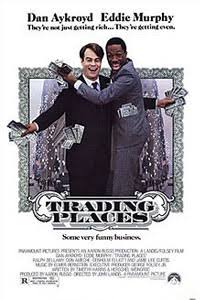
A couple of days ago, Marcia put out a call for business movie/TV recommendations.  A perennial favorite on such lists is the 1983 classic, Trading Places.  That movie is about two brothers who make a bet to see whether they can pluck a man off the street and – by providing him with the proper environment – turn him into a successful commodities trader.  Its stature is such that a real-life statutory amendment, intended to plug the regulatory loophole exploited by the film’s characters, is colloquially known as the “Eddie Murphy rule.”  The CFTC first exercised its authority under the new rule in 2015.

Well, apparently the movie was just as inspiring to business aficionados in 1983 as it remains today.  After seeing the film, two prominent commodities traders of the era, Richard Dennis and William Eckhardt, decided to reenact the brothers’ experiment.  (Except, rather than kidnap a homeless criminal and then frame one of their own employees for dealing PCP, Dennis just took out an ad in the newspaper).  Dennis selected people with a certain affinity for numbers and probability, but with no formal education in commodities, and trained them to trade.  The experiment

George Mocsary has an interesting paper that is officially in print. He makes some great points, but I think it undervalues the role of the business judgment rule. More on that later. I disagee, at least on the margins, but it’s worth a look.


Freedom of Corporate Purpose

77 PagesPosted: 13 Apr 2016Last revised: 2 Feb 2017

George A. Mocsary 

Southern Illinois University at Carbondale – School of Law

Date Written: 2017

Abstract

Every few decades, there erupt political and academic debates over the proper nature and purpose of the corporation. It is black letter law, according to most scholars, that corporations exist to maximize shareholder wealth. Others maintain that the corporation should exist for the benefit of multiple constituencies, regardless of what current black letter law may say. The current discourse of corporate purpose, however, is incomplete and misleading. The disarray has resulted from insufficient reliance on historical context in (1) analyzing the firm under modern theories of corporate governance, and (2) interpreting the “purpose” language in corporate charters and corporation-law statutes.

Modern conceptions of corporate governance, and by extension, corporate purpose, have failed

This Saturday, I point you to a colorful long read: Sheelah Kolhatkar’s deep dive into William Ackman’s short bet against Herbalife.  Unabashedly sympathetic to Ackman, the article describes how Herbalife was brought to his attention (there are analyst firms that just identify shorting opportunities?  Who knew?  Please don’t answer that everybody knew; that would be embarrassing) and ultimately ended up as something of a crusade to expose what Ackman believes is a pyramid scheme. (And the FTC believes is a scheme that is awfully like a pyramid scheme but without actually using those words.)  According to Kolhatkar, Ackman and his people want to make money, sure, but they also want to expose a fraud that – like Trump’s universities (a comparison Kolhatkar explicitly makes) – robs desperate people of their savings.  

The article describes the titanic battle between Herbalife and Ackman (Herbalife’s CEO is described as having an “air of PTSD”), including how Ackman even tried to enlist Latino civil rights groups to advocate on his behalf.  It’s reminiscent of that time the NAACP involved itself in the epic battle over debit card swipe fees.

Ackman has held on to this bet for a while, combatting other