
Well, Hurricane Francine passed through New Orleans, and left me with power (yay!) but no internet (boo!), which means I’m relatively helpless.

Still, I’ll take this opportunity to announce that I’ve started a podcast, Shareholder Primacy, with Mike Levin (The Activist Investor).  We’re still working out what it wants to be, but our first episode is up (here on Apple, here on Spotify, here on YouTube) addressing the status of the Tesla compensation case, and the implications of the universal proxy.

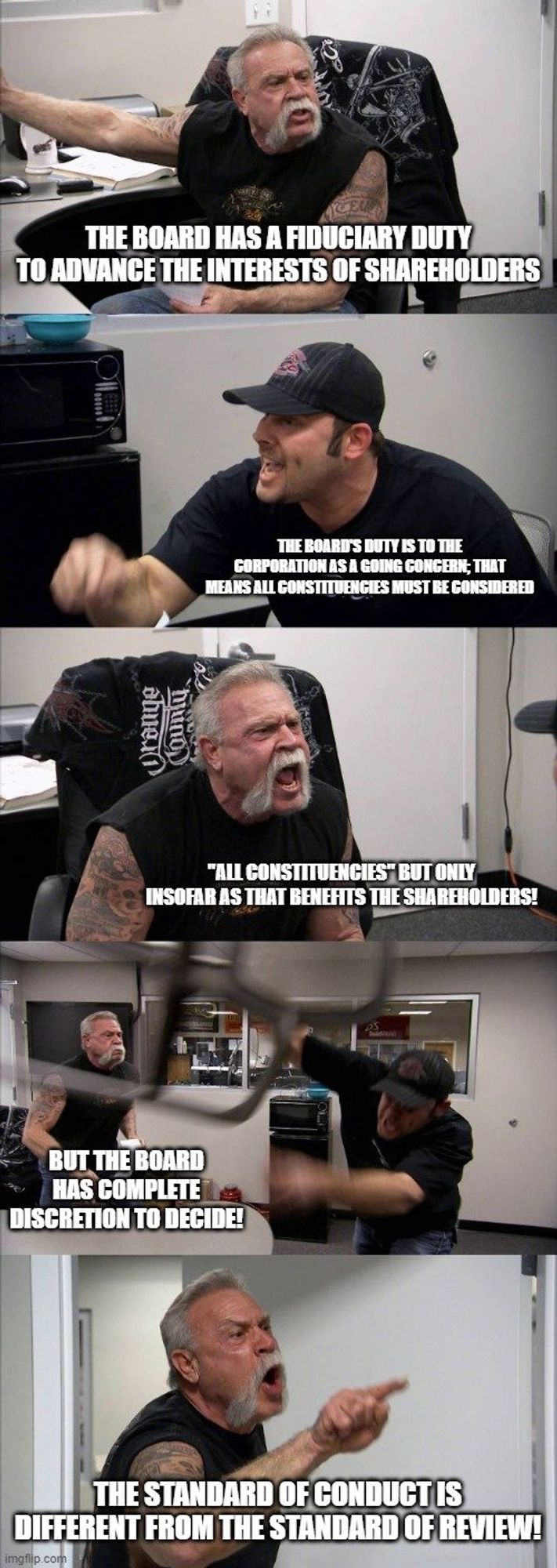
Also, I’m very proud of this meme I made:
E8831d72-6284-44d5-b15c-0e87ffc7551e

The University of Maine School of Law, in the thriving and increasingly diverse coastal community of Portland, Maine, invites applications for four full-time faculty positions to begin in 2025 – two doctrinal and two clinical.  The Law School is particularly interested in doctrinal candidates whose focus includes criminal law and related subjects (including criminal procedure); and property law and related subjects (including land use and environmental law).  The Law School is interested in clinical faculty to direct its Youth Justice Clinic and direct its new Business Law Clinic.

Applicants must possess a J.D. degree, an excellent academic record, a record or promise of high scholarly achievement (particularly for doctrinal positions), and a record or promise of successful teaching and mentoring students. Both lateral and entry level candidates will be considered. Rank and salary will be competitive and commensurate with qualifications and experience. Members of minority groups, women, and others whose background would contribute to the diversity of the Law School are encouraged to apply.

Application materials should include a cover letter, C.V., and research agenda. Please direct application materials and questions to the chair of the Appointments Committee, Professor Anthony Moffa, at the following email address: mainelawsearch@maine.edu.

Review of

This time, it’s Brazil.

If you’re not following the saga, the story is apparently that ex-Twitter, now controlled by Elon Musk (not the CEO, though; you can’t even really say he’s the owner without qualifying about the interests of other investors and – don’t forget – the debtholders), ignored the order of Brazilian Supreme Court Justice Alexandre de Moraes to remove certain accounts associated with hate speech and misinformation.  Apparently out of fear that Twitter’s Brazilian employees would be arrested, Twitter shut down its Brazilian offices.  At that point, Twitter was out of compliance with a Brazilian requirement that a legal representative be present in the country.  So, Justice de Moraes ordered that access to Twitter be blocked throughout Brazil.  (Legal challenges to that order continue)

That’s not great for Twitter, but it turns out, it was even worse for Starlink, a wholly-owned subsidiary of Musk-controlled SpaceX, because the Justice ordered that Starlink’s financial accounts be frozen in order to force payment of fines owed by Twitter.  Musk at first insisted that he would not block access to Twitter via Brazilian Starlink, then – on that point – relented.  Shortly thereafter, it was reported SpaceX was evacuating its personnel from the country.  As the Wall Street Journal put it, “Starlink’s entanglement in a dispute originally about X is a stark illustration of how some government officials around the world may draw few distinctions between enterprises that Musk runs.”

So, all of this has the makings of a great introductory classroom discussion of corporate separateness, enterprise liability, and veil-piercing.  I have no idea what the law on this is in Brazil, but let’s talk about how we’d analyze this under American law.

(more under the jump)

The AALS Section on Transactional Law & Skills is pleased to announce a session at the 2025 AALS Annual Meeting in San Francisco, C.A.

Pedagogy Panel on Experiential Exercises in Business Law

We invite submissions for a panel that highlights experiential exercises in business law. Exercises might include, for example, contract drafting, transactional research, mock negotiations, or other exercises that would fit into a law school course. We invite speakers to share exercises with the panel, to discuss how they facilitate and/or grade the exercises, and/or to teach a short mock version of their exercise during the panel.

Please submit a short proposal and/or a draft of the exercise you would like to present to Professor Benjamin Edwards (Benjamin.Edwards@unlv.edu) on or before Friday, September 20th.  Authors should include their name and contact information in their submission email but remove all identifying information from their submission.  Please include the words “AALS – Transactional Pedagogy” in the subject line of your submission email. Papers will be selected after review by members of the Executive Committee of the Transactional Law & Skills Section. Presenters will be responsible for paying their registration fee, hotel, and travel expenses.

Please direct any questions

The University of Louisville’s Brandeis School of Law invites applications for tenure-track full-time faculty positions at the Assistant/Associate level position to commence on July 1, 2025.  Specific curricular needs are for estate planning and tax. Academic rank and salary will be commensurate with qualifications and experience.

The Louis D. Brandeis School of Law: The Brandeis School of Law is committed to excellence in preparing lawyers for productive careers. The school boasts an excellent faculty with a deep commitment to teaching and academic support, and a low student-faculty ratio.  Our smaller class sizes foster close interaction between students and faculty, nurture a culture of collegial learning, and provide opportunities for individualized attention.  In addition to teaching excellence, our faculty is deeply committed to producing excellent scholarship and to community engagement.  Our faculty boasts many engaged scholars.

The School of Law strives to promote collegiality and professionalism, and its culture is based on civility and respect for all students, faculty, and staff. The school also seeks to admit and support a diverse law school population and provides opportunities to share and discuss differing opinions. 

Applicants: Applicants for this position should have distinguished academic credentials, a record of scholarship, and a strong commitment

Not a whole lot going on this week in terms of legal developments, so I thought I’d reach back to an older post of mine, where I talked about a case pending before the Fifth Circuit regarding 14a-8.  The original petitioner, the National Center for Public Policy Research, argued that the SEC engages in viewpoint discrimination when it issues no-action letters; an intervenor challenged the entire basis for Rule 14a-8 as unauthorized by statute and unconstitutional to boot.  The SEC, for its part, addressed these substantive arguments but concentrated most of its energies on arguing that no-action letters are not final orders subject to challenge in the first place.

Normally, I’d assume a case like this wouldn’t have much chance of succeeding, but it’s the Fifth Circuit, which tends to take an entrepreneurial approach to issues like corporate rights, standing, and administrative authority.  Even then, I’d say the petitioners were likely out of luck, because the panel turned out to be Jones, Douglas, and Dennis – meaning, two Democrats and a Republican – and, indeed, only Judge Jones demonstrated any sympathies for the petitioners during oral argument.  But! The last time sec reg ended up before a 2-1

For decades, we’ve known that many arbitration awards in the FINRA arbitration forum go unpaid.  This happens because many brokerage firms collapse after liability for abusive sales practices comes home.  Last Friday, arbitrators rendered an award finding SW Financial liable for over $13 million in damages to a group of dozens of investors.  SW Financial was expelled by FINRA in 2023 for, among other things, making false statements to customers and failing to supervise its personnel.  

Congress has noticed the problem.  The Senate Committee on Appropriations recently found that “FINRA has failed to undertake steps to address unpaid arbitration awards by its members.”  It directed the SEC to “continue to engage with FIRNA to identify ways to reduce and eliminate the occurrence of unpaid awards.”  This comes after a 2018 bipartisan proposal to create a recovery pool failed to pass.

FINRA has tracked this issue for some time and keeps statistics on unpaid awards.  That an award goes unpaid, does not mean that every customer with an unpaid award recovers nothing.  FINRA explains it this way:

At times when an arbitration panel does award monetary damages to the claimant, the respondent may fail to pay the awarded damages. If

Thing One: 

I jotted!  Which is to say, I wrote a Jotwell review of Hilary Allen’s Interest Rates, Venture Capital, and Financial Stability, forthcoming in the University of Illinois Law Review.  Her paper is here, and you can find my review here.

Thing Two:  I have a new paper-ish thing.  As y’all know, I’ve been keeping an eye on litigation-limiting bylaw and charter provisions, including – as I previously posted – the Ninth Circuit’s en banc decision in Lee v. Fisher, which permitted The Gap to enforce a forum selection bylaw directing derivative Section 14(a) claims to Delaware’s Court of Chancery – even though that court has no jurisdiction to hear Section 14(a) claims.  In practical effect, then, the bylaw operated as a waiver of the federal claim.

That decision cited a draft version of an article by Professors Mohsen Manesh and Joseph Grundfest, Abandoned and Split But Never Reversed: Borak and Federal Derivative Litigation, in which they defended such bylaws.  The article was published in the Business Lawyer late last year, and is available here.

Anyhoo, I now have a (very short) reply to Professors Manesh and Grundfest, also forthcoming

In 1995, Congress passed the Private Securities Litigation Reform Act (PSLRA), which dramatically heightened the pleading burden for plaintiffs bringing securities fraud cases.  At the same time, the PSLRA also instituted a mandatory stay on discovery until resolution of any motions to dismiss, which means plaintiffs have to use their own investigation – relying on public information, confidential sources, and the like – to draft a complaint that is sufficiently particular to satisfy PSLRA standards.

In 2002, Steve Bainbridge and Mitu Gulati published How Do Judges Maximize? (The Same Way Everybody Else Does – Boundedly): Rules of Thumb in Securities Fraud Opinions.  The paper explained that, given the high pleading standards of the PSLRA, judges deciding motions to dismiss lighten the workload by coming up with various rules of thumb for determining whether a complaint pleads materiality or scienter.  For example, they identified the puffery doctrine (presuming that investors treat vague statements of optimism as immaterial), the bespeaks caution doctrine (predictions of the future are immaterial if they are caveated by warnings of future uncertainty), and fraud by hindsight (refusing to draw inferences about what the company knew at an earlier time due to negative disclosures at a later time)

Yesterday, the Delaware Supreme Court released its decision in the Dell fee award appeal.  It’s available here.  The Dell case presents a question for blockbuster shareholder litigation–when the damages numbers in dispute grow particularly large, should courts apply a declining percentage when setting the attorneys’ fees?  (Disclosure, I joined an amicus brief on this issue at the trial level.)  The Dell plaintiffs secured a billion dollars in settlement.  Delaware’s Chancery Court opted to give the lawyers $267 million in fees.  

Ultimately, funds holding about 24% of the class objected to the fee award.  This is how the Delaware Supreme court stated their argument:

Pentwater argued that awarding a percentage of the settlement sought without considering the size of the settlement was unfair to the class. They contended that, in this case, the proposed fee was disproportionate to the value of the settlement. The objectors urged the court to apply a declining percentage to the fee award, which is similar to the approach used by federal courts in large federal securities law settlements. The declining percentage method reduces the percentage of the fee awarded to counsel as the size of the recovery increases. According to Pentwater, fee awards “are meant