Last week, I posted about a discussion group I am organizing on teaching numeracy for the Southeastern Association of Law Schools (SEALS) 2024 annual meeting.  (Thanks to those who responded!)  I also am working with folks who are organizing another session.  More on that in another post!  And some of you or others you know also may be proposing panels or discussion groups.  But the Business Law Workshop at the conference can always use another program, imv.

With that thought in mind, I am reaching out to suggest that you organize a business program for the SEALS 2024 annual meeting.  The SEALS submission webpage includes instructions and information about the submission process and a hypertext link to the the submission site.  The submission site is open for 2024 program proposals now and is easy to navigate.  I am happy to help by answering any questions you may have (or by getting answers for you).

The only tricky parts are determining the type of session you want to organize and complying with the requirements for that type of session.  The two most common types of programs are panels and discussion groups, as follows:

PANELS

Panels are the traditional presentations at most
Natalya Shnitser posted a really fascinating paper that taught me about collective investment trusts (CITs), which, I have to admit, wasn’t something I knew anything about.

As I understand it, they function very much like a mutual fund, but they’re managed by banks instead of investment companies.  As such, they are exempt from much of the securities regulation that protects mutual fund investors – very little transparency or liquidity – but they’re increasingly showing up on 401k menus, to the point where, according to Shnitser, they now represent 30% of defined contribution plan assets.

The rationale for this exemption from securities regulation is that, once upon a time, when defined benefit plans dominated the workplace, it was assumed employers/pension plans would be able to bargain on equal terms, but that’s not true today, when individual workers simply select CITs from among other investment choices.

One area I’m particularly interested in is their role in corporate governance.  Because these are retirement plan assets, CITs are ERISA fiduciaries, and that means, among other things, that they must vote their shares to benefit the plan, just like a pension fund would.  But because they don’t have to publicly report their votes, there’s no

Another case challenging FINRA’s constitutionality has generated a District Court opinion upholding FINRA’s constitutionality.  Judge Reyes found that, Alpine “does not suggest that courts must enjoin every challenged FINRA enforcement action pending the Alpine merits decision.”

Kim differs from Alpine in some significant ways.  The plaintiff does not face expulsion, just an ordinary fine and disciplinary proceeding.  Kim faces a possible $30,000 fine and a requirement to disgorge $16,000 in profits.  This, unsurprisingly, complicates his attempt to secure an injunction against the enforcement action because it doesn’t seem as though he will face any irreparable harm–just “an enforcement hearing, months away, and most likely, monetary fines.”

The case also differs in that amici got involved at an early stage this time.  The opinion thanks “CBOE Global Markets, Inc.; CME Group Inc.; National Futures Association; and the Securities Exchanges.”  

Most courts will not be familiar with SROs.  Given that, it makes sense for a range of amici to come in on these cases to help give context to courts.

Ultimately, how this issue will turn out for Kim depends on the pending Alpine appeal.

On September 29, the Supreme Court granted cert in Macquarie Infrastructure Corp. v. Moab Partners, to decide:

whether the Second Circuit erred in holding—in conflict with the Third, Ninth, and Eleventh Circuits—that a failure to make a disclosure required under Item 303 can support a private claim under Section 10(b), even in the absence of an otherwise-misleading statement. 

(The question, I think, mischaracterizes the Third Circuit; you’ll get a sense of why below, the parties will argue the rest.  But leaving that point aside – )

I have no idea how the case will unfold, of course, but I tend to assume that despite the narrow framing, the real question is whether silence in the face of a regulatory duty to disclose constitutes a misleading omission.  I.e., it does not matter what the particular required disclosure is, or what the cause of action is; the question is whether, if you remain silent when a regulation requires you to speak, that is the equivalent of an affirmatively misleading statement.  The Second Circuit has repeatedly held yes, it is, usually in the context of 10b claims over Item 303 omissions.  Other circuits – well, to be honest, have been muddled.

This

You may be interested in an event taking place on October 11 at the Center for American Progress in Washington, DC, which will focus on the regulation of private markets and feature SEC Commissioner Caroline Crenshaw, as well as business law professors Renee Jones (BC) and George Georgiev (Emory).

The registration link (in-person or virtual) is as follows: https://www.americanprogress.org/events/accessing-public-capital-without-public-disclosure/

Event description:

Accessing Public Capital Without Public Disclosure

Oct. 11, 2023

12:30 PM – 12:35 PM

Introductory remarks provided by CAP Senior Vice President for Inclusive Growth Emily Gee.

12:35 PM – 1:05 PM

Keynote remarks provided by Caroline A. Crenshaw, Commissioner of the U.S. Securities and Exchange Commission.

1:05 PM – 1:45 PM

A panel discussion with experts on the topic moderated by CAP Senior Director for Financial Regulation Alexandra Thornton, featuring Renee Jones (Boston College Law School) and George Georgiev (Emory University School of Law)

Today, more capital is raised annually in private markets than in the public markets. Hundreds of multibillion-dollar companies can raise all the capital they need from an unlimited number of unaffiliated investors, while selling products and services to tens of thousands of customers and employing thousands of people. Many are unicorns—companies that started in

Dear BLPB Readers:

“Minnesota State University Mankato is hiring a full-time tenure track Assistant Professor of Business Law position starting Fall 2024. Here is a link to the job posting –https://minnesotastate.peopleadmin.com/postings/2485.

The Business Law program offers a stand-alone certificate and teaches a robust curriculum to undergraduate and MBA students. Classes regularly offered include Legal Environment of Business; Contracts, Sales and Professional Responsibility; Employment and Labor Law; Technology and Intellectual Property Law; Negotiation and Conflict Resolution, International Legal Environment of Business; and Environmental Law.

Applications will start to be reviewed after December 1 and continue until the position is filled. MSU-Mankato is an equal opportunity employer and is a member of the Minnesota State System. Contact Wade Davis if you have any questions: wade.davis@mnsu.edu.”

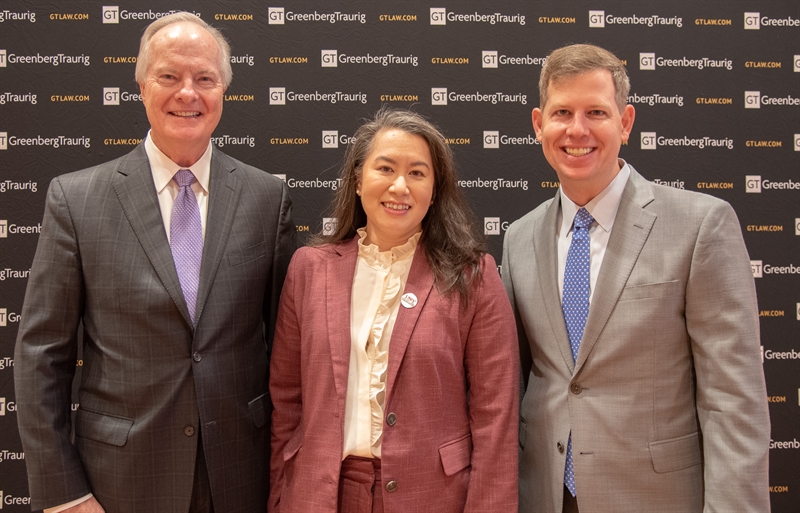
Last week, we hosted the Fourth Annual Corporate Governance Summit at the Wynn in Las Vegas.  You can see the program here.  Stephen Bainbridge came in to give our keynote address in a talk focused on his new book, The Profit Motive.  We ended up drawing about 130 participants.  I’m incredibly grateful to Mike Bonner at Greenberg Traurig and the rest of the Greenberg team that helped put the event together.  We were also fortunate to have some great sponsors for the event: Joele Frank, Connor Group, Deloitte, J.P. Morgan Chase & Co., and Whittier Trust.  

Bonner_Ginvald_Edwards

Dear BLPB Readers:

“The Vanderbilt Policy Accelerator (VPA) seeks applications for a fellow in the field of networks, platforms, and utilities (NPUs). The two-year NPU fellowship is designed to support individuals who are interested in becoming law professors in the field of networks, platforms, and utilities, defined broadly as including transportation, communications, energy, banking, and tech platforms, and cross-cutting issues and themes across these sectors. The NPU fellow is expected to write academic articles for publication in legal journals, participate in the NPU workshop and annual NPU conference, and go on the academic job market in the second year of the fellowship. The NPU fellow will receive mentoring and guidance from Vanderbilt law faculty.

Criteria: Fellows must, by the time of the start of the fellowship, be a graduate of an accredited law school.

Salary and Benefits: Fellows receive a salary and benefits.

Location: Relocation to Nashville is preferred and encouraged, but remote work with occasional travel may be possible.

Application details: Please send cover letter, CV (including references), law school transcript, and a research agenda to policyaccelerator@vanderbilt.edu.”

Additional information is here.

I previously blogged about the shareholder derivative claims against Fox Corp, alleging that it violated its Caremark/Massey duties by defaming Dominion.  And then I had a few follow ups on Caremark generally here and here.

This week, sorry, still more, because two additional shareholder plaintiffs filed complaints in Fox.  One group is led by the New York City Employees’ Retirement System and includes the Oregon Public Employees Retirement Fund; the other is led by Tredje AP-Fonden.  These complaints differ from the ones filed earlier in that the plaintiffs sought books and records under 220, and incorporated the results into their pleadings.

VC Laster has scheduled a hearing on November 9 to choose the leadership structure for the action – in other words, all the cases will be combined, some plaintiff(s) will be lead, and some counsel will be lead. If the parties don’t work that out amongst themselves (and they’ve had plenty of time so far), VC Laster will select one plaintiff/counsel group to control the action.

Under Delaware law, these decisions are made according to what are known as the Hirt factors, which evaluate which group can best represent the shareholders, based on size of stake, absence