
The following excerpt is from the introduction to a recent publication that may be of interest to BLPB readers. The publication is: Emilie Kao, 303 Creative v. Elenis: Can Stand-Alone Dignitary Harm Create A Right to Endorsement and Duty to Endorse?, 2023 Harv. J.L. & Pub. Pol’y Per Curiam 5, 2–5 (2023). Emilie Kao is Senior Counsel and Vice-President for Advocacy Strategy at Alliance Defending Freedom (ADF), which represents Lorie Smith.

All people have inherent dignity and should be treated with respect. However, whether and how courts should address legal claims surrounding dignity are notoriously complicated. Does the government have an interest in protecting citizens from “dignitary harm”–subjective feelings of emotional distress or stigma? If so, does the government’s interest require it to compel or silence the expression of certain views? If so, does the dignity of the person compelled to speak or remain silent matter? Dignitary harm has played important roles in conflicts between religious freedom and anti-discrimination laws in Masterpiece Cakeshop v. Colorado Civil Rights Commission and Fulton v. Philadelphia. And they are at issue again in 303 Creative v. Elenis, a free-speech case that was recently argued at the U.S. Supreme Court.
Section 12 of the Securities Act gives a right of rescission to purchasers of illegally unregistered securities, and purchasers of securities sold by means of a false prospectus. See 15 U.S.C. § 77l.  Although the right of action has existed since 1933, its exact contours have always been somewhat hazy.  But now, in the age of social media – with the potential for widespread promotion of unregistered and/or fraudulent investments (lately, cryptocurrencies) – interpretations of Section 12 are getting a work out, and the legal ground may be shifting.

So, the background.  Section 12 provides:

(a)In general

Any person who—

(1) offers or sells a security [without meeting registration requirements]

(2) offers or sells a security (… by the use of any means or instruments of transportation or communication in interstate commerce or of the mails, by means of a prospectus or oral communication, which includes an untrue statement of a material fact or omits to state a material fact necessary in order to make the statements, in the light of the circumstances under which they were made, not misleading (the purchaser not knowing of such untruth or omission), and who shall not sustain the burden of proof that

From the Office of the Utah Attorney General (here):

Today, [January 26, 2023,] Utah Attorney General Sean D. Reyes led a 25-state coalition in a lawsuit over a Department of Labor rule which would affect the retirement accounts of millions of people. The rule would allow 401(k) managers to direct their clients’ money to ESG (Environmental Social Governance) investments and runs contrary to the laws outlined in the Employee Retirement Income Security Act of 1974 (ERISA). “The Biden Administration is promoting its climate change agenda by putting everyday people’s retirement money at risk,” Attorney General Reyes said. “Americans are already suffering from the current economic downturn. Permitting asset managers to direct hard-working Americans’ money to ESG investments puts trillions of dollars of retirement savings at risk in exchange for someone else’s political agenda…. From the complaint: “[T]he 2022 Investment Duties Rule makes changes that authorize fiduciaries to consider and promote “nonpecuniary benefits” when making investment decisions. Contrary to Congress’s clear intent, these changes make it easier for fiduciaries to act with mixed motives. They also make it harder for beneficiaries to police such conduct.” The 25 states joining Utah Attorney General Reyes in this lawsuit are: Alabama, Alaska, Arkansas,

One of the bigger securities stories these days is the “taking Tesla private at 420” trial going on right now, simply because it’s so rare to have a securities fraud class action trial at all.  And this one is even more bizarre because the judge has already granted summary judgment to plaintiffs on two key elements: falsity and scienter.

As readers of this blog are no doubt aware, in August 2018, Musk tweeted “Am considering taking Tesla private at $420. Funding secured.”  A couple of hours later he tweeted “Investor support is confirmed. Only reason why this is not certain is that it’s contingent on a shareholder vote,” linking to this blog post.  The blog post elaborated that Musk “would like to structure this so that all shareholders have a choice. Either they can stay investors in a private Tesla or they can be bought out at $420 per share” – a merger structure that never made sense legally.   Eventually Tesla backtracked with a blog post announcing that the company would remain public.

The plaintiffs now allege – and the jury is being asked to decide whether – those two tweets were fraudulent.

According to the jury

A couple of months ago, I blogged about Menora Mivtachem Insurance v. Frutarom, 54 F.4th 82 (2d Cir. 2022).  There, a public company issued new stock in connection with a merger, and the S-4 contained false information about the target, supplied by the target.  The truth came out, the stock price fell, and shareholders sued the target and some of its officers under 10(b).  In that context, the Second Circuit held that the plaintiffs, who had purchased shares in the publicly-traded acquirer and not the target itself, did not have “standing” to pursue claims against the target defendants.

The original decision issued on September 30; on November 30, the Second Circuit issued some minor revisions to its ruling (deleting, as far as I can tell, language that suggested that the defendants in a 10(b) action must be agents of the subject company, i.e., that plaintiffs couldn’t sue if a stranger to a company made false statements about it and caused plaintiffs to make a purchase of that company’s stock).

The plaintiffs sought rehearing, and one of the arguments they made was that the Menora reasoning was so broad that purchasers of shares in a SPAC would be unable to sue

This is sort of arcane, but I am fascinated by two decisions that came out of Delaware this week from VC Laster and VC Glasscock.  They are remarkably similar in facts and result, but travel slightly different paths to get there.

The first case, Harris v. Harris, concerned a family corporation.  The mother was alleged to have systematically looted the company and – aware that a books-and-records action was likely to be filed by her children – forced through a merger with a shell New Jersey entity.  After the merger, all of the former shareholders of the old corporation now held identical interests in the new corporation, which was the same in every respect, except for the new state of organization.

The second case, In re Orbit/FR Stockholders Litigation, concerned a corporation with private equity investors.  The controller, a French corporation, was alleged to have systematically looted the company, and then effectuated a cash squeeze out merger in order to avoid any potential claims for breach of fiduciary duty.

Because in both cases, the minority stockholders no longer held shares in the looted entity – they held shares in the reorganized entity in Harris, and cash in

Last year, I covered a lawsuit challenging FINRA’s constitutional status and the top-notch lawyers FINRA hired to defend it.  Since then, FINRA has filed its motion to dismiss.  You can read it yourself here if you’re interested.  The plaintiffs have until January 30th to respond.

My sense after reading it is that FINRA would prefer to shift the focus off itself and keep the court’s attention on the plaintiffs’ tattered regulatory history.  The initial robust defense argues that the case should be dismissed for purported jurisdictional, venue, and standing flaws.   The first seventeen and a half pages of the motion to dismiss focus on these arguments and a review of the plaintiffs.  As a matter of litigation strategy, taking these shots early makes sense to me.  If the arguments succeed, they’ll knock the case out entirely.

The final seven pages make the case for FINRA’s constitutional status.  It argues that:  (1) FINRA is a private entity exempt from separation of powers or appointments clause issues; and (2) that no non-delegation doctrine violation has occurred because the SEC supervises FINRA.  

It’ll be interesting to see how these arguments hold up, if Judge Scriven ever reaches them.  On the whole, the arguments so

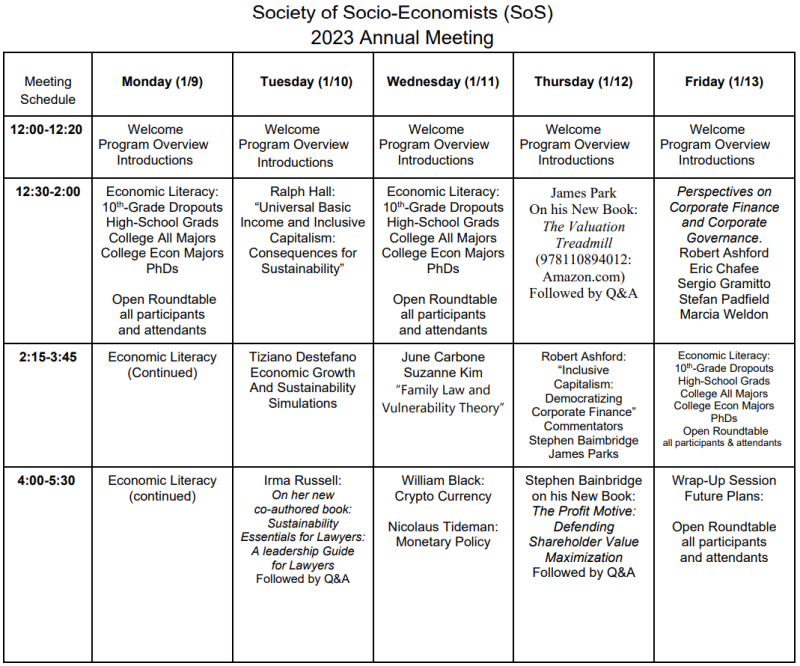
Below are the upcoming events taking place online as part of the Society of Socio-Economists Annual Meeting (all times EST). All events are accessible via a single link, which will be sent to you after registering here (registration is free). Readers of this blog will likely recognize a number of the presenters. I hope to see you there.

SOS 2023

UPDATE: You can find the paper Robert Ashford will be discussing Thursday at 2:15 here: https://scholarlycommons.pacific.edu/cgi/viewcontent.cgi?article=1372&context=uoplawreview

UPDATE 2: Two videos from economists discussing Professor Ashford’s Inclusive Capitalism: (1) https://youtu.be/lL1gEEj0tCU; (2) https://video.syr.edu/media/t/1_nnt9e504 .

Couple of things this week.

First, the FTC proposed a new rule that would bar employers from requiring employees to sign noncompetes that extend post-employment.  It’s a very broad proposal; it applies to “a contractual term between an employer and a worker that prevents the worker from seeking or accepting employment with a person, or operating a business, after the conclusion of the worker’s employment with the employer,” and includes “a contractual term that is a de facto non-compete clause because it has the effect of prohibiting the worker from seeking or accepting employment with a person or operating a business after the conclusion of the worker’s employment with the employer.”

The sole exception is for “a non-compete clause that is entered into by a person who is selling a business entity or otherwise disposing of all of the person’s ownership interest in the business entity, or by a person who is selling all or substantially all of a business entity’s operating assets, when the person restricted by the non-compete clause is a substantial owner of, or substantial member or substantial partner in, the business entity at the time the person enters into the non-compete clause.”  A substantial owner

Vikas Mittal and Jihye Jung have posted Strategic Management of Corporate Political Activism on SSRN.  Here is the abstract:

Senior leadership at many organizations engages in overt corporate political activism (CPA), defined as activities that are visible to stakeholders that support or undermine issues viewed as politically charged. According to media accounts, consumers, employees and shareholders want executives to engage in CPA. Evidence from peer-reviewed research shows that CPA does not help, but can harm companies on many fronts. This evidence shows that CPA is detrimental to a company’s brand equity, employee productivity, and financial performance while also alienating some customers. To help address these issues, this article develops a strategic framework to assess where a company is in its CPA journey and determine its path forward. The framework proposes four strategies: convergence, divergence, selective engagement, and depoliticized but supporting stance. Companies can use this framework to assess whether and how they should engage in political activism and then find ways to adapt their political activism strategy over time.