
I just posted Does Stakeholder Capitalism Have a (Viewpoint) Diversity Problem?, U. Puerto Rico Bus. L.J. (forthcoming) on SSRN (here).  The abstract:

Does stakeholder capitalism have a viewpoint diversity problem? What follows constitutes an initial inquiry into that issue.

Following the Introduction, Part II provides an overview of the Free Enterprise Project’s (FEP’s) 2021 Investor Value Voter Guide, which focuses at least in part on both stakeholder capitalism and viewpoint diversity in a way that provides a good introduction to a perceived tension between the two. This part of the essay contains three sub-parts. Sub-parts A and B provide at least some support for connecting stakeholder capitalism (in all its forms) to partisanship as well as a lack of relevant viewpoint diversity. Sub-part C then unpacks specific proposals that the FEP is submitting and/or recommends supporting/opposing. This sub-part is further broken down into brief overviews of the FEP’s viewpoint diversity and stakeholder capitalism proposals.

Part III shifts attention to related research and commentary. This part includes four sub-parts (A-D). Sub-part A addresses the issue of stakeholder capitalism as greenwashing. Sub-part B addresses some of the possible problems caused by a lack of viewpoint diversity in stakeholder capitalism
Sean Griffith has posted What’s “Controversial” About ESG? A Theory of Compelled Commercial Speech under the First Amendment on SSRN (here). The abstract:

This Article uses the SEC’s recent foray into ESG to illuminate ambiguities in First Amendment doctrine. Situating mandatory disclosure regulations within the compelled commercial speech paradigm, it identifies the doctrinal hinge as “controversy.” Rules compelling commercial speech receive deferential judicial review provided they are purely factual and uncontroversial. The Article argues that this requirement operates as a pretext check, preventing regulators from exceeding the plausible limits of the consumer protection rationale.

Applied to securities regulation, the compelled commercial speech paradigm requires the SEC to justify disclosure mandates as a form of investor protection. The Article argues that investor protection must be conceived on a class basis—the interests of investors qua investors rather than focusing on the idiosyncratic preferences of individuals or groups of investors. Disclosure mandates that are uncontroversially motivated to protect investors are eligible for deferential judicial review. Disclosure mandates failing this test must survive a form of heightened scrutiny.

The SEC’s recently proposed climate disclosure rules fail to satisfy these requirements. Instead, the proposed climate rules create controversy by imposing a political viewpoint

But a few days ago, he published this Op-Ed in the Wall Street Journal:

ESG is a pernicious strategy, because it allows the left to accomplish what it could never hope to achieve at the ballot box or through competition in the free market. ESG empowers an unelected cabal of bureaucrats, regulators and activist investors to rate companies based on their adherence to left-wing values.

While I do believe that some aspects of ESG are financial (climate change is a clear example), others seem to be more of an expression of moral value (and apparently at least some investors view it that way).  In that sense, it is an attempt to accomplish what cannot be achieved at the ballot box.  Some surveys show support for gun control measures that reach nearly 90%; a majority of Americans support greater action on climate change, and a majority want to keep abortion available under at least some circumstances.  Yet increasingly, our political leaders fail to adopt policies that the populace supports; the ballot box is simply not an available tool.  It’s no wonder, then, that voters turn to corporations as a source of power that at least

A FINRA comment period for a proposed rule to accelerate arbitration proceedings for seriously ill or elderly parties recently expired. The proposal recognizes that the existing voluntary expedited processing for elderly parties has not resulted in swifter resolutions.  The new proposal would allow persons over age 75 or who face some increased medical risk (e.g. cancer diagnosis) to seek expedited processing.  Often, the arbitration panel will need to hear from the customer to make an informed decision.  Dead customers don’t ordinarily testify.

The comments to the proposal reveal real stakeholder concern about the speed with which FINRA has put forward rules to address known problems with the dispute resolution process.  A letter from Steven B. Caruso, a retired former chair of FINRA’s National Arbitration and Mediation Committee (NAMC) makes for a compelling read.  Procedurally, FINRA has put the proposal out for comment on its website.  If it later seeks to advance it, it will need to appear for comment again when it is submitted to the SEC for approval.  Caruso questions why FINRA did not simply send the rule to the SEC for one round of notice and comment.  The rule may eventually make its way through this lengthy process

The world seems to be fascinated with Musk’s antics in connection with the Twitter acquisition (I have to pay attention; it’s my job), and in particular, a question that seems to be coming up a lot is, “Why isn’t the SEC doing anything?”  The answer, of course, is that none of this has anything to do with the SEC.  Yes, sure, Elon Musk didn’t file a form on time, and, now that we have the preliminary proxy, it seems the forms he did file were false in that they claimed he had no designs on a merger when in fact he absolutely did have designs on a merger, but delayed 13D/13G filings have never been a high priority for the SEC and in most cases have been met with a small fine.  The rest of it – Musk’s arguable violation of the merger agreement by tweeting confi info and disparaging everyone in sight, and his fairly transparent attempt to back out of his obligations with pretextual excuses about spambots – simply are not the SEC’s bailiwick.  That’s Delaware’s problem, which dictates the fiduciary duties of Twitter board members, and whose law governs the merger agreement.  And

The Fifth Circuit recently decided Jarkesy v. Sec. & Exch. Comm’n, No. 20-61007, 2022 WL 1563613, at *1 (5th Cir. May 18, 2022).  The case has significant implications for the SEC’s use of administrative law judges (ALJs).  The majority opinion was written by Judge Elrod and joined by Judge Oldham. Judge Davis penned a dissent.  The majority issued three holdings:

We hold that: (1) the SEC’s in-house adjudication of Petitioners’ case violated their Seventh Amendment right to a jury trial; (2) Congress unconstitutionally delegated legislative power to the SEC by failing to provide an intelligible principle by which the SEC would exercise the delegated power, in violation of Article I’s vesting of “all” legislative power in Congress; and (3) statutory removal restrictions on SEC ALJs violate the Take Care Clause of Article II.

The case involved two hedge funds founded by Jaresky, an investor, businessman, and conservative radio host.  The SEC alleged that Jaresky: (i) misrepresented the identity of the prime broker and auditor; (ii) misrepresented the funds’ investment parameters and safeguards; and (iii) overvalued the funds’ assets to increase the fees collected.  After an evidentiary hearing, an SEC ALJ found that the funds had committed

I was excited to see that Professor Jeremy Kress‘ excellent new article, Banking’s Climate Conundrum, is forthcoming in the American Business Law Journal!  Kress presented this article during The Changing Faces of Business Law and Sustainability Symposium at the end of February (post here).  As with all his pieces, it’s highly-readable, understandable, and enjoyable.  I’m a bit less sanguine than he is regarding relying on external credit rating agencies in calculations of bank capital requirements.  I encourage BLPB to read and decide what they think!  Here’s the abstract:

Over the past decade, a consensus has emerged among academics and policymakers that climate change could threaten the stability of banks, insurers, and the broader financial system. In response, regulators from around the world have begun implementing policies to mitigate emerging climate risks in the financial sector. The United States, however, lags significantly behind other countries in addressing such risks. This Article argues that the United States’ sluggishness in responding to climate-related financial risk is problematic because the U.S. banking system is uniquely susceptible to climate change. The United States’ vulnerability stems, in part, from a little-known statutory provision that prohibits U.S. regulators from relying on

Over at the University of Chicago’s ProMarket site, Bernard Sharfman has posted: Will “Portfolio Primacy” Throw a Monkey Wrench in Elon Musk’s Plans to Acquire Twitter? In the piece, Sharfman argues that even if one assumes Musk’s offer for Twitter maximizes the value of that firm, “investment advisers to index funds, such as BlackRock, Vanguard, and State Street (the Big Three)” may vote against the deal on the basis of portfolio primacy because:

[A]n investment adviser who manages a stock fund should be managing the fund based on an approach that attempts to maximize the financial value of the entire stock portfolio at any point in time, not just the value of any individual stock investment. This approach is referred to as “portfolio primacy.”… [L]et’s say that the investment adviser to the S&P 500 fund comes to the conclusion that a Musk takeover of Twitter will so distract Musk from his duties at Tesla that it will lead to a significant reduction in the market value of Telsa’s stock. Because the S&P 500 fund has so much more in terms of dollar holdings of Tesla than Twitter, this expected reduction in the market value of Tesla stock could easily outweigh

So of course, after I drafted this post about Chancellor McCormick’s decision in Coster v. UIP Companies, the Ninth Circuit came down with a decision affirming the district court opinion in Lee v. Fisher.  I blogged about that case here; the short version is, the district court enforced a forum selection bylaw that required derivative 14(a) claims to be litigated in Delaware Chancery, despite the fact that Delaware Chancery has no jurisdiction to hear 14(a) claims.  Based on Ninth Circuit precedent, the district court held that the Exchange Act’s antiwaiver provision was not a clear enough statement of a federal public policy against forum selection to prohibit enforcement of the bylaw.   The Ninth Circuit, on appeal, agreed (you know the drill by now; no one engaged the question whether the bylaw is the equivalent of a contractual agreement, naturally).  By affirming the district court’s decision, the Ninth Circuit sort of – but not exactly – created a split with the Seventh Circuit’s decision in Seafarer’s Pension Plan v. Bradway; I say “sort of” because – as I explained in my post about the Bradway decision, here – most of the Seventh Circuit’s logic refusing to enforce

After the end-of-semester crunch and a bout with Covid, I’m back to reading Hilary Allen’s Driverless Finance.  Chapter three, focused on Fintech and Capital intermediation seems prophetic today.  In it, she explains how stablecoins could lead to fiat currency runs and fluctuations.  She also explains how concerns about a particular cryptoasset could trigger panics affecting other cryptoassets.

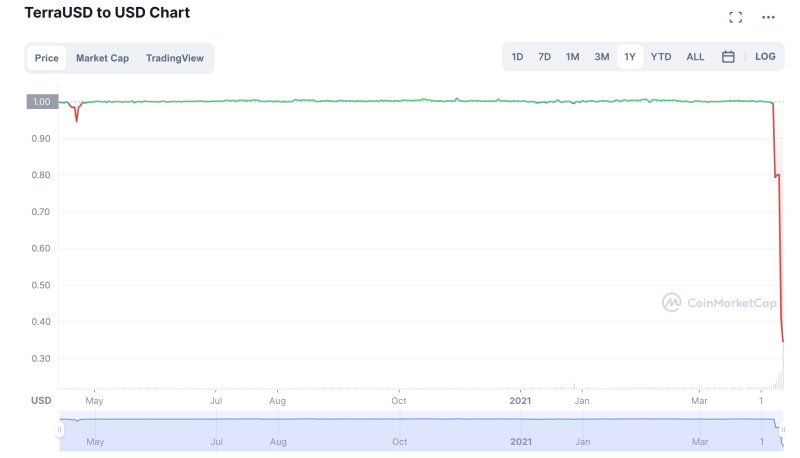
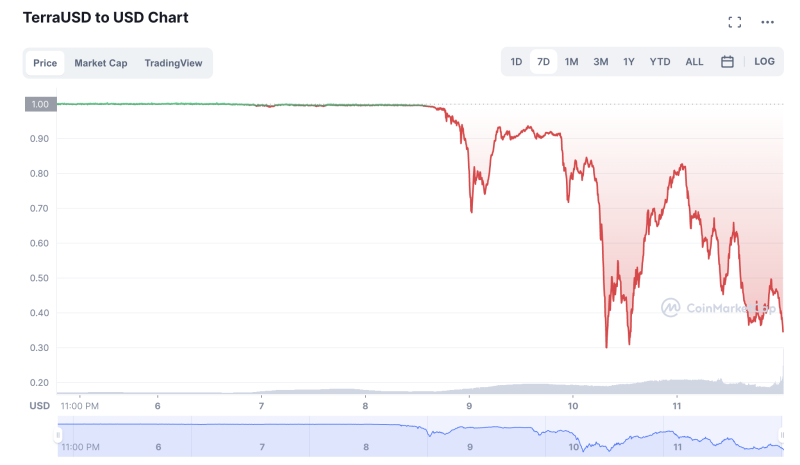
This brings me to our world today.  TerraUSD, a stablecoin, has become unstable.  It aimed to hold its value at $1 per coin to allow crypto enthusiasts to park cryptoassets in TerraUSD, avoiding market fluctuations.  For most of the past year, TerraUSD largely achieved this goal.  But then it didn’t.  As of Wednesday, TerraUSD traded at $0.23.  To help readers see the carnage, check out these charts, first the year and then the last seven days.

TerraUSD 1Y

TerraUSD 7d

Allen predicted that these sorts of things could happen.  The Wall Street Journal described the panic briefly spreading to another stablecoin, explaining that the “collapse saddled investors with billions of dollars in losses. It ricocheted back into other cryptocurrencies, helping drive down the price of bitcoin. Another stablecoin, tether, edged down to as low as 96 cents on Thursday before regaining its peg to the