
Over at Law & Liberty (here), George R. La Noue argues that: “Training sessions based on critical race theory run contrary to an employer’s responsibility to avoid creating a hostile work environment.”  Here is an excerpt:

Asking one set of employees to confess to the sins of their racial ancestors or their individual current white privilege runs contrary to an employer’s responsibility to avoid creating a hostile work environment.

Laws about hostile or toxic work environments are based in both Title VII and Title IX of the Civil Rights Act. The U.S. Equal Employment Opportunity Commission defines a hostile or toxic work environment as one that involves “unwelcome conduct that is based on race, color, religion, national origins, age, disability, or genetic information.” That conduct “may include, but is not limited to offensive jokes, slurs, epithets or name calling, physical assaults or threats, intimidation, ridicule or mockery, insults or put downs, offensive objects or pictures and interference with work performance.” CRT certainly can involve “slurs, epithets or name calling,” as well as “ridicule or mockery, insults or put downs.”

EEOC cautions against making petty slights, annoyances, or isolated incidents illegal, but calling out one racial group as privileged
Earlier this week, VC Laster issued his decision in United Food & Commercial Workers Union v. Zuckerberg.  Professor Stephen Bainbridge blogged about the decision here, with a lot more detailed discussion of the law than I’m going to provide, but I’m covering the same territory anyway because this case is an interesting example of the pathologies associated with the common law.

So, before stockholder plaintiffs are permitted to bring a derivative action on behalf of a corporation, they must first make a showing that the corporate board is too conflicted to be able to make the litigation decision themselves.  This may occur because board members are themselves at risk of liability regarding the underlying transaction being challenged, or because they are too close to someone who is.  The test was first articulated by the Delaware Supreme Court in Aronson v. Lewis, 473 A.2d 805 (Del. 1984), but because this was a common law creation and the court was mostly focused on the dispute in front of it, the test it articulated conflated the general inquiry – is the board able to be objective about the litigation – with the specific application of that inquiry to the Aronson

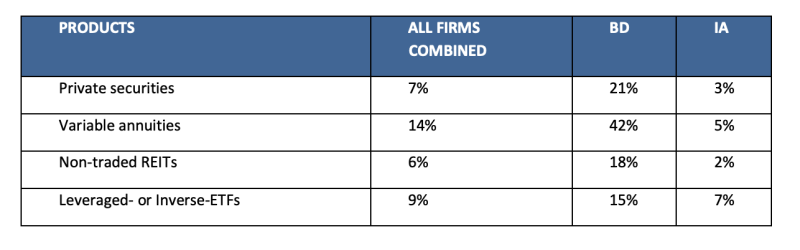
The North American Securities Administrators Association (NASAA) recently released a new report aimed at “identify a baseline of broker-dealer (“BD”) and investment adviser (“IA”) firm policies, procedures, and practices involving sales to retail investors, as those policies, procedures, and practices existed in 2018 prior to adoption and release of the final rule by the SEC (the “pre-BI period”).”  NASAA will do a second look later to see how Regulation Best Interest changes sales patterns.  My early prediction:  not much.

As it stands, some of the differences between the BD channel and the IA channel are shocking.  You’re nine times as likely to get sold a non-traded REIT by a BD than by an IA.  Across the board, BDs load investors up with riskier, complex products:

Screen Shot 2020-10-29 at 11.42.11 AM

This doesn’t surprise me.  Many of these complex products pay massive commissions to the brokers who sell them.  Unsurprisingly, they tend to get sold more often through that channel.  The IA channel compensates advisers differently and they lack the same incentive to get their clients into variable annuities and other complex, illiquid products.

Looking forward, if Regulation Best Interest has some meaningful effect, we would expect these numbers to change in some significant way.  I

The University of Wisconsin Law School is looking to hire in the areas of Business/Corporate Law, among other closely related areas. We invite applications for faculty position at the rank of Assistant, Associate or Full Professor of Law beginning academic year 2021-2022. We seek entry-level and lateral candidates who show scholarly promise, as evidenced by publications, works in progress, or a research agenda. Applicants should have relevant experience such as teaching, legal practice, or a judicial clerkship. Hiring rank will be commensurate with years of relevant experience. All candidates must have proven success in conducting research or publishing papers in high-impact journals, and teaching appropriate to their stage of career. The University of Wisconsin is an Equal Opportunity and Affirmative Action Employer. We promote excellence through diversity and encourage all qualified individuals to apply. 


The complete PVL is available here: https://jobs.hr.wisc.edu/en-us/job/505740/assistant-associate-or-full-professor-of-law

This week, I’m plugging a new piece I posted to SSRN, forthcoming as a chapter in Research Handbook on Corporate Purpose and Personhood (Elizabeth Pollman & Robert Thompson eds., Elgar). It actually includes a lot of the arguments/observations I’ve previously made in this space, but if you want them compiled in a handy chapter, here’s the abstract:

ESG Investing, or, If You Can’t Beat ‘Em, Join ‘Em

If corporate purpose debates concern whether corporations should operate solely to benefit their shareholders, or if instead they should operate to benefit the community as a whole, “ESG” – or, investing based on “environmental, social, and governance” factors – occupies a middle ground. Its adherents welcome shareholder power within the corporate form and accept that shareholders are the central objects of corporate concern, but argue that shareholders themselves should encourage corporations to operate with due regard for the protection of nonshareholder constituencies. This Chapter, prepared for the Research Handbook on Corporate Purpose and Personhood, will explore the theory behind ESG, as well as the barriers to its implementation.

Professor Dan Kleinberger and I have recently published a short article in the Business Law Today entitled “The Limited Effect of ‘Maximum Effect.'” The executive summary of the piece is that more than 20 jurisdictions have followed Delaware rather than the Uniform Law Commission in giving “maximum effect” to the principle of freedom of contract in LLC arrangements.  You may wonder, “Exactly how effective has the construct of ‘maximum effect’ been?”  Our answer is “not very.”

If you’re interested in reading beyond the executive summary, you can find the article here:  https://businesslawtoday.org/2020/08/limited-effect-maximum-effect/

With the comment period closing today, the SEC will consider a FINRA proposal to make some relatively minor changes to how the current process for expunging public records works.  In my comment letter, I explained that changes simply don’t do anywhere near enough to address the core problem underlying the current, fundamentally broken expungement process. In essence, the Proposal’s expungement process improperly relies on an adversarial system to surface information relevant to whether customer dispute information should be expunged.  This adversarial system fails to function in any reliable way because expungement hearings generally proceed as one-sided affairs which are functionally ex parte proceedings.  In these functionally ex parte proceedings, arguments and evidence submitted by brokers seeking expungement never receive any real scrutiny by anyone well-situated to carefully consider these expungement requests.  When arbitrators recommend expungement, courts—which are generally precluded from closely reviewing the underlying arbitration absent the rarest of circumstances—then confirm the arbitration awards.  Judicial review under these circumstances provides no meaningful check on this process and only serves as a dubious veneer. 

To help the Commission see that these expungement hearings often have little resemblance to the sort of adversarial proceeding one would expect in arbitration, I

Yesterday, the CFTC and the Bank of England signed a Memorandum of Understanding on the Cooperation and the Exchange of Information Related to the Supervision of Cross-Border Clearing Organizations. Heath Tarbert, the Chairman of the CFTC, and Jon Cunliffe, deputy governor for financial stability at the Bank of England, also authored an opinion piece published in Risk.  It notes that the UK is “the single largest investor in the US,” and that the US “is the largest investor in the UK.”  The two jurisdictions account for about 80% of the global market activity for interest rate derivatives. 

The global clearing mandates that followed the financial crisis of 2007-09 have increased the importance of cross-border financial market infrastructures such as clearinghouses and also the potential for these infrastructures to propagate risks throughout global financial markets.  The opinion notes that “The long-lasting significance of these reforms was seen when the Covid-19 pandemic sent shockwaves through the world’s financial markets earlier this year.  The largest dollar moves in history were recorded for the S&P 500, Dow Industrial Average and Nasdaq-100.  The FTSE All-Share index fell more than 10% on March 12.  Despite this market turmoil and a transition to a work-from-home

Lots of virtual events that should be of interest to our readers, including the “Showcase Discussion” on Thursday 11/12 from 11:00 a.m. – 12:15 p.m.: A Discussion with Professors Robert George and Cornel West on Freedom of Speech, Freedom of Thought, the Black Lives Matter Movement, and the Cancel Culture. You can find the full schedule and register here.