
By now, you’ve probably seen that the SEC filed a lawsuit against AT&T for, allegedly, violating Regulation FD by selectively leaking information about an upcoming earnings announcement in 2016.  According to the complaint, in previous quarters, AT&T had disappointed the market by announcing earnings below analysts’ consensus expectations; when it realized it was going to do so again, its Investor Relations department began contacting the analysts with high expectations in order to dampen their optimism.  The result was a lowered consensus estimate, and when AT&T did announce its 1Q2016 results, they actually came in slightly above expectations.

AT&T disputed the charges with a curious statement:

The evidence could not be clearer – and the lack of any market reaction to AT&T’s first quarter 2016 results confirms – there was no disclosure of material nonpublic information and no violation of Regulation FD.

Well, yeah, genius, because the point of the scheme was to prevent a market reaction to AT&T’s first quarter 2016 results.

But what really strikes me about the whole situation is that it’s as clear an example as you can imagine of a company apparently violating the securities laws for the explicit purpose of trying to avoid a negative market reaction rather than to induce a positive one.

That’s important because in recent years, defendants in Section 10(b) actions have tried to cast doubt on the viability of the “price maintenance” theory of fraud, i.e., the theory that some fraudulent actions are designed not to push prices upward, but to withhold negative information so that prices can be maintained at existing levels.  Defendants have argued that statements that merely maintain prices are not material to investors and/or have no impact on prices, and therefore cannot form the basis of a fraud claim.  Happily, most courts have rejected that argument, but it’s getting a new workout now before the Supreme Court in Goldman Sachs v. Arkansas Teachers’ Retirement System (my most recent blog post on that case is here; it links to earlier ones).  There, the defendants are not explicitly arguing that price maintenance theory is illegitimate, but they are suggesting there is something suspicious about it that warrants extra scrutiny:

Critically, respondents conceded that the challenged statements did not increase Goldman Sachs’ stock price when made. Instead, respondents relied on the increasingly popular “inflation-maintenance” theory—a theory this Court has never endorsed—to assert that the statements maintained the stock price at a previously inflated level….

The inflation-maintenance theory already seriously impedes a defendant’s ability to rebut the Basic presumption. The theory allows plaintiffs to rely on the presumption even if there is no evidence that a misstatement increased the stock price when it was made. Nor do plaintiffs need to identify what statement (if any) inflated the price in the first place.

Some of Goldman’s amici are attacking the theory more directly.  To wit.

Happily, a group of former SEC officials have filed a brief in support of the plaintiffs that is almost entirely devoted to defending the inflation-maintenance theory, and highlighting how important it’s been to SEC enforcement actions.

(In case anyone cares, I also signed on to a law professors’ brief in support of the plaintiffs, here).

To bring this back to AT&T, obviously, AT&T is not accused of fraud, or doing anything to mislead the market, but its alleged conduct demonstrates the lengths to which companies will go in order to avoid negative market shocks; it should be utterly unsurprising that many frauds are designed precisely to minimize market reaction, and defendants in those cases shouldn’t be rewarded for success.

That said, as Matt Levine points out, in AT&T’s case specifically, the whole kerfuffle raises interesting questions about what kinds of information move the market or are material to it.  If AT&T’s stock price stayed flat after its earnings announcement because the company had already lowered analysts’ expectations, you would expect to see a downward drift in the stock price before the announcement, when AT&T was quietly walking it down.  I eyeballed its stock prices during that period and – without running a statistical analysis or comparing it to peer companies or anything – it doesn’t seem like the revisions to analyst estimates was having much of an effect.  That could be for any number of reasons – my eyeballs may not be sensitive enough to the detect the pattern, or maybe these analysts were already known to get things wrong and their estimates weren’t baked into the stock price – but it’s amusing that (AT&T thought, at least) the difference between a negative market reaction and no reaction was not the earnings themselves, but what analysts had said about them the day before.  In fact, the market appears to have been a lot more sanguine about analyst commentary than AT&T was. 

Which, ahem, doesn’t mean that nonpublic information AT&T’s upcoming earnings was not material; just that it confirmed market expectations, no matter what analysts said.  If anything wasn’t material here, it was the analysts. 

The Goldman case is set for oral argument on March 29.
It’s been one year since the US declared a pandemic. It’s been a stressful time for everyone, but this post will focus on lawyers.

I haven’t posted any substantive legal content on LinkedIn in weeks because so many of my woo woo, motivational posts have been resonating with my contacts. They’ve shared the posts, and lawyers from around the world have reached out to me thanking me for sharing positive, inspirational messages. I hope that this care and compassion in the (my) legal community will continue once people return back to the office.

Earlier this week, I took a chance and posted about a particularly dark period in my life. I’ve now received several requests to connect and to speak to legal groups and law firms about mindset, wellness, resilience, and stress management. I’ve heard from executives that I used to work with 15 years ago asking to reconnect. Others have publicly or privately shared their own struggles with mental health or depression. I’m attaching a link to the video here. Warning- it addresses suicide prevention, but it may help someone. 

I’m also sharing an article that my colleague Jarrod Reich wrote last year. He and I have just finished sitting on a panel on Corporate Counsel and Professional Responsibility Post COVID-19, and it’s clear that the issue of lawyers and mental health could have been its own symposium. Here is the abstract for his article, Capitalizing on Healthy Lawyers: The Business Case for Law Firms to Promote and Prioritize Lawyer Well-Being. 

This Article is the first to make the business case for firms to promote and prioritize lawyer well-being. For more than three decades, quantitative research has demonstrated that lawyers suffer from depression, anxiety, and addiction far in excess of the general population. Since that time, there have been many calls within and outside the profession for changes to be made to promote, prioritize, and improve lawyer well-being, particularly because many aspects of the current law school and law firm models exacerbate mental health and addiction issues, as well as overall law student and lawyer distress. These calls for change, made on moral and humanitarian grounds, largely have been ignored; in fact, over the years the pervasiveness of mental health and addiction issues within the profession have persisted, if not increased. This Article argues that these moral- and humanitarian-based calls for change have gone unheeded because law firms have not had financial incentives to respond to them.

In making the business case for change, this Article argues that systemic changes designed to support and resources to lawyers will avoid costs associated with lawyer mental health and addiction issues and, more importantly, create efficiencies that will increase firms’ long-term financial stability and growth. It demonstrates that this business case is especially strong now in light of not only societal and generational factors, but also changes within the profession itself well. As firms have begun to take incremental steps to promote lawyer well-being, lasting and meaningful change will further benefit firms’ collective bottom lines as it will improve: (1) performance, as clients are demanding efficiency in the way their matters are staffed and billed; (2) retention, as that creates efficiencies and the continuous relationships demanded by clients; and (3) recruitment, particularly as younger millennial and Generation Z lawyers—who prioritize mental health and well-being—enter the profession.

If you have any feedback on Jarrod’s article or tips on how you are coping, surviving, or thriving in these times, please feel free to drop them in the comments. 

Take care and stay safe.

“I’m no civ-pro geek,” I confessed today at a research presentation by OU College of Law colleagues Professors Steven Gensler and Roger Michalski on their recent article, The Million Dollar Diversity Docket. But I also shared having been immediately intrigued by their paper after reading its abstract.  And I am even more so now after today’s presentation.  Diversity of citizenship jurisdiction is, of course, a tremendously important subject for both business lawyers and business litigation. So, even if like me, civil procedure generally isn’t your thing, check out their fascinating project!  Here’s the article’s Abstract: 

What would happen if Congress raised the jurisdictional amount in the diversity jurisdiction statute? Given that it has been almost 25 years since the last increase, we are probably overdue for another one. But to what amount? And with what effect? What would happen if Congress raised the jurisdictional amount from the current $75,000 to $250,000 or, say, $1 million?

Using a novel hand-coded data set of pleadings in 2900 cases, we show that the jurisdictional amount is not a neutral throttle. Instead, different areas of law, different parts of the country, and different litigants are more affected by changes in the jurisdictional amount than others. Our findings thus provide new guidance for Congress to consider when evaluating proposed changes to the amount threshold.

We build from our data to explore different ways Congress could use the amount in controversy lever to adjust the diversity docket, ranging from traditional techniques like incremental inflation-adjustments to radical experiments with lotteries or replacing the amount in controversy minimum with a maximum. Our analysis of the options highlights the normative choices Congress makes when deciding which cases to bless and curse with a federal forum. Thus, our study also provides a new window into the longstanding debates about the existence and reach of diversity jurisdiction. We hope our empirical work will inform these debates and enable a new wave of scholarship on the basic functions and functioning of the federal diversity docket.

Friend-of-the-BLPB Bernie Sharfman and his co-author Vincent Deluard recently posted their article, How Discretionary Decision-Making Has Created Performance and Legal Disclosure Issues for the S&P 500 Index, on SSRN.  The article plays to several audiences, as noted by the authors.  The SSRN abstract follows:

When investment funds track the S&P 500, the index becomes more than just a list of 500 companies. The focus then turns to the financial and regulatory issues that arise from the discretionary decision-making of its Index Committee. The discussion of these issues and their implications should be of extreme interest to both investors and regulators. This discussion involves: how Sharpe’s equality will hold in practice, what kind of companies may still be impacted by the index effect, how we are to understand the expected returns versus risk of a broad based market portfolio, whether funds that track the S&P 500 are to be considered actively managed or passive, the S&P 500’s suitability as an “appropriate” benchmark index, and what kind of legal disclosures are required in the use of the index. As a result of our discussion, including our empirical findings, we do not find the S&P 500 index to be desirable for either tracking or benchmarking purposes, even though our proposed legal disclosures should mitigate any potential legal liability for its continued use.

Our paper makes contributions to the literature on index managers and the SEC’s disclosure policy for open-end investment management companies. Most importantly, it will help guide the investment decisions of tens of millions of investors who are currently invested in, or are considering investing in, funds that track the S&P 500.

The abstract is thought-provoking.  I am always interested in reading works that rely, illuminate, or comment on disclosure policy.  And I believe my son has invested in at least one index fund that tracks the S&P 500. Other family members also may have investments in funds of that kind.  So, I may need to read this . . . .

Judge Rakoff’s decision in In re Nine West LBO Securities Litigation, 2020 WL 7090277 (S.D.N.Y. Dec. 4, 2020) is all the rage these days.  The short version is that Nine West was taken private in a leveraged buyout by Sycamore; as part of the deal, allegedly the Sycamore buyers caused the company to sell the profitable subsidiaries to its own affiliates for less than they were worth, and the whole thing ended in Nine West’s bankruptcy.  In the wake of all of this, the debtholders (many of whom held debt that predated the sale), via the litigation trustee, sued Nine West’s former directors – the ones who had approved the sale – for violating their fiduciary duties by negotiating a deal that would result in the company’s bankruptcy.  Last year, Judge Rakoff refused to dismiss the claims, in a decision that spawned a thousand law firm updates about directors’ duties when selling the company.

But what I find interesting is how little anyone – including Judge Rakoff – seems to have interrogated the legal question of to whom the directors’ fiduciary duties were owed.

The classic Delaware formulation is that directors owe a duty to advance the best interests of the “corporation and its stockholders.” Firefighters’ Pension Sys. Of Kansas City v. Presidio, 2021 WL 298141 (Del. Ch. Jan. 29, 2021).  Drill down a little further, and you discover that “the corporation” is equated with stockholders.  See, e.g., North American Catholic Educational Programming Foundation, Inc. v. Gheewalla, 930 A.2d 92 (Del. 2007) (“When a solvent corporation is navigating in the zone of insolvency…directors must continue to discharge their fiduciary duties to the corporation and its shareholders by exercising their business judgment in the best interests of the corporation for the benefit of its shareholder owners.”); Revlon, Inc. v. MacAndrews & Forbes Hldgs., Inc., 506 A.2d 173  (Del. 1986) (“A board may have regard for various constituencies in discharging its responsibilities, provided there are rationally related benefits accruing to the stockholders. However, such concern for non-stockholder interests is inappropriate when an auction among active bidders is in progress, and the object no longer is to protect or maintain the corporate enterprise but to sell it to the highest bidder.”).  Under these precedents, the directors’ duties are to maximize stockholder wealth.  Full stop.

Normally, it would be a proposition too obvious to articulate that of course if directors are to maximize shareholder wealth, a subsidiary obligation is to try to avoid bankruptcy.  But that’s because normally, bankruptcy harms the stockholders – they’re the ones left with worthless stock.  But, pace Revlon and Gheewalla, you’d think that if the stockholders themselves eagerly – nay, joyfully – court bankruptcy, because they’re being bought out at $15 per share and they don’t really care what happens after that, the directors have satisfied their duties and nothing more needs be said.  The whole point of Revlon, after all, is that there is such a thing as a endgame transaction, after which shareholders exit the company and fiduciary duties cease.

But even in Delaware, where the law is probably clearest, I’m not sure that’s accurate.  When a corporation is insolvent, the creditors have standing on behalf of the company to sue directors for breach of fidicuary duty. See Gheewalla, 930 A.2d at 101.  And what precisely are the duties of the directors in this scenario?  Per VC Laster, they are the same duties that directors always have, namely, “the fiduciary duties that directors owe to the corporation to maximize its value for the benefit of all residual claimants.” Quadrant Structured Products Co., Ltd. v. Vertin, 102 A.3d 155 (Del. Ch. 2014).  If directors’ duties, generally, are to benefit residual claimants, that presumably means they have a duty to avoid bankruptcy in the first place even if shareholders would prefer it.  But all that just highlights the difficulty with pinning fiduciary duties to residual claimants – all claimants are residual claimants, depending on the firm’s moment in its life cycle.

That’s Delaware.

But Nine West was not incorporated in Delaware; it was incorporated in Pennsylvania.  And, among other things, Pennsylvania has a constituency statute, which states that in discharging their duties to “the corporation,” Pennsylvania directors may (but are not obligated) to consider the effects of an action on all corporate constituencies. See 15 Pa. Cons. Stat. § 1715.  Meaning that whatever else directors’ duties are, they do not include a duty to maximize value to stockholders, whether in a sale scenario or at any other time.  Which is why Nine West’s litigation trustee argued that Pennsylvania law does not require maximizing value to “short-term” shareholders (although that still leaves maddeningly vague what to do when even the interests of long-term shareholders conflict with those of creditors), and the director-defendants argued that no duty to creditors would attach until the actual point of insolvency (never mind that they themselves had allegedly occasioned the insolvency).

Which is how matters stood when the case came before Judge Rakoff.

Rakoff chose not to engage in any of this.  Instead, he simply declared that the directors’ duties were to the company, but quite explicitly treated the company as having different constituencies, namely, stockholders and creditors.  For example, the director defendants tried to argue that any claims against them were res judicata because when the buyout was first proposed, stockholders brought a derivative claim on the company’s behalf arguing that the deal undersold the company, and that claim was settled. Rakoff rejected the argument in part because the stockholder plaintiffs – though they had acted on the company’s behalf – had not adequately represented the interests of creditors, who were now represented on the company’s behalf by the bankruptcy litigation trustee

Having thus recognized that “company” interests may be represented either by stockholders or by creditors – but that these two groups are distinct and often at odds – Rakoff went on to conclude that the Nine West directors had neglected their duties to the company by failing to investigate the effects of the deal on the company, and, in particular, failing to investigate the possibility that the transactions would harm the company by leaving it insolvent.  He further held that the Nine West directors had aided and abetted the fiduciary breaches of the Sycamore directors – who took over after the merger – by assisting them with their plan to sell off the profitable assets, which would bankrupt the company.

By focusing on the company, Rakoff obscured the implications of his holding regarding the true parties in interest.  He did not say so explicitly, but the import is that if directors had investigated, and had recognized (correctly) that the deal would leave Nine West bankrupt, but also believed that the price would benefit Nine West’s shareholders, they would still have violated their duties to the company by consciously choosing to leave the company insolvent.

Thus, in this scenario, Rakoff believed the directors’ fiduciary duties prohibited them from elevating shareholders over creditors.  But he didn’t cite any law for this point – not even Pennsylvania’s constituency statute (which by my read gives directors considerable discretion to decide which constituencies to favor).   It’s just what necessarily follows from his reasoning.

Nine West is, then, a real-world example of the “two masters” problem that is frequently used to justify shareholder primacy.   And Judge Rakoff’s opinion rejects shareholder primacy in favor of a stakeholder view of the corporation, with fiduciary duties that follow. 

Here’s my take:  Usually, we can avoid asking whether directors must take Action A or Action B because matters are not obviously a zero-sum game; directors are taking risks, and different constituencies may benefit more or less from those risks.  Yes, shareholders may benefit from risk-taking more than creditors, but it is by no means obvious that the risk won’t pay off for everyone, and exercising business judgment means deciding how to act under conditions of uncertainty.

But the Nine West problem presents things in starker terms: Accepting the allegations as true, it was clear at the outset that the buyout would benefit shareholders at the expense of creditors, because part of the plan was to undersell the profitable Nine West assets to Sycamore affiliates, where they would be out of creditors’ reach.  If that hadn’t been part of the plan, this might simply have been a gamble as to how much debt the company could support; because it was part of the plan, there was an unusually clear choice: cooperate in a scheme to remove assets from creditors’ grasp and pay off the shareholders for their participation, or – don’t.

So the question then becomes, do directors’ duties to shareholders include evading obligations to debtholders?

And I still don’t have a clear answer, but what is true is that on the one hand, directors (at least in Delaware) may not break the law even if it’s intended to benefit shareholders, In re Massey Energy Co., 2011 WL 2176479 (Del. Ch. May 31, 2011) (“Delaware law does not charter law breakers. Delaware law allows corporations to pursue diverse means to make a profit, subject to a critical statutory floor, which is the requirement that Delaware corporations only pursue ‘lawful business’ by ‘lawful acts.’), but on the other hand, in Delaware, directors may efficiently breach a contract if it benefits shareholders, see Frederick Hsu Living Trust v. ODN Holding, 2017 WL 1437308 (Del. Ch. Apr. 14, 2017) (“the fact that a corporation is bound by its valid contractual obligations does not mean that a board does not owe fiduciary duties when considering how to handle those contractual obligations; it rather means that the directors must evaluate the corporation’s alternatives in a world where the contract is binding. Even with an iron-clad contractual obligation, there remains room for fiduciary discretion because of the doctrine of efficient breach. Under that doctrine, a party to a contract may decide that its most advantageous course is to breach and pay damages. Just like any other decision maker, a board of directors may choose to breach if the benefits (broadly conceived) exceed the costs (again broadly conceived).”).

In other words, in a world where statutory law is “law” that the corporation may not break, but contract law is not “law” with a similar prohibition, I … do not know what to do with debt agreements subject to, among other things, bankruptcy’s prohibitions on fraudulent and preferential transfers, etc.

So really, it would be so much easier if bankruptcy law, tort law, and contract law were to solve this problem, and spare corporate law the trouble.

(For more discussion of consequences of shareholder primacy in the bankruptcy context, see Jared A. Ellias & Robert Stark, Bankruptcy Hardball, 108 Cal. L. Rev. 745 (2020)).

In a prior post, I reflected on evidence that motives other than profit seeking may be driving some of the recent social-media-driven “meme” trading in stocks such as GameStop. Indeed, many of these traders have publicized that they are buying and holding their positions as a form of social, political, or aesthetic expression.

We typically classify retail traders as either investors or speculators. Investors are those who research a stock’s fundamentals and buy it with the expectation that it will perform well over time. Speculators are less concerned with a stock’s fundamentals than its potential for volatility in price (up or down). A speculator looks to anticipate how other traders in a stock will react to price movements or market events and trade accordingly, sometimes entering and exiting the same position in a single trading session. Though they employ different strategies, the principal goal for both the investor and the speculator is to profit from their trading.

The recent meme-trading phenomenon, however, suggests that a new category of retail trader has emerged, the “expressive trader.” An expressive trader is one who does not trade for profit, but rather to send a message or produce a social/aesthetic effect. Social media has made expressive trading practicable for retail market participants by allowing a large number of small investors to coordinate their trading in real time to deliver their desired message in the form of a measurable impact on the targeted stock’s price.

A consistent message from expressive traders in GameStop has been to protest the Wall-Street elitism that motivated the Occupy Wall Street movement in 2011. In contrast to the Occupy Wall Street movement, however, expressive trading has permitted this message to be brought home with very real economic consequences for the movement’s perceived hedge-fund villains.

Of course expressive trading comes at a price. Expressive traders know the price movement they generate does not reflect a stock’s fundamentals, and that they may incur losses when the likely correction takes place, but they consider the act of sending the message to be worth the cost. Indeed many GameStop traders have demonstrated just such an attitude. As one commentator notes, GameStop retail traders frequently quote Heath Ledger’s Joker character from “The Dark Knight” on their trade-related posts: “It’s not about the money; it’s about sending a message.” Or as another commentator points out, “some investors have publicly said that as long as they can hurt the hedge funds, and hurt the system, that is a benefit to them; they don’t care if they hurt themselves.” Another retail trader admits to buying into the GameStop surge in the hope of a quick profit, but explains that “when individual investors like him managed to inflict some serious pain on hedge funds, it wasn’t about money anymore.” Similarly, a delivery driver in Central Florida described her purchase of GameStop shares as a “protest” and she explains that she’s “not selling” as the price declines.

The principal GameStop-related message may be anti-hedge-fund short selling, but future expressive trading may protest companies’ labor practices, lack of board diversity, controversial products, advertising, etc. As one Washington Post op-ed author suggests, “[i]f a corporation’s stock plummeted 20-30 percent in a single day, that would send a clear and resounding message to its board of directors, principal shareholders, and senior leadership team, i.e., the decision makers.” With all this in mind, we should expect more expressive trading in the future.

In future posts, I will address some potential risks and benefits of expressive trading, its consequences for our traditional understanding of market functioning, and how (if at all) regulators should address it. I am also working on an article concerning expressive trading with co-authors Jeremy Kidd and George Mocsary. We look forward to sharing a draft soon!

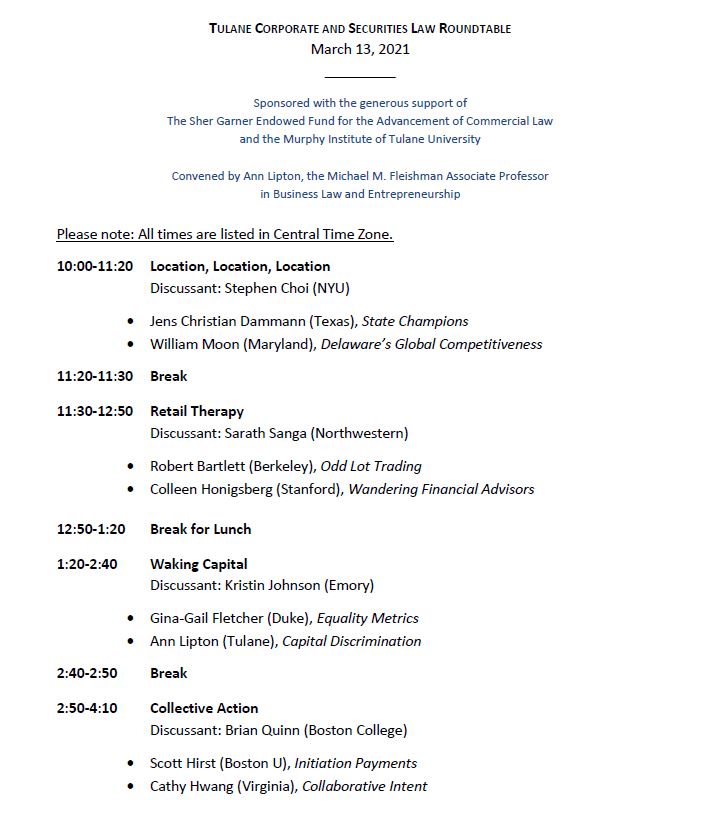
Four leading scholars (Jens Frankenreiter, Cathy Hwang, Yaron Nili, & Eric Talley) recently released a new paper, entitled Cleaning Corporate Governance.  This is the abstract:

Although empirical scholarship dominates the field of law and finance, much of it shares a common vulnerability: an abiding faith in the accuracy and integrity of a small, specialized collection of corporate governance data. In this paper, we unveil a novel collection of three decades’ worth of corporate charters for thousands of public companies, which shows that this faith is misplaced.

We make three principal contributions to the literature. First, we label our corpus for a variety of firm- and state-level governance features. Doing so reveals significant infirmities within the most well-known corporate governance datasets, including an error rate exceeding eighty percent in the G-Index, the most widely used proxy for “good governance” in law and finance. Correcting these errors substantially weakens one of the most well-known results in law and finance, which associates good governance with higher investment returns. Second, we make our corpus freely available to others, in hope of providing a long-overdue resource for traditional scholars as well as those exploring new frontiers in corporate governance, ranging from machine learning to stakeholder governance to the effects of common ownership. Third, and more broadly, our analysis exposes twin cautionary tales about the critical role of lawyers in empirical research, and the dubious practice of throttling public access to public records.

The authors recognized a major problem underlying much of the past empirical research, namely that “several of the most heavily relied-upon governance datasets suffer from inaccuracies so extensive so as to call into question some of the landmark insights of the field.”  After putting in an enormous amount of work to get a more reliable dataset, they show that some of the most significant findings in the field, now need to be re-evaluated.  They’re also releasing the dataset so that others can work with it.  They also explain that part of the reason why inaccuracies and poor datasets have lingered for so long is that notable jurisdictions (ahem Delaware) “actively throttle public access” to documents.

In the coming months and years, I expect that the dataset will be used to reevaluate much of what we now think we know about corporate governance.  By making their data open -source, any errors inadvertently made in the collection appear unlikely to persist as others work with the data.

The authors explain that they are “deeply indebted to” an extensive team of assistants for their work.  The Senior Research Assistants (JD students or recent grads) were:  Nicole Banton, Matthew Cunningham, Deandra Fike, Channing Gatewood, Katie Gresham, Qifan Huang, Elisha Jones, Sami Kattan, Gabrielle Kiefer, Andrew Kim, Adam Mazin, Cameron Molis, Courtney Murray, Doriane Nguenang, Sneha Pandya, Emily Park, Olivia Roat, Bhargav Setlur, Tom St. Henry, Avi Weiss, Gretchen Winkel, Geoffrey Xiao, and  Ben Zonenshayn.  Research Assistants (undergraduate students) were: Nathaniel Barrett, Amanda Cooper, Elif Nazli Hamutcu, Alex Inskeep, Justen Joffe, Alexa Levy, Annabelle Liu, Noam Miller, Emily Moini,Stephen Rothman, Adrien Stein, Max Swan, and Agnes Tran.

I recently had the good fortune to hear Professor Jonathan R. Macey speak about his insightful and timely new article, Fair Credit Markets: Using Household Balance Sheets to Promote Consumer Welfare (forthcoming, Texas Law Review).  I wanted to highlight it to readers and share the Abstract:

Access to credit can provide a path out of poverty. Improvidently granted, however, credit also can lead to financial ruin for the borrower. Strangely, the various regulatory approaches to consumer lending do not effectively distinguish between these two effects of the lending process. This Article develops a framework, based on the household balance sheet, that distinguishes between lending that is welfare enhancing for the borrower and lending that is potentially (indeed likely) ruinous, and argues that the two types of lending should be regulated in vastly different ways.

From a balance sheet perspective, various kinds of personal loans impact borrowers in vastly different ways. Specifically, there is a difference among loans based on whether the loan proceeds are being used: (a) to make an investment (where the borrower hopes to earn a spread between the cost of the borrowing and the returns on the investment); (b) to fund capital expenditures (homes, cars, etc.); or (c) to fund current consumption (medical care, food, etc.). From a balance sheet perspective, this third type of lending is distinct. Such loans reduce wealth and are correlated with significant physical and mental health problems. In contrast, loans used to acquire capital assets (i.e. houses) are positively correlated with such socioeconomic indicators.

Payday loans are the paradigmatic example of the use of credit to fund current consumption. Loans to fund current consumption reduce the wealth of the borrower because they create a liability on the “personal balance sheet” of the borrower, without creating any corresponding asset. The general category of loans to fund current consumption includes both loans used to fund unforeseen contingencies like emergency medical care or emergency car repairs, and those used to make routine purchases. Consistent with the stated justification for creating these lending facilities, which is to serve households and communities, the emergency lending facilities of the U.S. Federal Reserve should be made accessible to individuals facing emergency liquidity needs.

Loans that are taken out for current consumption but are not used for emergencies also should be afforded special regulatory treatment. Lenders who make non-emergency loans for current consumption should owe fiduciary duties to their borrowers. Compliance with such duties would require not only much greater disclosure than is currently required. It also would impose a duty of suitability on lenders, which would require lenders to provide borrowers with the loan most appropriate for their needs, among other protections discussed here. These heightened duties also should be extended to borrowers when they take out a loan that increases the debt on a borrower’s balance sheet by more than 25 percent.


On Saturday, March 6, 2021, 1:00 pm – 4:00 pm (Eastern Time) the following presentations/discussions are scheduled as part of the next Society of Socio-Economists Meeting (Zoom link and additional information here).

1:00 – 1:30 Welcoming Remarks, Discussion of Pressing Social Issues and Future Meetings

1:30 – 2:25 Ethical Dimensions of Economic Analysis

Deirdre McCloskey (Economics, History and Communication, Emerita, Illinois-Chicago)

Shubha Ghosh (Law and Economics, Syracuse)

2:30 – 3:25 Modern Monetary Theory: Is Money Debt? Does it Matter? Who Decides When the Economy is at Full Capacity?

Rohan Gray (Law, Willamette)

William Black (Law and Economics, Missouri – Kansas City)

Philip Harvey (Law and Economics, Rutgers – Camden)

Nicolaus Tideman (Economics, Virginia Tech)

3:00 – 3:25 Continuation of Discussion of Pressing Social Issues and Future Meetings

3:30 – 3:50 For Whose Benefit Public Corporations?

Sergio Gramitto (Law, Monash) “The Corporate Governance Game”

3:50 – 4:00 Concluding Session.