
On Thursday and Friday of last week, I had the honor of attending and presenting at the inaugural conference on Women’s Leadership in Academia at the University of Georgia School of Law.  The conference featured a wide variety of plenary and breakout/workshop sessions over the two days.  My dean and two other colleagues from UT Law also were presenters at the conference; an additional UT Law colleague attended but did not present.

The opening plenary panel featured four women talking about “Me Too and the Legal Academy.”  The panelists offered perspectives from journalism, criminal law, tort law, constitutional law, victim/survivor advocacy, classroom teaching, law school administration, campus Title IX adjudication, and personal experience.  Audience members actively participated in a dialogue with the panelists.  The keynote on the second day was delivered by the interim provost at UGA, Libby Morris, who offered information on women in leadership–data, anecdotes, and observations–and moderated a related audience Q&A.

The remainder of the program included various panels, presentations, and workshops.  Among them was a nifty combined PechaKucha/workshop offered by three of my UT Law colleagues on “Leadership Challenges and Solutions over the Course of a Career” and my breakout session entitled “Outside the Four Walls of the Law School: Law Faculty and Staff as Campus and University Service Leaders.”  A number of colleagues/friends attended my session, and two took pictures of me in action.  Although I look serious and pained in all of those photos, I am including one here since it features a key slide in my presentation.
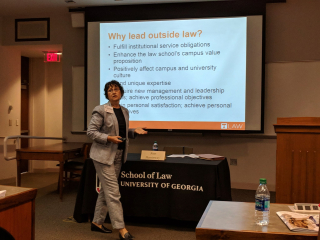
UGA2018(photo1)

The full program can be found here.  

Friend of the BLPB, Conglomerate blogger, and UGA Law colleague Usha Rodrigues worked with a team of female leaders from a number of schools to organize and carry off the conference.  It was exceptionally well done.  Future Women’s Leadership in Academia conferences will be held at the University of Virginia School of Law (2019), the University of California, Los Angeles, School of Law (2020), and Brigham Young University, J. Reuben Clark Law School (2021).  Look for more news here and elsewhere on these annual women’s leadership events.

This has been a banner week for embarrassing corporate manager stories.  In addition to the sudden resignation of Texas Instruments CEO Brian Crutcher for unspecified code-of-conduct violations (echoing the earlier, sudden firing of Rambus CEO, also for unspecified conduct violations) and Paramount’s firing of Amy Powell for racist commentary, Tesla’s Elon Musk ran into public relations trouble after a revelation that he donated to a Republican PAC, from which he cannily diverted attention by accusing one of the Thai cave diving rescuers of pedophilia.  Meanwhile, Papa John’s Founder and Chair John Schnatter – who previously was forced to resign as CEO after white nationalists were too enthusiastic about his condemnation of the NFL and protesting football players – was revealed to have used a racist slur on a conference call designed to prevent his racism from creating PR disasters.  That incident caused the Board to strip him of his chairperson title and remove his face from marketing materials, while the University of Louisville took his name off of its stadium.  Later, Forbes published an expose on the sexist and unprofessional culture at Papa John’s that he enabled – which incidentally confirms Ben Edwards’s post linking corporate cultures that tolerate sexual harassment to corporate cultures with other kinds of dysfunction.

Schnatter plans to fight to have his position restored.  Meanwhile, there’s no sign that shareholders or the Board of Tesla plans to remove Elon Musk, but shareholders are certainly beginning to chafe at his relentless attention-seeking

In both the Musk and Schnatter cases, the shareholders may have minimal options.  Schnatter owns roughly 30% of Papa John’s stock, and he has not resigned from the Board.  It is unclear what the next steps are going to be but he may be tough to oust, and may even be able to regain his Chair position.  (It would be awfully entertaining if he was forced to mount a proxy contest to maintain his seat but I assume one way or another it won’t come to that).  Meanwhile, Musk, who owns around 21% of Tesla’s stock, was deemed to be a controlling shareholder by a Delaware court, and thus would also be difficult to dislodge even if shareholders were so inclined.  Moreover, both Schnatter and Musk are paid in additional stock, which only increases their hold over their respective companies.  When Schnatter was CEO, roughly half of his compensation came in equity; as a director, his compensation package is smaller but still includes equity.  Musk shareholders, meanwhile, recently approved a massive equity award that could be worth as much as $50 billion if Musk meets certain milestones.

(Of course, it’s not impossible to get rid of a troublesome board member with a large but minority position -– as American Apparel can attest – but it isn’t a picnic, either).

Now, the trend of paying corporate executives in stock rather than cash is relatively recent; it took off in the 1990s as a way of aligning executives’ interests with shareholders’ interests.  And there are arguments about it back and forth – some say it encourages short-termism, others respond by saying you can have long term vesting schedules that alleviate that effect, there are disputes about how to design pay packages so they reward shareholder return rather than market conditions, etc – but one remaining concern might be that stock awards result in greater managerial control over their companies and therefore insulate them from shareholder discipline.

So, I ask – and I’ll admit, there are a lot of people who have thought very deeply about executive compensation and appropriate incentives, and I am … not one of them, so this may be either unhelpful or banal – but since dual-class stock is all the rage, have we considered paying corporate executives at least partially in nonvoting stock?  It could be structured to have all of the economic benefits of ordinary stock, and even automatically convert into voting stock as soon as the executive transfers it to a nonaffiliate (assuming, of course, the stock comes with the same restrictions/vesting schedules etc that ordinarily accompany such awards to prevent short-termism).  That way, corporate executives would be rewarded financially for increasing shareholder value, but their control over their companies would not be tightened.  The thinking here is that corporate execs already have plenty of control – they don’t need more – and shareholders may want to reward their financial performance without simultaneously further insulating them from market discipline. 

(To be sure, managers’ control doesn’t come from stock compensation alone – in Papa John’s case, for example, it appears that Schnatter increased his control from 27% to 30% in part through aggressive corporate buybacks, in which he did not participate, than through awards directly.)

But it seems like this is something worth trying.  Sure, there are plenty who argue that managers/founders should have more voting control so that they have room to innovate – here’s the latest paper I saw on that subject, which says yes but only under certain conditions – but that’s not usually the goal of stock compensation, which may unhelpfully conflate two separate things, namely, economic compensation and insider voting power.

This summer, I have met with a few of my pre-law advisees who will start their 1L years in a few weeks. 

While I have blogged on general advice for students before, I decide to memorialize some of my specific advice for 1Ls.

Of course, every student is different, and this advice may be amended a bit, depending on the student’s situation and goals. This advice, for example, assumes a desire to perform well academically. I encourage my co-bloggers to chime in through the comments or in separate posts. My co-blogger Josh Fershee (West Virginia) has already authored two 1L advice posts, which are worth consulting, here and here. It should go without saying that I did not follow all of my own advice, but I wish I had. 

  • Move into your house or apartment a few weeks early. Moving in early may not be possible for every student, but it is worth doing if you can. Getting settled before the work starts to pile up can help you avoid getting behind early.  
  • Live alone or with friends with similar schedules. I had some law school friends who lived with non-law students, usually people they knew from college who moved to the same town for a job. In many of these situations, the law school students were distracted from their studies and did not do particularly well in their 1L classes. I had the good fortune of living with an incredibly studious fellow 1L during my first year, and we provided each other with some positive peer pressure. Roommates don’t have to be law students, but I would choose someone, like a medical resident, who is likely to be focused on work more than social outings (and is unlikely to throw a Tuesday night party at your place). 
  • Ask for advice and outlines from 2Ls and 3Ls. Early in the semester seek out the 2L and 3Ls who did well in your professors’ classes. You can use law review membership as a proxy, and there may be a list of the students who got the highest grade in each class (usually called “booking” or “CALI-ing” the class). Ask those good students (politely) for their outlines and for tips about taking exams from your professors. Use those outlines–I suggest you get at least 3 for each class–as models and to check your own outlines, but not as an excuse to avoid producing your own outlines. The courses are likely to change a bit each semester, esp. if there is a new edition of the casebook, or if the professor switches casebooks, and much of the value of an outline comes from constructing it yourself. That said, having those other outlines to reference can be quite valuable. 
  • Consider the pros and cons of study groups. I decided against traditional study groups in law school because the two groups I briefly tried seemed to be (1) wasting a lot of time on law school gossip and (2) sharing their understudied ignorance. There were probably some better study groups, but I did not get invites to those, including one we called “the cult.” My roommate and a few other fellow students did, however, form a hybrid group of sorts. We did not meet regularly, as many groups did, but we did share our outlines, and we analyzed practice exams together, which proved extremely helpful.
  • Make contacts and be professional. Both the student and professor contacts you make in law school can be invaluable in your career. Also explore the mentor programs through your law school to meet some practicing lawyers. Know that your reputation from law school may follow you into practice, so be professional even if some of your fellow classmates are not (and don’t jump off a ferry boat at law prom).
  • Meet with your professors. I suggest meeting with each of your professors, in person, in the middle of the semester (and also after finals (and any midterms) to review your exams). The start of the school year is busy and you won’t be ready to ask good, substantive questions yet. A month or more into the semester, however, you should meet with your professors, ask for general advice, and pose some questions about your outline. You can also ask your professors to review a practice test answer,though I would limit the review to a single issue (or maybe two). 
  • Do practice tests. Answering a lot of practice tests (and analyzing the answers with smart friends to see what I missed) helped me immensely in law school. If your professor provides practice tests, those are the best ones to use, but you can also find practice tests from other schools posted online (or through your friends at other law schools). For some of the practice exams we would just issue spot, but I think it is important to fully write out, and time, at least one full practice exam per class.  
  • Start your outlines early and start actively studying 6 weeks out. Start your outlines very early, in the first week or two of school. Outlining is much more important than briefing the cases, in my opinion, though I would attempt to brief cases for a while too, so you learn that skill. I quickly learned I preferred book briefing to briefing on a Word document. About 6 weeks before finals started, my friends any I started actively studying for finals. Obviously, we had been outlining and reading all along, but at 6 weeks until the first exam we really started studying. We would devote a week to each subject–flushing out our outlines and doing practice exams. We still kept up with our other classes, but we devoted 1-2 hours per day to the subject of that week. In the week before finals, we spent one day on each class, finalizing the outlines and writing out practice exams under the time limits of that class. 
  • Have a life outside of law school, but try to minimize additional responsibilities. Some law students only focus on academics during law school, especially in the first year, and I think this is a mistake. But it is also a mistake, in my book, to overcommit yourself, given that your 1L grades will be the focus of employers looking to hire summer associates in the fall of your 2L year. Intramural flag football, for example, helped keep me sane. Also, I typically did no law school related work from Friday evenings until Saturday evenings (though this practice was mostly abandoned close to finals). While it is important to have one or two non-law outlets, I also know law students who got overextended with extracurriculars and regret that choice during interview season.  
  • Eat well, exercise regularly, and get consistent, sufficient sleep. It is difficult to do all three of these in law school, but well worth it if you can. Packing some healthy food the night before can help you from living out of the snack machine. Most law schools are attached to universities that have nice gyms. And if you do not get consistent, sufficient sleep you will quickly see diminishing returns on your studying. 

Good luck and enjoy the process!

Deal lawyers are not often framed as storytellers.  UNLV’s Lori Johnson has a new article in the St. John’s Law Review explaining why deal lawyers may also need to hone their ability to understand and present the essential “story” behind a  transaction or a client’s business.  She explains that getting clarity on the narrative behind the deal may improve overall outcomes:

This approach can enhance completeness and truthfulness in transactional documents.  As a result, lawyers create more holistic and ethical outcomes.  Relying on the narrative paradigm. . . narrative theory can improve a transactional lawyer’s approach to lawyering, relationships with clients, overall persuasiveness, and client outcomes.

Others have written about the gaps between the deals struck by clients and the documents and contracts memorializing these deals.  Although no approach will result in perfect contracts, a narrative-focused approach may help generate greater coherence in deal documents.

Had I not been taking pictures on the beach during a morning walk with dear college friends on the New England shoreline, I would not have seen the incoming call on my silenced cell phone–a call from a business law colleague from UT Law that I figured I ought to answer.  But the call was not, as I expected, a request for help with a research or teaching question.  Instead, this colleague was calling to inform me of an email message from our Dean letting us know that our junior business law colleague, Jonathan Rohr, had died the day before.  (I am linking here to a YouTube video featuring Jonathan, which will tell you much more about the man that he was than any CV or website.)

Jonathan came into my life almost two years ago when he interviewed with UT Law for a permanent, tenure track position after VAP-ing at his law alma mater, Cardozo.  From the start, Jonathan impressed me and others on the Appointments Committee with his intellect, his enthusiasm for the faculty task, and his intensity.  He survived the appointments tournament and came to work with us last summer.  Before his untimely death, he already had been invited to comment on a paper at last year’s AALS annual meeting and had symposium and virtual symposium invitations–as a first-year tenure-track colleague.  His scholarship was thoughtful and lucidly written.  He worked hard to make every piece better and better and better through editing.  He was a popular and revered teacher.  He was contributing to our College of Law community in significant ways.   I could not have been prouder to have him as a colleague and tried to introduce him to everyone imaginable to get his permanent teaching career off to the right start. 

I think it’s fair to say that no one was more excited for Jonathan’s arrival at UT Law than I.  He was what my dear husband calls a “Mini-Me”–someone at the early stages of a career trajectory with a similar professional background who aspires to similar career goals and seeks to be mentored by me along the way.  Most of the Mini-Mes that I have worked with were and are law practice colleagues and students.  Jonathan was my first faculty Mini-Me.  I had plans for our ongoing work together.  I think he had plans of that kind, too.  We had started working in a number of areas informally.  We drank beer and discussed strategies for research, teaching, tenure, promotion, etc.  The one academic year that we had together was idyllic in so many ways–too good to be true, for me, as I often observed.  Our last conversation about his current work and my current work was last week.  He was writing a guest post for this blog.  He promised to send me his most recent essay in draft form for review.  On July 11, he sent the essay to me and a few others.  Two days later, he was no longer with us.  Unbelievable.

And so, on Saturday, after my colleague delivered the news during that beach walk, I stopped and cried.  I asked “why?” so many times and shook my head in disbelief as I moaned and the tears fell.  What else could I do?  The once colorful, happy beach scene turned gray.  Over 20 years ago, I remember my husband relating that the colors were taken from him when his Dad, a vibrant graphic artist, died too young (but at a much older age than Jonathan).  I understood in that moment on the beach exactly what my husband meant.  Yet, I knew I had to move on.  My friends were way down the beach by that time.  They needed to know what had transpired.  I needed their support and love; and I knew I needed them to to try help me make sense out of the world around me.  Everything was and remains a bit off-kilter.  I know many of you can identify with that feeling.

As I walked down the beach, head bowed low, the first thing that stood out for me on the bland, gray sand was this rock.

BeachRock

It appeared blue in the sunshine–a striking blue in the dull sandy grayness–although in other lights it takes on more charcoal color, as it does in this photo.  Like Jonathan, it stood out as special, a near-perfect specimen among many others.  In finishing the walk, I picked up several other objects that stood out from others on the beach.  Somehow, that effort comforted me.  I cannot really say why . . . .

Over the past few years, those of us who research and teach business law have mourned the loss of a number of amazing colleagues.  These passings have hit all of us hard, professionally and personally.  But the loss of Jonathan Rohr from our midst feels qualitatively different to me, as a close colleague and mentor.  It will take time for me and many others who knew him to even begin to process this tragic loss.  Perhaps this post will begin a process of healing for me.  But I do not know that I ever will make sense out of this.  We have lost a man that many had loved and respected.  In his way-too-short life, he touched colleagues and students, as well as family and friends.  His enthusiasm and love for life was so palpable and contagious; I still feel that energy now.  I hope that sense of connection lingers.  It also is a comfort.  

I dedicate this post to Jonathan, with offers of sympathy and love to his wonderful wife, Jing, and the rest of their family.  I am so glad that he became part of my life and so mournfully sad that he has left us.

Several months ago, I posted about the Chancery decision finding Elon Musk to be a controlling shareholder of Tesla for the purposes of Corwin v. KKR Financial Holdings, 125 A.3d 304 (2015), despite the fact that he held only a 22% stake.  The decision took into account both Musk’s stock holdings and his other mechanisms of influence.

One of the reasons the decision stood out was because, while there is a long history in Delaware of considering both voting power and other factors to determine controlling shareholder status, after a certain point, you have to wonder whether the “stockholder” piece is doing any work, and whether instead the question should just be whether someone has effective control, either of the corporation generally or of a particular business decision.

Well, last week, we took a few steps more toward answering that question in Basho Technologies Holdco B, LLC et al v. Georgetown Basho Investors, LLC et al.  There, plaintiffs contended that a minority stockholder was a “controller” for purposes of owing fiduciary duties to the corporation.  Vice Chancellor Laster agreed, based on a holistic inquiry that took into account, among other things, the stockholder’s contractual rights via preferred stockholdings, its use of those rights (to block alternative transactions), its control over certain board members, and those members’ conduct.

But that’s not the important part.  The important part is that Laster laid out a test for “controller” that appears to depend minimally – if it all – on voting power.  As Laster put it:

If a defendant wields control over a corporation, then the defendant takes on fiduciary duties, even if the defendant is a stockholder who otherwise would not owe duties in that capacity. One means of establishing that a defendant wields control sufficient to impose fiduciary duties is for the plaintiff to show that the defendant has the ability to exercise a majority of the corporation’s voting power.  A defendant without majority voting power can be found to owe fiduciary duties if the plaintiff proves that the defendant in fact “exercises control over the business and affairs of the corporation.” …

To show that the requisite degree of control exists generally, a plaintiff may establish that a defendant or group of defendants exercised sufficient influence “that they, as a practical matter, are no differently situated than if they had majority voting control.”  One means of doing so is to show that the defendant, “as a practical matter, possesses a combination of stock voting power and managerial authority that enables him to control the corporation, if he so wishes.”

It is impossible to identify or foresee all of the possible sources of influence that could contribute to a finding of actual control over a particular decision. Examples include, but are not limited, to: (i) relationships with particular directors that compromise their disinterestedness or independence, (ii) relationships with key managers or advisors who play a critical role in presenting options, providing information, and making recommendations, (iii) the exercise of contractual rights to channel the corporation into a particular outcome by blocking or restricting other paths, and (iv) the existence of commercial relationships that provide the defendant with leverage over the corporation, such as status as a key customer or supplier.  Lending relationships can be particularly potent sources of influence, to the point where courts have recognized a claim for lender liability when a lender exercises influence over a company that goes “beyond the domain of the usual money lender” and, while doing so, acts negligently or in bad faith.

Broader indicia of effective control also play a role in evaluating whether a defendant exercised actual control over a decision. Examples of broader indicia include ownership of a significant equity stake (albeit less than a majority), the right to designate directors (albeit less than a majority), decisional rules in governing documents that enhance the power of a minority stockholder or board-level positon, and the ability to exercise outsized influence in the board room, such as through high-status roles like CEO, Chairman, or founder Invariably, the facts and circumstances surrounding the particular transaction will loom large.

All of which begs the question whether stockholder status is necessary at all.  Are pure lenders, or pure board members, potential controllers?  Or is stockholder status a nominal necessity, so that one share is sufficient to begin the inquiry into controller status?  These questions are left unanswered by Laster’s opinion. 

Now, to be fair, no one who has ever studied Martin v. Peyton or Gay Jensen Farms v. Cargill in their Business Associations class would be surprised to learn that a lending relationship may ultimately transform into a control relationship, with associated duties.  That said, it is still striking that Laster concluded that the particular stockholder in Basho was a “controller” for fiduciary purposes without even mentioning how much voting power the controller had, other to say that it was less than a majority.  This nominal controller also did not have more than two appointees to a multi-member board.  Nonetheless, its contractual rights were sufficient to trigger, in Laster’s view, fiduciary duties.

And that just raises more questions.  For example, does a controlling stockholder – versus a controller by any other means – have any special status in this formulation, on the theory that controlling stockholders are uniquely invulnerable to challenge?  Or is control the only relevant inquiry?  And if control by any means is all that is necessary, can Laster’s analysis square with Corwin?  There, the Delaware Supreme Court refused to find controller status where a nominal stockholder nonetheless had complete contractual control of the corporation’s business.

And how are we going to deal with complex capital structures?  Both Tesla and Basho dealt with shareholders who had “blocking” rights – i.e., not enough votes to control the Board and dictate corporate action, but enough to block actions with which they disagreed.  In Tesla’s case, this was because of a supermajority charter provision; in Basho, it was because a private company had issued multiple rounds of preferred financing with bespoke characteristics.  As more companies stay private longer – and as more issue nonvoting stock, and/or high-vote shares – Delaware is going to have to ask more complex questions regarding controlling status and what it precisely entails.  On this point, I note that in Third Point LLC v. Ruprecht, 2014 WL 1922029 (Del. Ch. May 2, 2014), the Chancery court determined that Sotheby’s could properly adopt a low-threshold poison pill in order to prevent a hedge fund from obtaining “negative” control, namely, the power to block corporate action, even if it could not generally control corporate policy.  Is that what counts as control now?  And does that mean – as recommended by Iman Anabtawi and Lynn Stout – that hedge funds now have fiduciary duties? (h/t Eric Goodwin for suggesting the possibility).  As I alluded to in my Tesla post, the questions take on a new urgency in the wake of Corwin and Kahn v. M&F Worldwide, 88 A.3d 635 (Del. 2014).

My final thought is, so much of corporate law these days has a back to the future quality.  Complex capital structures with multiple rounds of financing, different classes of stockholders with different rights – many of which are nonvoting – were once the norm.  Corporate control was relatively concentrated.  For example, when Berle & Means wrote The Modern Corporation, they raised the alarm that one-third of America’s wealth was concentrated among 1800 corporations and 200 men.

That changed.  With the federal regulation of the apparatus for securities issuance and trading, control over the Exchanges, and so forth, one-share-one-vote became the norm, as did dispersed share ownership and control.

Today, it feels like the pendulum has swung back the other way.  As Jan Fichtner, Eelke M. Heemskerk & Javier Garcia-Bernardo put it, “we witness a concentration of corporate ownership not seen since the days of J.P. Morgan and J.D. Rockefeller.” Hidden Power of the  Big  Three?  Passive  Index  Funds,  Re-Concentration  of  Corporate  Ownership, and  New  Financial  Risk, 19 Bᴜs. & Pᴏʟ. 238  (2017).  The statistics are well-known – and I talk about a lot of this in my new article, Shareholder Divorce Court (stealth plug! I am so stealthy!) – but, for example, BlackRock, State Street, and Vanguard together constitute the largest shareholder in 88% of the S&P 500, and 40% of all U.S. listed firms.  In 2005 ownership of the S&P 500 was so concentrated that in any hypothetical conflict between two member firms, 15% of the equity on either side would be held by institutions that preferred the other side to win.

Meanwhile, we’ve begun to depart from a one-share-one-vote norm as more companies offer private financing with different terms, and even maintain differential voting rights after going public.  Even fiduciary duties are up for debate again; they were a matter of some debate back in the early 1900s, they became standard, and now the fastest growing business form is the LLC, which allows fiduciary waivers.  It’s as though in many areas – corporate law being, ahem, but one – we’re going to have to learn the lessons of the 20th Century all over again.

The Huffington Post has a gripping article detailing alleged sexual harassment at HSBC.  The case has been covered before and featured allegations about a boss instructing a female subordinate to:

• Dress provocatively on the job
• “…have sex with male HSBC executives and clients at company-sponsored events”
• Specifically, “have sex with an unnamed senior executive at the bank’s Mexico unit”

In addition to:

• “…falsely t[elling] co-workers that Doe was having sex with clients when they traveled to bank functions outside the U.S.”
• “… attempt[ing] to pull down Doe’s blouse and expose her breasts in the presence of male HSBC employees.”

The new story on this HSBC case resonates because it also seems to suggest a link between sexual harassment and other compliance concerns:

Mike couldn’t shake the feeling that he was being retaliated against for elevating sexual harassment complaints—and that the retaliation also conveniently sidelined his questioning of compliance issues. Moving him into what was essentially a junior position limited his exposure to HSBC’s internal operations and contained his objections, at a time when pressure on the bank was intensifying.

HSBC has had other compliance problems in the past and only recently exited a deferred prosecution agreement after its $1.9 billion fine for “helping Mexican drug cartels launder money and breaching international sanctions by doing business with Iran.”

How an organization handles sexual harassment and gender equality issues may correlate with how it handles other compliance issues.  In both instances, the organization will often need to discipline upper management.  In organizations where “producers” break rules with impunity, they may not confine misbehavior to one area.  Weak compliance systems that fail to check sexual harassment will also, predictably, fail in other areas.  If management does not respect the compliance team on sexual harassment issues, they probably will not respect them on suitability issues.

If sexual harassment suits do serve as an indicator about other compliance problems, it’s another reason to exempt these types of claims from arbitration agreements.  If everything can be hidden away within arbitration systems, public enforcers lose the ability to see the signals that they should take a closer look at a particular firm’s compliance systems.