
I’m the newest member to the Business Law Prof Blog and also
the newest member of the team to academia. 
In my past life, I spent several years as outside counsel doing
commercial litigation and labor and employment work and then twelve years as
in-house counsel, leaving corporate life as a deputy general counsel, chief
privacy officer, and compliance and ethics officer.  That experience guides my scholarly and
teaching interests, which include corporate governance, regulatory compliance,
corporate social responsibility, business and human rights, legal ethics, legal
issues related to social enterprises and social entrepreneurship; and how
legislation affects and motivates corporate behavior.

To that end I have written on (1)  the need for
an affirmative defense to corporate criminal liability for an effective
compliance program, using the FCPA as a pilot
;  (2) the potential
unintended consequences of the Dodd-Frank conflict minerals provision
,
which requires US issuers to disclose whether they source minerals from the
Democratic Republic of Congo and relies on the SEC for execution of this human
rights law; and (3) how the government can incentivize corporations to move beyond
voluntary initiatives and industry standards for human rights due diligence in
the wake of  the 2011 UN Guiding
Principles, demands from socially responsible investors, and pressures from worldwide
exchanges that require or recommend disclosure on environmental, social and
governance factors.  My next couple of posts
will address the latter two topics- the Dodd Frank provision, which is on
appeal to the DC Circuit Court of Appeals and is the model for potential
legislation in the EU, and the role of corporations vis a vis the state and
various stakeholders in human rights.  This
is the topic of an upcoming conference at West Virginia University supported by
the UN Working Group on Business and Human Rights featuring academics, government
officials, business leaders and civil society organizations. You can register
here for the conference. http://law.wvu.edu/bhr2013

I look forward to sharing ideas with you all. 
Greetings Business Law Prof Blog Readers.   By way of quick introduction, I am a business law professor
at Georgia State University, College of Law in Atlanta, Georgia.  I teach Corporations, Contracts, and
Unincorporated Business Associations, which is a hybrid doctrinal and
experiential class where students learn default rules and negotiate and draft
three agreements.  My research broadly
focuses on the roles, rights, and responsibilities of corporations.  What does that
mean?  It means that I am interested in the
spaces where corporate law bumps up against the rights of individuals or intersects
with society more broadly.  For example,
I wrote about corporate director oversight liability in the middle of the financial
crisis.  I wrote a few pieces on
corporate political spending and speech rights in the wake of Citizens United.  My latest projects have looked at the
millions of Americans who invest in the stock market through defined
contribution plans for retirement savings, becoming what I call citizen
shareholders, and challenge some of the fundamental assumptions about corporate
power balancing mechanisms, shareholder rights and the roles of corporate,
securities and ERISA laws.

In my experience, if I am not writing, I am not reading or thinking about issues the way that I should be, or at least want to be.  Weekly posts are a great way to stay engaged in a larger conversation and to make sure that I read with curiosity.  Thanks to Stefan Padfield’s efforts in successfully re-launching this blog and for the opportunity to regularly contribute to it.

See you back here each week,

Anne Tucker

The future leadership of the Federal Reserve, at a time when
the Fed has indicated an inclination to change policy and lessen quantitative
easing
, is uncertain with the anticipated retirement of Chairman Ben Bernanke
at the end of this year.  At the center
of the debate is whether President Obama should pick Lawrence
Summers
or Janet
Yellen
, the two front-runners, to replace Bernanke.  The topic has been surprisingly controversial
and received significant play in the mainstream press fueled in no small part
by the spotlight the contenders shine on gender issues.  Lawrence Summers, ended his term as Harvard’s
president amid controversy for his remarks
attributing the gap between male and female advancement in hard sciences to
inherent differences between the sexes. 
(The legacy of his presidency was also marred by a billion
dollar endowment loss
due to poor investments under his leadership.)  Janet Yellen is not just a counter point to
Summers; she serves as her own figurehead in this debate.  If appointed, Yellen would be the first
female to lead the Federal Reserve, an important milestone for women. It could
also be a potentially important litmus test for the Obama administration, which
has come under scrutiny for the absence of women in top leadership positions,
especially in economic issues.

Of course, the heart of the differences between the two
stands not on gender alone, but on substance. 
While both Summers
and Yellen have
incredible CV’s combining academic, regulatory and policy-focused credentials,
I categorize the differences that will make a distinction between them as
foresight, process and balance.  (In full
disclosure, in August I signed on to a letter in support for Janet Yellen as
one of many business law professors who favor her candidacy.  That letter is available here 
Download Fed Nomination Letter final.)

On the foresight issue, Janet Yellen, in her role as the
President of the San Francisco Federal Reserve Bank, expressed concern for the
housing bubble and its impact on price stability as early as 2005.  Lawrence Summers, on the other hand, supported
the repeal of the Glass-Steagall Act and the Commodity Futures Modernization
Act while also touting the role and continued deregulation of derivatives—all
considered contributing factors to the Great Recession, as it is now called. 

Process speaks to how the Fed Chair will be appointed and
how the Chair will operate in the position. 
Without having personally worked with either, Janet Yellen is believed
to be collaborative and open-minded in her decision-making process drawing comparisons
between her style and that of current, and highly regarded, Chairman Ben Bernanke.  More than 200 economics professors (the
number is now reportedly 350) signed an open
letter
 to President Obama lauding
her leadership style and praising her for being “willing to hear multiple
points of view and to bring many voices into the policy making arena.”   Summers’ reputation,
on the other hand, is one of confrontation. 
While Summers is rumored to be the top Obama contender, the uncertainty
surrounding the Syria vote and the lack of unity behind Summers as a candidate
among the Democratic ranks means that limited
political capital
may tip the scales in favor of Yellen as the less
controversial candidate, at least among Democratic lawmakers.


Balance.  A main
function of the Board of Governors of the Federal Reserve System is to set
monetary policy, which is done, in part, through the Federal Open
Market Committee or FOMC
, comprised of 7 of the Governors and 5 of the 12
Reserve Bank presidents.  The FOMC
influences monetary policy through interest rates, which it sets directly
through the discount rates and can also impact through the buying and selling
of government securities.  These actions
can result in a higher (tightened monetary supply) or lower (eased monetary
supply) interest rates.  The current
composition of the Board or Governors is about to undergo a dramatic change
with the anticipated retirement of Chairman Bernanke and 3 other female
Governors:   Elizabeth Duke, Sarah Raskin
and Sandra Pianalto.  If Summers is
selected as the new Chair, it is speculated that Janet Yellen would resign from
the Board of Governors creating significant turnover, a power vacuum, a loss of
institutional knowledge, and an absence of women at the head of monetary
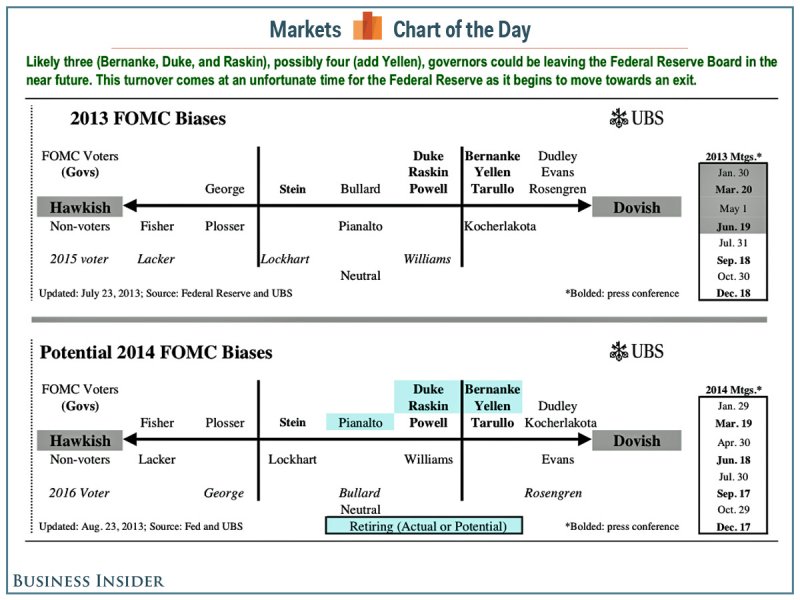
policy.  Additionally, in a brilliant
little diagram provided by the folks at Chart
of the Day
, the loss of these particular Governors would mean that the
economic policy of the Fed would be tipped away from its current dovish
tendencies of lower interest rates towards a more hawkish inclination.

Fed FOMC Policy Chart

As an aside, a new favorite past-time since the birth of my
son in July has been watching re-runs of The West Wing
during those late feedings or hours when I am awake, but brain-dead.  Of the many political scenarios that play
out, one involves the unexpected
death of the Federal Reserve Chairman and a public dispute over who should be
named the successor
.  Sound
familiar? 

 -Anne Tucker

I intended to begin with a brief introduction, but I beat myself to the gun. 

I’m happy to be blogging on the Business Law Prof Blog once again. I enjoyed it the first time but got too busy to continue and, quite frankly, ran out of interesting things to say. (People who know me well may doubt that.) I’ll try to keep the posts interesting. If I can’t, I’ll quit. You all have enough drivel to read without me adding to the load.

For those of you who don’t know me, I’m a professor at the University of Nebraska College of Law. I teach Business Associations;  Mergers and Acquisitions; Accounting for Lawyers; Securities Regulation; and Mutual Funds, Investment Advisers, and Brokers. My primary area of research is Securities Act exemptions, particularly small business exemptions. If you read the prior blog, you know I have a strong interest in crowdfunding, and I’m sure I will be blogging more about that as time passes.

I hope you all enjoy the blog. If you have any suggestions for improvement, don’t hesitate to contact one of us.

The New York Times Dealbook has an interesting article on why the SEC hasn’t sued any Lehman Brothers executives in connection with the 2008 collapse of that firm. The short answer: because they didn’t think they could prove those executives violated federal securities law.

The Times article is a strong reminder that business responsibility for a business’s collapse is not equivalent to a securities law violation and that the SEC’s scarce resources are best directed to violations it can prove. The SEC’s role is to enforce the law, not to satisfy the public clamor for a scapegoat.

The Times article is also an interesting story of how an SEC staff member, George S. Canellos, resisted the political pressure to bring a case. Canellos was the head of the SEC’s N.Y. office at the time and now heads the SEC’s enforcement division. According to the article, he faced strong pressure from then-Chair Mary Schapiro to bring a case, but refused.

The failure to find a case apparently wasn’t from lack of trying. According to the Times, the SEC reviewed more than 15 million documents and interviewed three dozen witnesses.

Following a hiatus of almost 2 years, Steve Bradford, Josh Fershee, Anne Tucker, and I are pleased to announce the grand re-opening of the BLPB.  We are excited to be joined by Marcia Narine, and also expect Eric Chaffee to be stopping by occasionally with contributions.  All the relevant profiles (except for Eric’s, which we hope to have available soon) can be found at the bottom of this blog.  I will leave it to each of my co-bloggers to provide additional information about themselves as they see fit.

Personally, I’d like to thank Jay Brown for allowing me to blog over at the Race to the Bottom these past two years.  While I am excited about returning here to “get the band back together,” I regret having to leave the RTTB (though I may still occasionally pop in over there, time permitting).  Jay is one of the true stars in corporate law, and I consider him a friend, mentor, and inspiration.

I’d also like to thank Paul Caron for welcoming us back, and note the updates to the Law Prof Network look great.

Finally, please drop me a line directly at spadfie@uakron.edu if you have any interest in guest-blogging, or if you have any general comments regarding the blog.

Warm regards,

SJP

The Atlanta Falcons lost to the New Orleans Saints in overtime in Sunday.  The Falcons failed in a fourth-down attempt in their own territory, leading to a lot of second guessing on the NFL post-game shows. Here’s the breakdown from Slate & Deadspin‘s NFL roundtable:

So arbitrary formulas aren’t always the thing. But pure probabilities? Everyone’s an expert today, thanks to the Falcons’ decision to go for it in overtime on fourth and inches from their own 29-yard line. They were stuffed by the Saints, who slotted home a gimme field goal for a big division win. Here is a comprehensive list of every reason why Mike Smith’s decision is being criticized: because it didn’t happen to work.


. . . . A fourth-and-a-yard succeeds 74 percent of the time, and Michael Turner was not a yard away. . . . .


Brian Burke at Advanced NFL Stats has picked the perfect day to unveil the Fourthdownulator, a handy little application that allows you to plug in the situation and decide whether going for it makes statistical sense. Before running the fourth-down play, the Falcons’ win probability stood at 47 percent (it would’ve risen to 57 percent if they had picked up the first down). Had they chosen to punt, that figure would’ve dropped to 42 percent. The difference is slight but undeniable, and becomes starker when you take into account both the Falcons’ success at running the ball all day and the threat presented by the Saints’ offense with decent field position.


. . .  Maybe this is why coaches are so hesitant to go for it on fourth down: not because they might be unsuccessful, but because everyone’s going to break down why.

Clearly, NFL pundits are paid to second-guess coaches and say what should have happened.  That’s their job.  But notice that (in my highly unscientific and unreliable review of NFL commentators) no one seems to have thought it was the right call.  [Update: Via the comment below (thanks), I know there’s at least one who thinks the choice, if not the play call, was right.] If the numbers indicate it was a good call — or even a reasonable call — it would seem that 50% of the commentators would agree with the coach. But when we know how the decision turned out, that’s highly unlikely to happen.  

This is one key reason we have the business judgment rule (BJR) for corporate directors.  That rule states that absent fraud, self-dealing or illegality, directors decisions cannot be judged. “Courts do not measure, weigh or quantify directors’ judgments. We do not even decide if they are reasonable in this context. Due care in the decisionmaking context is process due care only. Irrationality is the outer limit of the business judgment rule. ” Brehm v Eisner, 746 A.2d 244 (Del. 2000)(emphasis added)(footnote omitted).  As Smith v. Van Gorkom further explained, “The business judgment rule exists to protect and promote the full and free exercise of the managerial power granted to Delaware directors.” 488 A.2d 858 (Del. 1985) Although there are times when the BJR seems to protect stupidity (and it does), the BJR or some similar rule is necessary to allow directors to take chances.  

I realize that the comparison to NFL pundits and judicial review is a stretch given that both the charge and the authority of the judges is very different than that of NFL commentators. Still, I think that the inability to make rational post hoc assessments of decisions that turn out wrong is illustrative. As such, I am becoming more firmly convinced that Professor Bainbridge has it right when he says that the BJR is an abstenstion doctrine, and not a standard of review. As the good professor argues: “[C]orporate decisionmaking efficiency can be ensured only by preventing the board’s decisionmaking authority from being trumped by courts under the guise of judicial review.”  

The New York Times says Falcons’ Coach Mike Smith’s decision “backfired horribly and handed the New Orleans Saints a 26-23 overtime victory over the Falcons at the Georgia Dome.”  That’s not what the numbers say. The numbers say he made a reasonable call, and it didn’t turn out well. There was no “handing” the game to anyone.  If I’m a Falcons fan (and I’m not), I’d hope my coach is making his decisions based on his own judgment and assessment of the situation, and not external noise.  That’s what he’s been hired to do.  Just like the members of a board of directors.

–JPF 

Interesting news today that North Dakota may not actually be a proper state.  It seems that the state’s constitution lacks a requirement that the state’s executive officers uphold the U.S. Constitution, thus violating Article VI.  

If the state is not really a state, then would that mean that corporations under “state” law are not really formed either? Would the fictional corporate person suddenly become a fictional, fictional person? Heady stuff.  

Add to this the fact that most of the state is violating North Dakota law by reporting that the flooding in Minot (the western part of the state) is caused by the Souris River, using the French (and Canadian) name, rather than the English (and state-mandated) name, the Mouse River.

Even if most people are getting name of the river that is causing the flooding wrong, the flooding is very, very real. Please help if you can. Here are a couple places:  http://minotfloodshirts.myminto.com/ and http://minotredcross.org/.

–JPF

As the discussion about law reviews and the value (or lack thereof) of student-edited reviews continues, I can’t help but feel like some very thoughtful people are talking past each other. (See, e.g.herehere, and here.) As I mentioned last week, I see both sides of the story, and I often find myself agreeing in part with both camps. I am a former editor in chief (EIC) of the Tulane Law Review, and a law professor, and a law review advisor (the latter two at the University of North Dakota). I mention this because I feel like I have seen all sides of the law review process in a way that is (I think) different from many. 

As I noted before, I don’t think that those who have expressed frustration with law reviews are mean spirited or inherently wrong. They have a point, but I can’t quite get there. I simply think we can do better without scrapping everything. So, to add to the discussion (or further muddy the waters), here are some thoughts and examples from both sides of the experience:

(1) When I took over as EIC, I followed the format of prior editors, which involved a junior (usually 2L) member “sub and cite” edit, with oversight by a senior (3L) managing editor.  The article was then sent back to the author for the “initial edit.”  (There were a few more internal steps, but this was roughly it.) The author would send the article back, and it would go through a more stringent review with the Senior Managing Editor, and then to me. One of our first articles came back from the author with a firm, but very thoughtful, and detailed response explaining why he believed many of our edits were wrong, and a request that I review the edits. 

During my review of the author’s re-edits, I found that his original manuscript was right prior to our edits in most cases, and he was 100% correct in each place he took issue with our changes.  This was a great lesson for me.  I made his requested changes (and changed back some things he did not request), and apologized for adding to his workload, which we clearly did.  I also learned a valuable lesson. From that point forward, nothing went out of our office without my review. 

That may seem like a simple lesson, but it was not. I had a career before law school in public relations, and I had learned there that no PR plan, no press release, and no promotion prototype should go out without my review. And I still made the mistake because I stepped into a law review process and simply followed the system.  For me, there were many, many historical parts of the process I kept and found immensely valuable.  But nothing ever went out without me seeing it first after that. 

(2) I published an article for a symposium early after accepting my tenure-eligible position.  The symposium was great, and it was a wonderful experience.  The publishing, less so.  It took about a year for the article to get published, and when I asked for a redline of the article, I was told no.  Then I asked for a Word or Word Perfect version of the article, and despite some pleading, was again told no.  I wanted the article in print, so I said fine.  I then converted the PDF I was sent to a text, and ran a redline anyway.  It was hard, not easy to do, and probably missed some things.  In hindsight, I don’t know why I accepted that, but I really wanted the article out. Awful. 

(3) I have since published with a number of different law reviews and journals, often related to symposiums.  Most of my experiences have been truly outstanding. The editors have been patient, detail oriented, and willing to work with me. Even when they have been wrong, they have been open to my rationale and explanation. And when I have been wrong, they have been courteous, intelligent, and thoughtful. 

Ultimately, I think student-edited law reviews can serve a great role in advancing scholarship, as long as we all better define and understand our roles.  Students could use help from experts in the field to know if the premise of an article is accurate and the foundation for an article is sound. And many editors are now getting that help. Students also ask good questions, and can help make sure a piece is accessible to more than just experts in an area. And, for the most part, they are smart and careful, and willing to look closely at details many people want to ignore. 

Plus, students learn more than just how to cite esoteric sources correctly and measure a margin.  They learn management, organization, and diplomacy.  These, too, are critical skills for lawyers, and there is no reason law reviews and journals shouldn’t serve that role. For too many students, unfortunately, it is the only place they learn such skills in law school.  And they need to get those skills somewhere. 

As authors, we should be frustrated with student editors who don’t treat articles and us with respect. (That applies to nonstudent editors, too, for that matter). We should expect deference to our positions and our style because it’s our piece. But we should also respect the time and effort that goes into the process on the editing side. We should be respectful of students who care to spend countless hours with our work, and we should assume they are smart people trying to do the right thing, even if they aren’t getting it quite right.  We just need to make sure they do get right.

At least for those of us who are professors, as most of us know, teaching doesn’t end when the class period ends. We should offer help, input and constructive criticism when warranted. The authors who did that for me taught me invaluable lessons, and I am a better author, teacher, and scholar because of it.