
The following is from the ADF press release, which you can find here.

The U.S. Securities and Exchange Commission has ruled against JPMorgan Chase’s attempt to exclude a shareholder resolution on viewpoint diversity from its ballot for its annual shareholder meeting…. Submitted by the Bahnsen Family Trust, the proposal directs Chase’s board of directors to evaluate and issue a report on the bank’s disturbing trend of politicized debanking…. In the past two years, Chase has denied payments or canceled accounts associated with people and organizations who hold mainstream American values, such as former Ambassador Sam Brownback, the Arkansas Family Council, and Defense of Liberty…. The SEC ruling comes amid a rising wave of opposition to Chase’s engagement in cancel culture through politicized debanking. Chase was featured prominently in the “Statement on Debanking and Free Speech,” signed in November of last year by a group of nearly 60 financial professionals. Last week, Nebraska State Treasurer John Murante led a group of 14 colleagues in a letter to Chase CEO Jamie Dimon calling on him to address and correct the issue by adopting policies recommended by ADF’s Viewpoint Diversity Score 2022 Business Index and providing necessary shareholder transparency by participating in the survey portion of the 2023 Business Index. Citing analysis from the 2022 Business Index, where Chase scored just 15% overall, the Bahnsen Family Trust proposal also calls on Chase to adopt those policies and participate in the survey. Along with criticizing Chase’s actions as “an affront to public trust,” the proposal highlights the vague and subjective terms-of-use policies (including terms like “hate speech” and “intolerance”) that allow companies like Chase unbridled discretion to discriminate against customers for their views.
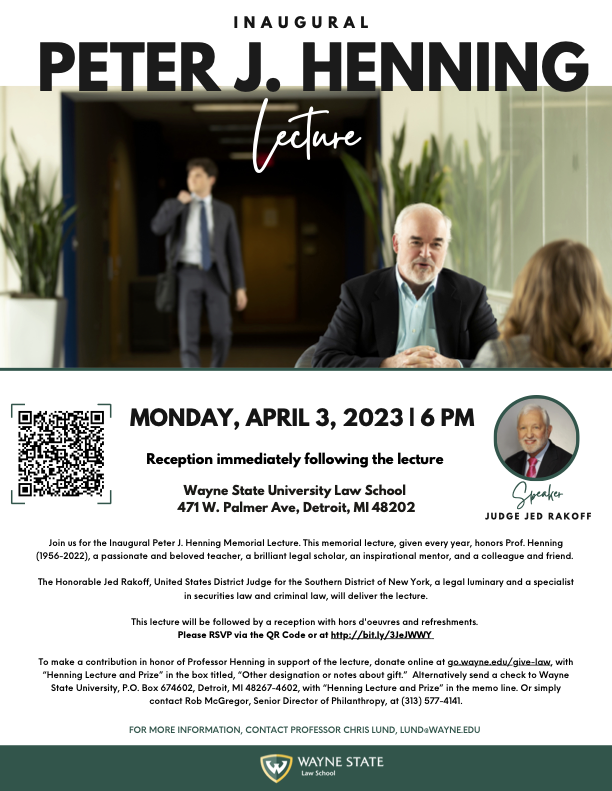
I am pleased to share with you that the inaugural Peter J. Henning Lecture at Wayne State University Law School will be held next Monday, April 3rd, at 6:00 pm.  The speaker is the Honorable Jed S. Rakoff (United States District Court for the Southern District of New York) who knew Peter and valued his work.  See the flyer below.  Come if you are able.

As readers may recall, Peter was a mentor and friend.  His work and my work in insider trading law and practice intersected.  I offered some comments on my relationship with him here on the BLPB shortly after his untimely passing last year.  I also shared some thoughts at the 2022 National Business Law Scholars Conference and wrote a short related tribute to Peter forthcoming in the Wayne Law Review.  I will be at the lecture on Monday. 

I know many of you also have been touched by Peter or his work.  He was a special man who made great contributions in many spheres.  Please note in the flyer below that financial support for the lecture series is being solicited.  I hope that some of you will take advantage of this opportunity to honor Peter and his legacy.

*          *          *

Henning(LectureFlyer)

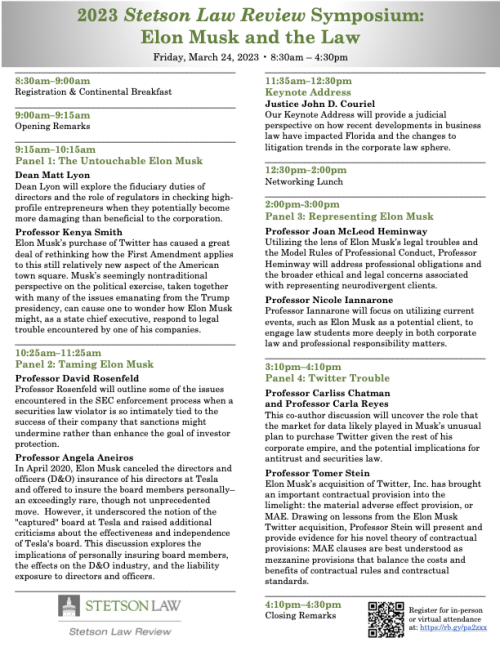
Last Friday, I had the privilege of speaking, with other colleagues, at the 2023 Stetson Law Review Symposium on “Elon Musk and the Law.”  (See the flyer on the program, below.)  This symposium grew out of a discussion group I organized at the 2022 Southeastern Association of Law Schools Conference.  I posted about it here back in May of last year.

I could not have been happier with the way the symposium worked out.  The Stetson Law students, faculty, and administration were well organized, kind, and fun–a total pleasure to work with.  And I got excellent questions and feedback on my early draft paper, Representing Elon Musk, which focuses attention on the lawyer-client relationship under the American Bar Association’s Model Rules of Professional Conduct.  I look forward to seeing the final published proceedings in two forthcoming books of the Stetson Law Review.

*               *               *

Stetson2023(flyer)

When covid first hit and we were all in lockdown, a number of courts held proceedings virtually rather than live.  Since then, questions have been raised about how the technology should continue to be used, given that it may make courts proceedings easier for litigants and witnesses to attend, but may also make it difficult to question hostile witnesses and present documentary evidence, as Scott Dodson, Lee Rosenthal, and Christopher Dodson discuss when weighing the benefits and drawbacks of Zoom proceedings

There has not been a ton of empirical work on this (yet), but David Horton found that arbitrations conducted with at least one Zoom hearings resulted in worse outcomes for plaintiffs.  And Jill Gross at Pace recently posted an analysis of customer win rates in FINRA arbitration.  She found that early in the pandemic, customers who had at least one Zoom hearing fared substantially worse than customers who proceeded entirely live, though, as the pandemic wore on, the two became virtually indistinguishable.  At least one explanation might be that, over time, customers were able to choose “mixed” formats more easily, where only one or two witnesses appeared by Zoom and most were live, making the Zoom category of cases indistinguishable from live ones.  Another might simply be that customers had a Zoom learning curve.  Mostly, though, she finds customers in general fared worse during lockdown, regardless of how hearings were conducted.

One question I have about Zoom, however, concerns not just the original hearings themselves, but the standard of review when the outcome is appealed.  Not long ago, VC Laster issued an opinion reviewing the conclusions of Master Patricia W. Griffin.  Reviews of Masters in Chancery are de novo, and VC Laster wrote, “The trial was recorded so that a constitutional judge could review the proceedings de novo.”  Because it was de novo review, VC Laster, among other things, engaged in credibility determinations regarding witnesses (see op. at 5, 14), which he was able to do because he was seeing exactly what Master Griffin had seen.

Ordinarily, of course, a standard thing for appellate courts to say is that trial judges are in a unique position to determine the credibility of a witness.  They do so even when the standard of review is de novo, see, e.g., State v. Emery, 2011 WL 3795021 (N.J. Sup. Ct. App. Div Aug. 29, 2011), and standards of review often shift from de novo to something more deferential if the question turns on determinations of credibility, see, e.g., State v. Godwin, 2004 WL 3217722 (Tex. Ct App. July 22, 2004); Burton v. State, 2007 WL 1417286 (Del. May 15, 2007).  The fact that trial judges view witnesses live when appellate courts cannot is one reason for deferential review in the first place.

So my question is, if hearings are held by Zoom, and recorded (and there’s certainly no reason not to record), should appellate standards of review change?  Or, perhaps more relevantly, will they change sub rosa even if they don’t change formally?

As regular readers of this blog will know, you can’t go touting crypto-securities without disclosing how much you’ve been paid to push those products.  I first wrote about this issue in 2018 after Evander Hollyfield attracted attention for promoting the fraudulent AriseBank coin. The same issue showed up again with Kim Kardashian last year.  Now, we’ve got the SEC taking action against eight more:

  • Lindsay Lohan

  • Jake Paul

  • DeAndre Cortez Way (Soulja Boy)

  • Austin Mahone 

  • Michele Mason (Kendra Lust)

  • Miles Parks McCollum (Lil Yachty)

  • Shaffer Smith (Ne-Yo)

  • Aliaune Thiam (Akon)

They all allegedly touted TRX and BTT without disclosing that they were paid to do so or the amount they were paid.  The enforcement actions arise out of the SEC’s pursuit of Justin Sun for allegedly fraudulently manipulating the secondary market for TRX through wash trades.  

I remain skeptical about much of the asset valuation in the crypto and NFT space.  I’d expect that the SEC will continue to pursue these kinds of actions when it has evidence that much of the market for a particular cryptocurrency or type of NFT is largely illusory wash trading designed to generate the appearance of value to suck in money.

Soulja Boy and Austin Mahone have not yet reached an agreement with the SEC to resolve the matter.  Hopefully, going forward, Soulja Boy will tell ’em to stop touting crypto without disclosing what they have been paid.  To help with that, I asked ChatGPT to write a song in the style of Soulja Boy to warn people not to tout crypto for compensation without disclosure.  And here it is:

Listen up, y’all, I got something to say ‘Bout this crypto game that people play Everyone’s talking ’bout how much they make But some of y’all ain’t being straight

Chorus: Don’t tout your crypto without disclosure SEC will bring that regulatory exposure If you’re being paid, you gotta let people know Or else you might end up in a world of woe

Verse 2: I know it’s tempting to flex on the ‘gram Posting pics with your new Lambo, damn But you gotta remember the rules of the game Or else you might end up in shame

Chorus: Don’t tout your crypto without disclosure SEC will bring that regulatory exposure If you’re being paid, you gotta let people know Or else you might end up in a world of woe

Verse 3: It’s all good to be excited ’bout your gains But don’t forget to disclose the chains That tie you to the coins you’re promoting Or else you might find yourself floating

Chorus: Don’t tout your crypto without disclosure SEC will bring that regulatory exposure If you’re being paid, you gotta let people know Or else you might end up in a world of woe

Verse 4: So listen up, my friends, and hear me loud Don’t be a shill, don’t be part of the crowd Just be honest, disclose what you’re paid And you’ll be safe in the crypto game

Chorus: Don’t tout your crypto without disclosure SEC will bring that regulatory exposure If you’re being paid, you gotta let people know Or else you might end up in a world of woe

Outro: That’s my message, hope you learned something new Don’t be a scammer, be honest and true And you’ll succeed in the crypto space Just remember to disclose, and keep up the pace.


Dear BLPB Readers:

My colleague Professor Joseph Thai  at OU College of Law shared the following:

“Do you have an interest in securities fraud and investor protection? Want to ask national experts about the current banking crisis and its implications for regulators, investors, and the general public?

On behalf of OU College of Law, please join us for the Wilkinson Family Speaker Series (WFSS) in the Bell Courtroom at OU College of Law on Friday, March 24, 2023, from 9:15 a.m. – 1:15 p.m. The event is free, breakfast and lunch are included, and you are welcome to come and go if you cannot stay the entire duration.

Please see the flyer and attached program, and RSVP at the link below. Thank you!”

Program flyer is here: Download WSS Program

RSVP here

Earlier this month, Daniel Lennington, deputy counsel at the Wisconsin Institute for Law and Liberty, published a piece at The Federalist entitled, “How Corporations Launder Their Race Discrimination Through Third Parties.” Here is an excerpt:

[T]he world’s largest corporations desperately want credit for being “woke” and advancing “racial equity” through programs targeted solely at certain races. Such practices — involving blatant race discrimination — are immoral and contrary to core American values, despite being in fashion with corporate elites. Yet the typical guide rails — state and federal law — may be less available remedies if corporations launder their discrimination through third parties. Corporations should avoid this temptation to outsource their discrimination and perhaps take a lesson from Comcast, one of the first corporations to face legal scrutiny for its race-based program. Following the settlement with our clients, Comcast renewed its efforts toward something called “Project Up,” which, from all indications, is a race-neutral program designed to “advance economic mobility, and open doors for the next generation of innovators, entrepreneurs, storytellers, and creators.” Comcast will run this program itself and reap the goodwill that will undoubtedly come, while adhering to (lawful) nondiscrimination principles.

In response to this piece, Scott Shepard, director of the Free Enterprise Project at the National Center for Public Policy Research, published “States Can Stop the Outsourcing of Race Discrimination by Corporations” over at RealClearMarkets. Here is an excerpt:

The clearest route to ending this practice is through state corporations laws. A very short amendment would serve the purpose. Add to the law this phrase at an appropriate spot: “Corporate donations or other pecuniary grants to entities that discriminate, facially or in fact, on grounds forbidden by the civil rights acts of this state have breached their fiduciary duty to shareholders unless they have secured from each shareholder written confirmation of their desire to contribute corporate assets to discriminatory entities.”… [A] second move by states inclined to rein in the new discrimination …. [is to] add to their civil rights statutes a line to the effect that “publicly traded corporations doing business in this state violate this statute if they use corporate assets to fund entities that discriminate in violation of this statute” unless getting the express permission of all shareholders.

From a New Civil Liberties Alliance press release (here):

In a thorough and well-reasoned decision, Judge Terry A. Doughty of the U.S. District Court for the Western District of Louisiana has denied government defendants’ motion to dismiss in State of Missouri, et al. v. Joseph R. Biden, Jr., et al. The New Civil Liberties Alliance, a nonpartisan, nonprofit civil rights group, represents renowned epidemiologists Drs. Jay Bhattacharya and Martin Kulldorff, as well as Dr. Aaron Kheriaty and Ms. Jill Hines, in a lawsuit that has exposed an elaborate, multi-agency federal government censorship regime. Judge Doughty wrote, “The Court finds that the Complaint alleges significant encouragement and coercion that converts the otherwise private conduct of censorship on social media platforms into state action, and is unpersuaded by Defendants’ arguments to the contrary.”

UPDATE (3/21/23): Keith Bishop was kind enough to pass along a related post of his entitled “Government Censorship By Proxy?” wherein he notes:

Last week, I wrote about an unsuccessful challenge to the activities of the Office of Elections Cybersecurity within the California Secretary of State’s office: Is The California Secretary of State Monitoring What You Publish Online? In that case, O’Handley v. Weber, 2023 WL 2443073, the Ninth Circuit Court of Appeals found that the Secretary of State did not violate federal law when it notified Twitter of tweets containing false or misleading information that potentially violated the company’s content-moderation policy. More recently, Judge Terry A. Doughty, who sits in the Western District of Louisiana, refused to dismiss claims for “alleged coercion by the Biden Administration and various government agencies and officials of social-media companies, urging those companies “to censor viewpoints and speakers disfavored by the Left”. In this memorandum ruling, Judge Doughty distinguishes O’Handley as follows: ….

This just in from friend-of-the-BLPB Josephine Sandler Nelson:
 
ComplianceNet 2023’s deadline to apply has been extended to March 31, 2023. This is an amazing conference. See info below and at the website here. There is also a best paper prize that attendees should know about.

ComplianceNet 2023 will be hosted by American University’s Washington College of Law in Washington, DC on June 21-23, 2023. It will have an anti-corruption theme, though papers on all topics related to compliance will be welcome. We are currently accepting panel or paper submissions, with an extended deadline of Friday, March 31, 2023. 
 
ComplianceNet seeks to bring together scholars from a range of different disciplines to study the interaction between rules (broadly defined) and individual, group, or organizational behavior. The first five meetings have been highly successful, bringing together academics from business, criminology, economics, law, political science, psychology and sociology, among other fields. See the ComplianceNet website at www.compliancenet.org for more details about the organization’s structure and goals.

The DePaul Law Review will devote the third issue of its 73rd volume (slated for publication in Spring 2024) to a Symposium addressing the Emmy-winning scripted drama Succession from a legal and pedagogical point of view. The aim of this special issue is to collect in one place the insights of a variety of faculty members with different legal subject-matter expertise, as a resource for all who are interested in the use of this award-winning work for the teaching, practice, and study of law. The DePaul Law Review has already secured the participation of a number of distinguished scholars. 

The DePaul Law Review invites proposals from others for two to four additional contributions to be included in this special issue. Proposals for a contribution of between 5,000 and 10,000 words are welcome from all who teach any area of law. (The print symposium will be accompanied by simultaneous online publication with live hyperlinks, allowing readers to access video links if the author desires.)

Potential contributions to the special issue might take a variety of forms. For example, these essays might:

  • explore the legal implications of various plotlines through a variety of doctrinal lenses (e.g., mergers and acquisitions, wills and trusts, corporate law, employment law, criminal law);
  • share classroom techniques for using Succession, and its scenarios or characters, in law teaching;
  • consider how matters such as race, gender, sexual orientation, and class are represented on Succession, or how the show depicts law, law enforcement, and lawyers; or 
  • draw on literary techniques to illuminate (or critique) Succession‘s approach to the myriad legal issues it presents.

Interested individuals should send an abstract outlining the topic and substance of their proposed contribution to the DePaul Law Review by email to Lizzie Carroll, Managing Editor of Lead Articles at lawreviewdepaul@yahoo.com, or to Prof. Susan Bandes, sbandes@depaul.edu, or Visiting Professor Diane Klein, dklein14@depaul.edu.  Abstracts (of 250 words at most) should be submitted by April 30, 2023. Proposals will be reviewed and invitations issued by June 1, 2023. Initial drafts will be due August 15, 2023, with final drafts due by October 1, 2023.