September 2017

A reader of the Business Law Prof Blog, Kevin Fandl, from Temple University’s Fox School of Business asked that I share this. It looks like a great opportunity, so please get in touch with him if you’re interested. 

Call for Contributors/ Chapter Authors: Law and Public Policy Textbook

The field of public policy has exploded in recent years as our regulatory environment becomes more complex and challenging for individuals and businesses to navigate. Law schools, business schools, and schools in related disciplines are developing seminars on the policy environment that discuss issues such as economic policy, social policy, and foreign policy. However, in many cases, the linkages between government policies and the laws and precedent that interpret (or in some cases create) them are not made clear. But as we know, laws and policies do not exist in a vacuum—they must be understood in their contextual environment. Currently, no single text offers a complete picture of the law and policy environment, depriving students across many disciplines of the deeper understanding necessary to operate in today’s business and legal environment.  That is the impetus for this new book.

If you would like to contribute to the drafting of this new

Last Thursday, Jay Brown filed an amicus brief with the U.S. Supreme Court coauthored by him, me, Jim Cox, and Lyman Johnson.  The brief was filed in Leidos, Inc., fka SAIC, Inc., Petitioners, v. Indiana Public Retirement System, Indiana State Teachers’ Retirement Fund, and Indiana Public Employees’ Retirement Fund, an omission case brought under Section 10(b) of and Rule 10b-5 under the Securities Exchange Act of 1934, as amended.   An abstract of the brief follows.

This Amicus Brief was filed with the U.S. Supreme Court on behalf of nearly 50 law and business faculty in the United States and Canada who have a common interest in ensuring a proper interpretation of the statutory securities regulation framework put in place by the U.S. Congress. Specifically, all amici agree that Item 303 of the Securities and Exchange Commission’s Regulation S-K creates a duty to disclose for purposes of Rule 10b-5(b) under the Securities Exchange Act of 1934.

The Court’s affirmation of a duty to disclose would have little effect on existing practice. Under the current state of the law, investors can and do bring fraud claims for nondisclosure of required information by public companies. Thus, affirming the existence of

My family has been touched by terrorism.  My cousin, Scott Marsh Cory, died on Pan Am Flight 103–the Lockerbie flight–on December 21, 1988.  He was a Syracuse University student coming home from a semester abroad in England.  Every December 21, with Christmas and grading on my mind, I stop for a moment to remember him.  I think of him at various other times, too.  My son Scott is named after him.

The events of September 11, 2001 are irrevocably connected in my mind to all that.  I taught that morning after both World Trade Center towers had been hit.  I gave students permission to come and go in my class that day.  But I felt that I had to teach that class.  I vowed that I was not going to let terrorists have power over me and rule my life–which is, after all, what they want to do.  I did not teach my afternoon class.  I had learned after my morning class that my brother was scheduled to be down near the World Trade Center towers that morning–and we could not reach him.  I was too emotional to be able to teach, and almost everyone had cancelled their classes

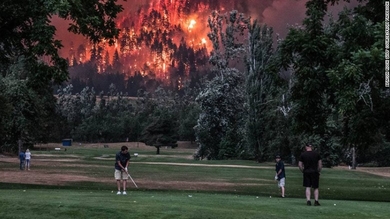
It’s Saturday morning, and I’m guessing a lot of us are watching apprehensively as Irma heads for Florida (others of us are probably trying desperately to escape the storm’s path, possibly receiving an impromptu lesson in dynamic pricing).  Meanwhile, Jose and Katia are close behind, even as Houston faces years-long recovery efforts from Harvey, and then there’s, well:

Resize golf

It’s impossible to consider these events – which, in addition to the human toll, will inflict billions if not trillions of dollars of damage – without thinking that this is what climate change looks like.

The reason I mention it on this blog is that climate change is an increasingly popular subject for shareholder proposals.  More and more, shareholders are seeking information from companies about how they are responding to climate change, including the precautions being taken, and the expected costs of disasters. 

Considering that we are now being treated to a dramatic demonstration of just how climate change can have a devastating impact on economies generally and individual companies in particular, isn’t it time for critics of the shareholder proposal mechanism to at least admit that climate change proposals belong in the “corporate governance” category, and not the

Gabriel (“Gabe”) Azar and I graduated one year apart, from the same law school. He has an undergraduate degree in electrical engineering from Georgia Tech and started his legal career as an associate practicing patent law at Finnegan, Henderson, Farabow, Garrett & Dunner, LLP. He moved from Finnegan to Paul Hastings and from there to an in-house position with FIS. Currently, he is Senior Patent Counsel at Johnson & Johnson. I’ve admired, mostly from a distance (he lives in Jacksonville, FL now), how Gabe has balanced family, work, and health. We recently reconnected on Strava, and it has been inspiring to see a dedicated husband/father/attorney taking his fitness seriously.   


The interview is below the page break.

As previously mentioned, I am always looking for good podcasts. I listen to podcasts while mowing our lawn and on road trips. 

StartUp is the latest podcast series that I have uncovered, thanks to a recommendation from my sister Anna who works for a media/marketing start up herself.

From what I have uncovered so far, StartUp seems to be quite like NPR’s How I Built This, which I mentioned in a previous post. Hosts of both podcasts interview entrepreneurs about the founding of their businesses and the ups and downs thereafter. The biggest difference I see is that StartUp seems to focus on smaller companies (a number that I had never heard of), while How I Built This seems to focus on companies that are now quite large and successful. In early seasons of StartUp there appear to be a number of the podcasts that depart from the entrepreneur-interview model, but I haven’t dug into the early seasons yet. I am mainly focused on the recent podcasts. 

Perhaps most interestingly, I recently listened to a podcast on StartUp about Mokhtar Alkhanshali and his specialty coffee. Mokhtar sources his coffee beans from war-torn Yemen and a cup of his

Reading closely is a highly valuable skill for both lawyers and law students.  But reading closely is not the only key to getting the most out of reading materials.  Often, knowing what to look for can help us discern what we’re really being told. An article at LawFare, How to Read a News Story About an Investigation: Eight Tips on Who Is Saying What, by Benjamin Wittes, does a nice job of providing some tools to help read news stories more carefully, and perhaps accurately, especially when it comes to sources.  Note that this piece applies to reputable reporters, not everyone who has written something about current events.  

One solid takeaway: 

Reporters publish what they know. If a story describes a series of interactions between a witness or a subject of an investigation and the investigators and the story contains information about one side’s thinking but not the other’s, that’s a powerful sign of where the disclosure came from.

Many of the skills here would translate into other settings, too.  For example, Wittes’ first rule: The Words Describing a Source Should Be Presumed Accurate.  He says, “Always start with the precise words the journalist is using to describe

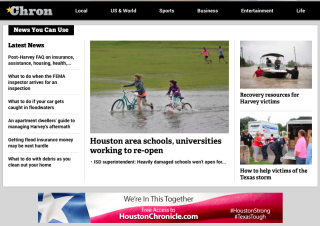
Screenshot 2017-09-03 19.09.35

Now that Hurricane Harvey’s threat to the United States has dissipated, we can begin to fully appreciate the damage it has caused to person, property, and business.  It’s staggering.  The screenshot included above was captured from the Houston Chronicle’s website yesterday.  Although I am not sure how one calculates such things, Wikipedia notes that, “[b]ased on current damage estimates made by multiple agencies, Hurricane Harvey is likely to be at least the second-most costly natural disaster in U.S. history, behind only Hurricane Katrina in 2005.”  I am heartbroken for all those who have lost so much, yet grateful for those who survived such a wicked storm, including the BLPB’s own Doug Moll.

I am confident that too many folks are using this holiday weekend–one they had hoped to spend enjoying last-of-summer moments with family and friends–mourning the loss of life and digging out from the mess at their homes or workplaces.  The damage in Tennessee from the related rain and winds was significant but pales in comparison to what the folks have suffered and continue to contend with in Houston and the surrounding areas.  Luckily, the storm threw very little at Knoxville, since the heart of it passed to the