January 2018

Shu-Yi Oei and Diane Ring of Boston College Law School have posted Is New Code Section 199A Really Going to Turn Us All into Independent Contractors? to SSRN.  Here is the abstract:

There has been a lot of interest lately in new IRC Section 199A, the new qualified business income (QBI) deduction that grants passthroughs, including qualifying workers who are independent contractors (and not employees), a deduction equal to 20% of a specially calculated base amount of income. One of the important themes that has arisen is its effect on work and labor markets, and the notion that the new deduction creates an incentive for businesses to shift to independent contractor classification. A question that has been percolating in the press, blogs, and on social media is whether new Section 199A is going to create a big shift in the workplace and cause many workers to be reclassified as independent contractors.

Is this really going to happen? How large an effect will tax have on labor markets and arrangements? We think that predicting and assessing the impact of this new provision is a rather nuanced and complicated question. There is an intersection of incentives, disincentives and risks in play among

As Joan and Josh previously posted, Stefan organized an excellent AALS panel on Rule 14a-8. We covered a number of topics, including the appropriate role of retail and employee shareholders, the proper sphere of activity for shareholders vis a vis managers, the true audience for shareholder proposals, and how to construct Rule 14a-8 so that frivolous and improper proposals can be easily weeded out.

In my remarks, I focused on the fact that shareholder proposals are usually precatory, even when they don’t have to be.  For example, shareholders have the right to pass bylaws, but even the Boardroom Accountability Project typically sponsors proposals that merely request that directors use their power to craft proxy access bylaws.  (I assume that’s at least in part because a good bylaw must address administrative matters that shareholders are ill-equipped to manage – for example, see management’s response to Proposal Ten, for a majority-rule bylaw at Netflix).

Because shareholder proposals are precatory, their main function is informational: they allow shareholders to communicate with management, with each other, and with the market more generally.  I suspect that this function may become especially important as passive investing’s popularity increases; absent the ability to sell

The-overnighters

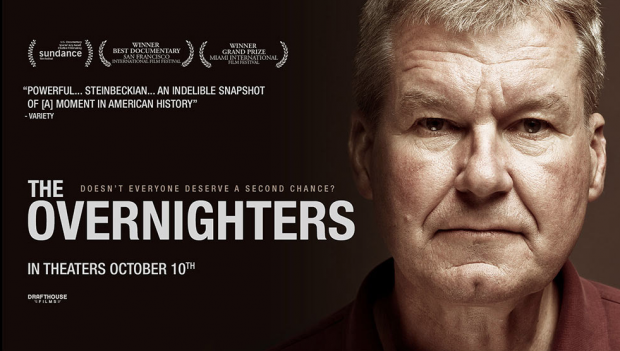
Over the break, I watched the documentary Overnighters on Netflix. 

In short, the documentary chronicles the story of a pastor who opens the church to migrant workers in North Dakota during the energy boom in that state. The pastor faces pushback from his congregation, neighbors, and city officials who do not appreciate having these men – some with criminal records – housed so close. 

In my opinion, the pastor is right, and the congregants are wrong, about the purpose of a church. The church should be in a community to serve, especially its needy neighbors. That said, the logistics of how to serve may be up for debate. Also, it is at least arguable that by serving the migrant workers the church strayed from serving its congregation. It would have been helpful if the church had a clear statement on its purpose and priorities. Many social enterprises have extremely vague purpose statements, which I do not think are very helpful. Benefit corporations are often required by statue to “benefit society and the environment.” A purpose statement like that would not have helped the church in Overnighters much at all. A statement that showed that those in need would be prioritized

Ponzi schemes recur with an astounding regularity.  The latest comes from the Woodbridge group of companies.  The $1.2 billion scheme ran for about five years.  It took advantage of about 8,400 investors, many of them elderly. 

Like many other Ponzi schemes, commission-hungry sales agents brought fresh infusions of capital to the scheme.  Interestingly, the scheme allowed sales agents to pick how much they would receive in commissions:

The sales agents were paid well. According to the SEC complaint, “Woodbridge offered its [mortgage] product to its external sales agents at a 9% wholesale rate, and the agents in turn offered the [mortgage notes] to their investor clients at 5% to 8% annual interest — the external sales agent received a commission equivalent to the difference,” the SEC asserted.

In total, Woodbridge may have paid out over $64 million in commissions to sales agents.  Some of these sales agents had been kicked out of the securities industry.  The Investment News details some of the sales claims that enabled the scheme:

For example, one insurance salesman and former broker, James H. Gilchrist, promoted the loans at dinners in Jensen Beach. The invitation encouraged potential attendees to “learn how to earn 6% fixed interest”

Article-h-m2-0108

Swedish clothing giant H & M caused a huge stir this week with an ad campaign depicting a young black boy in a sweatshirt that proclaimed him the “Coolest Monkey In the Jungle.”  The company’s misstep is surprising given the public condemnations of the use of the word “monkey” in Europe over the past few years when soccer fans have used it as a slur against black players. Notwithstanding H & M’s many apologies, several megastars have denounced the company and some have even pulled their fashion collaborations. As usual, several have called for boycotts of the retailer. But will all of this really matter? The sweatshirt was still for sale in the UK days for days after the controversy erupted, and the Weeknd, one of the megastars who vowed to never work with H & M, still has his 18-piece H & M collection available online and available for purchase on the store’s  U.S. portal.

I’m headed out of the country tomorrow and in my quest for a new sweater, I glanced in the H & M store in my local mall earlier today. The store was packed and likely with fans of the artists who called for a boycott.

The new semester is upon us, and AALS (as it tends to) ran right into the new semester.  Joan Heminway provided a nice overview of some of her activities, including her recognition as an outstanding mentor by the Section on Business Associations, and it was a pleasure to see her recognized for her tireless and consistent efforts to make all of us better.  Congratulations, Joan, and thank you! 

I, too, had a busy conference, with most of it condensed to Friday and Saturday. (As a side note, it was pretty great to run along the water in 55-65 degree weather. As much as I love New York and appreciate San Francisco and DC, I’d be quite content with AALS moving between San Diego and New Orleans.)  I spoke on a panel with my co-bloggers, as Joan noted, about shareholder proposals, and I spoke on a panel about the green economy and sustainability, which was also fun.  It’s nice when I am able to spend some time with a focus on my two main areas of research. 

As to our panel on shareholder proposals, I thought I’d share a few of my thoughts.  First, as I have explained in the past

AALS2018(SHProposalPanel)

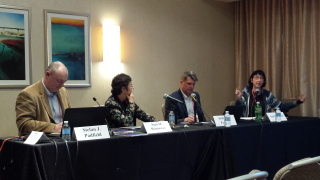
Last week, I had the privilege of attending and participating in the 2018 annual meeting of the Association of American Law Schools (#aals2018).  I saw many of you there.  It was a full four days for me.  The conference concluded on Saturday with the program captured in the photo above–four of us BLPB co-bloggers (Stefan, me, Josh, and Ann) jawing about shareholder proposals–as among ourselves and with our engaged audience members (who provided excellent questions and insights).  Thanks to Stefan for organizing the session and inspiring our work with his article, The Inclusive Capitalism Shareholder Proposal.  I learned a lot in preparing for and participating in this part of the program.

Earlier that day, BLPB co-blogger Anne Tucker and I co-moderated (really, Anne did the lion’s share of the work) a discussion group entitled “A New Era for Business Regulation?” on current and future regulatory and de-regulatory initiatives.  In some part, this session stemmed from posts that Anne and I wrote for the BLPB here, here, and here.  I earlier posted a call for participation in this session.  The conversation was wide-ranging and fascinating.  I took notes for two essays I am writing this

Over the holidays, I saw The Greatest Showman and Molly’s Game.  You wouldn’t have thought they’d be all that similar, but in fact, they’re both stories about nontraditional entrepreneurs who build unusual businesses from scratch. Molly’s Game understands that; sadly, Greatest Showman does not.  As a result, Molly’s Game is the more successful film.

The bulk of Molly’s Game is spent on building a business.  She learns the field, she identifies prospects, she finances and markets her game, she maintains her position and handles competition.  This is the heart of the movie and much of its appeal lies in the illustration of her ingenuity and expertise.

Those are also the best parts of The Greatest Showman, yet – and I rarely say this about a movie – the film was too short (1.5 hours). Too short because it quickly moves away from that theme to focus on a different story, namely, something about inclusion and acceptance for people who don’t fit society’s mold.  As one review put it, “it doesn’t really tell Barnum’s story. Rather, it appropriates his name for a pop-culture sermon on inclusion that lets us know, just in case we didn’t realize, that 500-pound men