
December 2018

Has an airline ever told you it wasn’t responsible for costs you would incur because of a flight initially delayed for “mechanical reasons” that was now delayed due to weather?  In thinking about how potential losses resulting from both a clearing member default and non-default issues (such as operational, investment, or custody problems) are likely to be allocated among a clearinghouse and clearing members, I think of such past travel experiences.  From my perspective, the issue of ownership is key to both.   

Hence, I’d like there to be an increased amount of discussion about clearinghouse ownership.  The word “ownership” was barely mentioned (maybe once) during the December 4th meeting of the Market Risk Advisory Committee, sponsored by CFTC Commissioner Rostin Behnam,  which largely focused on issues related to clearinghouses.  In contrast, participants frequently mentioned clearinghouse capital (“skin in the game”), and extensively discussed (Panel 2) the allocation of default versus non-default losses (which could occur nearly simultaneously).  Surprisingly, there is scant legal guidance on the allocation of non-default losses in the U.S. 

Clearinghouses, financial market infrastructure utilities, tend to be owned by their members or by investors (I’ve written extensively about clearinghouses for readers interested in learning more
I just don’t get the fascination that courts have with calling LLCs (limited liability companies) limited liability corporations. Yes, at this point, I can no longer claim to be surprised, but I can remain appalled/disappointed/frustrated/etc. Today I happened upon a U.S. District Court case from Florida that made just such an error.  This one bugs me, in part, because the court’s reference immediately precedes a quotation of the related LLC statute, which repeatedly refers to the “limited liability company.”  It’s right there! 
 
That said, the court assesses the situation appropriately, and (I think) gets the law and outcome right.  The court explains: 
In this case, Commerce and Industry served the summons on Southern Construction by serving the wife of the manager of Southern Construction. Doc. No. 10. Because Southern Construction is a limited liability corporation, service is proper under Fla. Stat. § 48.062 . . . .
*2 (1) Process against a limited liability company, domestic or foreign, may be served on the registered agent designated by the limited liability company under chapter 605. A person attempting to serve process pursuant to this subsection may serve the process on any employee of the registered agent during the

I posted about my summer reading here, and I have decided to write this sort of post each semester, at least for a few semesters. 

This semester was incredibly busy, and I didn’t read as much as I would have liked, but I am glad I finished at least a few books. Nearly all of these books were pretty light

Always looking for interesting books to read – and I am open to reading in most areas – so feel free to leave a comment with suggestions or e-mail me

The Honest Truth About Dishonesty – Dan Ariely (Non-Fiction – Ethics/Behavioral Economics, 2013). Duke University behavioral economist examines the environs/structures that encourage or discourage honesty.

Hannah Coulter – Wendell Berry (Fiction-Novel, 2005). Elderly lady, twice widowed, reflects on her life and the lives of her family members as the world changes after World War II, and as the modern world diverts from rural, farming communities like Port William, KY. Berry’s first novel with a female narrator.

The Most Important Year – Suzanne Bouffard (Non-Fiction – Education, 2017). Discusses the importance of the year before kindergarten. (My oldest child starts kindergarten this coming fall). Biggest takeaway was to engage

On November 15, the Securities and Exchange Commission (SEC) convened a Roundtable on the Proxy Process.  (See also here.)  I have not been following this as closely as co-blogger Ann Lipton has (see recent posts here and here), but friend-of-the-BLPB, Bernie Sharfman (Chairman of the Main Street Investors Coalition Advisory Council) has been active as a comment source.  Both contribute valuable ideas that I want to highlight here as the SEC continues to chew on the information it amassed in the roundtable process. 

Ann, as you may recall, has been focusing attention on the uncertain status of proxy advisors when it comes to liability for securities fraud.  In her most recent post, she observes that

There’s a real ambiguity about where, if it all, proxy advisors fit within the existing regulatory framework, and while I am not convinced there is a specific problem with how they operate or even necessarily a need for regulation, I think it can only be for the good if the SEC were to at least clarify the law, if for no other reason than that these entities play an important role in the securities ecosystem, and if we expect market

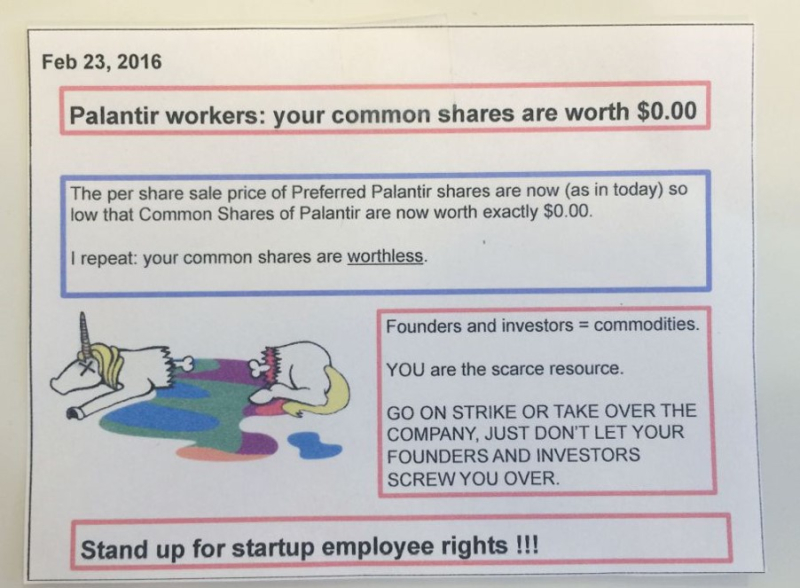
Palantir

On Wednesday, I had the great pleasure of delivering an address at the North American Securities Administrators Association’s annual training conference for its corporate finance division.  I spoke about equity compensation for employees in private companies (you may recall that Joan linked to Anat Alon-Beck’s paper on that subject a couple of weeks ago).  Equity compensation to employees is exempt from federal registration under Rule 701 – and the SEC is currently deciding whether to broaden that exemption – but is still subject to state regulation.  Most states, however, simply follow the federal rules.  The purpose of my talk was to discuss some of the risks posed to employee-investors when companies stay private for prolonged periods, and to suggest that state securities regulators may want to consider if there is a need for additional oversight.

Under the cut, I offer the (massively) abridged (but still probably too long) version of my remarks.  For those interested in further reading on the subject, in addition to Anat’s paper highlighted by Joan, I recommend Abraham Cable’s excellent breakdown of the issues in Fool’s Gold? Equity Compensation and the Mature Startup.

[More under the jump]