
October 2021

The following comes to us from one of our devoted readers (and fellow business law blogger), Walter Effross. He writes to inform us about a new initiative that he suggested to the American University Law Review, in which faculty, practitioners, judges, regulators, and others discuss “My Favorite Law Review Article.” The inaugural video (in which Walter recommends an Elizabeth Warren article) is here.

The guidelines for submissions are as follows:

1. Select the law review article that you wish to discuss. (Please choose an article that you did not write or co-author.)
2. All forms of video recording (Zoom, Photo Booth, phone camera, etc.) are acceptable; our team will edit appropriately.
3. Please try to keep your review between five and seven minutes long.
4. At the beginning of the video, please introduce (1) yourself and (2) the title and author of the Article. [including the citation, or at least the year of publication?]
5. Please provide a brief synopsis of the piece, read one or more pertinent passages, and/or discuss a particularly moving/interesting segment.
6. Most importantly, explain why this article is your favorite. You might consider discussing: when and how you first read it
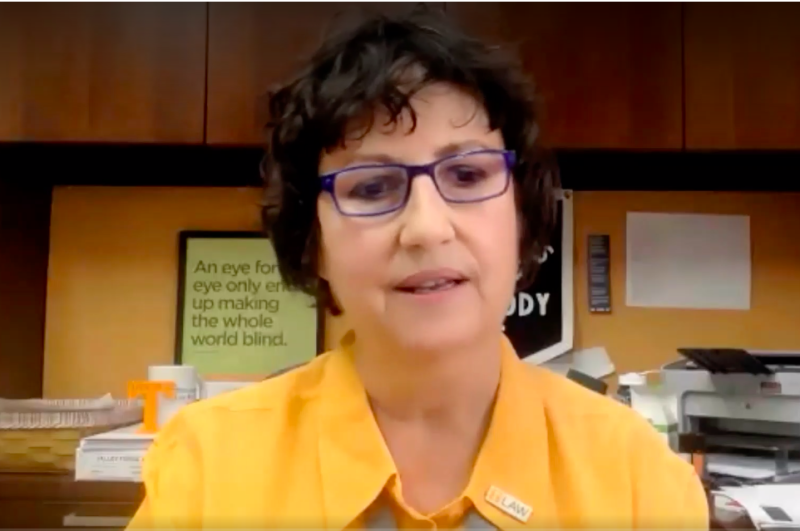
Screen Shot 2021-10-04 at 7.36.06 PM

With my bum shoulder and a lot of work on our dean search cramping my style over the past few weeks, I have been remiss in posting about the 2021 Business Law Prof Blog Symposium, Connecting the Threads V.  The idea behind the name (and Doug Moll likes to riff on it–so have at it, Doug!) is that our bloggers here at the BLPB connect the many threads of business law in what we do–here on the blog and elsewhere.

Anyhoo (as Ann would say), as always, my BLPB co-bloggers did not disappoint in their presentations.  I know our students look forward to publishing many of the articles and the related commentaries in the spring book of our business law journal, Transactions: The Tennessee Journal of Business Law.  I also am always so proud of, and interested to hear, the commentary of my colleagues and students.  This year was no exception.

In the future, I will post more about the article that I presented.  But I will offer a teaser here, accompanied by the above screen shot from the symposium.  (It was “Big Orange Friday” on our campus.  The orange had to be worn.  Go Vols!)

The title

Northwestern Pritzker School of Law invites applications for tenured or tenure-track faculty positions with an expected start date of September 1, 2022. This is part of a multi-year strategic hiring plan, and we will consider entry-level, junior, and senior lateral candidates.

Northwestern seeks applicants with distinguished academic credentials and a record of or potential for high scholarly achievement and excellence in teaching. Specialties of particular interest include: tax, anti-discrimination law, international law (joint search with the Buffett Institute for Global Affairs), health law (joint search with the Feinberg School of Medicine), and business law. Northwestern welcomes applications from candidates who would contribute to the diversity of our faculty and community. Positions are full-time appointments with tenure or on a tenure-track.

Candidates must have a J.D., Ph.D., or equivalent degree, a distinguished academic record, and demonstrated potential to produce outstanding scholarship. Northwestern Pritzker School of Law will consider the entry level candidates in the AALS Faculty Appointments Register, as well as through application directly to our law school. Candidates applying directly should submit a cover letter, C.V., and draft work-in-progress through our online application system: https://facultyrecruiting.northwestern.edu/apply/MTE3Mw. Specific inquiries should be addressed to the chair of the Appointments Committee, Zach Clopton

Western State College of Law (WSCL) at Westcliff University invites applications from entry-level and lateral candidates for up to two tenure-track faculty positions beginning August 1, 2022. We have particular interest in persons interested in teaching Business Organizations, Contracts, Sales, Evidence, Professional Responsibility, and Remedies. Candidates should have strong academic backgrounds, commitment to teaching excellence, and demonstrated potential for productive scholarship. 

WSCL is located in the city of Irvine, California – close to miles of famous beaches, parks, recreation facilities and outdoor activities as well as the many museums, music venues, and diverse cultural and social experiences of greater Los Angeles.

Founded in 1966, WSCL is the oldest law school in Orange County, California, and is a fully ABA approved for-profit, private law school. Noted for small classes and personal attention from an accessible faculty focused on student success, WSCL is proud that our student body is among the most diverse in the nation. Our 11,000+ alumni are well represented across public and private sector legal practice areas, including 150 California judges and about 15% of Orange County’s Deputy Public Defenders and District Attorneys.

WSCL is committed to providing workplaces and learning environments free from discrimination on the basis of

A while back, I posted about how there’s been some institutional investor support for the proposal that the SEC require not only public companies, but private companies, disclose climate change information.

Usually, of course, private companies aren’t required to disclose things – especially to institutional investors – on the theory that institutional investors can themselves bargain for the information that they need.  (Yes, yes, there are kind of exceptions, like Securities Act Section 4(a)(7), etc).  But the SEC and Congress have been gradually expanding which companies count as private, raising concerns that not only that they have assumed too much sophistication on the part of institutions (for example, institutional investors themselves have complained about opacity among the PE funds in which they invest), but also that the SEC and Congress have ignored the benefits of creating a body of public information across a wide swath of companies.

Which is why this article grabbed me

The California Public Employees’ Retirement System and Carlyle Group Inc. helped rally a group of more than a dozen investors to share and privately aggregate information related to emissions, diversity and the treatment of employees across closely held companies. More firms and

Insider trading reform has been a consistent theme in my last few posts (see, e.g., here, here, here, and here). In keeping with this theme, I’d like to highlight a new article, How Creepy Concepts Undermine Effective Insider Trading Reform, which was posted just yesterday by Professor Kevin R. Douglas (Michigan State College of Law). Professor Douglas is an important new voice in the areas of securities regulation, corporate finance, and business law more generally. Here’s the abstract:

Lawmakers are building momentum towards codifying our insider trading laws to clarify which kind of trading is illegal. In May 2021, the US House of Representatives passed the Insider Trading Prohibition Act for the second time in two years. In January 2020, a Securities and Exchange Commission sponsored task force on insider trading released a report containing proposed legislation. Both the House Bill and the task force proposal would prohibit trading while in possession of “wrongfully obtained” information and prohibit trades that involve a “wrongful use” of information. This article explains why the concept of “wrongful” trading is too ambiguous to improve insider trading law and explores the requirements of effective legislative reform.

For decades, scholars have