February 2023

I teach business law courses that involve planning and drafting in connection with business transactions. I know many of you do, too.  My question is, how do you teach your students to find drafting precedents (if that is part of your teaching) for transactional business law projects/tasks?  Do you advise students to use forms or to walk back provisions in fully negotiated agreements?

In our capstone 3L planning and drafting course at UT Law, Representing Enterprises, I let students take their own path in finding drafting precedents and ask them to report out their process to the class.   We talk through the pros and cons of their individual approaches, which I capture on the whiteboard.  My board notes from a recent class (during which we talked through how students located precedent bylaws for a closely held–preferably Tennessee–corporation) are included below.
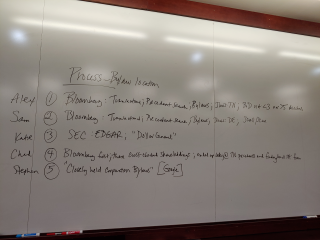
RE(LocatingBylaws2023)

Although Bloomberg Law was a popular resource for students who shared their process in this particular class meeting, the Securities and Exchange Commission’s website and Google also got some love.  In the ensuing discussions, a student also mentioned Westlaw’s Practical Law as a resource, although that’s not reflected in this picture.

In other advanced business law planning/drafting courses, I
The following came to me from Patricia Wilson, Associate Dean and Professor of Law, Chair of the Faculty Appointments Committee at Baylor Law:

Baylor Law is accepting applications for two lecturer positions in our Legal Analysis, Research and Communication (LARC) program, as described below, to begin no later than August 1, 2023.  Please share with anyone you believe may be interested.

Lecturer (Transactional Drafting)

Candidates must possess a juris doctor. You will be asked to provide a letter of interest; curriculum vitae; transcripts, a list of three references in the application process, and two writing samples demonstrating the candidate’s writing style.  Salary is commensurate with experience and qualifications.

The selected individual will have responsibility for teaching in the Legal Analysis, Research & Communications (LARC) program. Responsibilities include working collaboratively with other faculty members of the Baylor Law Writing Program to create, teach and grade assignments for the LARC 4 course (Transactional Drafting) and coordinating all of the writing efforts across all three years of the curriculum to ensure consistency and best management of resources. The ideal candidate will have at least three years of transactional legal writing experience, including drafting and analyzing a variety of different contracts and business entity governing documents.

Quick post today to mention that I did a podcast!  Evan Epstein of UC Law San Francisco hosts a regular podcast called “Boardroom Governance” for which he’s interviewed everyone who has anything to do with corporate issues – academics, practitioners, board members, you name it.  Recently, he was kind enough to invite me for an interview.  It was a great discussion, covering everything from Twitter v. Musk (of course), to the McDonald’s decision, to Sam Bankman-Fried, to public benefit corporations, to Domino’s pizza.

You can give it a listen here (and at that link there’s a handy index, if you want to jump to particular points).

Screenshot 2023-02-24 at 5.47.18 PM

Catholic Law seeks to fill several faculty positions to begin in Fall 2023. We are seeking candidates for entry-level and lateral positions, tenure-track or contract, in a wide variety of subjects, including Clinical Education, Lawyering Skills, Civil Procedure, Family Law, Trusts and Estates, Criminal Law and Procedure, Evidence, Corporate and Securities Law, International Law, and Contracts and Commercial Law.

Candidates in Clinical Education may have opportunities to teach in our existing clinics but also may propose new clinical areas. We are particularly interested in clinical offerings compatible with participation by our evening students.

We are also seeking candidates whose teaching and research interests may be in any of the above subject matter areas (or others) who are also interested in participating in our University’s Institute for Latin American and Iberian Studies.

Catholic Law is a national leader in preparing students of all faiths for the practice of law and is an integral part of The Catholic University of America, the national university of the Catholic Church, located on a beautiful residential campus in the heart of the nation’s capital.

Candidates must possess a J.D. or equivalent, superior academic credentials, and relevant professional experience, such as teaching, legal practice, or

Professor Emeritus Arthur E. Wilmarth recently posted a new article, We Must Protect Investors and Our Banking System from the Crypto Industry.  I always learn a ton in reading his work, so I’m looking forward to the opportunity to review this paper.  Here’s the abstract:

The crypto boom and crash of 2020-22 demonstrated that (i) cryptocurrencies with fluctuating values are extremely risky and highly volatile assets, and (ii) cryptocurrencies known as “stablecoins” are vulnerable to systemic runs whenever there are serious doubts about the adequacy of reserves backing those stablecoins. Crypto firms amplified the crypto boom with aggressive and deceptive marketing campaigns that targeted unsophisticated retail investors. Scandalous failures of prominent crypto firms accelerated the crypto crash by inflicting devastating losses on investors and undermining public confidence in crypto-assets.

Federal and state regulators have allowed banks to become significantly involved in crypto-related activities. Several FDIC-insured banks that provided financial services to crypto firms suffered substantial losses and incurred extensive legal, operational, and reputational risks during the crypto crash. Meanwhile, stablecoins issued by nonbanks and uninsured depository institutions threaten to become a new form of “shadow deposits” that could undermine the integrity of our banking system and require costly

Health Sciences at Belmont University | Professional Graduate &  Undergraduate Degree Programs

Belmont University (my employer) is seeking an Assistant Professor and Program Director of Legal Studies.

This professor will sit across campus from me, in our College of Liberal Arts and Social Sciences (“CLASS”), but I will likely interact with them because my Business Law 1 and 2 classes feature in the legal studies major, in addition to the business majors on campus. Happy to discuss Belmont University with anyone who may be interested. 

You can apply for the position (by March 15) here.  

For those of you who may have been wondering about Emory Law’s biennial Conference on the Teaching of Transactional Law and Skills, I have posted current information below.  I am pleased to see that our business law journal, Transactions: The Tennessee Journal of Business Law, is again publishing the proceedings.  This has been a great partnership between Emory Law and Tennessee Law over the years.  The proceedings of the 2021 Emory Law conference can be found here.

Just as I was ready to post this, I heard from the 2023-24 Editor-in-Chief of the journal, Bethany Wilson, that we are currently accepting articles for the Fall 2023 edition of Transactions. The articles published by Transactions typically focus on transitional business law issues and topics, including agency, antitrust, arbitration, bankruptcy, business associations, contracts, insurance, intellectual property, labor and employment, property, real estate, secured transactions, securities regulation, shareholder litigation, and tax. If you have any articles that you would be interested in having published by Transactions, please send them our way. Articles can be submitted via Scholastica or by emailing an abstract and copy of the article to bwilso92@vols.utk.edu.

image from dim.mcusercontent.com

This post was originally intended to be submitted as a comment to Ann Lipton’s recent “Don’t Say Anything” post – so please read that post first before continuing. I ultimately decided to publish this as a free-standing post because it got a bit long for a comment and I’ll be better able to follow any subsequent comments here. As always, I remain open to changing my mind in the light of convincing feedback.

Ann’s post starts by referencing “Florida’s ‘Don’t Say Gay’ law, HB 1557.” For context, the following from Heritage Action’s Executive Director Jessica Anderson (here) may be helpful:

While the Left and the corporate media continue to lie about Florida’s Parental Rights in Education bill, HB 1557, Florida Republicans haven’t stopped working to protect parents and children. Nothing in the bill bans the word ‘gay’ or censors schools — it simply protects grades K-3 from sexualized instruction and bolsters parents’ rights to know what’s going on in their children’s lives at school.

As for the substance of the case, I predict that Chancery will not dismiss the request. Why? Because it does not have to dismiss it in order to discourage “bullying” because this

Warning: this post addresses suicide.

I was supposed to post yesterday about a different topic but I’m posting today and not next week because someone needs to read this today.

Maybe it’s you. Maybe it’s your “strong” friend or colleague.

I found out yesterday that I lost a former student to suicide. She lit up every room she walked into and inspired me, her classmates, and everyone she met. I had no idea she was living in such darkness. Lawyers, law students, compliance professionals, and others in high stress roles are conditioned to be on top of everything. We are the strong ones that clients and colleagues rely on. We worry so much about the stigma of not being completely in control at all times, that we don’t get help. We worry that clients won’t trust us with sensitive or important matters. We worry that we won’t pass the character and fitness assessments to get admitted to the bar. 

The CDC released a report this week showing an alarming rise in depression, suicidal thoughts, and anxiety among our youth. The report noted that:

  • Female students and LGBQ+ students are experiencing alarming rates of violence, poor mental health, and suicidal thoughts

As you may be aware, a Disney shareholder, Kenneth Simeone, has filed a Section 220 action in Delaware Chancery seeking books and records pertaining to Disney’s announcement in early 2022 that it opposed Florida’s “Don’t Say Gay” law, HB 1557. 

Before the law was passed, Disney’s CEO, Robert Chapek, told employees that the company would not take a public position on the law.  That decision infuriated Disney employees, who, among other things, began staging walkouts in protest.  Ultimately, Chapek reversed course and publicly stated that Disney opposed the law.

In the wake of that announcement, Governor Ron DeSantis and the Florida legislature voted to dissolve Disney’s self-governed Reedy Creek Improvement District, although they later walked back their actions by maintaining the district but transferring control to Florida political appointees.  Chapek was fired by the board (likely for a host of reasons), and former CEO Robert Iger was restored to his old role.

Anyway, Simeone claims that he has a credible basis to suspect that Disney’s public opposition to the law was the result of mismanagement and breach of fiduciary duty.  In particular, he claims that Disney’s officers and directors may have put their personal political preferences