
Photo of Ann Lipton

Ann M. Lipton is a Professor of Law and Laurence W. DeMuth Chair of Business Law at the University of Colorado Law School.  An experienced securities and corporate litigator who has handled class actions involving some of the world’s largest companies, she joined the Tulane Law faculty in 2015 after two years as a visiting assistant professor at Duke University School of Law.

As a scholar, Lipton explores corporate governance, the relationships between corporations and investors, and the role of corporations in society.  Read more.

Yesterday, the Department of Justice unsealed indictments of several cryptocurrency exchange operators for various forms of market manipulation, in coordination with SEC complaints targeting the same conduct.  It turns out there was an elaborate FBI sting operation involved, whereby the FBI actually created a token for the targeted individuals to manipulate.  The FBI set up a website and everything – the website is actually hilarious, because it describes the token with every bit of crypto-futurish-gibberish you can imagine.  To wit:

It almost reads like it was written by AI as a parody, but I hope a real human person got to draft this.  They must be so proud.

Anyhoo, that’s not the only interesting thing.  Here’s what’s also interesting.

Often, when DOJ comes for crypto, it just charges wire fraud.  That way – unlike the SEC – it can avoid getting into a fight about whether a particular token was or was not a security.  But market manipulation, specifically, is a security-related offense.  And the DOJ wanted to get at market manipulation.  By creating its own token, DOJ could be sure that the token satisfied the definition of a “security.”  It designed it to be a security! 

For example, one
This week, we got two denials of class certification in 10b-5 securities cases involving meme stocks.  The first concerned Bed Bath and Beyond, the second concerned a fintech called Rocket Companies, which is not one of your more famous meme stocks, but apparently met the definition for 2 days out of a 2-and-a-half month class period.  One case presented a refreshingly accurate application of current doctrine.  The other presented a clarifying illustration of the doctrinal mess created by the Supreme Court’s decision in Goldman Sachs v. Arkansas Teacher Retirement System and its subsequent interpretation by the Second Circuit.

[More under the jump]

Section 10(b), and Rule 10b-5, prohibit fraud in connection with securities transactions.  Among other things, they prohibit corporate executives from publicly lying about a company, which typically causes the stock price to go up – only to crash again when the truth is revealed.

But when a plaintiff tries to sue in these cases, she confronts a fundamental problem: Fraud claims require proof of reliance.  And most stock purchasers may have trouble proving they relied on any specific false statement.  Maybe the investor didn’t hear the statement personally; maybe they relied on analyst advice – or an

The SEC recently settled an enforcement action against Zymergen for making false projections about its business.  Prior to its IPO in April 2021, many of these projections were given directly to analysts.  Zymergen did not include the projections in its registration statement, because companies are strictly liable to investors for false statements in a registration statement under Section 11 of the Securities Act, and so they generally try to avoid making projections that may turn out to be overly optimistic.  Instead, Zymergen gave the false projections to analysts, so the analysts would take the projections, and use them in building their models, which they would pass on to investors with a recommendation of some sort.

One question then, is, if the SEC had not brought an enforcement action, could Zymergen have been liable to investors for passing on bad info to analysts?

The answer is, maybe not.  Certainly not under Section 11, which only applies to information in a registration statement.  And maybe not under Section 10(b), the general antifraud statute, because Stoneridge v. Scientific-Atlanta holds that public investors are not deemed to “rely” on behind-the-scenes conduct that’s filtered to the public through the false statements of another entity. 

A while ago, I posted about an SEC enforcement action against Wahed Invest.  Wahed Invest is a religious investment advisor that purported to select and monitor investments to ensure compliance with Shari’ah law.  In fact, according to the SEC, it did not in fact have policies in place to assess ongoing Shari’ah law compliance,  

At the time, I noted that I had not before seen an enforcement action based on false nonfinancial representations – that were nonetheless material to investors’ nonfinancial goals – and I compared it to the then-proposed climate change rule’s consideration for the nonfinancial goals of investors.  Specifically, the proposed rule justified, in part, its requirement that companies disclose GHG emissions on the ground that some investors have made net-zero commitments, regardless of whether the emissions data would be financially material to the operating company.

Well, this morning, I learned about a new SEC enforcement action against Inspire Investing.  Like Wahed, Inspire is a religious investment advisor, and like Wahed, it purported to engage in a “biblically responsible” investment strategy that required it to use sophisticated data analysis to ensure no companies in its ETFs engaged in certain prohibited activities.  In fact, its methods were

Well, Hurricane Francine passed through New Orleans, and left me with power (yay!) but no internet (boo!), which means I’m relatively helpless.

Still, I’ll take this opportunity to announce that I’ve started a podcast, Shareholder Primacy, with Mike Levin (The Activist Investor).  We’re still working out what it wants to be, but our first episode is up (here on Apple, here on Spotify, here on YouTube) addressing the status of the Tesla compensation case, and the implications of the universal proxy.

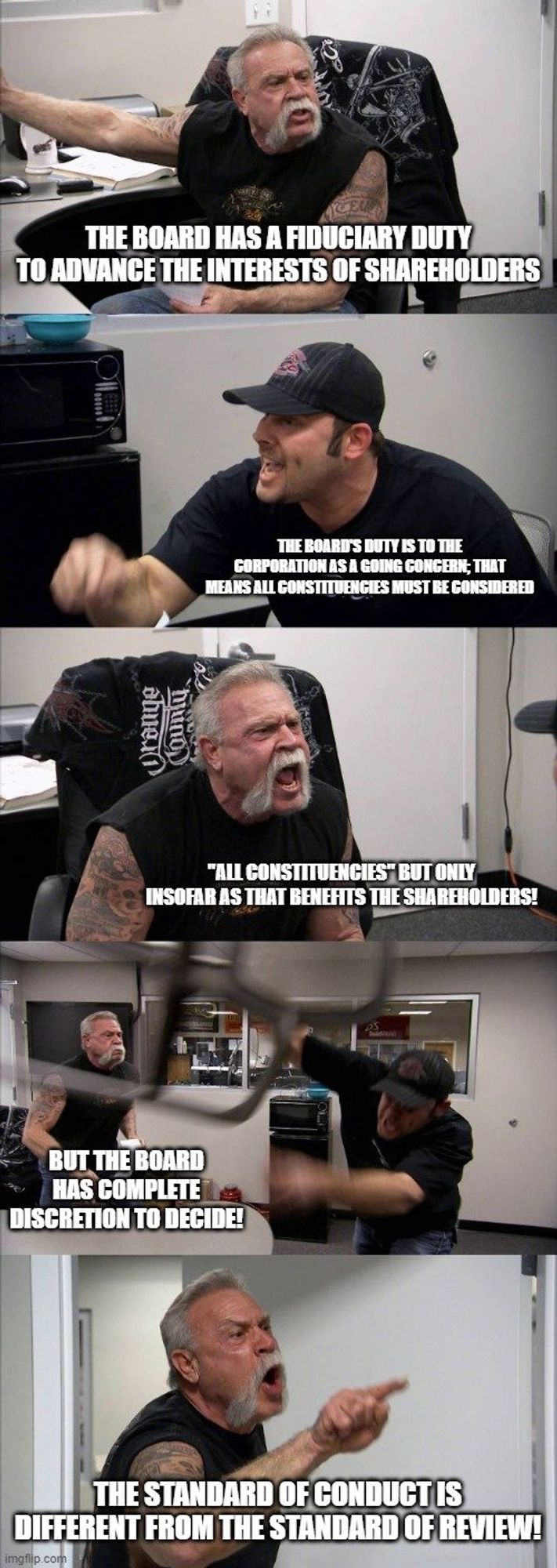
Also, I’m very proud of this meme I made:

E8831d72-6284-44d5-b15c-0e87ffc7551e

This time, it’s Brazil.

If you’re not following the saga, the story is apparently that ex-Twitter, now controlled by Elon Musk (not the CEO, though; you can’t even really say he’s the owner without qualifying about the interests of other investors and – don’t forget – the debtholders), ignored the order of Brazilian Supreme Court Justice Alexandre de Moraes to remove certain accounts associated with hate speech and misinformation.  Apparently out of fear that Twitter’s Brazilian employees would be arrested, Twitter shut down its Brazilian offices.  At that point, Twitter was out of compliance with a Brazilian requirement that a legal representative be present in the country.  So, Justice de Moraes ordered that access to Twitter be blocked throughout Brazil.  (Legal challenges to that order continue)

That’s not great for Twitter, but it turns out, it was even worse for Starlink, a wholly-owned subsidiary of Musk-controlled SpaceX, because the Justice ordered that Starlink’s financial accounts be frozen in order to force payment of fines owed by Twitter.  Musk at first insisted that he would not block access to Twitter via Brazilian Starlink, then – on that point – relented.  Shortly thereafter, it was reported SpaceX was evacuating its personnel from the country.  As the Wall Street Journal put it, “Starlink’s entanglement in a dispute originally about X is a stark illustration of how some government officials around the world may draw few distinctions between enterprises that Musk runs.”

So, all of this has the makings of a great introductory classroom discussion of corporate separateness, enterprise liability, and veil-piercing.  I have no idea what the law on this is in Brazil, but let’s talk about how we’d analyze this under American law.

(more under the jump)

Not a whole lot going on this week in terms of legal developments, so I thought I’d reach back to an older post of mine, where I talked about a case pending before the Fifth Circuit regarding 14a-8.  The original petitioner, the National Center for Public Policy Research, argued that the SEC engages in viewpoint discrimination when it issues no-action letters; an intervenor challenged the entire basis for Rule 14a-8 as unauthorized by statute and unconstitutional to boot.  The SEC, for its part, addressed these substantive arguments but concentrated most of its energies on arguing that no-action letters are not final orders subject to challenge in the first place.

Normally, I’d assume a case like this wouldn’t have much chance of succeeding, but it’s the Fifth Circuit, which tends to take an entrepreneurial approach to issues like corporate rights, standing, and administrative authority.  Even then, I’d say the petitioners were likely out of luck, because the panel turned out to be Jones, Douglas, and Dennis – meaning, two Democrats and a Republican – and, indeed, only Judge Jones demonstrated any sympathies for the petitioners during oral argument.  But! The last time sec reg ended up before a 2-1

Thing One: 

I jotted!  Which is to say, I wrote a Jotwell review of Hilary Allen’s Interest Rates, Venture Capital, and Financial Stability, forthcoming in the University of Illinois Law Review.  Her paper is here, and you can find my review here.

Thing Two:  I have a new paper-ish thing.  As y’all know, I’ve been keeping an eye on litigation-limiting bylaw and charter provisions, including – as I previously posted – the Ninth Circuit’s en banc decision in Lee v. Fisher, which permitted The Gap to enforce a forum selection bylaw directing derivative Section 14(a) claims to Delaware’s Court of Chancery – even though that court has no jurisdiction to hear Section 14(a) claims.  In practical effect, then, the bylaw operated as a waiver of the federal claim.

That decision cited a draft version of an article by Professors Mohsen Manesh and Joseph Grundfest, Abandoned and Split But Never Reversed: Borak and Federal Derivative Litigation, in which they defended such bylaws.  The article was published in the Business Lawyer late last year, and is available here.

Anyhoo, I now have a (very short) reply to Professors Manesh and Grundfest, also forthcoming

In 1995, Congress passed the Private Securities Litigation Reform Act (PSLRA), which dramatically heightened the pleading burden for plaintiffs bringing securities fraud cases.  At the same time, the PSLRA also instituted a mandatory stay on discovery until resolution of any motions to dismiss, which means plaintiffs have to use their own investigation – relying on public information, confidential sources, and the like – to draft a complaint that is sufficiently particular to satisfy PSLRA standards.

In 2002, Steve Bainbridge and Mitu Gulati published How Do Judges Maximize? (The Same Way Everybody Else Does – Boundedly): Rules of Thumb in Securities Fraud Opinions.  The paper explained that, given the high pleading standards of the PSLRA, judges deciding motions to dismiss lighten the workload by coming up with various rules of thumb for determining whether a complaint pleads materiality or scienter.  For example, they identified the puffery doctrine (presuming that investors treat vague statements of optimism as immaterial), the bespeaks caution doctrine (predictions of the future are immaterial if they are caveated by warnings of future uncertainty), and fraud by hindsight (refusing to draw inferences about what the company knew at an earlier time due to negative disclosures at a later time)

Two job announcements, early career and later stage:

Tulane University Law School invites applications from entry-level and early career lateral candidates (less than three years of tenure-track teaching experience) for one or more tenure-track faculty positions.  We welcome applications from candidates with teaching and research interests in all topics, but we are particularly interested in candidates who focus on maritime law and the first year curriculum: civil procedure, contracts, property, and torts. Please direct any questions about this position to Freddy Sourgens at fsourgen@tulane.edu. To learn more about the law school, visit our website at https://law.tulane.edu/. Interested applicants may apply at the following link: http://apply.interfolio.com/150799.

Tulane University is committed to creating a community and culture that foster a sense of belonging for all. We are a recognized employer and educator valuing AA/EEO, Protected Veterans, and Individuals with Disabilities. We encourage all qualified candidates to apply. We are intentionally seeking candidates who contribute to fostering equity, diversity, and inclusion in support of Tulane’s strategic initiatives.  

Also:

Tulane University Law School seeks to fill these faculty positions:

Houck Chair in Environmental Law (and Director of the Center for Environmental Law)
Niels F. Johnsen Chair in Maritime Law
David Boise