
Photo of Colleen Baker

PhD (Wharton) Professor Baker is an expert in banking and financial institutions law and regulation, with extensive knowledge of over-the-counter derivatives, clearing, the Dodd-Frank Act, and bankruptcy, in addition to being a mediator and arbitrator.

Previously, she spent time at the U. of Illinois Urbana-Champaign College of Business, the U. of Notre Dame Law School, and Villanova University Law School. She has consulted for the Federal Reserve Bank of Chicago, and for The Volcker Alliance.  Prior to academia, Professor Baker worked as a legal professional and as an information technology associate. She is a member of the State Bars of NY and TX. Read More

From an e-mail I received this week:

———-

The UNIVERSITY OF NEBRASKA COLLEGE OF LAW invites applications for lateral candidates for a tenured faculty position to hold the Clayton K. Yeutter Chair at the College of Law. This chaired faculty position will be one of four faculty members to form the core of the newly-formed, interdisciplinary Clayton K. Yeutter Institute for International Trade and Finance. The Institute also will include the Duane Acklie Chair at the College of Business, the Michael Yanney Chair at the College of Agriculture and Natural Resources, and the Haggart/Works Professorship for International Trade at the College of Law. The Yeutter Chair, along with the other three professors, will be expected to support the work and objectives and ensure the success of the Yeutter Institute. The Yeutter Chair will teach courses at the College of Law, including International Finance. Other courses may include Corporate Finance and/or other classes related to business and finance. More on the Yeutter Institute can be found at http://news.unl.edu/free-tags/clayton-k-yeutter-institute-of-international-trade-and-finance/.

Minimum Required Qualifications: J.D Degree or Equivalent; Superior Academic Record; Outstanding Record of Scholarship in International Finance and/or other areas related to international business; and Receipt of Tenure at an Accredited Law School.
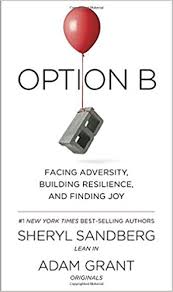
OptionB

Shortly after hearing Sheryl Sandberg and Adam Grant speak on a Harvard Business Review podcast, I purchased Option B.

After listening to the podcast, I expected the book to contain more references to the research on resilience than it ultimately did. While I knew the book was popular press, I expected Penn Professor Adam Grant to add a more scholarly flavor. As it was, the book was a relatively short memoir focused on the death of Sheryl Sandberg’s husband Dave. Had I started the book expecting a window into Sandberg’s grieving process rather than an accessible integration of the resilience research, I think I would have appreciated the book more.  

On the positive side, the book is an extremely easy read and is written with a punchy, engaging style. Sandberg is quite honest, and is blunt in sharing with the readers what is and isn’t helpful in interacting with those who have experienced great personal loss. In Sanberg’s opinion, you should address the elephant in the room, and should not worry about reminding them of their loss, as they are already thinking about it all the time. Vague offers like “let me know if I can do anything to help”

These days it is easy to get discouraged on how divided our nation seems to be on a number of issues. John Inazu, Distinguished Professor of Law, Religion, and Political Science at Washington University, maps a way forward in his book Confident Pluralism (2016).

The book is divided into two parts: (1) Constitutional Commitments, and (2) Civic Practices.

The first part “contend[s] that recent constitutional doctrine has departed from our longstanding embrace of pluralism and the political arrangements that make pluralism possible.” (8) Further, the first part offers guideposts for future decisions and political solutions. The first part argues for both inclusion and dissent, for the free formation of voluntary groups, for meaningful access to public forums, and for access to publicly available funding for diverse organizations. Provocatively, Inazu claims that Bob Jones case – which stripped tax-exempt status from Bob Jones University due to its prohibition of interracial dating/marriage – is “normatively attractive to almost everyone, [but] is conceptually wrong.” (75) Inazu claims that “[t]he IRS should not limit tax-exempt status based on viewpoint of ideology.” (79) He extends the argument to “generally available resources.” While the Trinity Lutheran case was decided by the Supreme Court after publication

At the beach with my wife’s family, I read Parker J. Palmer’s Courage to Teach in a couple sittings. Palmer has a PHD in sociology from UC Berkeley, and has written extensively on education.

My mother-in-law was reading the book for her job at a private elementary school, and I brought a limited number of books (due to the weight of my hardcopy books), so I read this book too. Our teaching center at Belmont University has mentioned Palmer’s work a number of times, so I was interested in the book.

Simply stated, Palmer’s thesis is that “good teaching comes from the identity and integrity of the teacher.” He defines identity as “an evolving nexus where all the forces that constitute my life converge in the mystery of self,” and he defines integrity as “whatever wholeness I am able to find within that nexus as its vectors form and re-form the pattern of my life.” (13) Teaching, he argues, comes from the heart and soul of the teacher, and not primarily from chosen techniques. 

Palmer makes a solid point about paradox and pedagogical design. “The space should be bounded and open….hospitable and charged….invite the voice of the

Tomasz Piotr Wisniewski, Liafisu Sina Yekini, and Ayman M. A. Omar posted “Psychopathic Traits of Corporate Leadership as Predictors of Future Stock Returns” on SSRN on June 13, 2017. You can find their abstract here

I was particularly interested in how the authors measured psychopathy. Here is a relevant excerpt:

Using UK data, we construct a number of corporate psychopathy indicators and link them to the returns that ensue over the next 250 trading days – a period roughly equivalent to one calendar year.

Even if clear guidance exists on how to diagnose psychopathic personality disorder in humans (Hare 1991, 2003), the practical difficulty is that executives will be generally unwilling to participate in time consuming surveys, particularly those that are likely to expose the dark side of their character. We choose to follow a more pragmatic approach and, similarly to Chatterjee and Hambrick (2007), collect information in an unobtrusive way by going through company-related archives and data. Firstly, using automated content analysis we assess to what extent the language in annual report narratives is symptomatic of psychopathy. This is done by counting the frequency of words that are aggressive, characteristic of speakers who are self-absorbed and who have