Photo of Colleen Baker

PhD (Wharton) Professor Baker is an expert in banking and financial institutions law and regulation, with extensive knowledge of over-the-counter derivatives, clearing, the Dodd-Frank Act, and bankruptcy, in addition to being a mediator and arbitrator.

Previously, she spent time at the U. of Illinois Urbana-Champaign College of Business, the U. of Notre Dame Law School, and Villanova University Law School. She has consulted for the Federal Reserve Bank of Chicago, and for The Volcker Alliance.  Prior to academia, Professor Baker worked as a legal professional and as an information technology associate. She is a member of the State Bars of NY and TX. Read More

From the Faculty Lounge: “Villanova University – Charles Widger School of Law seeks an outstanding lawyer/educator/scholar to teach business law and entrepreneurship courses, broadly defined, and to serve as the Faculty Director for The John F. Scarpa Center for Law and Entrepreneurship.” More information available here.

Updated Law Professor (Business Areas) Position List.

Updated Legal Studies Professor Position List (Mostly Business Schools).

At this point in the year, I imagine that some, if not many, of the positions on the list may be filled.

I am taking a MOOC from University of Illinois and Coursera on digital marketing. I’ve been trying to take at least one course a semester. Both the underlying material, and the intricacies of online education have been interesting. I chose this course because I have family members in the digital marketing area, and I am taking (and discussing) this course with them.

Later, I may discuss some of  the substantive take-aways from the course — I have completed about 50% of the course so far — but in this post I want to discuss business/academic entanglement.

In this digital marketing class, an assignment on co-creation (by firms & their customers) consisted of creating an online account with Starbucks, submitting an idea for consideration, and reporting how the idea was received by commenters. This was a useful exercise and it made the concept come alive, but I couldn’t help wondering if Starbucks was somehow involved with University of Illinois and/or Coursera in creating this assignment. To be clear, I have no idea whether Starbucks was or was not involved.  But, in any event, with the thousands (and maybe 10s of thousands) of people who are taking this course, this assignment seemed like a win for Starbucks.  Well, actually, this idea

Mnookin

Perhaps the most common question I receive from the MBA students in my Decision Making & Negotiation Skill class is – what do I do when the other side is completely unreasonable or evil?

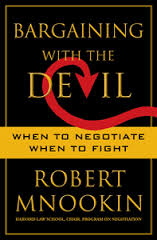
Robert Mnookin (Harvard) explores this question in his book Bargaining with the Devil: When to Negotiate and when to Fight

I won’t attempt to summarize the entire book, but I share a few representative quotes below. (Page numbers correspond to the 2010 hardback edition).

“By ‘Devil’ I mean an enemy who has intentionally harmed you in the past or appears willing to harm you in the future. Someone you don’t trust. An adversary whose behavior you may even see as evil.” (pg. 1)

“An act is evil when it involves the intentional infliction of grievous harm on another human being in the circumstances where there is no adequate justification.” (pg. 15)

Consider “Interests [of both sides]…Alternatives [of both sides]…Potential negotiated outcomes…Costs…Implementation…What issues of recognition and legitimacy are implicated in my decision” (pgs. 27-34).

“I believe there is reason to be deeply concerned whenever an agent or representative allows personal morality to override a rational analysis favoring negotiation – even with a devil.” (pg. 49)

“If you bargain

I recently listened to a podcast on temptation bundling, featuring the work of Katherine Milkman (Wharton)

Temptation bundling is explained here and here by Katherine Milkman, who (I believe) coined the term.

In short, temptation bundling is putting something you want to do together with something you should do. 

Temptation bundling can make both activities more enjoyable — you feel better about the want activity because you also accomplished a should activity, and the should activity is less difficult because it is married with a want activity. For example, temptation bundling is what I have been doing with podcast listening; I only listen to podcasts (want) when I workout (should).

Below are a few temptation bundles that might work for professors:

  • Drinking caffeinated drinks only while researching;
  • Listening to your favorite music only while grading; and
  • Eating chocolate only when in faculty meetings.

I was a little rough on BigLaw last week, so I want to sing BigLaw’s praises this week. Granted, this post is scheduled for Christmas, so it may be even more lightly read than my previous post.

Students often ask me about BigLaw, and I tell them that if I had to do it over again, I would still start my career in BigLaw. Under the break, I explain why that is true.

My co-blogger Marcia Narine shared an article on social media this week entitled Lawyers have lowest health and wellbeing of all professionals, study finds. Sadly, this is not new news. 

Those results, I am afraid, would be even worse if only members of the nation’s largest law firms (a/k/a “BigLaw”) were surveyed. Deborah Rhode (Stanford) talks about some of the problems in BigLaw, described in her book the Trouble with Lawyers

Let’s assume, for the sake of this post, that the executive committee of a large law firm wants to improve employee welfare. What could the committee realistically do to improve employee wellbeing? Part of the low score for lawyers, I imagine, is just the nature of BigLaw, but under the break I make a few suggestions for consideration. 

WCU

Western Carolina University is looking to hire three business law faculty members: two tenure-track and one for a fixed term.

Descriptions of the positions are available under the break. Western Carolina University is one of the few universities in the country with an undergraduate degree in Business Administration and Law. In the spring of 2014, I presented at WCU. They have thoughtful professors, a beautiful campus, and engaged students.

I have updated my lists of legal studies professor openings and law school (business area) professor openings.