
As reported by America First Legal (here), Texas Governor Greg Abbott’s office recently issued a memo reminding state agencies and universities that “federal and state law forbid discrimination against a current or prospective employee because of that person’s race, color, religion, sex, national origin, age, disability or military service.” As stated in the letter (here): “Rebranding this employment discrimination as ‘DEI’ doesn’t make the practice any less illegal.” Of course, the extent to which diversity may be deemed a compelling interest justifying at least some forms of racial discrimination is an issue currently before the Supreme Court (see here).

Bainbridge on “The Profit Motive”
Many BLPB readers are likely aware that Stephen Bainbridge recently published a new book, The Profit Motive: Defending Shareholder Value Maximization. I must admit that I’m a fan of the Introduction:
There are a lot of books on the market praising stakeholder capitalism. They proclaim a new age in which big corporations should embrace—and, in fact, are embracing—environmental, social, and governance (ESG) goals. Whether putatively objective academic tomes filled with statistics or mass market books filled with bullet points, the bottom line is the same; namely, that stakeholder capitalism is the right thing to do both morally and financially. This is not one of those books.
For those of you on the fence, there is an hour-long overview on YouTube (here), but if that’s too long you might consider a recent guest post by Prof. Bainbridge on the Corporate Finance Lab discussing the book (here). Below is a brief excerpt from that post.
Three major themes animate the project. First, any conception of corporate purpose that embraces goals other than creating value for shareholders is inconsistent with the mainstream of U.S. corporate law. Second, directors do—and should—have wide and substantially unfettered discretion as to how
Emilie Kao on 303 Creative v. Elenis: “Can Stand-Alone Dignitary Harm Create A Right to Endorsement and Duty to Endorse?”
The following excerpt is from the introduction to a recent publication that may be of interest to BLPB readers. The publication is: Emilie Kao, 303 Creative v. Elenis: Can Stand-Alone Dignitary Harm Create A Right to Endorsement and Duty to Endorse?, 2023 Harv. J.L. & Pub. Pol’y Per Curiam 5, 2–5 (2023). Emilie Kao is Senior Counsel and Vice-President for Advocacy Strategy at Alliance Defending Freedom (ADF), which represents Lorie Smith.
All people have inherent dignity and should be treated with respect. However, whether and how courts should address legal claims surrounding dignity are notoriously complicated. Does the government have an interest in protecting citizens from “dignitary harm”–subjective feelings of emotional distress or stigma? If so, does the government’s interest require it to compel or silence the expression of certain views? If so, does the dignity of the person compelled to speak or remain silent matter? Dignitary harm has played important roles in conflicts between religious freedom and anti-discrimination laws in Masterpiece Cakeshop v. Colorado Civil Rights Commission and Fulton v. Philadelphia. And they are at issue again in 303 Creative v. Elenis, a free-speech case that was recently argued at the U.S. Supreme Court.
Society of Socio-Economists Annual Meeting Continues Through Friday
Below are the upcoming events taking place online as part of the Society of Socio-Economists Annual Meeting (all times EST). All events are accessible via a single link, which will be sent to you after registering here (registration is free). Readers of this blog will likely recognize a number of the presenters. I hope to see you there.
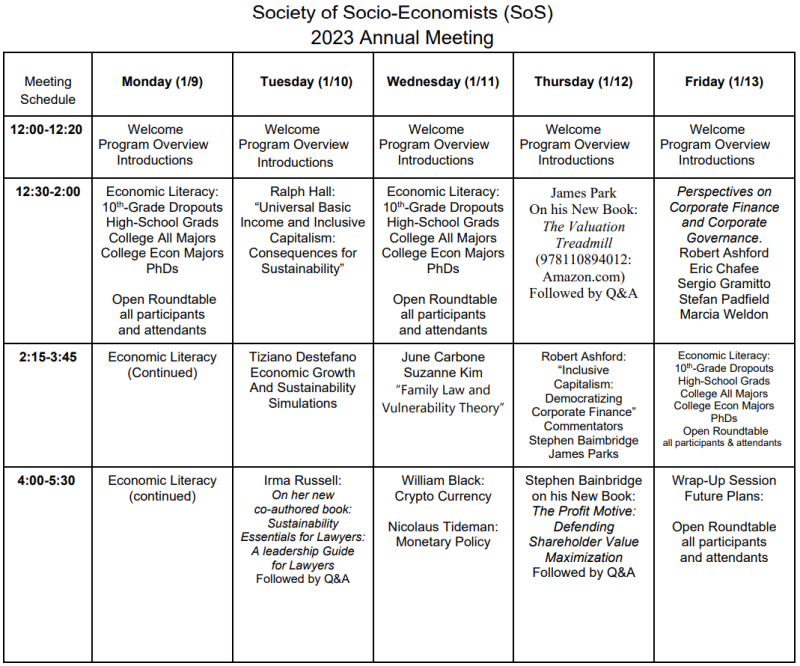
UPDATE: You can find the paper Robert Ashford will be discussing Thursday at 2:15 here: https://scholarlycommons.pacific.edu/cgi/viewcontent.cgi?article=1372&context=uoplawreview .
UPDATE 2: Two videos from economists discussing Professor Ashford’s Inclusive Capitalism: (1) https://youtu.be/lL1gEEj0tCU; (2) https://video.syr.edu/media/t/1_nnt9e504 .
Mittal & Jung on “Strategic Management of Corporate Political Activism”
Vikas Mittal and Jihye Jung have posted Strategic Management of Corporate Political Activism on SSRN. Here is the abstract:
Senior leadership at many organizations engages in overt corporate political activism (CPA), defined as activities that are visible to stakeholders that support or undermine issues viewed as politically charged. According to media accounts, consumers, employees and shareholders want executives to engage in CPA. Evidence from peer-reviewed research shows that CPA does not help, but can harm companies on many fronts. This evidence shows that CPA is detrimental to a company’s brand equity, employee productivity, and financial performance while also alienating some customers. To help address these issues, this article develops a strategic framework to assess where a company is in its CPA journey and determine its path forward. The framework proposes four strategies: convergence, divergence, selective engagement, and depoliticized but supporting stance. Companies can use this framework to assess whether and how they should engage in political activism and then find ways to adapt their political activism strategy over time.
Call for Submissions: Akron Law Review Sports and Entertainment Law Symposium
The Akron Law Review seeks articles and essays of any length, speakers, and panel participants for a symposium on issues related to sports and entertainment law. The Symposium, “Game Changers: Rewriting the Playbook” A Sports and Entertainment Law Symposium will take place at the University of Akron School of Law, Akron, OH, on Friday, April 14, 2023.
The editors seek articles, essays, and speakers that address one or more of the following topics, or other related topics:
- Contract Negotiations
- Diversity in Sports Leadership
- The Interplay of Ethics and Sports Agency
The editors seek articles, essays, and speakers for panel discussions on the following topics:
- Name, Image, and Likeness (NIL) – With this panel, we seek discussion of NIL policy and how athletes do, can, and/or should navigate new and evolving guidelines.
- Equality in Pay – With this panel, we seek discussion of the differences in pay between women and men in team and individual sports, such as soccer and golf.
The Akron Law Review has been highly ranked in the Washington and Lee Law Review Rankings for several years. In five recent years (2015-2019), the Akron Law Review ranked in the top 100 for student-edited, general journals in the Washington
ICYMI: “VC Law” Podcasts
I highly recommend these podcasts from the ABA Business Law Section:
VC Law: Episode 8: Capital Raising Considerations for Emerging Companies with Jose Ancer, author of Silicon Hills Lawyer and partner at Optimal Counsel (here)
Host Gary J. Ross talks with Jose Ancer, partner (and CTO) at Optimal Counsel and the author of Silicon Hills Lawyer, an internationally-recognized legal blog on emerging companies and VC fundamentals. Gary and Jose discuss the advantages and disadvantages of different securities instruments for emerging companies, including convertible notes and pre-money and post-money SAFEs; friends & family vs. angel rounds; the Series Seed and NVCA documents; valuation caps; and the significance of relationship building in the VC world.
VC Law: Episode 9: Discussing down round financings with Troy Foster, partner at Perkins Coie (here)
Host Gary J. Ross discusses down round financings with Troy Foster, partner and firmwide co-chair of emerging companies and venture capital practice at Perkins Coie. Topics covered include common provisions in down round term sheets, such as pay-to-play and pull-up mechanisms; anti-dilution adjustment mechanisms; obtaining the consent of previous investors; Section 228 notices; and Business Judgment Rule vs. Entire Fairness Review.
ICYMI: “Oral Argument: Mallory v. Norfolk Southern”
The Federalist Society has posted a review of the oral argument in Mallory v. Norfolk Southern (here):
Under Pennsylvania law, a foreign corporation “may not do business in this Commonwealth until it registers” with the Department of State of the Commonwealth. State law further establishes that registration constitutes a sufficient basis for Pennsylvania courts to exercise general personal jurisdiction over that foreign corporation. Norfolk Southern Railway objected to the exercise of personal jurisdiction, arguing that the exercise violated the Due Process Clause of the Fourteenth Amendment. The trial court agreed and held Pennsylvania’s statutory scheme unconstitutional. The Pennsylvania Supreme Court affirmed. The Supreme Court is to decide if a state registration statute for out-of-state corporations that purports to confer general personal jurisdiction over the registrant violates the Due Process Clause of the Fourteenth Amendment.
Hrdy on “The Value in Secrecy”
My Akron Law colleague Camilla Hrdy recently published The Value in Secrecy in the Fordham Law Review. You can find the SSRN version here. Below is the abstract.
Trade secret law is seen as the most inclusive of intellectual property regimes. So long as information can be kept secret, the wisdom goes, it can be protected under trade secret law, even if patent and copyright protections are unavailable. But keeping it a secret does not magically transform information into a trade secret. The information must also derive economic value from being kept secret from others. This elusive statutory requirement–called “independent economic value”–might at first glance seem redundant, especially in the context of litigation. After all, if information had no value, why would the plaintiff have bothered to keep it secret, and why would the parties be arguing over the right to use or disclose it? Surely, well-kept secrets that end up in court must be valuable.
That assumption is pervasive. But it is wrong. Secrecy does not demonstrate value. Even a company’s best-kept secrets might be commercially worthless if vetted against what is known in the rest of the industry. Nor does the decision to pursue litigation indicate
ICYMI: Louisiana divests nearly $800 million from BlackRock over ESG policies
At our wonderful BLPB conference a week ago (details here), I presented “An Introduction to Anti-ESG Legislation.” Thus, news that Louisiana Treasurer John Schroder plans to liquidate all BlackRock investments within three months over Blackrock’s ESG policies caught my eye. Here are some notable excerpts from the FOXBusiness article (here) on the news:
Louisiana Treasurer John Schroder penned a letter to BlackRock CEO Larry Fink, explaining the state would liquidate all BlackRock investments within three months and, over a period of time, divest nearly $800 million from the bank’s money market funds, mutual funds or exchange-traded funds. The state treasurer blasted Fink’s pursuit of so-called environmental, social and governance (ESG) standards that promote green energy over traditional fossil fuels. “Your blatantly anti-fossil fuel policies would destroy Louisiana’s economy,” Schroder wrote to Fink in the letter …. “Consumers’ Research applauds Treasurer Schroder’s commendable decision to withdraw the state’s assets from BlackRock’s misuse,” Will Hild, the executive director of Consumer’s Research, told FOX Business in a statement. “As noted in his letter, BlackRock is using the people of Louisiana’s money to advance a destructive agenda that raises costs for consumers in the state and across the country. The seeds