
Photo of Joshua Fershee

Joshua Fershée, JD, became the 11th dean of the Creighton University School of Law on July 1, 2019. Fershée previously served as associate dean for faculty research and development, professor of law, and director of LLM programs at West Virginia University College of Law.

Earning a bachelor’s degree in social science from Michigan State University in 1995, Fershée began his career in public relations and media outreach before attending the Tulane University School of Law, graduating magna cum laude in 2003 and serving as editor in chief of the Tulane Law Review. He worked in private practice at the firms of Davis Polk & Wardell in New York and Hogan & Hartson, LLP, in Washington, D.C., before joining the legal academy. Read More

The SEC has proposed, but not yet adopted, an exemption that would allow securities to be sold to the general public through crowdfunding. But a number of states have beat the SEC to the punch, adopting exemptions allowing securities to be sold in crowdfunding offerings within those states. See here for a list of the state exemptions.

Those state exemptions do not (and cannot) provide an exemption from federal law. Even if a state exemption is available, the issuer of the securities must still register with the SEC unless a federal exemption is available. The obvious exemption is the intrastate offering exemption in section 3(a)(11) of the Securities Act, and its safe harbor, Rule 147.

The intrastate offering exemption imposes a number of restrictions on the issuer and the issuer’s use of the offering proceeds. But there’s a potential problem with crowdfunded intrastate offerings even if the issuer complies with all of those other restrictions.

Both section 3(a)(11) and Rule 147 require that the securities be offered and sold only to residents of that one state. It’s not enough to limit sales to residents. An offer to nonresidents would violate the intrastate offering exemption, even if those nonresidents were successfully
Delaware, like most states, has a provision in its corporate statutes allowing corporations to limit directors’ liability for breaches of fiduciary duty. Delaware section 102(b)(7) allows corporations to include in their charter “a provision eliminating or limiting the personal liability of a director to the corporation or its stockholders for monetary damages” for certain breaches of fiduciary duty.

A recent Delaware case plows a huge hole through the protection provided by a section 102(b)(7) charter provision. In the Rural Metro case [In Re Rural Metro Corp. Stockholders Litigation, 2014 WL 971718 (Del. Ch. Mar. 7, 2014)], the Delaware Court of Chancery held that a 102(b)(7) provision does not protect against claims that non-directors aided and abetted a duty-of-care violation by directors, even when the directors themselves are protected.

The Chancery Court’s reasoning is sound. Section 102(b)(7), and the associated charter provision, don’t say there’s no breach of fiduciary duty, just that directors aren’t personally liable for damages. The underlying conduct by the directors is still a breach of fiduciary duty, and injunctive relief is still available, just no money damages.Since there’s still a breach of duty, and the statute says nothing about the liability of aiders and abettors

My co-bloggers Haskell Murray and Anne Tucker recently posted their views on FOMO (“fear of missing out”) and family. See here and here. As an old guy, I didn’t know what FOMO meant until Haskell defined it, but I think the issues Haskell and Anne raise about balancing work and personal time are important.

My youngest child is almost 24 years old, so it’s been a while since I had to face the conflict between my professional life and raising a family. But it was a tough struggle. I decided to leave my job as a corporate litigator and enter legal education after I missed two consecutive Easters with my children due to hostile takeover cases. I loved the work, but I loved the time with my family more.

When I began teaching, I had three young children (4 months to 4 years old), and a fourth child was born three years later. I decided to pack as much work as I could into an 8:00-5:00 workday, and spend as much of the the rest of my time as I could with my kids.

It wasn’t always easy. I sometimes had to remind myself that my job was just

Tyler Cowen has more on the value of high-frequency trading here.

By the way, if you’re not familiar with Tyler Cowen’s blog, Marginal Revolution, you should check it out. Cowen is an economist at George Mason University and he always has interesting things to say on issues of public policy. I don’t always agree with him, but his comments are always thought-provoking.

On Monday, I posted links to books and articles on high-speed, computerized trading and its effect on securities markets.  A reader has made me aware of another recent law review article on the phenomenon. It’s The New Financial Industry, by Tom C. W. Lin, available here.

I seem to have reached the unfortunate age where one begins to lose friends and colleagues. Not long ago, my good friend and colleague John Gradwohl died. Now, my first academic mentor, Alan Bromberg, a long-time professor at SMU’s School of Law, has died. His obituary is here.

Many of you know Alan as an outstanding scholar of securities and partnership law. I can’t count the number of times I have turned to his treatises on securities fraud and partnership. But I owe Alan a personal debt I could never repay. Alan was the person most responsible for my entry into the profession I love, legal academia.

Alan was of counsel to the Dallas firm for which I worked when I decided to become a law professor. He advised me, served as a reference, and helped me obtain my first academic job—a visiting position at SMU. He continued to advise me and often provided feedback on the reprints I sent him. I called on Alan several times during the course of my career, and he always went out of his way to help.

Alan was a great scholar, but, more important than that, he was an extremely kind

Michael Lewis, the author of Liar’s Poker and The Big Short, has just released a new book, Flash Boys: A Wall  Street Revolt. He argues that high-speed trading results in “rigged” securities markets. I don’t always agree with Lewis’s positions, but he writes well and it should be an interesting book.

Here are two other interesting takes on the effect of high speed trading on securities markets:

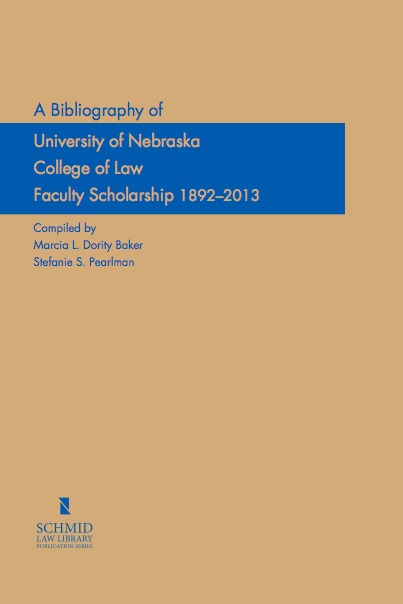
  Faculty Bib book cover

Two of the reference librarians at my school, Marcia Dority Baker and Stefanie Perlman, have compiled and published a bibliography of all the scholarship by Nebraska College of Law faculty going back to 1892: Marcia L. Dority Baker & Stefanie S. Perlman, A BIBLIOGRAPHY OF UNIVERSITY OF NEBRASKA COLLEGE OF LAW FACULTY SCHOLARSHIP 1892-2013 (2014).

I don’t know if others schools have done anything like this, but I think it’s a great idea. It’s really interesting to look at what people were writing one hundred years ago, and to consider the body of work of my current colleagues, only a couple of whom I believe were here a hundred years ago. I found the 14 pages of entries for the great legal scholar Roscoe Pound, including dozens of books, humbling.

On the domestic front, I’m happy to report that my listing is twice as long as my wife’s, although I’m not sure she will be happy to know that I reported that. I want to make it clear that she was not here a hundred years ago.

My law school, the University of Nebraska, has received quite a bit of favorable publicity because of its rise in the U.S. News and World Report rankings. We’re now 54th, having risen 35 places in the last two years.

The University and the Dean are publicizing our new ranking; the local newspaper has noted it; we even got a favorable mention in the Wall Street Journal’s Law Blog.

But, as people much smarter than me have pointed out (in more gentle language), the U.S. News rankings are crap. U.S. News takes a series of numbers that have little to do with the quality of legal education offered by a school, weights each of those numbers in a semi-random way, and produces a final number that’s as faulty as the inputs. But the mathematical mystery and precision lead some people to give it more credence than it deserves.

Those numbers were crap when my school was ranked significantly lower and they’re still crap now that my school’s ranking is higher. The reliability of an index doesn’t depend on how high or low one falls on that index.

I don’t blame my University or my Dean for promoting those numbers.

The federal restrictions on offering securities are a mess. Section 5, even with the recent additions of subsections (d) and (e), is short—less than 600 words by my count. However, as every Securities Regulation student comes to appreciate, that brevity is deceptive. Section 5 is incredibly complex. The SEC regulations increase that complexity: almost everything in Section 5 has been modified or displaced by SEC regulations.

Consider just the question of what an issuer may say before filing its registration statement. Section 5(c) says the issuer may not make an offer to sell the securities. But the SEC says “offer to sell” means more than just asking people to buy the securities. It includes any communication, even if you don’t mention the offering, that might generate public interest in buying the security, what the SEC calls conditioning the market. But, if it’s more than 30 days prior to when you’re going to file your registration statement, see Rule 163A. After that, see Rule 163, Rule 168, or Rule 169, depending on what type of company you are. But don’t mention the offering in any of those communications, unless, of course, you fit within Rule 135.

Or consider section 5(b)(1)’s bar