
Photo of Joan Heminway

Professor Heminway brought nearly 15 years of corporate practice experience to the University of Tennessee College of Law when she joined the faculty in 2000. She practiced transactional business law (working in the areas of public offerings, private placements, mergers, acquisitions, dispositions, and restructurings) in the Boston office of Skadden, Arps, Slate, Meagher & Flom LLP from 1985 through 2000.

She has served as an expert witness and consultant on business entity and finance and federal and state securities law matters and is a frequent academic and continuing legal education presenter on business law issues. Professor Heminway also has represented pro bono clients on political asylum applications, landlord/tenant appeals, social security/disability cases, and not-for-profit incorporations and related business law issues. Read More

On this Labor Day, some of us business law profs are about to start our semesters, while others are already a few weeks into the fall term.  However, we all understand that our profession involves labors of many kinds.  Seldom do we reflect on those labors with the thought of planning for a positive experience for all.  Today seems like a good time to do that.

A bit more than two weeks ago (August 15), as many of us were beginning to teach for the semester, our law professor colleague Etienne Toussaint (University of South Carolina Joseph F. Rice School of Law, @ProfToussaint) posted a set of tips and strategies for law professors on Twitter (rebranded as X).  His counsel is so wonderful–so apt.  I asked if I could re-publish his post here, and he gave me permission to do that.  So, here are Etienne’s words of advice, introduced as he introduced them in his original post.

I always get nervous, so planning helps.

Here are ten tips and strategies to help you (and me) get mentally prepared and set a positive tone in the classroom to ensure a great experience for both you and your students this upcoming academic
As you may recall, Ann and I got a bit wound up last summer about the Delaware General Assembly’s consideration of Delaware S.B. 313 (and, within it, the proposed addition of § 122(18) of the General Corporation Law of the State of Delaware (“DGCL”)). We each offered brief oral testimony and even wrote letters to the Delaware House Judiciary Committee, which you can find here and here.

A comrade in that effort, Mark Lebovitch, has taken time to reflect a bit on the crazy summer that brought a new and troubling corporate purpose to Delaware’s venerable corporate law and to prognosticate about the future impact of DGCL § 122(18).  The result?  Soap Opera Summer: Five Predictions About DGCL 122(18)’s Effect on Delaware Law and Practice.  The abstract follows.

Predictability and stability are often cited as leading reasons for why Delaware’s corporate law system is world renowned and widely emulated, giving the First State dominance in the competition for domiciling business entities. The first half of 2024 was anything but predictable and stable in Delaware’s legal community. Rarely has an amendment to the Delaware General Corporation Law (“DGCL”) triggered as much public debate as SB 313, which became effective

Lincoln Memorial University Duncan School of Law in Knoxville, TN, seeks entry-level and lateral candidates for full-time, tenure-track faculty positions starting July 2025. LMU Law aims to provide legal education to students from underserved regions, focusing on practice-oriented training for diverse backgrounds. The goal is to produce graduates who will pass the bar and serve their communities, particularly addressing the legal needs of Appalachia and other underserved areas.

We welcome applications from all subject areas, with particular need for expertise in business associations, civil procedure, evidence, property, constitutional law, and criminal law and procedure. As we expand our predominantly online hybrid program, we seek candidates across all doctrinal areas and are particularly interested in those who would enjoy the challenges of online teaching.

Educating the next generation of lawyers is our top priority. Faculty members are committed to supporting students in their academic, professional, and personal development. Our campus design ensures faculty accessibility and active engagement in law school life. We work collaboratively to provide innovative legal education, incorporating skill-based and experiential learning and best practices from academic and bar success. We seek candidates who share this ethos and are excited to contribute.

Candidates must have a J.D. or equivalent

Hiring Announcement: Emory University School of Law

Robert T. Thompson Professorship in Business Law

Emory University School of Law seeks applications from outstanding tenured scholars for the Robert T. Thompson Professorship in Law. This professorship recognizes outstanding achievement in scholarship and teaching in disciplines related to business law, including mergers & acquisitions, securities regulation, corporate finance, and other related business law fields.  Candidates should have exceptional records in research, teaching, and service and have attained a J.D., Ph.D., or equivalent degree. Candidates should currently hold a tenured academic appointment and should be eligible for appointment as a full professor at Emory. 

Candidates must complete the online application which requires creating an account, uploading a resume or CV, and providing basic demographic information. In addition, applicants should submit a cover letter, a current CV, a published or unpublished academic article, a brief research agenda, and an indication of teaching interests (if not listed on the CV) to the chair of the Appointments Committee: Professor Joanna Shepherd, at law.faculty.appointments@emory.edu. Applications will be considered on a rolling basis. 

Description

The Washington and Lee University School of Law warmly invites applications for up to two tenure-track or tenured faculty positions that will begin on July 1, 2025. We are excited to advance our trajectory of outstanding scholarship and teaching with these new hires. A central aspect of the mission of our Law School is to promote a diverse, equitable, and collaborative intellectual community. To do so, we continually strive to foster an inclusive campus community that recognizes the value of all persons regardless of identity. In keeping with the University’s Strategic Plan, we welcome applications from candidates belonging to communities traditionally underrepresented in the legal academy.

Qualifications

A J.D. from an ABA-accredited law school or equivalent is required. We particularly encourage applications from entry-level and junior lateral candidates (either pre-tenure or recently tenured) to join our faculty at the Assistant or Associate Professor level, but we welcome applications from candidates at all levels of experience. Candidates should have a distinguished record of scholarly achievement or demonstrated potential for high scholarly achievement, effective teaching, active service, and a record of inclusion. Our search will focus on applicants whose research and teaching interests include corporate and business law (including commercial law)

Last month I had the privilege of presenting some of my current work at Bocconi University in Milan, Italy.  The promotional poster for the event is included below. All of the workshop presentations (present company excepted) were engaging.

I presented on part of an ongoing research project–a series of papers on environmental, social, and governance (ESG) information.  The first two papers on the series, The Materiality of ESG Information: Why It May MatterT, 84 LSU L. Rev. 1365 (2024), and ESG and Insider Trading: Legal and Practical Considerations, 26 U. Penn. J. Bus. L. __ (forthcoming 2024), address the significance of ESG information under the U.S. federal securities laws and the potential and actual involvement of ESG information in insider trading.  In Milan, I shared my ideas and preliminary research for a third paper currently titled Corporate Information Compliance in an ESG World.  I expect to turn to work on this paper in earnest in the coming months.  I will briefly lay out my current thoughts here in the hope that you may have some feedback.

ESG information plays a role in many business operational settings that are invoked in legal compliance and addressed in compliance policies

AALS Section on Agency, Partnerships, LLCs, and Unincorporated Associations

Calls for Papers

The AALS Section on Agency, Partnerships, LLCs, and Unincorporated Associations is pleased to announce two calls for papers, one for a panel presentation and one for a works-in progress session geared to workshopping the research and writing of junior faculty.

Panel Presentation:

Up to three paper presenters will be selected for the section’s principal panel to be held during the AALS 2025 Annual Meeting in San Francisco, CA. The program is entitled Technology’s Intersection with Agency, Partnerships, and Unincorporated Associations. Co-Sponsored by the Sections on Technology, Law and Legal Education and Transactional Law and Skills, the session is designed to explore research and teaching involving the interactions of principal/agent relationships, partnerships, and unincorporated business associations with artificial intelligence, blockchains, cybersecurity, and other technological developments.

Works-in-Progress Session:

The section seeks paper proposals from junior scholars for a works-in-progress program.  Submissions for this session may relate to any topic within the scope of the law governing agency, partnerships, LLCs, or unincorporated associations.

Submission Information: 

To respond to either or both calls for papers, please submit a substantial abstract (five or more pages) or draft of an unpublished paper to

The Southern Illinois University Simmons Law School is searching for three tenure-track professors to join us next fall. The successful candidates will teach doctrinal law courses. Current needs include Criminal Law, Criminal Procedure, Evidence, Business Courses, Contracts, Labor & Employment, Family Law, and Trust & Estates. Other courses are dependent on the needs of the institution and the candidate’s experience. 

See the position description for additional information.

THE OHIO STATE UNIVERSITY MORITZ COLLEGE OF LAW

Location: Columbus, OH

Subjects: Contracts, Intellectual Property, Business Law, Constitutional Law Start Date: August 15, 2025

The Ohio State University Moritz College of Law seeks to hire up to two entry-level or lateral candidates for positions in Private Law (especially contracts, intellectual property, and business law and complementary areas, including securities regulation, corporate finance, and tax) and Public Law (especially constitutional law and complementary areas).

The Ohio State University’s Shared Values include Excellence and Impact, Diversity and Innovation, Inclusion and Equity, Care and Compassion, and Integrity and Respect. Ouruniversity community welcomes differences, encourages open-minded exploration and courageous thinking, and upholds freedom of expression. We define diversity broadly andvalue multiple dimensions of diversity, including, but not limited to, demographic, religion, country of origin, perspective, ability status, and background.

Ohio State prides itself on welcoming a wide range of viewpoints and providing opportunities for all to deepen and develop their intellectual curiosities. As a land-grant university, werecognize and understand that a diverse faculty, staff, and student body in which all may engage in open dialogue, be exposed to new ideas and perspectives, belong, and feel valuedand included is essential to our efforts in meeting

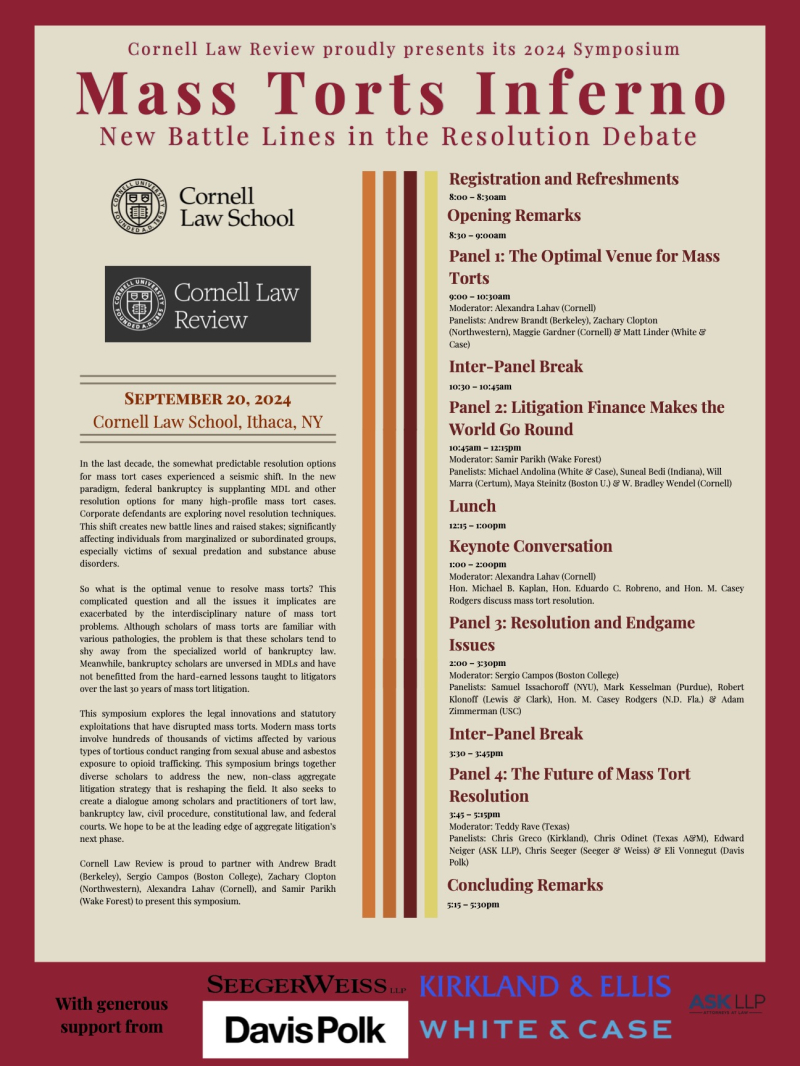
Cornell Law Review will be hosting its 2024 symposium, Mass Torts Inferno: New Battle Lines in the Resolution Debate, on September 20, 2024 in Ithaca, New York. Modern mass torts involve hundreds of thousands of victims affected by various types of tortious conduct ranging from sexual abuse and asbestos exposure to opioid trafficking. This symposium brings together diverse scholars to address the new, non-class aggregate litigation strategy that is reshaping the field. It also seeks to create a dialogue among scholars and practitioners of tort law, bankruptcy law, civil procedure, and constitutional law. The law review is proud to partner with Andrew Bradt, Sergio Campos, Zachary Clopton, Alexandra Lahav, and Samir Parikh to present this event.  

For those interested in attending, please contact Griffin Perrault at gp344@cornell.edu.

CornellPoster2024