Photo of Joan Heminway

Professor Heminway brought nearly 15 years of corporate practice experience to the University of Tennessee College of Law when she joined the faculty in 2000. She practiced transactional business law (working in the areas of public offerings, private placements, mergers, acquisitions, dispositions, and restructurings) in the Boston office of Skadden, Arps, Slate, Meagher & Flom LLP from 1985 through 2000.

She has served as an expert witness and consultant on business entity and finance and federal and state securities law matters and is a frequent academic and continuing legal education presenter on business law issues. Professor Heminway also has represented pro bono clients on political asylum applications, landlord/tenant appeals, social security/disability cases, and not-for-profit incorporations and related business law issues. Read More

At Emory Law’s Eighth Biennial Conference on the Teaching of Transactional Skills back in the fall of 2023, I had the privilege of presenting with my UT Law clinical teaching colleague, Brian Krumm.  (Congratulations are due to Brian, who was recently appointed the Interim Director of our Clayton Center for Entrepreneurial Law!)  The title of this post is also the title of our presentation.  An edited transcript of the presentation was recently published by Transactions: The Tennessee Journal of Business Law and can be found here. The abstract is as follows:

In this edited transcript, we explain how each of us–a doctrinal law professor and a clinician–use members of our campus and local communities to help instruct transactional business law students. We each have independently realized that there is a value to sharing these outside business and legal experts with our students. Among other things, we have found that we can bring unique areas of legal and business expertise into our teaching and, at the same time, introduce our students to real-life practice experiences and related simulations. All of this is foundational to law practice. In addition, experiences of this kind are, in our view, increasingly useful and

Over the years, I have written a number of blog posts here on Memorial Day that honor those who sacrificed their lives for us through national military service.  You can find the last few here, here, and here.  When practicable, I work in something about business law in those posts.

This year, as I contemplated what to write, I also was mired in grading and other teaching-related work.  On my mind throughout was generative artificial intelligence, a hot topic in law school circles and throughout education (and, of course, elsewhere, too).  The full range of benefits and burdens of generative artificial intelligence still remain to be discovered.

I wondered what a generative artificial intelligence tool would draft up as a blog post for Memorial Day.  Then, I thought, why wonder?  Why not give it a whirl?  So, I asked Google Gemini to “[w]rite a short blog post that combines business law with Memorial Day.”  Set forth below is what I got back.

Honoring Heroes, Respecting Rights: Business Law and Memorial Day

Memorial Day is a time to remember the brave men and women who died serving our country. But for businesses, it also presents some legal considerations.

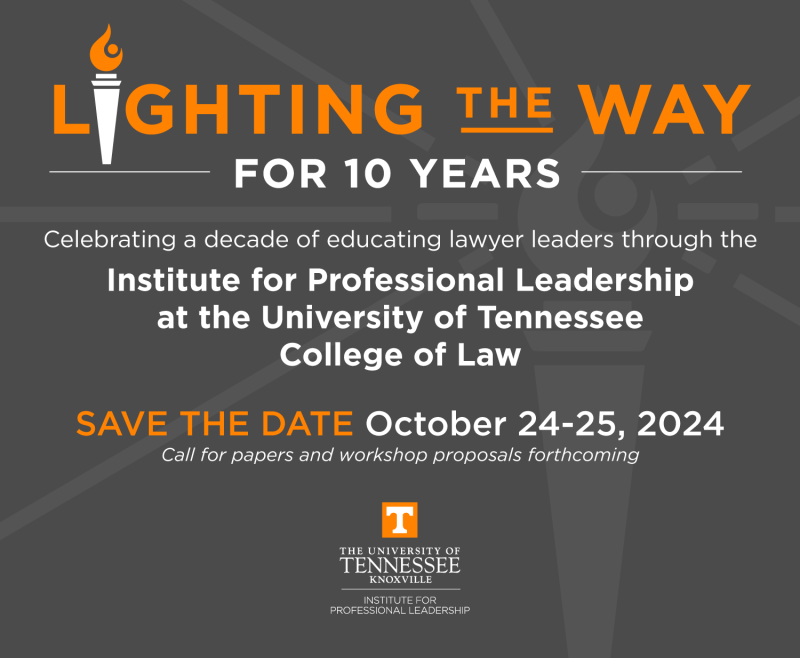
IPL(Symposium2024-SaveDate)

I have written in the past about the intersections of leadership and law, including business law.  See, for example,  here, here, here, here, and here.  And I was privileged to be the Interim Director, for over three years, of the institute for Professional Leadership at The University of Tennessee College of Law.  I find there is such a strong connection between leadership and business law teaching and practice . . . .

We are celebrating the tenth anniversary of the Institute for Professional Leadership this fall.  The celebration, which will take place on Thursday, October 24 and Friday, October 25, will include a gala dinner and a symposium featuring workshops, a call-for-papers panel, and a series of expert panels.  The “save the date” notice is included above.  I hope you will consider responding to the forthcoming call for proposals and papers.  But regardless, I hope you will consider attending. Feel free to reach out to me with any questions.

ESG greenwashing has been getting attention among legal academics.  In Rainbow-Washing, 15 Ne. U. L. Rev. 285 (2023), LMU Law’s John Rice explores the

increasingly common, but destructive, practice in which corporations make public-facing statements espousing their support of the LGBTQIA+ community . . . to draw in and retain consumers, investors, employees, and public support, but then either fail to fulfill the promises implicit in those statements or act in contravention to them. 

My own forthcoming article in the University of Pennsylvania Journal of Business Law, presented at the November 2023 ILEP-Penn Carey Law symposium honoring Jill Fisch, mentions the increasing notoriety of ESG greenwashing and cites to John’s article.

Last week, UVA Law Professor Naomi Cahn called out ESG greenwashing in Forbes, citing to a study to be published in the Journal of Accounting Research that finds “firms’ ESG rhetoric may not match their reality.”  She suggests that “a meaningful analysis of a firm’s ESG commitment requires much further digging, and ultimately it requires meaningful oversight from outside the ESG community on what should be disclosed and the accuracy of the reports.”  The article references a forthcoming book coauthored by Cahn, June Carbone (Minnesota

Corporate & Securities Litigation Workshop: 

Call for Papers 

UCLA School of Law, in partnership with the University of Illinois College of Law, University of Richmond School of Law, and Vanderbilt Law School invites submissions for the Eleventh Annual Workshop for Corporate & Securities Litigation. This workshop will be held on September 20-21, 2024 in Los Angeles, California. 

Overview 

This annual workshop brings together scholars focused on corporate and securities litigation to present their scholarly works. Papers addressing any aspect of corporate and securities litigation or enforcement are eligible, including securities class actions, fiduciary duty litigation, and SEC enforcement actions. We welcome scholars working in a variety of methodologies, as well as both completed papers and works-in-progress at any stage. Authors whose papers are selected will be invited to present their work at a workshop hosted by UCLA School of Law. Participants will pay for their own travel, lodging, and other expenses. 

Submissions 

If you are interested in participating, please send the paper you would like to present, or an abstract of the paper, to corpandseclitigation@gmail.com by Friday, June 7, 2024 Please include your name, current position, and contact information in the e-mail accompanying the

Check out the third issue of volume 73 of the DePaul Law Review!  It includes a series of papers emanating from the HBO series Succession.  As you may recall, I posted a call for papers for this issue about a year ago.  Most of the papers in the issue came from a venture originated and organized by Susan Bandes and Diane Kemker called the Waystar Royco School of Law.  I wrote about that enterprise here.  

I participated in the Waystar Royco School of Law Zoom meetings as the “Roy/Demoulas Distinguished Professor of Law and Business.”  I presented on fiduciary duty issues comparing the principals of two family businesses–The Demoulas family from Northern Massachusetts and Succession‘s Roy family from New York.  You can find my Zoom session here (Passcode: #hN+7J5N).  That presentation resulted in an essay that I wrote for the DePaul Law Review issue as well as an advanced business associations course based on the Succession series. I finish teaching that course this week.  I also presented on the topic of my Succession essay at the Popular Culture Association conference back in March.  I include a screenshot of my cover slide below.

I just posted the

I appreciate Ann’s super helpful post on omissions liability after the U.S. Supreme Court’s decision in Macquarie Infrastructure Corp. et al. v. Moab Partners, L. P., et al.  The hair splitting in that opinion is, in my view, dubious at best.  The Court’s creation of a legally significant concept of “pure omissions” in a public company disclosure context is doctrinally counterfactual.  The omission to state a fact required to be disclosed under a mandatory disclosure rule like Item 303 of Regulation S-K necessarily occurs in a veritable river of disclosures in SEC filings and more generally and has the potential of making those disclosures misleading.  If material, such an omission should be actionable as deceptive or manipulative conduct under Section 10(b) of and Rule 10b-5 under the Securities Exchange Act of 1934, as amended.  Period.

Of course. civil liability would require proof of all elements of the claim, including (even for public enforcement officials) the requisite state of mind or scienter.  Private class action plaintiffs also would have heightened pleading burdens.  And a criminal prosecution can only be sustained if the predicate conduct is willful, as provided in Section 32(a) of the Exchange Act.

The point is that

Widener University Commonwealth Law School is seeking to hire two visiting professors for the 2024-25 academic year.  We have strong needs in Property, Legal Methods and Contracts.  Additional courses are flexible but we have additional needs in the areas of environmental law, intellectual property, wills & trusts, administrative law and other upper level courses.  Interested persons should submit a cover letter and resume to Professor Robyn Meadows, Chair, Faculty Appointments Committee, at rlmeadows@widener.edu.  

A federal jury found Matthew Panuwat liable for insider trading late last week.  As you may recall, the U.S. Securities and Exchange Commission (SEC) brought an enforcement action against Mr. Panuwat in the U.S. District Court for the Northern District of California back in August 2021.  In that legal action, the SEC alleged that Mr Panuwat violated Section 10(b) of the Securities Exchange Act of 1934, as amended, and Rule 10b-5, seeking a permanent injunction, a civil penalty, and an officer and director bar. The theory of the case, as described by the SEC in a litigation release, was founded on Mr. Panuwat’s deception of his employer, Medivation, Inc., by using information obtained through his employment to trade in the securities of another firm in the same industry.

Matthew Panuwat, the then-head of business development at Medivation, a mid-sized, oncology-focused biopharmaceutical company, purchased short-term, out-of-the-money stock options in Incyte Corporation, another mid-cap oncology-focused biopharmaceutical company, just days before the August 22, 2016 announcement that Pfizer would acquire Medivation at a significant premium. Panuwat allegedly purchased the options within minutes of learning highly confidential information concerning the merger. According to the complaint, Panuwat knew that investment bankers had cited Incyte

Calling attention today to Sue Guan’s paper, Finfluencers and the Reasonable Retail Investor, posted on SSRN and forthcoming to the University of Pennsylvania Law Review Online.  The abstract is copied in below.

Much recent commentary has focused on the dangers of finfluencers. Finfluencers are persons or entities that have outsize impact on investor decisions through social media influence. These finfluencers increasingly drive investing and trading trends in a wide range of asset markets, from stocks to cryptocurrency. They do so because they can provide powerful coordination mechanisms across otherwise diffuse investor and trader populations. Of course, the more influence wielded over their followers, the easier it is for finfluencers to perpetrate fraud and manipulation.

The increase in finfluencing has highlighted a gray area in the securities laws: a finfluencer’s statements may not be factually untrue or clearly deceptive, but they can be interpreted as misleading depending on the context and the particular beliefs held by the finfluencer’s social media followers. Moreover, such statements can harm investors who buy or sell based on their interpretation of the finfluencer’s activity. In other words, finfluencers can easily profit off of their followers’ trading activity while steering clear of the securities laws.