Photo of Joan Heminway

Professor Heminway brought nearly 15 years of corporate practice experience to the University of Tennessee College of Law when she joined the faculty in 2000. She practiced transactional business law (working in the areas of public offerings, private placements, mergers, acquisitions, dispositions, and restructurings) in the Boston office of Skadden, Arps, Slate, Meagher & Flom LLP from 1985 through 2000.

She has served as an expert witness and consultant on business entity and finance and federal and state securities law matters and is a frequent academic and continuing legal education presenter on business law issues. Professor Heminway also has represented pro bono clients on political asylum applications, landlord/tenant appeals, social security/disability cases, and not-for-profit incorporations and related business law issues. Read More

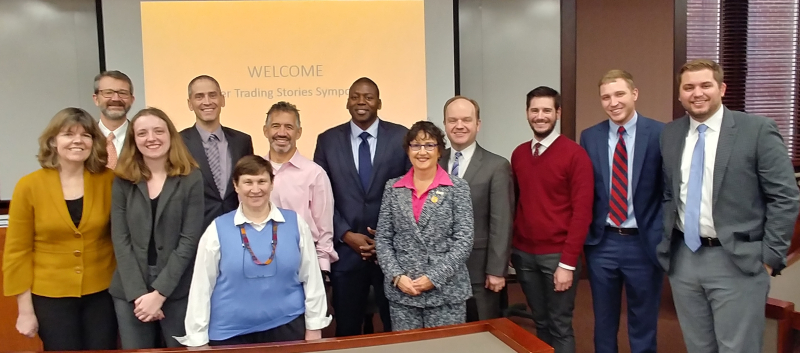
TJLP(InsiderTradingStories2019)

I was thrilled to be with so many wonderful colleagues and students (pictured above) at the Tennessee Journal of Law and Policy‘s symposium at UT Law last Friday.  The symposium, “Insider Trading: Stories from the Attorneys,” featured presentations about famous and not-so-famous insider trading cases.  Presenters included Michael Guttentag (Loyola, Los Angeles), me, Jeremy Kidd (Mercer), Ellen Podgor (Stetson), John Anderson (Mississippi College), Eric Chaffee (Toledo), Kevin Douglas (Scalia), and Donna Nagy (Maurer).  The papers presented highlight a variety of salient issues (including observations about the impact of gender and sexual orientation in specific cases or types of cases) involving or touching insider trading regulation.  They are being published in 2020 by the Tennessee Journal of Law & Policy.

The idea for the symposium came from a Southeastern Association of Law Schools (SEALS) discussion session convened last summer by John and me.  I described it in this post.  Let me or John know if you are working in the insider trading area and would like to join us for our 2020 SEALS discussion group, “Insider Trading: Is It All about the Money?”  The SEALS conference is scheduled to be held July 30 – August 5, 2020.  The

Korean-war-memorial-1809436_1920

The above photo honors my father’s U.S. Army service and my father-in-law’s U.S. Army service, in each case, in the Korean War.  I took a pause today to respect what they and so many others have done to serve our country.  I hope that all veterans and their families and friends have enjoyed a Happy Veteran’s Day.

With veteran legal service projects (some through student organizations, like our award-winning Vols for Vets organization at UT Law, a nonprofit supported by many in our community), including full-fledged law clinics (e.g., here and here and here and here and here), emerging across the country, I wondered whether there was any assistance outside the law school context, specifically for veterans who are entrepreneurs.  I did find, through a page on the U.S. Veterans Administration (VA) website, that the Office of Small & Disadvantaged Business Utilization has a program for Veteran-Owned Small Businesses.  Under the program, a veteran who owns a small business “may qualify for advantages when bidding on government contracts—along with access to other resources and support—through the Vets First Verification Program.”  A number of additional entrepreneurship programs exist under the auspices of the same VA office.  Many can be

I approached with some curiosity the Securities and Exchange Commission’s recent shareholder proposal guidance in Staff Legal Bulletin No. 14J (“SLB 14J”).  My interest in this topic stems from my past life as a full-time lawyer in private practice.  During that time, I both wrote shareholder proposals and wrote no-action letters to the Securities and Exchange Commission (“SEC”) to keep shareholder proposals out of corporate proxy statements.

In SLB 14J, the SEC clarifies its application of the “ordinary business” exception to the inclusion of a shareholder proposal under Rule 14a-8.  Specifically, “[t]he Commission has stated that the policy underlying the ‘ordinary business’ exception rests on two central considerations. The first relates to the proposal’s subject matter; the second relates to the degree to which the proposal ‘micromanages’ the company.”  I want to share the SEC’s guidance with you on the latter.

The idea of shareholders micromanaging most public firms is almost laughable.  Yet, certain shareholder proposals do get somewhat specific in their direction of the firm and its resources.

In considering arguments for exclusion based on micromanagement, . . . we look to whether the proposal seeks intricate detail or imposes a specific strategy, method, action, outcome or

The recent Tennessee Court of Appeals decision in Mulloy v. Mulloy has me thinking.  Here is the case synopsis:

Two brothers formed a limited liability company to own and lease a commercial property. When the tenant sought to expand, both brothers sought to find a suitable space for the tenant to lease. The younger of the two brothers found a property that would ideally suit the tenant’s needs, a fact that was communicated to his brother. The older brother purchased the property through a newly created limited liability company without his younger sibling’s involvement. The older brother’s new limited liability company then leased the new property to the tenant. The younger brother brought a derivative suit against his brother and the newly formed limited liability company, claiming usurpation of a corporate opportunity belonging to the limited liability company that the brothers had formed together and tortious interference with business relationships. The younger brother also claimed unjust enrichment. Following a trial, the chancery court found in favor of the older brother and his newly formed limited liability company and dismissed the complaint. After our review of the record, we affirm.

The facts are quite a bit more complex than that.  But

After spending the entire day grading undergraduate business law exams, I drove to my son’s elementary school for our first parent-teacher conference. On my wife’s advice, I mostly just listened. My legal and academic training have given me “a very particular set of skills” that I can use to construct and deconstruct arguments in a way some people find combative, so my wife’s advice was probably wise.

The parent-teacher conference for our kindergarten-aged son went well. Most important to me, it was clear that our son’s teacher already appeared to love him and seemed committed to helping him develop. But I worry about what our education system may do to my son. Only two months into formal school, my sweet son, who has been in speech therapy since age two, is already receiving grades. Granted, the grades are pretty soft at this point – 3 for mastery, 2 for on track to complete this year, 1 for behind schedule. I hope he will not get overly discouraged. I also know he will not receive nearly as much affirmation in school for his impressive, budding artistic skills as he would for a photographic memory. 

This parent-teacher conference, coupled with

Image result for Abhijit Banerjee, Esther Duflo and Michael Kremer

Congrats to MIT professors Abhijit Banerjee, Esther Duflo and Michael Kremer on their recent Nobel Prize in Economics

A few years ago, I completed Professors Banerjee and Duflo’s free online EdX course on “The Challenges of Global Poverty.”

Evidently, they are doing a rerun of that course, starting February 4, 2020. You can sign up here

BLPB2019(MergerPanel)

I want to follow on Colleen’s post from yesterday with my own Business Law Prof Blog Symposium commentary.  But first, I want to thank Colleen, Ben, Josh, Doug, Haskell, and Stefan for participating with me in the symposium this year.  Our continuing legal education attendees, as well as our faculty and students, love this symposium each year.  It always turns out to be a wonderful pot pourri of business law topics that literally connect the threads of what we do as business lawyers and business law educators.

Rather than being a featured presenter this year, I chose to present panel-style with two of my UT Law colleagues.  (That’s us, plus our student commentator, Dixon Babb, in the photo above.  Thanks for capturing that, Haskell!)  The panel was designed to describe different conceptions of mergers based on distinct areas of legal expertise, together with related professional responsibility commentary.  I chose my colleagues Don Leatherman and Tom Plank to join me for this session–Don a tax law practitioner and teacher and Tom a property law practitioner and teacher.  The reason for these choices was simple: the three of us had covered this issue before in an informal conversation, and I had found

The Kelley School of Business at Indiana University is hiring legal studies professors. Details about the positions below. 

———–

Tenure-Track Position(s)

The Kelley School of Business at Indiana University seeks applications for a tenured/tenure-track position or positions in the Department of Business Law and Ethics, effective fall 2020. The candidate(s) selected will join a well-established department of 25 full-time faculty members who teach a variety of courses on legal topics, business ethics, and critical thinking at the undergraduate and graduate levels. It is anticipated that the position(s) will be at the assistant professor rank, though appointment at a higher rank could occur if a selected candidate’s record so warrants. 

To be qualified, a candidate must have a J.D. degree (or equivalent terminal law degree) with an excellent academic record and must demonstrate the potential for outstanding teaching and research in law and/or ethics. We seek applicants with research and teaching interests across a broad range of law and ethics issues in business, and we would be pleased to receive applications from scholars whose research or teaching interests intersect with issues of racial, ethnic, and gender diversity and equity in corporate and work environments (including but not limited to corporate board

Today marks the 125th anniversary of our celebration of Labor Day as a U.S. national holiday.  As the U.S. Department of Labor reminds us:

Labor Day, the first Monday in September, is a creation of the labor movement and is dedicated to the social and economic achievements of American workers. It constitutes a yearly national tribute to the contributions workers have made to the strength, prosperity, and well-being of our country. . . .

The vital force of labor added materially to the highest standard of living and the greatest production the world has ever known and has brought us closer to the realization of our traditional ideals of economic and political democracy. It is appropriate, therefore, that the nation pays tribute on Labor Day to the creator of so much of the nation’s strength, freedom, and leadership – the American worker.

Certainly, there remains much to celebrate.  Yet, an online piece written two years ago that focuses in on the history in a more detailed way offers words of caution:

The original holiday was meant to handle a problem of long working hours and no time off. Although the battle over these issues would seem to have been won

The City University of New York (CUNY) School of Law seeks highly-qualified candidates for a tenured or tenure-track faculty appointment to begin in Fall 2020. The principal responsibility of this faculty member will be to teach business law related courses, including Business Associations, U.C.C. Survey, and Contracts. All faculty are also expected to teach our first-year Lawyering course on a rotating basis, and all faculty are expected to teach in both the day and evening programs on a rotating basis.

CUNY SCHOOL OF LAW: “LAW IN THE SERVICE OF HUMAN NEEDS

CUNY School of Law is a national leader in progressive legal education: we are ranked first in the country for public interest law and third in the county for clinical programs, and we are one of the most diverse law schools in the nation.

Our mission at CUNY School of Law is two-fold: training public interest attorneys to practice law in the service of human needs; and providing access to the profession for members of historically underrepresented communities. The Law School advances that mission though an innovative curriculum that brings together the highest caliber of clinical training with traditional doctrinal legal education to train lawyers prepared to serve