
Photo of Joan Heminway

Professor Heminway brought nearly 15 years of corporate practice experience to the University of Tennessee College of Law when she joined the faculty in 2000. She practiced transactional business law (working in the areas of public offerings, private placements, mergers, acquisitions, dispositions, and restructurings) in the Boston office of Skadden, Arps, Slate, Meagher & Flom LLP from 1985 through 2000.

She has served as an expert witness and consultant on business entity and finance and federal and state securities law matters and is a frequent academic and continuing legal education presenter on business law issues. Professor Heminway also has represented pro bono clients on political asylum applications, landlord/tenant appeals, social security/disability cases, and not-for-profit incorporations and related business law issues. Read More

In this semester’s student mentorship group, we have been discussing personal priorities and principles. The consensus from the students seems to be that this topic is not only useful, but also more difficult than originally envisioned. A number of the students expressed a lack of clarity regarding their own priorities and life principles, but they recognized the need for deep thinking about those things.

Outlining priorities and principles could be a useful exercise for politicians and professors as well. Without a clear understanding of our priorities and principles, we often drift toward our political parties and the visible rewards dangled in front of us.

Regarding both politicians and professors, I am most inspired by those who take stands that do not benefit their party or themselves, but rather make the stand because it is the “right thing” to do. Professors, obviously, have more freedom to seek and speak the truth, but I think that professors’ impact will be greater if they stick to their principles regardless of the party in power.

Of course sticking to priorities and principles does not guarantee a good or admirable outcome. One must have “good” priorities and principles. What qualifies as “good” is beyond the scope of

By now, I am sure virtually all of our readers have heard about the United Airline issue involving the dragging of a passenger off the plane.

If not, you can catch up here, here, and here. And you can watch the viral video here.  

Shortly following the incident, United Airlines stock dropped sharply, losing hundreds of millions of dollars of value. (Of course, it is difficult to tell how much of this drop is related to the incident).

The CEO of United Airlines’ first public statement was tone deaf at best. He wrote, “I apologize for having to re-accommodate these customers” when better terms would have been “unacceptable” and “immediate corrective procedures.” There is not evidence that they “had” to remove passengers; they removed passengers because they wanted to transport some of their employees on that flight. The internal e-mail to the corporation’s employees was no better, calling the passenger “disruptive and belligerent.”

My social media feeds, which include many lawyers and legal academics, are full of debate over whether United Airlines acted within the bounds of the law and their terms & conditions. While this is an interesting discussion, I think it is largely beside the point in this case. Regardless of

Barkley

Today’s topic does not have a direct connection to business law, but I do think toughness is important to students, professors, and lawyers. And the Barkleys Marathon is all about toughness, and maybe insanity. So indulge me. I have been thinking about the race, which happened this past weekend, all week. My wife said I wasn’t allowed to talk about the Barkley Marathons anymore, so I am going to write about it here.

If you have not seen the documentary on Netflix entitled The Barkley Marathons: The Race that Eats its Young, watch it. See the documentary’s trailers here and here. See more about the race here.

I will save you from this overlong, mostly unrelated post with a page break, but if you are interested, you can proceed and read below.

As Professor Steve Bainbridge and others reported last May, SSRN was sold to Elsevier

Until a few weeks ago, I hadn’t noticed much of a difference, except for an improved layout on the article pages.

After posting my American Business Law Journal (“ABLJ”) article, however, I got an e-mail that my article had been taken down. They claimed that the copyright was held by the ABLJ, which is simply incorrect, as my contract with Wiley (the publisher of the ABLJ) clearly states “The Author retains ownership of the copyright in the Article,” and the contract explicity allows me to post the article (including on SSRN) with citation. (Section 2.1)

I sent SSRN my contract and waited a number of days without a response. I then called SSRN’s help line and received an apology, but the person did not have the ability to post my article even though she said that they had received the contract and that everything was cleared. The article is now up (and went up shortly after my phone call to SSRN), unless they have already taken it down again.

The whole thing was quite a hassle, and I am not quite sure why they flagged this article.

I

Attorney Kyle Westaway has started a monthly e-mail that compiles information about social enterprise and impact investing law. You can subscribe here.

In the latest Impact Esq. newsletter, Kyle included a link to the Kickstarter’s 2016 Benefit Statement. Kyle wrote that he had “never seen [a benefit report] as strong as Kickstarter’s.” Personally, I am not sure I would go that far. I think Greyston Bakery’s Report and Patagonia’s Report are at least as good. I do think the Kickstarter report is relatively good, but the bar is incredibly low, as many benefit corporations are ignoring the statutory reporting requirement or doing a pathetically bad job at reporting.

While the Kickstarter report is more detailed than most, it still reads mostly like a PR piece to me. The vast majority of the report is listing cherry-picked, positive statistics. That said, Kickstarter did note a few areas for possible improvement, which is extremely rare in benefit report. Kickstarter stated that they could do more to promote “sustainability,” that they could do more to encourage staff to “take advantage of the paid time off we provide for volunteering,” and that they wanted to “encourage greater transparency from creators, better educate

Professor Keith Diener of Stockton University School of Business, who is a former law school classmate of mine and the current managing editor of the Atlantic Law Journal, agreed to answer some questions related to the journal.  

The flagship journals for the Academy of Legal Studies in Business (“ALSB”) are the American Business Law Journal (ABLJ) and the Journal of Legal Studies Education (JLSE, primarily pedagogy articles and teaching cases). In addition to these two journals, each regional association is generally responsibly for at least one journal with the Atlantic Law Journal coming out of the Mid-Atlantic region.

As Keith explains below, these journals are open to a wide range of scholars, including professors from law schools. I would encourage legal scholars who have not published in a traditional peer reviewed journal to consider submitting to one of the ALSB journals. I have published in both the ABLJ and the JLSE, and I have had good experiences in both cases.

———- 

Please provide us a brief overview of the Atlantic Law Journal and the MAALSB.

The Mid-Atlantic Academy for Legal Studies in Business (MAALSB) is an association of teachers and scholars primarily in the fields of business law, legal environment, and law-related courses outside

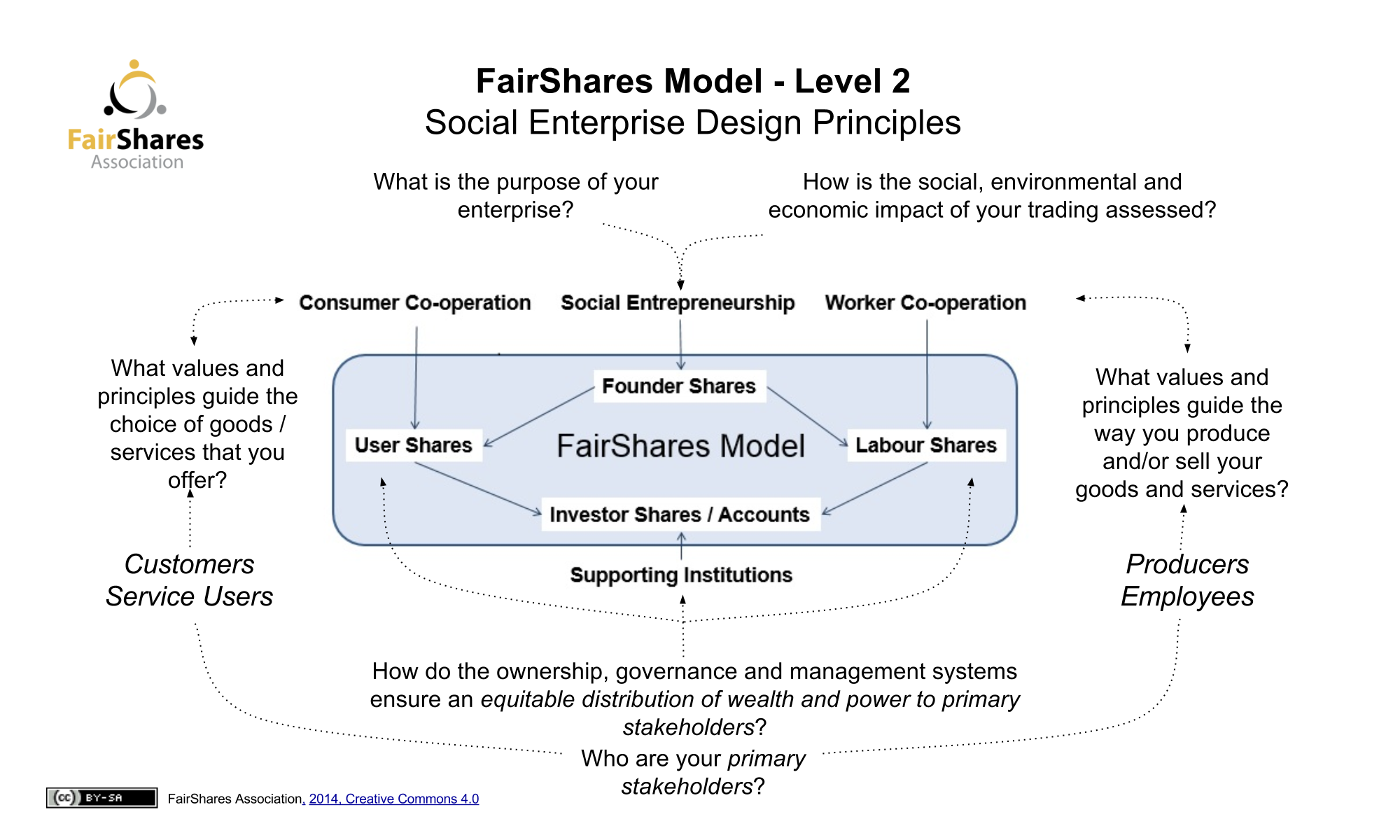
On of the many interesting things discussed during the social enterprise law workshop at Notre Dame Law School was the “FairShares Model.” Nina Boeger (University of Bristol-UK) brought the model to the group’s attention, and the model was new news to me.

The FairShares Model was “created during a research programme on democratising charities, co-operatives and social enterprises involving academics at Sheffield Hallam University and Manchester Metropolitan University in the UK.”

The FairShares Model cites the “Social Enterprise Europe Ltd” when noting that social enterprises “aim to generate sustainable sources of income, but measure their success through:

  • Specifying their purpose(s) and evaluating the impact(s) of their trading activities;

  • Conducting ethical reviews of their product/service choices and production/consumption practices;

  • Promoting socialized and democratic ownership, governance and management.”

To address theses aims, the FairShares Model offers social audits and suggests the issuing some combination of (1) founder shares, (2) labour shares, (3) investor shares, (4) user shares.

While I agree that significant corporate governance changes should be considered, at first glance this model seems a bit unwieldy if all four types of shares are issued. Still, I am interested in learning more. 

With co-editor Joan Heminway (and Anne Tucker via Skype), I am at Notre Dame for a symposium on social enterprise law. I will be presenting on aforthcoming book chapter, which builds on my stakeholder advisory board idea. My article Adopting Stakeholder Advisory Boards article was recently published in the American Business Law Journal and I posted it to SSRN this week. The abstract is reproduced below.

———–

Over the past decade, interest in socially responsible business has grown exponentially. The social business movement seeks to have firms focus on the interests of all corporate stakeholders, rather than solely the financial interests of shareholders. Coupled with the social business movement of the past decade has been the passage of social enterprise statutes by over thirty states. The social enterprise statutes provide legal frameworks for firms that seek profit alongside broader social and environmental ends. A plethora of social enterprise legal forms have been created in the United States since 2008, including benefit corporations, public benefit corporations, benefit LLCs, low-profit limited liability companies (L3Cs), general benefit corporations, specific benefit corporations, sustainable business corporations, and social purpose corporations.

Despite the interest in social business and the passage of numerous social enterprise laws, the basic

I have updated my business law professor jobs list here

While many of the schools on this list, which was originally posted this past summer, have likely now filled those positions, there are a few new postions posted in the last month or so.

Those new position postings include two in law schools: NYU (a law & social enterprise fellowship) and Victoria University (New Zealand). And five new postings are legal studies positions in business schools: Appalachian State University, Minnesota State University, Morgan State University, St. Peter’s University, and Warner University.