Photo of Marcia Narine Weldon

Professor Narine Weldon is the director of the Transactional Skills Program, Faculty Coordinator of the Business Compliance & Sustainability Concentration, Transactional Law Concentration, and a Lecturer in Law.

She earned her law degree, cum laude, from Harvard Law School, and her undergraduate degree, cum laude, in political science and psychology from Columbia University. After graduating, she worked as a law clerk to former Justice Marie Garibaldi of the Supreme Court of New Jersey, a commercial litigator with Cleary, Gottlieb, Steen and Hamilton in New York, an employment lawyer with Morgan, Lewis and Bockius in Miami, and as a Deputy General Counsel, VP of Global Compliance and Business Standards, and Chief Privacy Officer of Ryder, a Fortune 500 Company. In addition to her academic position, she serves as the general counsel of a startup and a nonprofit.  Read More

Many financial industry analysts are bearish on the oil industry right now. I’m not sure they’re right, as I note below, but I also think it’s important to recognize that financial market impact of oil price fluctuations is not the only impact U.S. oil production has on markets generally.

One thing I want to make clear at the outset, though, is that I am not a financial analyst, or an economist (as I have previously noted). My comments here are reactions to things analysts are saying based on my experience researching U.S. shale oil markets and activity, as well as the U.S. transportation sector in recent years.  My thoughts are related to my expectations for how I think the companies and people in the industry are likely to react, and reflect my hope that financial market changes don’t negatively impact other essential planning, in areas related to health, safety, and the environment, the industry desperately needs.

Back to the market predictions:  Goldman Sachs and some other analysts see the oil sector as over saturated and anticipate continued supply gluts to keep prices down.  According to a report from Goldman analysts, U.S. price indicator West Texas Intermediate (WTI) crude will fall

In Business Organizations today, I spent some time reviewing the differences between varying entity types.  I made the point that courts often make mistakes on this front, especially with LLCs and corporations, and it reminded me I needed to follow up on my own pet LLC protection project. 

Over the years, I have taken more than a passing interest in how often courts refer to (and ultimately treat) LLCs. I have this thing where I think LLCs are not treated as well doctrinally as they should. In February of this month, I made the argument,  Courts Should Get the Doctrinal Distinction Between LLCs and Corporations, and I have made other similar arguments (herehere, and here).  

As part of this I committed to noting when courts refer to LLCs as “limited liability corporations” and not “limited liability companies,” as they should.  Almost one year ago, I noted this continuing theme, repeating the search I did for a 2011 article, where I found in a May 2011 search of Westlaw’s “ALLCASES” database that there were 2,773 documents with the phrase “limited liability corporation,” in describing an LLC. (That article is here.)  Things are not getting much better.

To be clear, I’m not an economist. I do, however, have an interest in economics, economic theory, and especially behavioral economics.  I incorporate basic concepts of economics into my courses, especially Business Organizations and Energy Law.   This week’s announcement of  Jean Tirole as the 2014 Nobel Laureate in economics thus caught my eye.  

I admit I did not much about Tirole before the announcement, and after just a little reading, it’s clear to me that I need to know more.  A nice summary of Tirole’s work (written by Tyler Cowen) can be found here. Cowen introduces the announcement and Tirole this way:

A theory prize!  A rigor prize!  I would say it is about principal-agent theory and the increasing mathematization of formal propositions as a way of understanding economics.  He has been a leading figure in formalizing propositions in many distinct areas of microeconomics, most of all industrial organization but also finance and financial regulation and behavioral economics and even some public choice too.  He is a broader economist than many of his fans realize.

Tirole is a Frenchman, he teaches at Toulouse, and his key papers start in the 1980s.  In industrial organization, you can think of him
Maryland State Senator and American University Washington College of Law professor Jamie B. Raskin recently wrote an opinion piece for the Washington Post, A shareholder solution to ‘Citizens United’. In the piece, he explains that 

Supreme Court Justice Anthony M. Kennedy’s majority opinion in Citizens United essentially invites a shareholder solution. The premise of the decision was that government cannot block corporate political spending because a corporation is simply an association of citizens with free-speech rights, “an association that has taken on the corporate form,” as Kennedy put it. But if that is true, it follows that corporate managers should not spend citizen-shareholders’ money on political campaigns without their consent.

Senator Raskin further notes that the Congress doesn’t appear interested in moving forward with the Disclose Act, and the Securities and Exchange Commission has not pursued requiring campaign spending disclosures.  In response, the senator has a proposal:

Our best hope for change is with the state governments that regulate corporate entities throughout the year and receive regular filings from them. I am introducing legislation in January that will require managers of Maryland-registered corporations who wish to engage in political spending for their shareholders to post all political expenditures on company Web sites within 48 hours and confirm that any political spending fairly reflects the explicit preference of shareholders owning a majority interest in the company.

Further, if no “majority will” of the shareholders can form to spend money for political candidates — because most shares are owned by institutions forbidden to participate in partisan campaigns — then the corporation will be prohibited from using its resources on political campaigns.

Back in early 2010, as a guest blogger here, I wrote a post, Citizens United: States, where I noted my reaction to the case, which was that I wondered how states would react and that the case made the issue “an internal governance issue, which is a state-level issue.” (Please click below to read more.)

There is a growing drumbeat for banning laptops in the classroom, as a recent New Yorker article explained. The current case for banning laptops appeared on a Washington Post blog (among other places), in a piece written by Clay Shirky, who is a professor of media studies at New York University, and holds a joint appointment as an arts professor at NYU’s graduate Interactive Telecommunications Program in the Tisch School of the Arts, and as a Distinguished Writer in Residence in the journalism institute.

The piece makes a compelling case for banning laptops, and I agree there are a number of good reasons to do so.  I’ll not recount the whole piece here (I recommend reading it), but here’s a key passage:

Anyone distracted in class doesn’t just lose out on the content of the discussion but creates a sense of permission that opting out is OK, and, worse, a haze of second-hand distraction for their peers. In an environment like this, students need support for the better angels of their nature (or at least the more intellectual angels), and they need defenses against the powerful short-term incentives to put off complex, frustrating tasks. That support and those defenses

(Note:  This is a cross-posted multiple part series from WVU Law Prof. Josh Fershee from the Business Law Prof Blog and Prof. Elaine Waterhouse Wilson from the Nonprofit Law Prof Blog, who combined forces to evaluate benefit corporations from both the nonprofit and the for-profit sides.  The previous installments can be found here and here (NLPB) and here and here (BLPB).)

In prior posts we talked about what a benefit corporation is and is not.  In this post, we’ll cover whether the benefit corporation is really necessary at all. 

Under the Delaware General Corporation Code § 101(b), “[a] corporation may be incorporated or organized under this chapter to conduct or promote any lawful business or purposes . . . .” Certainly there is nothing there that indicates a company must maximize profits or take risks or “monetize” anything. (Delaware law warrants inclusion in any discussion of corporate law because the state’s law is so influential, even where it is not binding.) 

Back in 2010, Josh Fershee wrote a post questioning the need for such legislation shortly after Maryland passed the first benefit corporation legislation:

I am not sure what think about this benefit corporation legislation.  I can understand how expressly stating such public benefits goals might have value and provide both guidance and cover for a board of directors.  However, I am skeptical it was necessary. 

Not to overstate its binding effects today, but we learned from Dodge v. Ford that if you have a traditional corporation, formed under a traditional certificate of incorporation and bylaws, you are restricted in your ability to “share the wealth” with the general public for purposes of “philanthropic and altruistic” goals.  But that doesn’t mean current law doesn’t permit such actions in any situation, does it? 

The idea that a corporation could choose to adopt any of a wide range of corporate philosophies is supported by multiple concepts, such as director primacy in carrying out shareholder wealth maximization, the business judgment rule, and the mandate that directors be the ones to lead the entity.  Is it not reasonable for a group of directors to determine that the best way to create a long-term and profitable business is to build customer loyalty to the company via reasonable prices, high wages to employees, generous giving to charity, and thoughtful environmental stewardship?  Suppose that directors even stated in their certificate that the board of directors, in carrying out their duties, must consider the corporate purpose as part of exercising their business judgment. 

Please click below to read more.

After my long trip away from my wonderful family in western North Dakota, I stopped in Chicago for the ABA Site Evaluation Workshop on my way home.  I’m not quite where my co-blogger is on the whole accreditation thing, but it was not my favorite thing to add another day away from my family. On the plus side, I got to see my brother and his family the night before it, and I appreciated my time with my colleagues from WVU and beyond, so it was okay.  

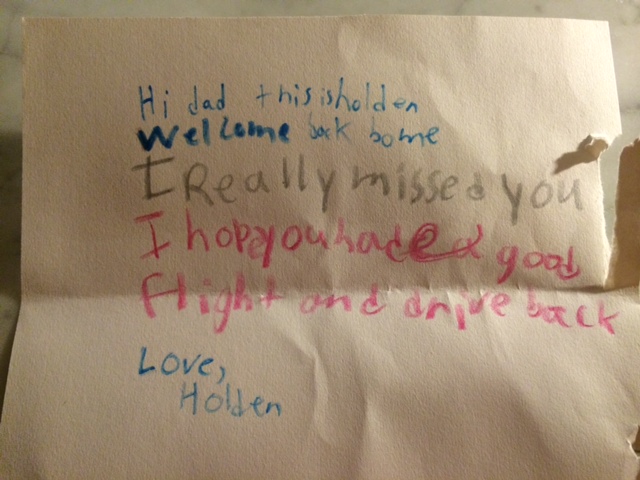
It was hard to be away, but it sure was a great to get home. I even got to come home to this after a long five days: 

H

On so many levels, I am very, very fortunate. 

Today started in Williston, ND, and we then went to Mountrail County.  We vistied Tioga and Stanley, then headed south through New Town and Killdeer on the way back to Dickinson, where we stay tonight before flying out tomorrow morning (ridiculously early, I might add). 

We started the day at Williston State College, where we learned about the TrainND program and other degree programs.  TrainND works with companies to do OSHA and other safety training, and trained more than 16,000 people last, the vast majority of whom were employed.  The College also offers degree programs for those seeking to be Lease Operators and PLC-trained operators. Interesting for academics, the college had 38% turnover last summer.  The college has invested in campus housing for faculty, which can be part of the incentive package to bring people.  Apartments run from $2600/mo for 1 and 2 BR options, with home rentals over $3K.  Seventy percent of new faculty hires are moving into the new campus housing apartments (which looked nice from the outside). Just like the industry, the college is “catching up” with the whole thing. 

We saw more densely packed well sites, such at this 9-pack (nine wells on one

We covered a lot of ground today, driving up from Medora, ND, to Williston, ND, through Watford City.  The traffic was not terrible for us, though the truck traffic and the road construction was slow going for a while.  We’re told we missed the worst of the traffic because our timing was good. It still felt like big city traffic in what is not a big city.  Traffic

Watford City has been a prime example of a place where the oil boom has caused significant growing pains. A recent article in The Atlantic asked, What If Your Small Town Suddenly Got Huge?, and explained: 

The Bakken oil boom has brought rapid growth to many towns and cities in western North Dakota, including Williston, north of the Missouri River, and Dickinson, alongside Interstate 94. But Watford City, where the population has jumped from just 1,400 people six years ago to more than 10,000 today, has experienced a particularly dramatic shift in character. 

There is dirt being moved everywhere: for roads, for housing, and, of course, for oil.  Driving this region you see very few homes, rolling hills, a few small buttes, and some abandoned farm homes. Oil wells blend in surprisingly well

Following are some pictures from my adventures so far, as described in my prior posts on my Bakken Oil trip in western North Dakota, here and here. Thanks to co-blogger Haskell Murray for the suggestion.

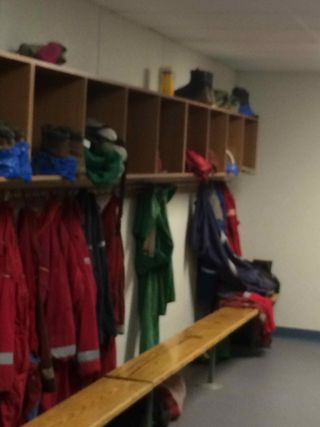
 This is a picture of one of the mudrooms from a crew camp near Dickinson, ND, in Dunn County:

Mudroom

This is a VIP room in the same facility. It has a private bath, while other rooms are smaller and share a jack-and-jill style bathroom. 

VIP

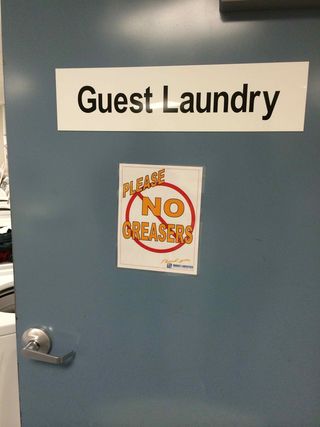
This is the sign for the guest laundry — No Greasers. 

NoGrease

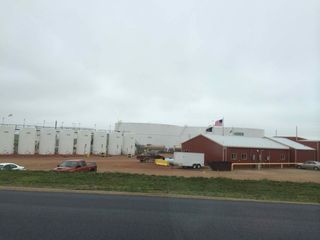
This is a picture of the crude oil site for loading oil on the tanker cars.  

OIlfield

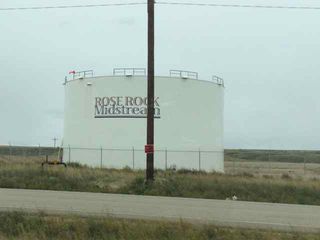
A crude storage tank: 

CrudeStorage

Most of the oil coming out of North Dakota, 1 million barrels a day, is shipped by rail: 

Railcars

This is North Dakota crude. It comes from the ground a little more orange in color, but mellows to this over time.  It’s not thick; it almost like iced tea. 

NDCrude

Flaring natural gas remains a problem, though some gathering is underway to help reduced the amount of flaring in the state. 

Flare

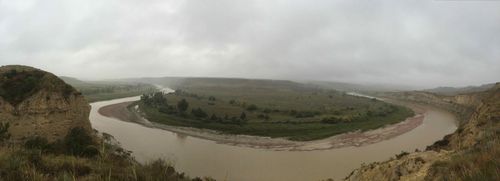
Finally, some pictures from Theodore Roosevelt National Park:

TRPark1

TR2

Ttpan

TRHorses