
For last year’s Business Law Prof Blog symposium at UT Law, I spoke on issues relating to the representation of business firms classified or classifiable as social enterprises.  Last September, I wrote a bit about my presentation here.  The resulting essay, Lawyering for Social Enterprise, was recently posted to SSRN.  The SSRN abstract follows.

Social enterprise and the related concepts of social entrepreneurship and impact investing are neither well defined nor well understood. As a result, entrepreneurs, investors, intermediaries, and agents, as well as their respective advisors, may be operating under different impressions or assumptions about what social enterprise is and have different ideas about how to best build and manage a sustainable social enterprise business. Moreover, the law governing social enterprises also is unclear and unpredictable in respects. This essay identifies two principal areas of uncertainty and demonstrates their capacity to generate lawyering challenges and related transaction costs around both entity formation and ongoing internal governance questions in social enterprises. Core to the professionalism issues are the professional responsibilities implicated in an attorney’s representation of social enterprise businesses.

To illuminate legal and professional responsibility issues relevant to representing social enterprises, this essay proceeds in four parts.

A recent Tennessee court decision subtly notes that limited liability companies (LLCs) are not, in fact corporations. In a recent Tennessee federal court opinion, Judge Richardson twice notes the incorrect listing of an LLC as a “limited liability corporation.”  

First, the opinion states:

The [Second Amended Complaint] alleges that Defendant Evans is a resident of Tennessee, Defendant #AE20, LLC is a California limited liability company, and Defendant Gore Capital, LLC is a Delaware limited liability “corporation.”3

Gore Capital is in fact a limited liability company.

FERNANDO CAMPS, Pl., v. GORE CAPITAL, LLC, KARL JAMES, ANGELA EVANS, and #AE20, LLC, Defendants., 3:17-CV-1039, 2019 WL 2763902, at *1 and n.3 (M.D. Tenn. July 2, 2019) (emphasis in original). 

Judge Richardson later notes, in footnote 11:

Plaintiff states that he was sent documents that listed Gore’s (not #AE20’s) principal place of business as being in Chattanooga, Tennessee, although the SAC lists Gore as a “Delaware limited liability corporation (sic)[.]”
Id. 2019 WL 2763902, at *6 n.11 (M.D. Tenn. July 2, 2019). 
 
Given all the times I have complained about courts not correcting such mistakes, I figured I should give this opinion a well-deserved shout out for getting this

Bird

“Bird Scooter” by mikecogh is licensed under CC BY-SA 2.0 

Here in Nashville, Mayor David Briley announced that he is seeking to ban scooters. This announcement follows the first scooter-related death in the city.

Currently, I am working on a project that looks at how social value is measured and reported. As I dig deeper, I am becoming even more convinced that measuring social value may be too difficult for us to do well.

Let’s take scooters as an example. How would you measure (and report) the social value of these scooter companies? How many points should a “third-party standard” assign for the jobs created, for the gasoline saved, for the affordable transportation provided, for the fun produced? How many points should you subtract for a death, for injuries, for obstructing sidewalks? In the language of the Model Benefit Corporation Legislation, how do you know if a scooter company is producing “[a] material positive impact on society and the environment, taken as a whole”?

Over the past few weeks, I’ve been diving into the B Impact Assessment, (which is the top third-party standard used by benefit corporations) and, frankly, the points assigned seem somewhat arbitrary

It has been kind of a unique end of the semester, and I am working feverously to get through my Business Organizations exams. I’m getting there.  So far, I have had zero exams reference a “limited liability corporation.”  If this holds, it will be at least three years in a row.  

I have had a couple of folks refer to LLC veil piercing as piercing the “corporate” veil (another no-no), and I did have some other “corporate” references to LLCs (e.g., “an LLC’s corporate formalities”), so we’re not all the way there. But so far, I am seeing improvement, and I appreciate the effort.  

Here’s hoping for 48 of 48 describing the LLC (as an entity) correctly.  I hope the rest of my colleagues are holding up well here in the home stretch. Good luck to all. 

A 2017 opinion related to successor liability just posted to Westlaw.  The case is an EEOC claim “against the Hospital of St. Raphael School of Nurse Anesthesia (“HSR School”) and Anesthesia Associates of New Haven (“AANH”), alleging gender discrimination and retaliation in violation of Title VII of the Civil Rights Act of 1964 . . . .” The plaintiff was seeking to join Yale New Haven Hospital (“YNHH”). MARGARITE CONSOLMAGNO v. HOSPITAL OF ST. RAPHAEL SCHOOL OF NURSE ANESTHESIA and ANESTHESIA ASSOCIATES OF NEW HAVEN, P.C., 3:11CV109 (DJS), 2017 WL 10966446, at *1 (D. Conn. Mar. 27, 2017). 


Apparently, the HSR School trained nurse anesthetists was owned and run by AANH a Connecticut “professional corporation.”  The plaintiff was in the HSR School for about six months before she was dismissed, she claimed, because of ” gender discrimination and retaliation for reporting a staff member’s inappropriate sexual conduct.” Id. The plaintiff sought to join YNHH because that entity took over running an anesthesia school that had been, in some form, the HSR school.  
 
The successor liability part is rather interesting, though largely devoid of facts from the transaction.  The court ultimately concludes that even though YNHH resumed a similar school,

Received today from BLPB friends Beate Sjåfjell and María Jesús Muñoz Torres:

Happy International Women’s Day! We celebrate this day by issuing the call for papers for the 5th international workshop of Daughters of Themis: International Network of Female Business Scholars. The theme is Finance for Sustainability; a highly topical theme! The deadline is 26 March, and we hope that the brief window of opportunity will be large enough for all interested to respond.

We appreciate if you would circulate this call to any interested colleagues identifying as female business scholars, including junior scholars (PhD candidates) as well as colleagues in lower-income countries. Please note that we this year do have some, very limited, funds available so that we can contribute to the funding for one or two participants based on financial hardship.

For those unfamiliar with Daughters of Themis: our annual workshop is the heart of our network, and you can read more here, reporting back from our three last workshops here: 2018, 2017 and 2016.

Please feel free to contact Beate or María Jesús with any questions you might have.

Unfortunately, this workshop overlaps a bit with the Grunin Center’s annual conference (which focuses in

Posted by request. Looks like a good event:

—————————————

Law and Ethics of Big Data
Hosted and Sponsored by:
Washington and Lee University School of Law
Lexington, Virginia

Co-Hosted by:
Kenan Institute for Ethics, Duke University; The Virginia Tech Center for Business Intelligence Analytics; The
Department of Business Law and Ethics, Kelley School of Business, Indiana University Bloomington

Wednesday-Thursday, April 24-25, 2019

Abstract Submission Deadline: Friday, March 1, 2019

We are pleased to announce the annual research colloquium, “Law and Ethics of Big Data,” which will be held this
year at Washington and Lee University School of Law in Lexington, Virginia. This year’s colloquium is co-hosted
by Associate Professor Margaret Hu at Washington and Lee University School of Law and Kenan Visiting Professor
at Duke University’s Kenan Institute for Ethics, Associate Professor Angie Raymond of Indiana University, and
Professor Janine Hiller of Virginia Tech.

Due to the success of this multi-year event that now is in its sixth year, the colloquium will be expanded and we seek broad participation from multiple disciplines. Please consider submitting research that is ready for the discussion stage. Each paper will receive detailed constructive critique. We are targeting cross-discipline opportunities for colloquium participants.

Examples of

In Business Organizations, I am in the early part of teaching agency and partnership. In my last class, we discussed Cargill, which is a fairly typical case to open agency discussions.  I like Cargill, and I think it is a helpful teaching tool, but I think one needs to go beyond the case and facts to give a full picture of agency. 

Of note, the case deals only with “actual agency” — for whatever reason, the plaintiffs did not argue “apparent agency” or estoppel in the alternative.  A. Gay Jenson Farms Co. v. Cargill, Inc., 309 N.W.2d 285, 290 n.6 (Minn. 1981) (“At trial, plaintiffs sought to establish actual agency by Cargill’s course of dealing between 1973 and 1977 rather than ‘apparent’ agency or agency by estoppel, so that the only issue in this case is one of actual agency. ”). I think this explains a lot about how the case turns out.  That is, the court recognized that to find for the farmer, there had to be an actual agency relationship.  

I don’t love this outcome because one of the hallmarks of an agency relationship is its reciprocal nature. That is, once we find an agency relationship, the

In Hexion Specialty Chemicals, Inc. v. Huntsman Corp., 965 A.2d 715, 730 (Del. Ch. 2008) – a case I worked on as a judicial clerk – the court wrote, “[m]any commentators have noted that Delaware courts have never found a material adverse effect to have occurred in the context of a merger agreement.”

That statement is no longer true.

Today–in a 3 page opinion–the Delaware Supreme Court affirmed the 240+ page opinion by Vice Chancellor Travis Laster in Akorn, Inc. v. Fresenius Kabi, AG, et al., which held that Akorn triggered the Material Adverse Effect (“MAE”) clause of the merger agreement at issue.

As the Chancery Daily reports, and as is clear looking at the recent opinions, the Delaware Supreme Court opinion does not provide much reasoning for its decision to affirm, but the Court of Chancery opinion does provide plenty of guidance. In the first few pages, the Court of Chancery notes that Akorn experienced a “dramatic, unexpected, and company-specific downturn in…business that began in the quarter after signing.” The Court of Chancery also notes the importance of whistleblower letters and issues with Akron and the FDA. 

Also of interest, the court notes that this

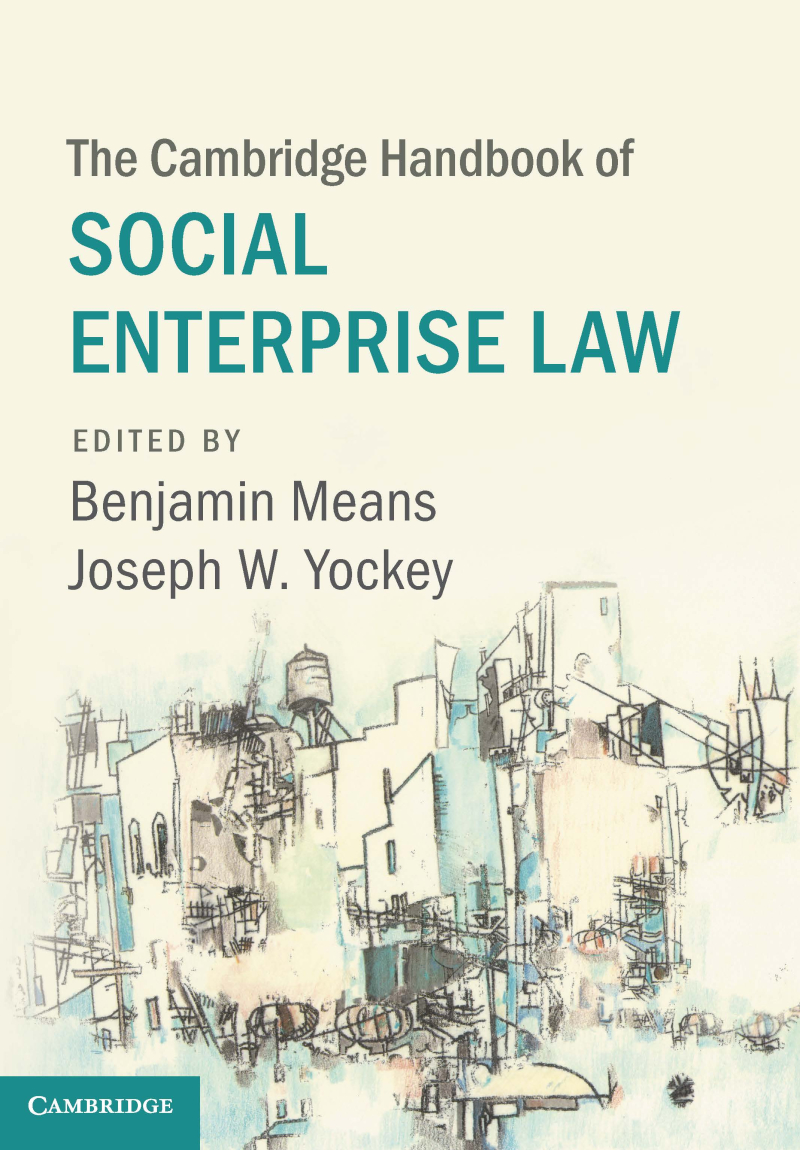
The Cambridge Handbook of Social Enterprise Law, edited by Ben Means (South Carolina) and Joe Yockey (Iowa) is at the printers and should be ready for orders in early 2019. 

My fellow BLPB editor Joan Heminway and I both have chapters in the book, along with many others. 

The introduction is posted on SSRN, for those who are interested. Also, editor Ben Means has many talents, as he did the cover artwork below as well.

The Cambridge Handbook of Social Enterprise Law_Cover