By now, I am sure virtually all of our readers have heard about the United Airline issue involving the dragging of a passenger off the plane.

If not, you can catch up here, here, and here. And you can watch the viral video here.  

Shortly following the incident, United Airlines stock dropped sharply, losing hundreds of millions of dollars of value. (Of course, it is difficult to tell how much of this drop is related to the incident).

The CEO of United Airlines’ first public statement was tone deaf at best. He wrote, “I apologize for having to re-accommodate these customers” when better terms would have been “unacceptable” and “immediate corrective procedures.” There is not evidence that they “had” to remove passengers; they removed passengers because they wanted to transport some of their employees on that flight. The internal e-mail to the corporation’s employees was no better, calling the passenger “disruptive and belligerent.”

My social media feeds, which include many lawyers and legal academics, are full of debate over whether United Airlines acted within the bounds of the law and their terms & conditions. While this is an interesting discussion, I think it is largely beside the point in this case. Regardless of

Attorney Kyle Westaway has started a monthly e-mail that compiles information about social enterprise and impact investing law. You can subscribe here.

In the latest Impact Esq. newsletter, Kyle included a link to the Kickstarter’s 2016 Benefit Statement. Kyle wrote that he had “never seen [a benefit report] as strong as Kickstarter’s.” Personally, I am not sure I would go that far. I think Greyston Bakery’s Report and Patagonia’s Report are at least as good. I do think the Kickstarter report is relatively good, but the bar is incredibly low, as many benefit corporations are ignoring the statutory reporting requirement or doing a pathetically bad job at reporting.

While the Kickstarter report is more detailed than most, it still reads mostly like a PR piece to me. The vast majority of the report is listing cherry-picked, positive statistics. That said, Kickstarter did note a few areas for possible improvement, which is extremely rare in benefit report. Kickstarter stated that they could do more to promote “sustainability,” that they could do more to encourage staff to “take advantage of the paid time off we provide for volunteering,” and that they wanted to “encourage greater transparency from creators, better educate

Ringling1

No.  This is not a travelogue.  Rather, it’s a brief additional bit of background on a case that business associations law professors tend to enjoy teaching (or at least this one does).

In Ringling Bros. Inc. v. Ringling, 29 Del. Ch. 610 (Del. Ch. 1947), the Delaware Chancery Court addresses the validity of a voting agreement between two Ringling family members, Edith Conway Ringling (the plaintiff) and Aubrey B. Ringling Haley (the defendant).  The fact statement in the court’s opinion notes that John Ringling North is the third shareholder of the Ringling Brothers corporation.

I spent two days in Sarasota Florida at the end of Spring Break last week.  While there, I spent a few hours at The Ringling Circus Museum.  It was fascinating for many reasons.  But today I will focus on just one.  I noted this summary in one of the exhibits, that seems to directly relate to the Ringling case:

Ringling2

Interestingly, 1938 is the year in which the plaintiff and defendant in the Ringling case created their original voting trust (having earlier entered into a joint action agreement in 1934).  The agreement at issue was entered into in 1941.  Could it be that, perhaps, the two women entered into

Professor Keith Diener of Stockton University School of Business, who is a former law school classmate of mine and the current managing editor of the Atlantic Law Journal, agreed to answer some questions related to the journal.  

The flagship journals for the Academy of Legal Studies in Business (“ALSB”) are the American Business Law Journal (ABLJ) and the Journal of Legal Studies Education (JLSE, primarily pedagogy articles and teaching cases). In addition to these two journals, each regional association is generally responsibly for at least one journal with the Atlantic Law Journal coming out of the Mid-Atlantic region.

As Keith explains below, these journals are open to a wide range of scholars, including professors from law schools. I would encourage legal scholars who have not published in a traditional peer reviewed journal to consider submitting to one of the ALSB journals. I have published in both the ABLJ and the JLSE, and I have had good experiences in both cases.

———- 

Please provide us a brief overview of the Atlantic Law Journal and the MAALSB.

The Mid-Atlantic Academy for Legal Studies in Business (MAALSB) is an association of teachers and scholars primarily in the fields of business law, legal environment, and law-related courses outside

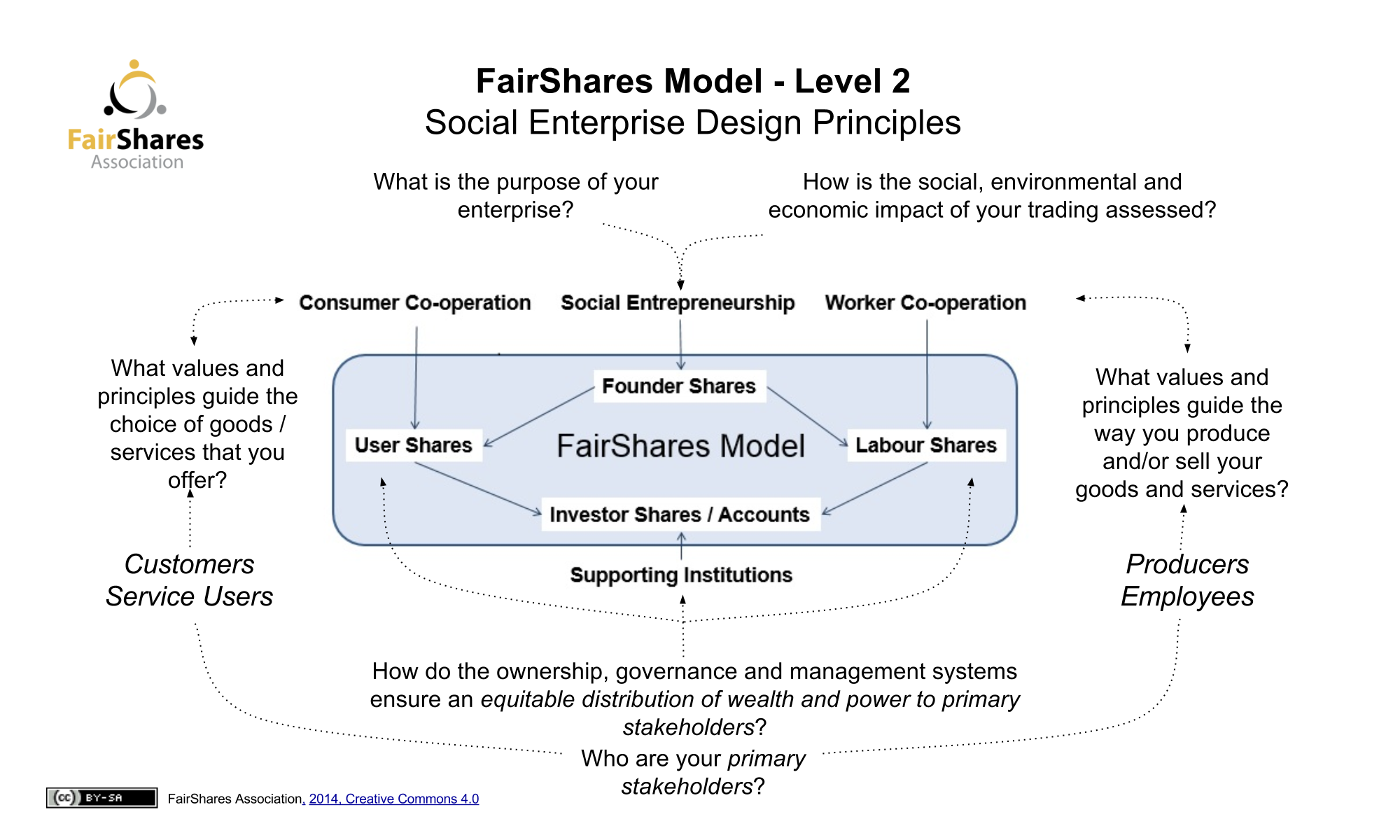
On of the many interesting things discussed during the social enterprise law workshop at Notre Dame Law School was the “FairShares Model.” Nina Boeger (University of Bristol-UK) brought the model to the group’s attention, and the model was new news to me.

The FairShares Model was “created during a research programme on democratising charities, co-operatives and social enterprises involving academics at Sheffield Hallam University and Manchester Metropolitan University in the UK.”

The FairShares Model cites the “Social Enterprise Europe Ltd” when noting that social enterprises “aim to generate sustainable sources of income, but measure their success through:

  • Specifying their purpose(s) and evaluating the impact(s) of their trading activities;

  • Conducting ethical reviews of their product/service choices and production/consumption practices;

  • Promoting socialized and democratic ownership, governance and management.”

To address theses aims, the FairShares Model offers social audits and suggests the issuing some combination of (1) founder shares, (2) labour shares, (3) investor shares, (4) user shares.

While I agree that significant corporate governance changes should be considered, at first glance this model seems a bit unwieldy if all four types of shares are issued. Still, I am interested in learning more. 

With co-editor Joan Heminway (and Anne Tucker via Skype), I am at Notre Dame for a symposium on social enterprise law. I will be presenting on aforthcoming book chapter, which builds on my stakeholder advisory board idea. My article Adopting Stakeholder Advisory Boards article was recently published in the American Business Law Journal and I posted it to SSRN this week. The abstract is reproduced below.

———–

Over the past decade, interest in socially responsible business has grown exponentially. The social business movement seeks to have firms focus on the interests of all corporate stakeholders, rather than solely the financial interests of shareholders. Coupled with the social business movement of the past decade has been the passage of social enterprise statutes by over thirty states. The social enterprise statutes provide legal frameworks for firms that seek profit alongside broader social and environmental ends. A plethora of social enterprise legal forms have been created in the United States since 2008, including benefit corporations, public benefit corporations, benefit LLCs, low-profit limited liability companies (L3Cs), general benefit corporations, specific benefit corporations, sustainable business corporations, and social purpose corporations.

Despite the interest in social business and the passage of numerous social enterprise laws, the basic

One of the many questions surrounding benefit corporations is whether their choice of legal entity form will scare away investors.

As previously reported, we now have our first publicly traded benefit corporation. And in this week’s news certified B corp and benefit corporation Data.world announced a 18.7 million dollar raise. This raise ranks in the top-ten largest raises by a benefit corporation, according to the information I have seen on benefit corporations. I compiled the publicly available information I was able to uncover on social enterprise raises (including by benefit corporations) in a forthcoming symposium article for the Seattle University Law Review. It is quite possible that there are raises that have been kept quiet and that I have not seen. This Data.world news was announced days after final edits and will not be in my article.

As is often the case in social enterprise news, this news could be seen as encouraging or discouraging for supporters of the benefit corporation form.

On one hand, this is a fairly sizeable raise and a bit of evidence that not all serious investors are scared away by a legal form that mandates a general public benefit purpose.

On the other hand, the mere fact

New job posting here; information below.

—–

How to Apply

A cover letter is required for consideration for this position and should be attached as the first page of your resume. The cover letter should address your specific interest in the position and outline skills and experience that directly relate to this position.

Applicants are required to submit their applications electronically by visiting the website: http://www.bus.umich.edu/FacultyRecruiting and uploading the following:1. Evidence of teaching experience and competence (if any)2. A curriculum vitae that includes three references

Please contact Jen Mason, Area Administrator, via email with questions at masonlj@umich.edu

Job Summary

The Stephen M. Ross School of Business at the University of Michigan is a diverse learning community grounded in the principle that business can be an extraordinary vehicle for positive change in today’s dynamic global economy. The Ross School of Business mission is to develop leaders who make a positive difference in the world. Through thought and action, members of the Ross community drive change and innovation that improves business and society.Ross is consistently ranked among the world’s leading business schools. Academic degree programs include the BBA, MBA, Part-time MBA (Evening and Weekend formats), Executive MBA, Global MBA, Master of

Laureate Education recently became the first standalone publicly traded benefit corporation. They are organized under Delaware’s public benefit corporation (PBC) law, are also a certified B corporation, and will be trading as LAUR on NASDAQ.  

Plum Organics, also a Delaware PBC, is a wholly owned subsidiary of publicly-traded Campbell Soup Company. And Etsy is a publicly traded certified-B corporation, but is organized under traditional Delaware corporation law.

Whether the for-profit educator Laureate will hurt or help the popularity of benefit corporations remains to be seen, but some for-profit educators have not been getting good press lately.

Inside Higher Ed reports on Laureate Education’s IPO as a benefit corporation below:

The largest U.S.-based for-profit college chain became the first benefit corporation to go public Wednesday morning.

Laureate Education, which has more than a million students at 71 institutions across 25 countries, had been privately traded since 2007. Several major for-profit higher education companies have over the last decade bounced back and forth between publicly and privately held status; also yesterday, by coincidence, the Apollo Group, owner of the University of Phoenix, formally went back into private hands….In its public debut, the company raised $490 million….

Becker

Prominent corporate governance, corporate finance and economics professors face off in opposing amici briefs filed in DFC Global Corp. v.  Muirfield Value Partners LP, appeal pending before the Delaware Supreme Court.   The Chancery Daily newsletter, described it, in perhaps my favorite phrasing of legal language ever:  “By WWE standards it may be a cage match of flyweight proportions, but by Delaware corporate law standards, a can of cerebral whoopass is now deemed open.”   

Point #1: Master Class in Persuasive Legal Writing: Framing the Issue

Reversal Framing: “This appeal raises the question whether, in appraisal litigation challenging the acquisition price of a company, the Court of Chancery should defer to the transaction price when it was reached as a result of an arm’s-length auction process.”

vs.

Affirmance Framing: “This appeal raises the question whether, in a judicial appraisal determining the fair value of dissenting stock, the Court of Chancery must automatically award the merger price where the transaction appeared to involve an arm’s length buyer in a public sale.”

Point #2:  Summary of Brief Supporting Fair Market Valuation:  Why the Court of Chancery should defer to the deal price in an arm’s length auction

  • It would reduce litigation and