
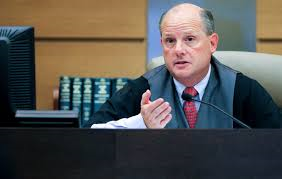
Strine

I haven’t seen his name on any of the short lists to replace Justice Scalia, but I would love to see the current Chief Justice of the Delaware Supreme Court, Leo Strine, get the nomination.

The benefits of nominating Chief Justice Strine include:

  • Promise of an entertaining nomination process. With all that he has said and written, there would be a lot of fodder, but he would be sure to hold his own. 
  • A nominee whose wit and writing style could rival Justice Scalia’s.
  • Diversity. Chief Justice Strine went to Penn for law school, not Harvard or Yale. (Granted, he does teach at Harvard).
  • Serious corporate law knowledge, and, at least on this blog, we know the Supreme Court of the United States needs help in this area.
  • Extremely bright, curious, and widely read. He likely has knowledge of and an opinion on most areas of law, well outside of just corporate law.

Anyway, I am sure President Obama will go with a more conventional pick, but I do hope to see a Supreme Court justice with corporate law expertise on the court eventually.

Today I tried an experiment in flipping the classroom. Instead of lecturing in class, I sent my Civil Procedure students a number of videos to watch in advance so that we could work through complex problems during class. I admit that I did this because I dread teaching supplemental jurisdiction, but I was surprised by the positive feedback that I received from the students. This is a topic that confuses students every year and although we are not finished with the unit, it does seem less painful this time around. I did not use my own videos, but I will be developing some soon for both Civil Procedure and for the next time I teach Business Associations.

I use a modified version of the flipped classroom already for Business Associations when I send the students YouTube clips to help them increase their understanding on complex issues but it doesn’t come close to having the whole lecture on video so that we can focus on drafting or working through hypos. In my Transnational Business and Human Rights Class I also use videos and extensive at home readings and limited lecture so that we can do simulations, but again, that is

Justice Scalia’s sudden passing has generated a tidal wave of media and academic attention on the future of the Supreme Court.   As a corporate law scholar, I have to admit to a tinge of jealousy to be seemingly outside of this controversy, the hand wringing, and the political equivalent of Dungeons and Dragons that has ensued as people examine the various maneuverers available to our elected politicians and those vying-to be elected.

My solution? I searched for pending corporate cases hanging in the balance of the new, and indeterminate, vacancy on the Supreme Court.  I wanted to know if there were any cases pending  that would likely be decided differently in a post-Scalia court, or at least hang in a 4-4 split and thus uphold the lower court ruling.  There isn’t a big juicy corporate law case pending, or at least one that I readily identified.

Not to be deterred, however, there is a case worth highlighting. Americold Realty Trust v. ConAgra Foods, Inc., was argued on January 19th before the Supreme Court (transcript available here).  The issue before the Supreme Court in Americold was how to establish the citizenship of a real estate trust for purposes

This week, Delaware Governor Jack Markell nominated Joseph R. Slights, III for the position held by retiring Vice Chancellor John Noble on the Delaware Court of Chancery.

Judge Slights previously served a 12-year term on the Delaware Superior Court. Immediately prior to his nomination, Judge Slights was a commercial litigation partner at the firm of Morris, James, Hitchens & Williams LLP.

Once Vice Chancellor Noble retires, Vice Chancellor Laster will become the judge with the most experience serving on the Delaware Court of Chancery. Vice Chancellor Laster was sworn into his position in October of 2009. It has been a quick 6+ years; it seems like that was just yesterday.

I outsource the details of Joseph Slights’ nomination below:

Starting on the first day of my Advanced Business Associations course, I attempt to tease out the policy underpinnings and theoretical conceptions of entity law and, in particular, corporate law.  This turns out to be a somewhat difficult task, since most students in the course, to the extent that they remember anything at all from their experience in the foundational Business Associations course, are more focused on what a corporation is and does than why we might have one in the first place.  As the semester proceeds and the readings unfold, the students get more comfortable talking about the rationale for certain aspects of the corporate form and why corporate law structures and operating rules promise to achieve the goals of those organizing a firm as a corporation.  But it’s a slow process.

I have to believe that some of my fellow law professors face similar challenges with their students.  I also believe that instructors in other educational settings face analogous difficulties when they incorporate abstract notions into the teaching of more “black letter” (for want of a better term at this point in my day) concepts.  My approach has been to assign readings of primary and secondary material and use classroom discussion

For the past four weeks I have been experimenting with a new class called Transnational Business and Human Rights. My students include law students, graduate students, journalists, and accountants. Only half have taken a business class and the other half have never taken a human rights class. This is a challenge, albeit, a fun one. During our first week, we discussed CSR, starting off with Milton Friedman. We then used a business school case study from Copenhagen and the students acted as the public relations executive for a Danish company that learned that its medical product was being used in the death penalty cocktail in the United States. This required students to consider the company’s corporate responsibility profile and commitments and provide advice to the CEO based on a number of factors that many hadn’t considered- the role of investors, consumer reactions, the pressure from NGOs, and the potential effect on the stock price for the Danish company based on its decisions. During the first three weeks the students have focused on the corporate perspective learning the language of the supply chain and enterprise risk management world.

This week they are playing the role of the state and critiquing and

Laurence Fink, CEO of BlackRock, the largest asset manager in the U.S., wrote a letter to the CEO’s of S&P 500 Companies urging reforms aimed at fostering long-term valuation creation and curbing a myopic focus on near-term profits.  Fink has long been a public advocate of long-term valuation creation for the health of American companies and the wealth of society (for an example see this April 2015 letter on the “gambling nature” of the economy”).  His message has been consistent:  long term, long term, long term. 

Citing to increased dividends and buyback programs as evidence of corrosive short-termism, Fink laid out a modest play for action.  He asks every CEO to publish an annual strategic plan signed off on by the board.  The CEO strategic plan should communicate the vision for the company and how such long-term growth can be achieved.  

[P]erspective on the future, however, is what investors and all stakeholders truly need, including, for example, how the company is navigating the competitive landscape, how it is innovating, how it is adapting to technological disruption or geopolitical events, where it is investing and how it is developing its talent. As part of this effort, companies should work to develop financial metrics, suitable for

Two weeks ago I posted about whether small businesses, start ups, and entrepreneurs should consider corporate social responsibility as part of their business (outside of the benefit corporation context). Definitions of CSR vary but for the purpose of this post, I will adopt the US government’s description as:

entail[ing] conduct consistent with applicable laws and internationally recognised standards. Based on the idea that you can do well while doing no harm … a broad concept that focuses on two aspects of the business-society relationship: 1) the positive contribution businesses can make to economic, environmental, and social progress with a view to achieving sustainable development, and 2) avoiding adverse impacts and addressing them when they do occur.

During my presentation at USASBE, I admitted my cynical thoughts about some aspects of CSR, discussed the halo effect, and pointed out some statistics from various sources about consumer attitudes. For example:

  • Over 66% of people say they will pay more for products from a company with “good values”
  • 66% of survey respondents indicated that their perception of company’s CEO affected their perception of the company
  • 90% of US consumers would switch brands to one associated with a cause, assuming comparable price

This post highlights SIGA Technologies, Inc. v. PharmAthene, Inc., Del. Supr., No. 20, 2015 (Dec. 23, 2015).

At the end of 2015, the Delaware Supreme Court issued an opinion affirming its earlier holding that where parties have agreed to negotiate in good faith, a failure to reach an agreement based upon the bad faith of one party entitles the other party to expectation damages so long as damages can be proven with “reasonable certainty.”

Francis Pileggi, on his excellent Delaware Commercial and Business Litigation blog, provides a succinct summary of the case, available here.  The parties to the suit entered into merger negotiations to develop a smallpox antiviral drug.  Due to the uncertainty of the merger negotiations, the parties also entered into a non-binding license agreement, the terms of which would be finalized if the merger fell through for whatever reason.   While nonbinding, the preliminary license agreement contained detailed financial terms and benchmarks.  When the merger was terminated, SIGA proposed terms for a collaboration that departed from the preliminary license agreement.  The Delaware Supreme Court affirmed the Court of Chancery finding that SIGA’s acted in bad faith.  The question of the case became what damages were due from

Tomorrow afternoon (as Anne promoted earlier today), I will participate in the annual Association of American Law Schools (“AALS”) panel discussion for the Section on Agency, Partnerships, LLCs and Unincorporated Associations.  The panel discussion this year is entitled “Contract is King, But Can It Govern Its Realm?” and focuses on the contractarian aspects of LLC law.  Here’s the panel description from the AALS annual meeting program:

This program will explore the role of contract in unincorporated associations, with particular emphasis on the LLC and limited partnership forms. In most jurisdictions, the sparse prescriptions in the default rules imply that the parties will draft an operating agreement that reflects the material points of their bargain. For example, Delaware emphasizes that its policy for LLCs and LPs is to give “maximum effect to the principle of freedom of contract.” Modern contract theory, however, raises significant questions about the extent to which any documentation of a transaction can be “complete,” even if sophisticated parties negotiate at arm’s length and attempt to fully reduce their expectations to writing. If complete contracts are indeed an ideal rather than the reality, can legislatures impose default rules (fiduciary or otherwise) to fill the gaps without