From the Faculty Lounge: “Villanova University – Charles Widger School of Law seeks an outstanding lawyer/educator/scholar to teach business law and entrepreneurship courses, broadly defined, and to serve as the Faculty Director for The John F. Scarpa Center for Law and Entrepreneurship.” More information available here.

Updated Law Professor (Business Areas) Position List.

Updated Legal Studies Professor Position List (Mostly Business Schools).

At this point in the year, I imagine that some, if not many, of the positions on the list may be filled.

I am taking a MOOC from University of Illinois and Coursera on digital marketing. I’ve been trying to take at least one course a semester. Both the underlying material, and the intricacies of online education have been interesting. I chose this course because I have family members in the digital marketing area, and I am taking (and discussing) this course with them.

Later, I may discuss some of  the substantive take-aways from the course — I have completed about 50% of the course so far — but in this post I want to discuss business/academic entanglement.

In this digital marketing class, an assignment on co-creation (by firms & their customers) consisted of creating an online account with Starbucks, submitting an idea for consideration, and reporting how the idea was received by commenters. This was a useful exercise and it made the concept come alive, but I couldn’t help wondering if Starbucks was somehow involved with University of Illinois and/or Coursera in creating this assignment. To be clear, I have no idea whether Starbucks was or was not involved.  But, in any event, with the thousands (and maybe 10s of thousands) of people who are taking this course, this assignment seemed like a win for Starbucks.  Well, actually, this idea

Mnookin

Perhaps the most common question I receive from the MBA students in my Decision Making & Negotiation Skill class is – what do I do when the other side is completely unreasonable or evil?

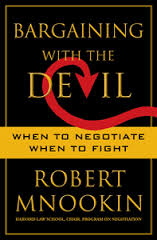
Robert Mnookin (Harvard) explores this question in his book Bargaining with the Devil: When to Negotiate and when to Fight

I won’t attempt to summarize the entire book, but I share a few representative quotes below. (Page numbers correspond to the 2010 hardback edition).

“By ‘Devil’ I mean an enemy who has intentionally harmed you in the past or appears willing to harm you in the future. Someone you don’t trust. An adversary whose behavior you may even see as evil.” (pg. 1)

“An act is evil when it involves the intentional infliction of grievous harm on another human being in the circumstances where there is no adequate justification.” (pg. 15)

Consider “Interests [of both sides]…Alternatives [of both sides]…Potential negotiated outcomes…Costs…Implementation…What issues of recognition and legitimacy are implicated in my decision” (pgs. 27-34).

“I believe there is reason to be deeply concerned whenever an agent or representative allows personal morality to override a rational analysis favoring negotiation – even with a devil.” (pg. 49)

“If you bargain

This is the time of year when many people make New Year’s resolutions, and I suppose that law professors do so as well. I’m taking a break from teaching business associations next semester. Instead, I will teach Business and Human Rights as well as Civil Procedure II. I love Civ Pro II because my twenty years of litigation experience comes in handy when we go through discovery. I focus a lot on ethical issues in civil procedure even though my 1Ls haven’t taken professional responsibility because I know that they get a lot of their context from TV shows like Suits, in which a young “lawyer” (who never went to law school) has a photographic memory and is mentored by a very aggressive senior partner whose ethics generally kick in just in the nick of time. It will also be easy to talk about ethical issues in business and human rights. What are the ethical, moral, financial, and societal implications of operating in countries with no regard for human rights and how should that impact a board’s decision to maximize shareholder value? Can socially-responsible investors really make a difference and when and how should they use their influence? Those

WCU

Western Carolina University is looking to hire three business law faculty members: two tenure-track and one for a fixed term.

Descriptions of the positions are available under the break. Western Carolina University is one of the few universities in the country with an undergraduate degree in Business Administration and Law. In the spring of 2014, I presented at WCU. They have thoughtful professors, a beautiful campus, and engaged students.

I have updated my lists of legal studies professor openings and law school (business area) professor openings.

Amazon Prime Now has debuted in Nashville. Amazon Prime Now offers free two-hour delivery on many items for Prime members. The service is amazing and is already changing the way I shop. I really dislike shopping malls, especially during the busy holiday season, but I also dislike waiting weeks (or even days) for shipments to arrive, so Amazon Prime Now is a perfect solution.

With Amazon Prime Now expanding, I imagine even more brick and mortar retailers will be headed to bankruptcy unless they find a way to differentiate their companies and add more value.

Brick and mortar retailers may find differentiation through community building services. I already see some retailers attempting this. Running footwear and apparel stores are offering free group runs starting from their storefronts and/or group training programs for a fee. Grocery stores are offering group cooking classes. Book stores are offering book clubs. The list goes on.

These brick and mortar retailers are finding it more and more difficult to compete with e-retailers on price and convenience. With the rise in technology, however, face to face community seems to be increasingly rare. Brick and mortar retailers that aid in community building may

I’m knee deep in grading my business associations exams and so far, I’m pretty pleased. Maybe it’s my in-house background, but I spend a lot of time with my students getting them to focus on providing strategic advice to their fictional clients because that’s what my former clients demanded. My operations and executive colleagues complained that lawyers didn’t understand business or their pressure points and offered legal advice without thinking of the big picture or strategic considerations. With that in mind, my students work in law firms and do a variety of exercises from Michelle Harner’s skills book. When they answer questions in class based on cases or drafting exercises, I force them to think like a client rather than just the lawyer. I drill into them the importance of speaking to their clients in plain English, and I tell them if they can’t break the concepts down in their own words, then they don’t really understand them. Their final exam required them to advise a number of different clients based on the same fact pattern, and I am enjoying reading the different strategies that my 69 students devised based upon the same set of facts.

I get a

Earlier this week, my co-blogger Josh Fershee authored an interesting post about the surprising crowdfunding success of the PicoBrew “Keurig for Beer.” After reading Josh’s post and the embedded links, I have to agree with him; I have no idea how they raised $1.4M for a product that I don’t see being that useful. The product appears to be both overly expensive and overly time-consuming.

I think many venture capitalists would join Josh and me in questioning the wisdom of PicoBrew, at least before it raised $1.4M. But as I wrote in an earlier post, crowdfunding may help overcome biases of venture capitalists. In the days since Josh’s posts, I have heard a few people talk about how excited they were about PicoBrew. These people were all at least 10 years younger than Josh, me, and most venture capitalists. While us “older folks” may not see a use for the product, judging from the crowdfunding results and a little anecdotal evidence here in Nashville, there appears to be significant market demand for PicoBrew. Similarly, on the show Shark Tank, the female “sharks” have accused their male counterparts of largely avoiding companies with products aimed at women; and while I