BLPBConferenceLogo

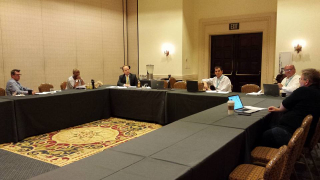
As I earlier reported, on Saturday, The University of Tennessee College of Law hosted “Business Law: Connecting the Threads”, a conference and continuing legal education program featuring most of us here at the BLPB–Josh, me, Ann, Doug, Haskell, Stefan, and Marcia.  These stalwart bloggers, law profs, and scholars survived two hurricanes (Harvey for Doug and Irma for Marcia) and put aside their personal and private lives for a day or two to travel to Knoxville to share their work and their winning personalities with my faculty and bar colleagues and our students.  It was truly wonderful for me to see so many of my favorite people in one place together enjoying and learning from each other.

Interestingly (although maybe not surprisingly), in many of the presentations (and likely the essays and articles that come from them), we cite to each other’s work.  I think that’s wonderful.  Who would have known that all of this would come from our decision over time to blog together here?  But we have learned a lot more about each other and each other’s work by editing this blog together over the past few years.  As a result, the whole conference was pure joy for

Uber has a new CEO. Perhaps his first task should be to require one of his legal or compliance staff to attend the FCPA conference at Texas A & M in October given the new reports of an alleged DOJ investigation.. I might have some advice, but Uber needs to hear the lessons learned from Walmart, who will be sending its Chief Compliance Officer. Thanks to FCPA expert, Mike Koehler, aka the FCPA Professor, for inviting me. Mike has done some great blogging about the Walmart case (FYI- the company has reported spending $865 million on fees related to the FCPA and compliance-related costs). Details are below:

THE F​CPA TURNS 40:
AN ASSESSMENT OF FCPA ENFORCEMENT POLICIES AND PROCEDURES

FCPA ConferenceThursday, October 12, 2017
Texas A&M University School of Law
Fort Worth, Texas

This conference brings together Foreign Corrupt Practices Act enforcement officials, experienced FCPA practitioners, and leading FCPA academics and scholars to discuss the many legal and policy issues relevant to the current FCPA enforcement and compliance landscape.

Register here

AGENDA

[Click here to download agenda pdf]

Registration, 8:30 a.m.

Morning Session, 9:00 a.m. to Noon

FCPA Legal and Policy Issues

I am excited and proud to make the following announcement about a cool (!) upcoming program being held on Saturday, September 16 at UT Law in Knoxville:

The University of Tennessee College of Law will host a conference and CLE program that will focus on trends in business law. Discussions will take place throughout the day featuring panel discussions that center upon business law scholarship, teaching and law practice.

Topics will include business transaction diagramming; risks posed by social enterprise enabling statutes; fiduciary obligations and mutual fund voting; judicial dissolution in LLCs; Tennessee for-profit benefit corporation law and reporting; corporate personality theory in determining the shareholder wealth maximization norm; and professional responsibility issues for business lawyers in the current, evolving business environment.

The presenters for the program panels are . . . well . . . us!  All of the BLPB editors and contributing editors, except Anne Tucker (we’ll miss you, Anne!), are coming to Knoxville to share current work with each other and conference attendees.  Each editor will anchor a panel that also will include a faculty and student discussant.  The BLPB blogger papers and the discussants’ written commentaries will all be published in a future issue of our

Call for Papers (DEADLINE: August 24, 2017)

AALS Section on Business Associations

Institutional Investors and Corporate Governance

AALS Annual Meeting, January 5, 2018

The AALS Section on Business Associations is pleased to announce a Call for Papers for a joint program to be held on Friday, January 5, 2018 at the 2018 AALS Annual Meeting in San Diego, California.  The topic of the program is “Institutional Investors and Corporate Governance.”

In thinking through the difficulty of agency costs within the public corporation, corporate law academics have turned repeatedly to institutional investors as a potential solution.  The agglomeration of shares within a large investing firm, together with ongoing cooperation amongst a large set of such investors, could overcome the rational apathy the average shareholder has towards participation in corporate governance.  Alternatively, activist investors could exert specific pressure on isolated companies that have been singled out—like the weakest animals in the herd—for extended scrutiny and pressure.  In these examples, the institutionalization of investing offers a counterbalance to the power of management and arguably provides a systematized way of reorienting corporate governance.  These institutional-investor archetypes have, in fact, come to life since the 1970s and have disrupted the stereotype of the passive investor.  But

Yesterday, on the last morning of the 2017 Southeastern Association of Law Schools (SEALS) conference, Matt Lyon, the Associate Dean at Lincoln Memorial University – Duncan School of Law (UT Law’s Knoxville neighbor) convened a discussion group on “Corporate and Financial Reform in the Trump Administration.” I was grateful to be asked to participate.  In addition to me, BLPB co-bloggers Josh Fershee and Marcia Narine Weldon, my UT Law coworker Brian Krumm, Securities Law Prof Blog editor Eric Chaffee, and University of Houston Law Center colleague Darren Bush were among the discussants.

SEALS2017(RegReformDiscGrp-1)

Each of us came with issues and questions for discussion.  Each of us offered reflections.  Recently made, currently proposed, and possible future changes to business regulation were all on the table.  I wish this session had been held earlier in the program, since many had left before the Sunday morning sessions (and we were competing with, among other enticing alternatives, a discussion session on marijuana regulation). However, we honestly had more than enough to discuss as among the seven of us, in any case.

I had to leave the session early to attend the SEALS board meeting.  But before I left, I took some notes on topics relating to my interest in and potential future work on regulatory reform.  I continue, for example, to be interested in the best approaches to reducing and streamlining regulation.  (See my posts here and here.)  A few additional outtakes follow.

I am speaking at a plenary session tomorrow during the the Energy Impacts Symposium at the Nationwide & Ohio Farm Bureau 4-H Conference Center in Columbus, Ohio. The program is exciting, and I look forward to being a part of it.  The program is described as follows: 

Energy Impacts 2017 is a energy research conference and workshop, organized by a 9-member interdisciplinary steering committee, focused on synthesis, comparison, and innovation among established and emerging energy impacts scholars from North America and abroad. We invite participation from sociologists, geographers, political scientists, economists, anthropologists, practitioners, and other interested parties whose work addresses impacts of new energy development for host communities and landscapes.

The pace, scale, and intensity of new energy development around the world demands credible and informed research about potential impacts to human communities that host energy developments. From new electrical transmission lines needed for a growing renewable energy sector to hydraulically fracturing shale for oil and gas, energy development can have broad and diverse impacts on the communities where it occurs. While a fast-growing cadre of researchers has emerged to produce important new research on the social, economic, and behavioral impacts from large-scale energy development for host communities and landscapes, their discoveries

Save the Date!

The Yale Law School Center for Private Law will host a Private Equity Conference on November 17, 2017. The conference will bring leading theorists from law, economics, finance, and sociology into dialogue with people with experience at the highest levels of private equity, including from law practice, financial firms, and institutional investors.

Oliver Hart, winner of the 2016 Sveriges Riksbank Prize in Economic Sciences in Memory of Alfred Nobel, will give the keynote address.

Other speakers include:

Jon Ballis, Kirkland & Ellis
Rosemary Batt, Cornell University, ILR School
Neil Fligstein, UC Berkeley Sociology Department
Stephen Fraidin, Pershing Square Capital Management
Will Gaybrick, Stripe
Adam Goldstein, Princeton University Department of Sociology
Victoria Ivashina, Harvard Business School
Andrew Metrick, Yale School of Management
Meridee Moore, Watershed Asset Management
John Morley, Yale Law School
Alan Schwartz, Yale Law School
David Swensen, Chief Investment Officer, Yale University

Location: Yale Law School, 127 Wall St., New Haven, CT

Time: Approximately 9:45 a.m.-4:00 p.m.

Cost: There is no cost associated with this event, though pre-registration is required. Registration information will be available soon at this link

Conference Announcement and Call for Papers
2017 Junior Scholars #FutureLaw Workshop 2.0 at Duquesne

The conference is organized by Seth Oranburg, Assistant Professor, Duquesne University School of Law. Funding is provided in part by the Federalist Society. All papers are selected based on scholarly merit, with an emphasis on scholarly impact, topical relevance, and viewpoint diversity.

September 7-8, 2017

By invitation only

OVERVIEW: The conference aims to foster legal and economic research on “FutureLaw” (as defined below) topics particularly by junior and emerging scholars by bringing together a diverse group of academics early in their career focusing on cutting-edge issues.

TOPICS: The conference organizers encourage the submission of papers about all aspects of FutureLaw, which includes open-data policy, machine learning, computational law, legal informatics, smart contracts, crypto-currency, block-chain technology, big data, algorithmic research, LegalTech, FinTech, MedTech, eCommerce, eGovernment, electronic discovery, computers & the law, teaching innovations, and related subjects. FutureLaw is an inter-disciplinary field with cross-opportunities in crowd science, behavioral economics, computer science, mathematics, statistics, learning theory, and related fields. Papers may be theoretical, archival or experimental in nature. Topics of interest include, but are not limited to:

– Innovation in legal instruments (e.g., new securities, new corporate forms, new

This post follows on my earlier travel posts on prepacking and packing for conference travel.  For last week’s post, I used my trip to Mexico City for the Law and Society Association conference as an example.  This week, I assess my packing skills by chronicling briefly what I used and commenting on that assessment.  Bottom line: I did OK but could have left a few items of clothing and my flip flops at home.

For my plane travel to Mexico City a week ago last Sunday, I wore the reversible dance leggings (pattern side facing out), one of the tank tops, the embellished sweatshirt, and the suit jacket wth my sneakers.

BLPBOutfits1

Once I got to the hotel, I determined to take a walk through Chapultepec Park (Mexico’s rough equivalent of New York’s Central Park).  For the walk (and the rest of the day), I swapped out the sweatshirt and jacket for one of the button-downs I had brought–a medium green insect-repelling shirt I originally had bought to use when I taught in a study abroad program in Brazil.

For Monday, another sightseeing day (but one that I planned to end with an Ashtanga yoga class), I dressed for the day at the outset: reversible yoga shorts (pattern side facing out), light blue tank top, same green button down, and sneakers.

BLPBOutfits2

I noticed during the day that folks in Mexico City do not wear yoga shorts around.  So, I would revisit my decision to wear them all day on that basis.

As I am traveling and conferencing, my thoughts already have turned to next summer’s conference schedule.  It seems like a good time to get two important business law conferences on the agenda for next year.  Those two conferences are: the sixth biennial conference on teaching transactional law and skills, “To Teach is to Learn Twice: Fostering Excellence in Transactional Law and Skills Education,” which will be held on June 1 – 2, 2018, at Emory Law in Atlanta, GA and the National Business Law scholars conference, which will be held at the University of Georgia School of Law in Athens, GA on June 21-22, 2018.  Emory Law’s “Save the Date” notice hit my in box this morning and appears below, FYI.

*          *          *

SAVE THE DATE

Emory’s Center for Transactional Law and Practice cordially invites you to attend its sixth biennial conference on the teaching of transactional law and skills. The conference, entitled “To Teach is to Learn Twice: Fostering Excellence in Transactional Law and Skills Education,” will be held at Emory Law, beginning at 1:00 p.m. on Friday, June 1, 2018, and ending at 3:45 p.m. on Saturday, June 2, 2018.