
Dear BLPB Readers:

For those of you who might be interested in strengthening your knowledge of empirical methods, Northwestern Law School is offering two summer workshops on Research Design for Causal Inference.  An overview of the main workshop and its target audience is below.  The complete details of the main and advanced workshops are here.

“Main Workshop Overview

We will cover the design of true randomized experiments and contrast them to natural or quasi experiments and to pure observational studies, where part of the sample is treated, the remainder is a control group, but the researcher controls neither which units are treated vs. control, nor administration of the treatment. We will assess the causal inferences one can draw from specific “causal” research designs, threats to valid causal inference, and research designs that can mitigate those threats.

Most empirical methods courses survey a variety of methods. We will begin instead with the goal of causal inference, and how to design a research plan to come closer to that goal, using messy, real-world datasets with limited sample sizes. The methods are often adapted to a particular study.

Target Audience

Quantitative empirical researchers (faculty and graduate students) in social science, including law

WayneLawLogo(2)

I have the privilege and honor to be in Detroit today to present the second annual Baiardi lecture at Wayne State University Law School.  Wayne Law is a bit of a second home for me (a status it enjoys with several other law schools).  I have presented at two symposia here (publishing twice, as a result, with the Wayne Law Review).  Also, Wayne Law was the academic pied à terre of Peter Henning, who was a trusted and dear mentor (and an accomplice in reasoning through insider trading and applied corporate governance questions) until his untimely death.

My lecture addresses aspects of a joint project I previewed at the National Business Law Scholars Conference at Tennessee Law last June.  The project is the brainchild of my Tennessee Law colleague Tomer Stein and involves taking a new approach to the ongoing debate about federalizing corporate law.  The talk offers some practical applied thoughts on the project and is entitled “Visioning (Not Advocating or Discounting) Federal Corporate Law.” I undoubtedly will have more to say on this topic as our work on the project progresses.  But if you think of or come across anything you deem relevant to the cause

National Business Law Scholars Conference (NBLSC) 

June 24-25, 2024 

Call for Papers 

The National Business Law Scholars Conference (NBLSC) will be held on Monday and Tuesday, June 24-25, 2024, at The University of California, Davis School of Law. 

This is the fifteenth meeting of the NBLSC, an annual conference that draws legal scholars from across the United States and around the world. We welcome all scholarly submissions relating to business law. Junior scholars and those considering entering the academy are especially encouraged to participate. If you are thinking about entering the academy and would like to receive informal mentoring and learn more about job market dynamics, please let us know when you make your submission. 

Submission Guidelines: 

Please fill out this form to register and submit an abstract by Friday, March 15, 2024. Please be prepared to include in your submission the following information about you and your work: 

Name 

E-mail address 
Institutional Affiliation & Title 
Paper title 
Paper description/abstract 
Keywords (3-5 words) 
Dietary restrictions 
Mobility restrictions 

If you have any questions, concerns, or special requests

Dear BLPB Readers:

“The Midwest Academy of Legal Studies in Business (MALSB) Annual Conference is held in
conjunction with the MBAA International Conference. MBAA International draws hundreds of
academics from business-related fields such as accounting, business/society/government, economics,
entrepreneurship, finance, health administration, information systems, international business,
management, and marketing. The MALSB has its own program track on Legal Studies and attendees
may take advantage of the multidisciplinary nature of this international conference and attend sessions
held by the other program tracks.

Presentations in 2024 will have the option of in person or live online delivery. Tentatively MALSB paper
and panel in person/live online presentations are scheduled to begin Thursday morning (April 11, 2024)
and conclude Friday afternoon (April 12, 2024). If registration numbers require additional sessions, they
will be held Wednesday afternoon (April 10, 2024).”

Note that the registration/submission deadline is January 15, 2024.  The complete call for conference participation is here. Download Malsb_call_for_participation_2024

The Southeastern Association of Law Schools (SEALS) is soliciting proposals for its 2024 annual meeting (to be held at the Harbor Beach Resort & Spa in Fort Lauderdale, Florida from July 21-July 27, 2024).  After last year’s meeting, folks suggested to me it could be time again to have a teaching panel at SEALS in 2024.  Specifically, the suggestion was made that a group be put together to talk about teaching numeracy to business-inclined students.  I am happy to organize it.

Please let me know if you want to join in on this discussion group.  I am looking for at least nine folks to join me.  Email me or leave a comment here if you would like to join in.

I am pleased to report that Connecting the Threads is back for another year–our seventh!  As readers will recall, this annual symposium features the work of your Business Law Prof Blog editors (sometimes with coauthors), with commentary from Tennessee Law faculty members and students.  Every year, my colleagues and I offer up a variety of presentation topics covering developing theory, policy, doctrine, pedagogy, and practice trends in various areas of business law.

This year’s panels include:

“Algorithms to Advocacy: How Emerging Technologies Impact Legal Practice and Ethics”
Marcia Narine Weldon

“The Road and Corporate Purpose”
William P. Murray and J. Haskell Murray

“Is the SEC Proposing a ‘Loaded Questions’ Climate Disclosure Regime?”
John P. Anderson

“Business Lawyer Leadership: Valuing Relationships”
Joan Heminway

“Metals Derivatives Markets and the Energy Transition”
Colleen Baker and James Coleman

If you are in the Knoxville area, please come join us on Friday for the day.  The program runs from 8:30 am (registration) to 3:00 pm.  Registration for CLE credit can be accessed here.


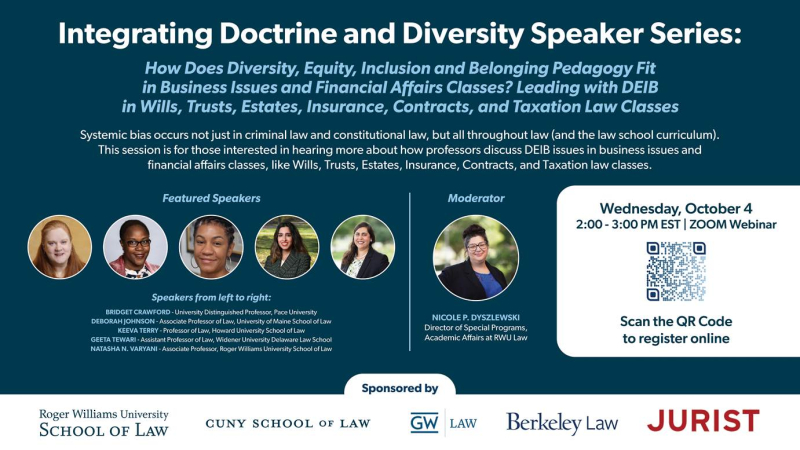
BLPB(DiversityProgramGraphic)

RWU Law looks forward to the next installment of the Integrating Doctrine & Diversity Speaker Series:

HOW DOES DIVERSITY, EQUITY, INCLUSION AND BELONGING PEDAGOGY FIT IN BUSINESS ISSUES AND FINANCIAL AFFAIRS CLASSES? LEADING WITH DEIB IN WILLS, TRUSTS, ESTATES, INSURANCE, CONTRACTS, AND TAXATION LAW CLASSES

Wednesday, October 4 | 2:00 – 3:00 PM EST

Zoom Webinar Registration here.

Details about the Featured Speakers & Program here.

Emory’s Center for Transactional Law and Practice has extended the deadline for proposal submissions for the 8th Biennial Conference on the Teaching of Transactional Law and Skills, scheduled for October 6-7, 2023.  Quoting from the email message from Sue Payne, Katherine Koops, and Kelli Pittman:

We know that mid-August is a busy time.  Therefore, by popular demand, we are extending the deadline for submitting a proposal through August 31st.  Submit your proposal here.

We are also extending the deadline for you to nominate a colleague or yourself for the Tina L. Stark Award for Teaching Excellence through August 31st.  Submit your nominations here.

I know many of you have valuable things to offer at this conference, which always is among my favorites.  I have picked up wonderful ideas for my teaching–things I do not hear in other conferences. I hope you will submit a proposal and attend.

Greetings from SEALS, where I’ve just left a packed room of law professors grappling with some thorny issues related to ChatGPT4, Claude 2, Copilot, and other forms of generative AI. I don’t have answers to the questions below and some are well above my pay grade, but I am taking them into account as I prepare to teach courses in transactional skills; compliance, corporate governance, and sustainability; and ethics and technology this Fall.

In no particular order, here are some of the questions/points raised during the three-hour session. I’ll have more thoughts on using AI in the classroom in a future post.

  1. AI detectors that schools rely on have high false positives for nonnative speakers and neurodivergent students and they are easy to evade. How can you reliably ensure that students aren’t using AI tools such as ChatGPT if you’ve prohibited it?
  2. If we allow the use of AI in classrooms, how do we change how we assess students?
  3. If our goal is to teach the mastery of legal skills, what are the legal skills we should teach related to the use of AI? How will our students learn critical thinking skills if they can