A few weeks ago, I posted on the SEC Roundtable on the Proxy Process (here).  I noted in a postscript to that post that friend-of-the-BLPB Bernie Sharfman had an additional comment letter (his fourth) relating to this regulatory project up his sleeve (so to speak).  That comment letter, dated December 17, 2018, was recently filed (see here) and focuses on voting recommendations.  The nub?

Investment advisers should not be in fear of breaching their fiduciary duties if they use board voting recommendations. . . . The SEC needs to go further than just approving the use of board voting recommendations as long as the investment adviser has an agreement with the client to use them. . . . [T]he SEC needs to explicitly state in some way that an investment adviser will not be in breach of its fiduciary duties under the Advisers Act if it uses board voting recommendations when voting its proxies.

To implement such a policy, this comment letter requests the SEC to provide investment advisers with a liability safe harbor under the Advisers Act when using board voting recommendations in voting their proxies as long as their clients do not prohibit their use

Haskell Murray, this one’s for you (and many others who work with B corporations and benefit corporations)!

Friend of the BLPB Tamara Belinfanti recently sent me a link to an article in which she was quoted.  The premise of the article is clear from its title: To B or not to B? That’s the question for companies who seek to “balance profit and purpose.”  Familiar proposition; great article title.  It’s certainly worth a quick read, even if it says nothing new.  (Although it does seem to imply that Justice Strine is no longer the Chief Justice of the Delaware Supreme Court . . . .)

In the article, various folks (including Justice Strine) comment about whether B corporation certification and/or benefit corporations are “needed” for social enterprise firms.  This is a question that I love to think about (especially if it can keep me from grading papers for a bit . . . ).  Some of you may remember my post on this topic from a few years ago.  It also is an issue that I have approached at times in pieces of my academic writing, including in the article featured in this post.

Next summer, at the

Jack Welch, former GE CEO (1981 to 2001) was revered for his ability to maximize shareholder value.  Yet in 2009, he explained that shareholder value was

“the dumbest idea in the world. Shareholder value is a result, not a strategy… your main constituencies are your employees, your customers and your products. Managers and investors should not set share price increases as their overarching goal… Short-term profits should be allied with an increase in the long-term value of a company.”

This runs contrary to how many people think about the role of the CEO and the board of directors.  I think it’s spot on, and it is a key reason the business judgment rule, and its role in preserving director primacy, is so critical.   

Last week, a Wall Street Journal article about Dick’s Sporting Goods made the rounds. The article reported: 

Ed Stack, the chairman and chief executive of Dick’s Sporting Goods Inc., arrived at work the Monday after a gunman killed 17 people at a school in Parkland, Fla., nearly certain the outdoor retailer should limit sales of some guns.

. . . .

Dick’s Financial Chief Lee Belitsky asked, “So what’s the financial implication here?” according to Mr.

In January 2018, Larry Fink of Blackrock, the world’s largest asset manager, shocked skeptics like me when he told CEOs:

In the current environment, these stakeholders are demanding that companies exercise leadership on a broader range of issues. And they are right to: a company’s ability to manage environmental, social, and governance matters demonstrates the leadership and good governance that is so essential to sustainable growth, which is why we are increasingly integrating these issues into our investment process. Companies must ask themselves: What role do we play in the community? How are we managing our impact on the environment? Are we working to create a diverse workforce? Are we adapting to technological change? Are we providing the retraining and opportunities that our employees and our business will need to adjust to an increasingly automated world? Are we using behavioral finance and other tools to prepare workers for retirement, so that they invest in a way that will help them achieve their goals?

In October 2018, Blackrock declared, “sustainable investing is becoming mainstream investing.” The firm bundled six existing ESG EFT funds and launched six similar funds in Europe and looked like the model corporate citisen.

So does Blackrock

On November 15, the Securities and Exchange Commission (SEC) convened a Roundtable on the Proxy Process.  (See also here.)  I have not been following this as closely as co-blogger Ann Lipton has (see recent posts here and here), but friend-of-the-BLPB, Bernie Sharfman (Chairman of the Main Street Investors Coalition Advisory Council) has been active as a comment source.  Both contribute valuable ideas that I want to highlight here as the SEC continues to chew on the information it amassed in the roundtable process. 

Ann, as you may recall, has been focusing attention on the uncertain status of proxy advisors when it comes to liability for securities fraud.  In her most recent post, she observes that

There’s a real ambiguity about where, if it all, proxy advisors fit within the existing regulatory framework, and while I am not convinced there is a specific problem with how they operate or even necessarily a need for regulation, I think it can only be for the good if the SEC were to at least clarify the law, if for no other reason than that these entities play an important role in the securities ecosystem, and if we expect market

From our friend and colleague, Djamchid Assadi at the Burgundy School of Business in Dijon, France:

Lisbon2019_EURAM-banner_1100

SIG 03 – ENT – Entrepreneurship

With our theme Exploring the Future of Management: Facts, Fashion and Fado, we invite you to participate in the debate about how to explore the future of management.

We look forward to receiving your submissions.

T03_08 – Entrepreneurship in the sharing economy: P2P strategies, models, and innovation paradigms

Proponents:

Djamchid Assadi, Burgundy School of Business BSB; Asmae DIANI, Sidi Mohamed Ben Abdellah University, Fez, Morocco; Urvashi Makkar, G.L. Bajaj Institute of Management and Research (GLBIMR), Greater Noida; Julienne Brabet, Université Paris-Est Créteil (UPEC); Arvind ASHTA, Arvind, CEREN, EA 7477, Burgundy School of Business – Université Bourgogne Franche-Comté, France

Short description:

Sharing of funds, files, accommodations, and other utilities and properties has become a vital part of the emerging social life and economy.

The traditional dyadic firm-to-customer transactions has given place to the depositional triadic of P2P platforms game changers which facilitate exchange between peer providers and peer recipients. As these P2P platforms disrupt conventional transactions, for example, P2P home exchange platforms like Airbnb thoroughly disorder the hotel industry, it is crucial that researchers consider conceptual refinement and empirical grounding for providing insights.

This track aims to bring together

Even after 19 years or so of teaching Business Associations courses, I still marvel at how hard it is to teach corporate fiduciary duty doctrine to my students.  A lot of my frustration comes from the amount of (perhaps not-so-useful) judicially instigated labeling involved under Delaware law, as the leading state in the area.  In particular, there is the narrowing of the duty of care to exclude both substantive duty of care claims and Caremark claims.  And then there is the matter of how to best describe the nature of the business judgment rule and how to describe the interaction of disclosure (candor) with the fiduciary duties of care and loyalty. And finally there is a lingering doctrinal question as to whether, in other jurisdictions, good faith, classified as a subsidiary component of the duty of loyalty in Delaware, may be a free-standing fiduciary duty or, in the alternative, foundational, penumbral, etc. to the fiduciary duties of loyalty and care  . . . .  Tough stuff.

Is anyone else out there suffering in the same way I do in teaching fiduciary duties in a Business Associations or Corporations class?  How do you handle the legal complexity/labeling questions?  I continue to

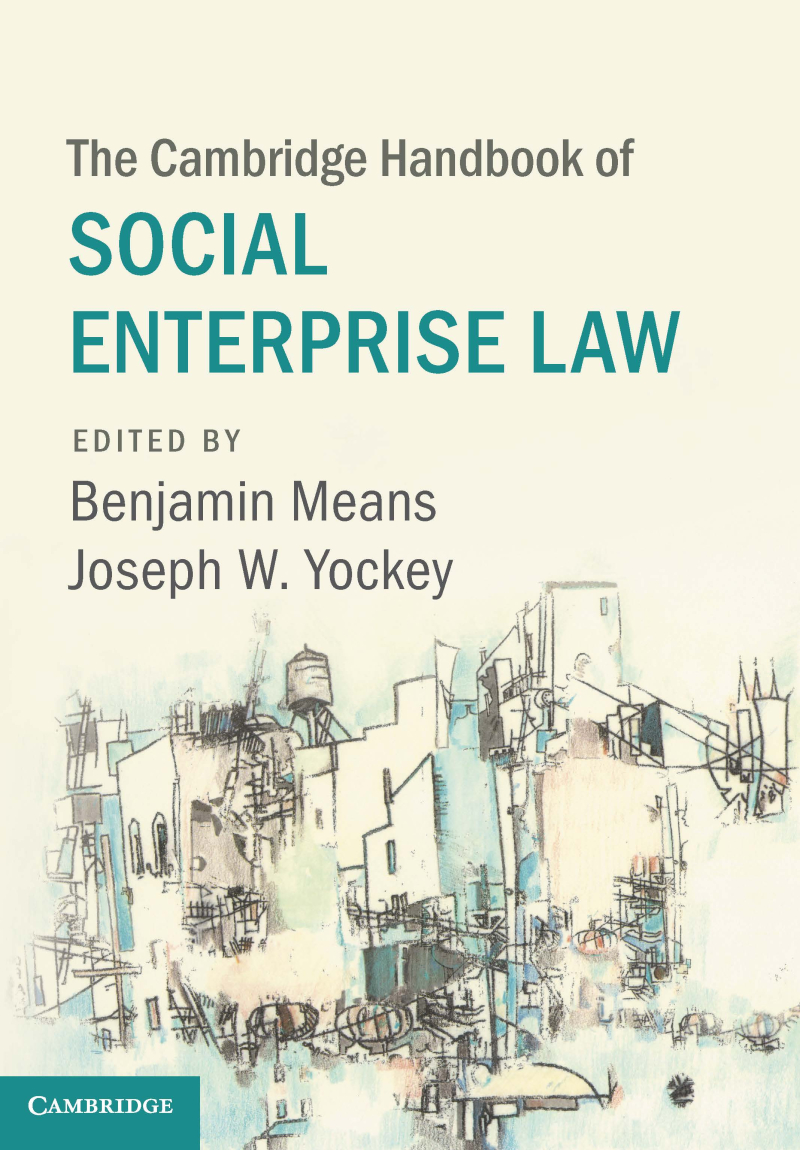
The Cambridge Handbook of Social Enterprise Law, edited by Ben Means (South Carolina) and Joe Yockey (Iowa) is at the printers and should be ready for orders in early 2019. 

My fellow BLPB editor Joan Heminway and I both have chapters in the book, along with many others. 

The introduction is posted on SSRN, for those who are interested. Also, editor Ben Means has many talents, as he did the cover artwork below as well.

The Cambridge Handbook of Social Enterprise Law_Cover

By the time many of you read this, Election Day 2018 will be upon us (or even over).  I have had elections on my mind for some time now–elections of the political and corporate kind.  As a result of an invitation to participate in last week’s symposium on women and corporate governance hosted by the George Washington Law Review (“Women and Corporate Governance: A Conference Exploring the Role and Impact of Women in the Governance of Public Corporations), my election-oriented thoughts somehow became infused with gender reflections . . . .

1992 was dubbed the political “Year of the Woman.” The appointment of Clarence Thomas to the U.S. Supreme Court in 1991 after hearings focused on sexual harassment allegations and revelations of Bill Clinton’s extramarital sexual conduct during his first campaign for election as U.S. President were and are credited with the record number of women elected to federal legislative positions in 1992. “When the ballots were counted, America had elected a record-breaking four women as senators and 24 women as representatives to Congress.” Li Zhou, The striking parallels between 1992’s “Year of the Woman” and 2018, explained by a historian, VOX, Nov 2, 2018, https://www.vox.com/2018/11/2/17983746/year-of-the-woman-1992

5th Conference of the French Academy of Legal Studies in Business (Association Française Droit et Management)

June 20 and 21, 2019 – emlyon – Paris Campus

CALL FOR PAPERS 2019 Social Issues in Firms

Social issues and fundamental rights occupy an increasingly important space in the governance of today’s companies. Private enterprises assume an increasingly active role not only in a given economy but also in society as a whole. Firms become themselves citizens. They recognize and support civic engagement by the men and women who work for them. Historically, the role of the modern firm that resulted from the Industrial Revolution has been torn between two opposing viewpoints.

[More information under the break.]