As Haskell earlier announced here at the BLPB, The first U.S. benefit corporation went public back in February–just before publication of my paper from last summer’s 8th Annual Berle Symposium (about which I and other BLPB participants contemporaneously wrote here, here, and here).  Although I was able to mark the closing of Laureate Education, Inc.’s public offering in last-minute footnotes, my paper for the symposium treats the publicly held benefit corporation as a future likelihood, rather than a reality.  Now, the actual experiment has begun.  It is time to test the “visioning” in this paper, which I recently posted to SSRN.  Here is the abstract.

Benefit corporations have enjoyed legislative and, to a lesser extent, popular success over the past few years. This article anticipates what recently (at the eve of its publication) became a reality: the advent of a publicly held U.S. benefit corporation — a corporation with public equity holders that is organized under a specialized U.S. state statute requiring corporations to serve both shareholder wealth aims and social or environmental objectives. Specifically, the article undertakes to identify and comment on the structure and function of U.S. benefit corporations and the unique litigation

The Uniform Law Commission is in the process of considering the Limited Liability Company Protected Series Act (f/k/a Series of Unincorporated Business Entities Act), and the final reading is schedule to take place in July 2017.  (Draft is here.) I have been discussing the challenges of Series LLCs with a variety of folks, and it strikes me that a consistent theme about the Series LLC is a concern about asset protection between each LLC in there Series. That is, there is concern that some courts may disregard the separateness of each LLC in the Series and treat the entire Series as a single entity.  I share this concern, but it strikes me that it is a rather outlandish concern that a court would do so without some significant level of fraud or other injustice to warrant whatever the state version of veil piercing would mandate. 

One source goes so far as to state: 

Case law has not been developed on Series LLCs yet, and there is much fear in the professional world that the assets may not be as protected as when the entity is formed. What is clear is that the “corporate formalities” must be carefully followed, such that:

The Washington Post reports

Back in 2015, Salesforce CEO Marc Benioff admitted something many CEOs wouldn’t: The company had found a pay gap between the men and women who worked for the cloud computing giant, and it was spending $3 million to fix it. Now after acquisitions and rampant growth at the company brought in 7,000 new employees in the past year, he’s doing it again, announcing Tuesday that the company has spent another $3 million to adjust for a pay gap that affects 11 percent of its more than 25,000 employees.

In an interview with The Washington Post, Benioff said he believed the re-opened gap was largely because of the company’s acquisitive streak — it bought 14 companies in its last fiscal year, the largest in its history. When companies acquire others, Benioff said, “you buy their pay practices, and this pay practice — of, basically, gender discrimination — is quite dramatic through our industry and other industries,” he said.

If one cares about equal pay, and I think people should (beyond just today), one needs to account for it in the purchase price of another entity.  This is a great reminder about the due diligence process. We need to think about all the things that

Earlier this month, the EU announced plans to implement its version of conflict minerals legislation, which covers all “conflict-affected and high-risk areas” around the world. Once approved by the Council of the EU, the law will apply to all importers into the EU of minerals or metals containing or consisting of tin, tantalum, tungsten, or gold (with some exceptions). Compliance and reporting will begin in January 2021. Importers must use OECD due diligence standards, report on their progress to suppliers and the public, and use independent third-party auditors. President Trump has not yet issued an executive order on Dodd-Frank §1502, aka conflict minerals, but based on a leaked memo, observers believe that it’s just a matter of time before that law is repealed here in the U.S. So why is there a difference in approach?

In response to a request for comments from the SEC, the U.S Chamber of Commerce, which led the legal battle against §1502, claimed, “substantial evidence shows that the conflict minerals rule has exacerbated the humanitarian crisis on the ground in the Democratic Republic of the Congo…The reports public companies are mandated to file also contribute to ―information overload and create further disincentives

I write often about how courts often incorrectly treat LLCs as corporations.  Last week, I reported on a case about a court that misstated, in my view, the state of the law regarding LLCs and veil piercing.  When I do so, I often get comments about how veil piercing should go away. Prof. Bainbridge replies similarly here

I am on record as being open to the elimination of veil piercing (I am actually, at least in theory, working on an article tentatively called Abolishing Veil Piercing Without Abolishing Equity), and I am especially open to the idea of abolishing veil piercing with regard to contract-based claims.  (Texas largely does this by requiring “actual fraud” for cases arising out of contract. For a great explanation of Texas law on the subject, please see Elizabeth Miller’s detailed description here.)

Several courts over the years, most notably the Wyoming court in Flahive, have extended the concept of veil piercing to LLCs, even where a statute did not explicitly provide the concept of veil piercing. Although I think these courts got it wrong, now that concept of veil piercing is well established for corporations and LLCs in virtually all (if not all)

Ringling1

No.  This is not a travelogue.  Rather, it’s a brief additional bit of background on a case that business associations law professors tend to enjoy teaching (or at least this one does).

In Ringling Bros. Inc. v. Ringling, 29 Del. Ch. 610 (Del. Ch. 1947), the Delaware Chancery Court addresses the validity of a voting agreement between two Ringling family members, Edith Conway Ringling (the plaintiff) and Aubrey B. Ringling Haley (the defendant).  The fact statement in the court’s opinion notes that John Ringling North is the third shareholder of the Ringling Brothers corporation.

I spent two days in Sarasota Florida at the end of Spring Break last week.  While there, I spent a few hours at The Ringling Circus Museum.  It was fascinating for many reasons.  But today I will focus on just one.  I noted this summary in one of the exhibits, that seems to directly relate to the Ringling case:

Ringling2

Interestingly, 1938 is the year in which the plaintiff and defendant in the Ringling case created their original voting trust (having earlier entered into a joint action agreement in 1934).  The agreement at issue was entered into in 1941.  Could it be that, perhaps, the two women entered into

Professor Keith Diener of Stockton University School of Business, who is a former law school classmate of mine and the current managing editor of the Atlantic Law Journal, agreed to answer some questions related to the journal.  

The flagship journals for the Academy of Legal Studies in Business (“ALSB”) are the American Business Law Journal (ABLJ) and the Journal of Legal Studies Education (JLSE, primarily pedagogy articles and teaching cases). In addition to these two journals, each regional association is generally responsibly for at least one journal with the Atlantic Law Journal coming out of the Mid-Atlantic region.

As Keith explains below, these journals are open to a wide range of scholars, including professors from law schools. I would encourage legal scholars who have not published in a traditional peer reviewed journal to consider submitting to one of the ALSB journals. I have published in both the ABLJ and the JLSE, and I have had good experiences in both cases.

———- 

Please provide us a brief overview of the Atlantic Law Journal and the MAALSB.

The Mid-Atlantic Academy for Legal Studies in Business (MAALSB) is an association of teachers and scholars primarily in the fields of business law, legal environment, and law-related courses outside

A new case, out just yesterday from the Southern District of Ohio, makes a mess of LLC veil piercing law. It appears that the legal basis put forth by the court in granting a motion to dismiss a veil piercing claim was probably right, but the statement of veil piercing law was not quite there.  

The case is ACKISON SURVEYING, LLC, Plaintiff, v. FOCUS FIBER SOLUTIONS, LLC, et al., Defendants., No. 2:15-CV-2044, 2017 WL 958620, at *1 (S.D. Ohio Mar. 13, 2017).  Here are the parties: the defendant is FTE Networks, Inc. (FTE), which filed a motion to dismiss claiming a failure to state a claim. FTE is the parent company of another defendant, Focus Fiber Solutions, LLC (Focus). The plaintiff, Ackison Surveying, LLC (Ackison) filed  a number of claims against Focus, added an alter ego/veil piercing claim against FTE. Thus, Ackison is, among other things, seeking to pierce the veil of an LLC (Focus). Focus appears to be a Pennsylvania LLC, based on a search here.

Pennsylvania law provides the liability cannot be imposed on a member of an LLC for failing to observe formalities. The law states: 

The failure of a limited liability partnership, limited partnership, limited liability limited partnership, electing partnership or limited liability

As you may know, I have had an abiding curiosity about the line between the U.S  private and public securities markets in large part because of my work on crowdfunding.  Almost three years ago, I published a post on the topic here at the BLPB.  I posted on the referenced paper here.  That paper recently was republished in a slightly updated form by The Texas Journal of Business Law,  the official publication of the Business Law Section of the State Bar of Texas (available here).

As a result of this work, my interest was (perhaps unsurprisingly) piqued by a this paper by Amy and Bert Westbrook.  Enticingly titled “Unicorns, Guardians, and the Concentration of the U.S. Equity Markets,” the article documents concentrations in both private and public equity markets in the United States and makes a number of interesting observations.  I was especially intrigued by the article’s identification of a potential resulting peril of this market concentration: the aggregation of both corporate management and ownership in the hands of the few.

[W]ealth has concentrated and private equity markets have emerged that serve as alternatives to the public equity market. At the same time, the public equity market has become dominated by highly concentrated shareholding, in

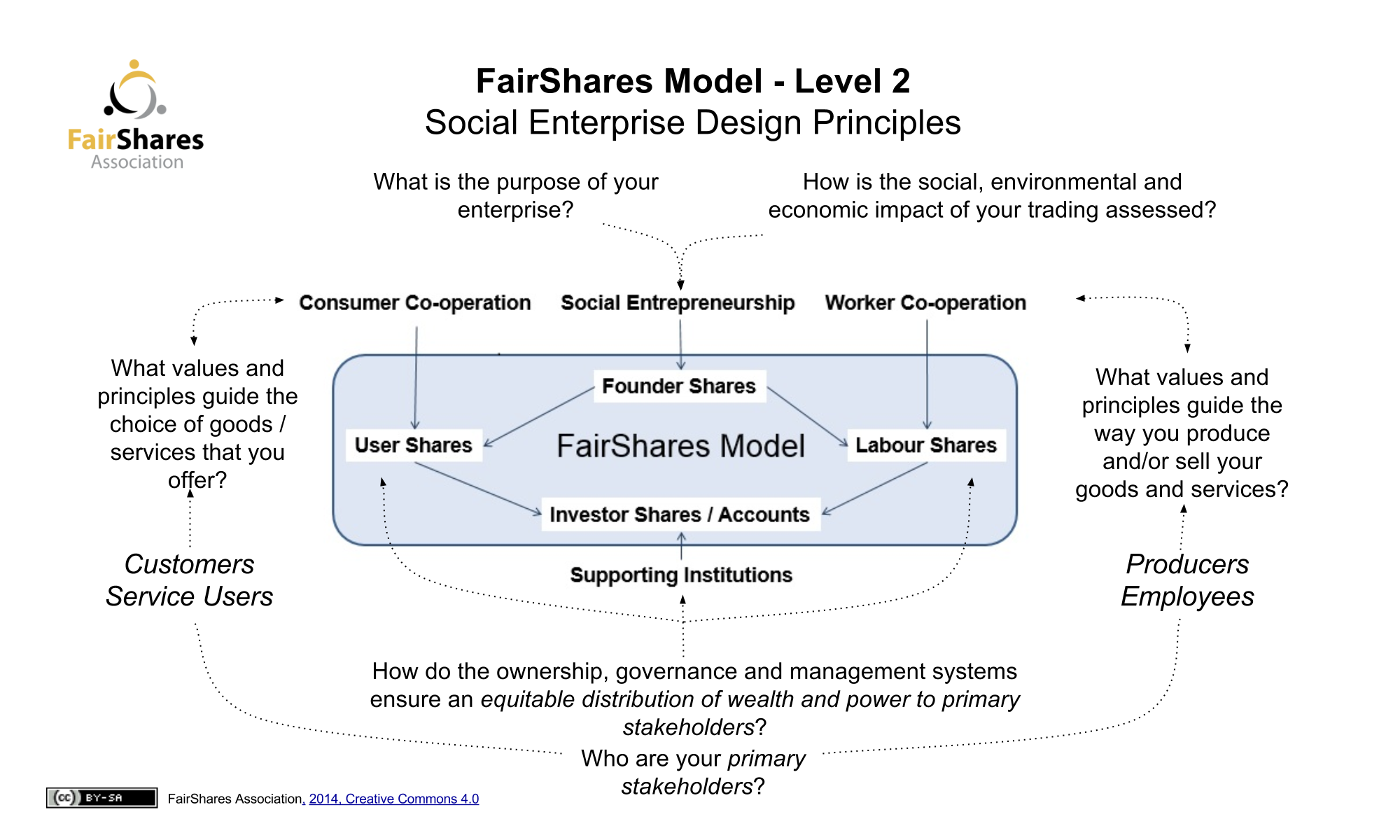
On of the many interesting things discussed during the social enterprise law workshop at Notre Dame Law School was the “FairShares Model.” Nina Boeger (University of Bristol-UK) brought the model to the group’s attention, and the model was new news to me.

The FairShares Model was “created during a research programme on democratising charities, co-operatives and social enterprises involving academics at Sheffield Hallam University and Manchester Metropolitan University in the UK.”

The FairShares Model cites the “Social Enterprise Europe Ltd” when noting that social enterprises “aim to generate sustainable sources of income, but measure their success through:

  • Specifying their purpose(s) and evaluating the impact(s) of their trading activities;

  • Conducting ethical reviews of their product/service choices and production/consumption practices;

  • Promoting socialized and democratic ownership, governance and management.”

To address theses aims, the FairShares Model offers social audits and suggests the issuing some combination of (1) founder shares, (2) labour shares, (3) investor shares, (4) user shares.

While I agree that significant corporate governance changes should be considered, at first glance this model seems a bit unwieldy if all four types of shares are issued. Still, I am interested in learning more.