“Injustice anywhere is a threat to justice everywhere.”

Martin Luther King, Jr., Letter from Birmingham Jail, Alabama, 16 April 1963, in Atlantic Monthly August 1963

I had wanted to post a tribute to Dr. King here early on Monday.  However, after posting the Emory conference announcement, I moved on to other work, and that work filled up the available time in the day.  So, this late post including the quote above will have to suffice.

As I read meaningful quotes from Dr. King on social media and elsewhere all day on Monday, I found myself thinking of examples of inequality and injustice.  Many are compelling; many are meaningful.  Some are current events; and some of those involve business law questions.

For a number of days now (since before MLK Day) we have been showered with news stories relating to the compensation disparity between Mark Wahlberg and Michelle Williams for reshooting scenes from All the Money in the World in the wake of Kevin Spacey’s replacement in the film resulting from allegations of sexual misconduct.  (See here, among other places.)  Most folks who follow Hollywood business issues know that gender discrimination is common.  My sister, a visual effects
The-overnighters

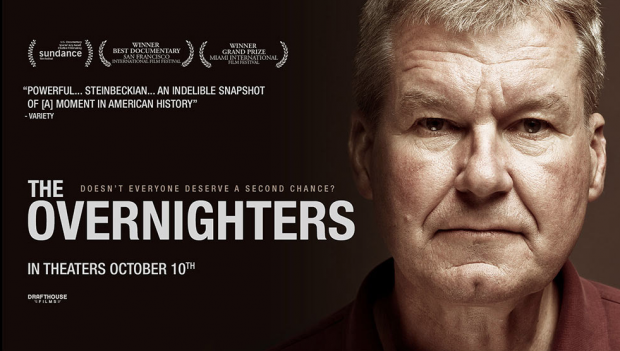
Over the break, I watched the documentary Overnighters on Netflix. 

In short, the documentary chronicles the story of a pastor who opens the church to migrant workers in North Dakota during the energy boom in that state. The pastor faces pushback from his congregation, neighbors, and city officials who do not appreciate having these men – some with criminal records – housed so close. 

In my opinion, the pastor is right, and the congregants are wrong, about the purpose of a church. The church should be in a community to serve, especially its needy neighbors. That said, the logistics of how to serve may be up for debate. Also, it is at least arguable that by serving the migrant workers the church strayed from serving its congregation. It would have been helpful if the church had a clear statement on its purpose and priorities. Many social enterprises have extremely vague purpose statements, which I do not think are very helpful. Benefit corporations are often required by statue to “benefit society and the environment.” A purpose statement like that would not have helped the church in Overnighters much at all. A statement that showed that those in need would be prioritized

Article-h-m2-0108

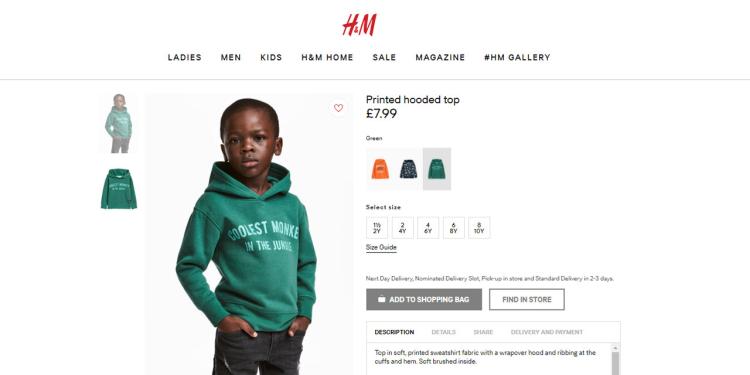
Swedish clothing giant H & M caused a huge stir this week with an ad campaign depicting a young black boy in a sweatshirt that proclaimed him the “Coolest Monkey In the Jungle.”  The company’s misstep is surprising given the public condemnations of the use of the word “monkey” in Europe over the past few years when soccer fans have used it as a slur against black players. Notwithstanding H & M’s many apologies, several megastars have denounced the company and some have even pulled their fashion collaborations. As usual, several have called for boycotts of the retailer. But will all of this really matter? The sweatshirt was still for sale in the UK days for days after the controversy erupted, and the Weeknd, one of the megastars who vowed to never work with H & M, still has his 18-piece H & M collection available online and available for purchase on the store’s  U.S. portal.

I’m headed out of the country tomorrow and in my quest for a new sweater, I glanced in the H & M store in my local mall earlier today. The store was packed and likely with fans of the artists who called for a boycott.

As I have written about in past posts (see, e.g., here and here), I fall among those who do New Year’s resolutions.

In 2017, I was 25 out of 34 (73.5%). (Yes, I set 34 resolutions; I may be crazy).

The biggest realization I had this year was that I struggled with resolutions that required daily/weekly tracking. A daily/weekly resolution has at least three issues: (1) if screw up once, you’ve blown the resolution for the year, (2) just tracking the resolution takes habit formation and daily/weekly time, and (3) creating a daily/weekly habit is generally difficult.

So, instead of a resolution to run 5x a week, I had better luck with an achievement goal like “run a mile under 5 minutes by the end of the year.” If the achievement goal was tough enough to require roughly 5x a week running then the achievement goal could get you to basically the same place as the weekly goal without the meticulous tracking requirement and with allowing occasional time off. The bigger achievement goals, however, may need to be broken into smaller steps.

My toughest resolution for 2018, and I “only” have 22 resolutions this year, will probably

At a time when many boards may be thinking of tax planning and possible M & A deals, they may have to start focusing more on the unseemly topic of their executives’ sex lives because the flood of terminations and resignations due to sexual misconduct shows no signs of slowing down. One of the most shocking but underreported terminations in 2017 related to VISA. The CEO, one year into the role, chose to terminate one of his most valuable executives after an anonymous tip about sexual misconduct.  He wanted his employees to know that the corporate culture and values mattered. Board members should look closely at the VISA example.

We will continue to see the rise of the #MeToo movement spurred on in part by the messaging from a star-studded task force  formed to address Hollywood issues and the establishment of a multimillion-dollar legal defense fund to help blue-collar workers. Even Supreme Court Chief Justice Roberts addressed sexual harassment in the court system in his Year-End Report on the Federal Judiciary.  More people than ever may now choose to come forward with claims of harassment or assault. Whether companies choose to terminate wrongdoers or the accused choose to

Earlier this week, President Trump gave his annual speech on national security. As in the past, he failed to stress human rights (unlike his predecessors) but did allude to cooperation, even with China and Russia, when warranted by geopolitical interests. Over the last several months, he has touted bilateral trade agreements. Coincidentally, my latest law review article on a potential bilateral investment treaty with Cuba came out the same day. As you may recall, Trump recently reversed some Obama-era policies on Cuba over human rights. My article may help his administration reconcile some of the apparent contradictions in his policies. The abstract is below. 

You Say Embargo, I Say Bloqueo—A Policy Recommendation for Promoting Foreign Direct Investment and Safeguarding Human Rights In Cuba

The United States is the only major industrialized nation that restricts
trade with Cuba. Although President Obama issued several executive orders
that have facilitated limited trade (and President Trump has scaled some
back), an embargo remains in place, and by law, Congress cannot lift it until,
among other things, the Cuban government commits to democratization and
human rights reform. Unfortunately, the Cuban and U.S. governments
fundamentally disagree on the definition of “human rights,” and neither side

A recent case in Washington state introduced me to some interesting facets of Washington’s recreational marijuana law.  The case came to my attention because it is part of my daily search for cases (incorrectly) referring to limited liability companies (LLCs) as “limited liability corporations.”  The case opens: 

In 2012, Washington voters approved Initiative Measure 502. LAWS OF 2013, ch. 3, codified as part of chapter 69.50 RCW. Initiative 502 legalizes the possession and sale of marijuana and creates a system for the distribution and sale of recreational marijuana. Under RCW 69.50.325(3)(a), a retail marijuana license shall be issued only in the name of the applicant. No retail marijuana license shall be issued to a limited liability corporation unless all members are qualified to obtain a license. RCW 69.50.331(1)(b)(iii). The true party of interest of a limited liability company is “[a]ll members and their spouses.”1 Under RCW 69.50.331(1)(a), the Washington State Liquor and Cannabis Board (WSLCB) considers prior criminal conduct of the applicant.2

LIBBY HAINES-MARCHEL & ROCK ISLAND CHRONICS, LLC, Dba CHRONICS, Appellants, v. WASHINGTON STATE LIQUOR & CANNABIS BOARD, an Agency of the State of Washington, Respondent., No. 75669-9-I, 2017 WL 6427358, at *1 (Wash. Ct. App.

Recently, the International Olympic Committee (IOC) announced that Russia will be banned from the 2018 Winter Games for systemic doping

If you have not watched Icarus (on Netflix) on this topic, I recommend it. The documentary starts slowly, and the story-line is a bit disjointed, but the information uncovered about state-sponsored doping in Russia is fascinating and depressing.  Even if you are not a sports fan, you may be interested in the parts in the documentary related to the alleged involvement of the Russian government. 

It has been a busy semester, but I am working (slowly) on a journal article on morality clauses in sports contracts. Doping is often specifically mentioned in these contracts, and doping is a sad reality in many sports. Doping also betrays, I think, improper prioritization. While we are starting to see more attention paid to courage and compassion in sports, “winning” has often been promoted as the top priority. Hopefully we will see more people (and  countries) who compete with passion, but also with integrity.  

While I was in France last week touring and attending an academic conference, a French music legend died and was mourned.  Johnny Hallyday, the King of French rock ‘n’ roll (known widely as the “French Elvis”), died earlier this month at the age of 74 after a battle with lung cancer.  I learned of this in a circuitous way–because one of his songs, Quelque Choses de Tennessee (Something of Tennessee), was playing on the radio in a hotel shuttle van and caught my attention (for obvious reasons, although the song refers to Tennessee Williams, not the state, as it turns out).  Also, I happened to be in Paris the day of his funeral, when many roads (including the Avenue des Champs-Élysées) were blocked off for the related activities.

Curiosity about the song and the singer led me to the Internet.  My Internet searching revealed Hallyday as the singer and described an interesting life.  This guy loved the United States–not only adopting rock ‘n’ roll, but also writing lyrics about this country based on his U.S. travels.  Perhaps most famous is Mon Amérique à Moi (My America and Me), which includes the following lyrics near and dear

Two weeks ago, I asked whether companies were wasting time on harassment training given the flood of accusations, resignations, and terminations over the past few weeks. Having served as a defense lawyer on these kinds of claims and conducted hundreds of trainings, I know that most men generally know right from wrong before the training (and some still do wrong). I also know that in many cases, people look the other way when they see or hear about the complaints, particularly if the accused is a superstar or highly ranked employee. Although most men do not have the power and connections to develop an alleged Harvey Weinstein-type “complicity machine” to manage payoffs and silence accusers, some members of management play a similar role when they ignore complaints or rumors of inappropriate or illegal behavior. 

The head in the sand attitude that executives and board members have displayed in the Weinstein matter has led to a lawsuit arguing that Disney knew or should have known of Weinstein’s behavior. We may see more of these lawsuits now that women have less fear of speaking out and Time honored the “Silence Breakers” as the Person of the Year. As I