
For those of you who talk about the recent problems at Volkswagen in your classes, this recently posted article may be useful. I connected with Charles Elson briefly when I lived in Delaware, and he is certainly an authority on corporate governance. The article is available here and the abstract is posted below. 

———–

Although the primary cause of the emissions scandal at Volkswagen appears to have been misfeasance and malfeasance on a corporate-wide scale, we argue that such a problematic culture existed at Volkswagen because of the composition of the board itself in combination with the unique governance structure known as “co-determination,” that defines many German companies, including VW. There are three major problems from a corporate governance standpoint with the Volkswagen board. First, is the interest-conflicting nature of the dual-class stock held by the dominant shareholding Porsche and Piech families. Second, is the presence of a government as a major shareholder. And third is the organization of its characteristically German “two-tier” board around the principle of co-determination, which mandated significant labor representation. We argue that each of these elements of the VW ownership and governance structure contributed in varying degrees to the board failure of oversight that led
I am looking forward to presenting at this conference next month. Looks like a great group of academics and practitioners.

—————–

University of Cincinnati College of Law

The 29th Annual Corporate Law Center Symposium – Corporate Social Responsibility and the Modern Enterprise

March 18, 2016

8:45 a.m. – 3:30 p.m.

Hilton Netherland Plaza

Pavilion Ballroom

This event is free. CLE: 5.0 hours, pending approval.

Presented by the University of Cincinnati College of Law’s Corporate Law Center and Law Review.

Symposium materials will be available on March 14 at: law.uc.edu/corporate-law-center/2016-symposium

Please register by contacting Lori Strait: email Lori.Stait@uc.edu; fax 513-556-1236; or phone 513-556-0117

Introduction, 8:45 a.m.

Keynote, 9:00 a.m.

Clare Iery, The Procter & Gamble Company

Social Enterprises and Changing Legal Forms, 9:30 a.m.

Mark Loewenstein, University of Colorado Law School

William H. Clark, Jr., Drinker Biddle & Reath LLP

Haskell Murray, Belmont University College of Business

Russell Menyhart, Taft Stettinius & Hollister LLP

Sourcing Dilemmas in a Globalized World, 11:00 a.m.

Steve Slezak, University of Cincinnati College of Business

Marsha A. Dickson, University of Delaware Department of Fashion & Apparel Studies

Tianlong Hu, Renmin University of China Law School

Anita Ramasastry, University of Washington School of Law

CSR

For the past four weeks I have been experimenting with a new class called Transnational Business and Human Rights. My students include law students, graduate students, journalists, and accountants. Only half have taken a business class and the other half have never taken a human rights class. This is a challenge, albeit, a fun one. During our first week, we discussed CSR, starting off with Milton Friedman. We then used a business school case study from Copenhagen and the students acted as the public relations executive for a Danish company that learned that its medical product was being used in the death penalty cocktail in the United States. This required students to consider the company’s corporate responsibility profile and commitments and provide advice to the CEO based on a number of factors that many hadn’t considered- the role of investors, consumer reactions, the pressure from NGOs, and the potential effect on the stock price for the Danish company based on its decisions. During the first three weeks the students have focused on the corporate perspective learning the language of the supply chain and enterprise risk management world.

This week they are playing the role of the state and critiquing and

Sports have had some well-publicized legal and ethical problems over the past few months.

I hope to look into these scandals more deeply in coming months, but it seems unchecked power and/or loose oversight are at least part of the problem.

As with many of the recent business scandals, I wonder if punishments need to be more severe to curb these problems, or if there is another, more effective, solution waiting to be uncovered.

Two weeks ago I posted about whether small businesses, start ups, and entrepreneurs should consider corporate social responsibility as part of their business (outside of the benefit corporation context). Definitions of CSR vary but for the purpose of this post, I will adopt the US government’s description as:

entail[ing] conduct consistent with applicable laws and internationally recognised standards. Based on the idea that you can do well while doing no harm … a broad concept that focuses on two aspects of the business-society relationship: 1) the positive contribution businesses can make to economic, environmental, and social progress with a view to achieving sustainable development, and 2) avoiding adverse impacts and addressing them when they do occur.

During my presentation at USASBE, I admitted my cynical thoughts about some aspects of CSR, discussed the halo effect, and pointed out some statistics from various sources about consumer attitudes. For example:

  • Over 66% of people say they will pay more for products from a company with “good values”
  • 66% of survey respondents indicated that their perception of company’s CEO affected their perception of the company
  • 90% of US consumers would switch brands to one associated with a cause, assuming comparable price

I am taking a MOOC from University of Illinois and Coursera on digital marketing. I’ve been trying to take at least one course a semester. Both the underlying material, and the intricacies of online education have been interesting. I chose this course because I have family members in the digital marketing area, and I am taking (and discussing) this course with them.

Later, I may discuss some of  the substantive take-aways from the course — I have completed about 50% of the course so far — but in this post I want to discuss business/academic entanglement.

In this digital marketing class, an assignment on co-creation (by firms & their customers) consisted of creating an online account with Starbucks, submitting an idea for consideration, and reporting how the idea was received by commenters. This was a useful exercise and it made the concept come alive, but I couldn’t help wondering if Starbucks was somehow involved with University of Illinois and/or Coursera in creating this assignment. To be clear, I have no idea whether Starbucks was or was not involved.  But, in any event, with the thousands (and maybe 10s of thousands) of people who are taking this course, this assignment seemed like a win for Starbucks.  Well, actually, this idea

Mnookin

Perhaps the most common question I receive from the MBA students in my Decision Making & Negotiation Skill class is – what do I do when the other side is completely unreasonable or evil?

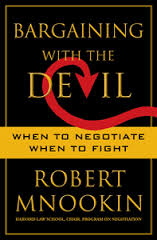
Robert Mnookin (Harvard) explores this question in his book Bargaining with the Devil: When to Negotiate and when to Fight

I won’t attempt to summarize the entire book, but I share a few representative quotes below. (Page numbers correspond to the 2010 hardback edition).

“By ‘Devil’ I mean an enemy who has intentionally harmed you in the past or appears willing to harm you in the future. Someone you don’t trust. An adversary whose behavior you may even see as evil.” (pg. 1)

“An act is evil when it involves the intentional infliction of grievous harm on another human being in the circumstances where there is no adequate justification.” (pg. 15)

Consider “Interests [of both sides]…Alternatives [of both sides]…Potential negotiated outcomes…Costs…Implementation…What issues of recognition and legitimacy are implicated in my decision” (pgs. 27-34).

“I believe there is reason to be deeply concerned whenever an agent or representative allows personal morality to override a rational analysis favoring negotiation – even with a devil.” (pg. 49)

“If you bargain

This is the time of year when many people make New Year’s resolutions, and I suppose that law professors do so as well. I’m taking a break from teaching business associations next semester. Instead, I will teach Business and Human Rights as well as Civil Procedure II. I love Civ Pro II because my twenty years of litigation experience comes in handy when we go through discovery. I focus a lot on ethical issues in civil procedure even though my 1Ls haven’t taken professional responsibility because I know that they get a lot of their context from TV shows like Suits, in which a young “lawyer” (who never went to law school) has a photographic memory and is mentored by a very aggressive senior partner whose ethics generally kick in just in the nick of time. It will also be easy to talk about ethical issues in business and human rights. What are the ethical, moral, financial, and societal implications of operating in countries with no regard for human rights and how should that impact a board’s decision to maximize shareholder value? Can socially-responsible investors really make a difference and when and how should they use their influence? Those

A year ago today, President Obama shocked the world and enraged many in Congress by announcing normalization of relations with Cuba. A lot of the rest of the United States didn’t see this as much of a big deal, but here in Miami, ground zero for the Cuban exile community, this was a cataclysmic event. Now Miami is one of the biggest sources of microfinance for the island.

Regular readers of this blog know that I have been writing about the ethical and governance issues of doing business with the island since my 10-day visit last summer. I return to Cuba today on a second research trip to validate some of my findings for my second article on governance and compliance risks and to begin work on my third article related to rule of law issues, the realities of foreign direct investment and arbitration, what a potential bilateral or multilateral investment agreement might look like, and the role that human rights requirements in these agreements could play.

This is an interesting time to be visiting Cuba. The Venezuelan government, a large source of income for Cuba has suffered a humiliating defeat. Will this lead to another “special period” for the