My friend and colleague at West Virginia University, Jena Martin, has posted her new paper, Hiding in the Light: The Misuse of Disclosure to Advance a Business and Human Rights Agenda. The paper is forthcoming in the Columbia Journal of Transnational Law and can be accessed at https://papers.ssrn.com/sol3/papers.cfm?abstract_id=3028826 

It’s worth a read. Here’s the abstract:

In June 2017, Waitrose, a top UK supermarket, pulled its cans of corned beef off the shelves after an investigation revealed that the meat might have been produced with slave labor. At the time of the recall, Waitrose was in compliance with the UK Modern Slavery Act (MSA), a 2015 law enacted to prevent human trafficking and modern-day slavery. Under the MSA, corporations are required to file annual reports disclosing what action they had taken to eradicate slavery and human trafficking in their supply chains. The Modern Slavery Act, in turn, was a much-lauded law that is part of the growing trend of States to move the international business and human rights agenda forward. A key component of that agenda involves disseminating the UN’s Protect, Respect and Remedy Framework and implementing the UN Guiding Principles, which have been praised by States around the

Today I sat through a panel at the ABA International Law Section Meeting entitled, I, Robot – The Increasing Use and Misuse of Technology by In-House Legal Departments. I have already posted here about Ross and other programs. I thought I would share other vendors that in-house counsel are using according to one of the panelists: 

  • Deal point – virtual deal room.
  • Casetext – legal research.
  • Disco AI; Relativity; Ringtail – apply machine learning to e-discovery.
  • Ebrevia; Kira Systems; RAVN – contract organization and analysis.
  • Julie Desk – AI “virtual assistant” for scheduling meetings.
  • Law Geex – contract review software that catches clauses that are unusual, missing, or problematic.
  • Legal Robot – start-up uses AI to translate legalese into plain English; flags anomalies; IDs potentially vague word choices.
  • LexMachina – litigation analytics.
  • NeotaLogic – client intake and early case assessment.
  • Robot Review – compares patent claims with past applications to predict patent eligibility.
  • Ross Intelligence – AI virtual attorney from IBM (Watson).

These and their future competitors lead to new challenges for lawyers, law professors, and bar associations. Will robots engage in the unauthorized practice of law? What are the ethical ramifications of using artificial intelligence in legal engagements? How

Earlier this week, my two-year old daughter was in the pediatric ICU with a virus that attacked her lungs. We spent two nights at The Monroe Carell Jr. Children’s Hospital at Vanderbilt (“Vanderbilt Children’s). Thankfully, she was released Wednesday afternoon and is doing well. Unfortunately, many of the children on her floor had been in the hospital for weeks or months and were not afforded such a quick recovery. There cannot be many places more sad than the pediatric ICU.

Since returning home, I confirmed that Vanderbilt Children’s is a nonprofit organization, as I suspected. I do wonder whether the hospital would be operated the same if it were a benefit corporation or as a traditional corporation.

Some of the decisions made at the hospital seems like they would have been indefensible from a shareholder perspective, if the hospital had been for-profit. Vanderbilt Children’s has a captive market, with no serious competitors that I know of in the immediate area. Yet, the hospital doesn’t charge for parking. If they did, I don’t think it would impact anyone’s decision to choose them because, again, there aren’t really other options, and the care is the important part anyway. The food court

Uber has a new CEO. Perhaps his first task should be to require one of his legal or compliance staff to attend the FCPA conference at Texas A & M in October given the new reports of an alleged DOJ investigation.. I might have some advice, but Uber needs to hear the lessons learned from Walmart, who will be sending its Chief Compliance Officer. Thanks to FCPA expert, Mike Koehler, aka the FCPA Professor, for inviting me. Mike has done some great blogging about the Walmart case (FYI- the company has reported spending $865 million on fees related to the FCPA and compliance-related costs). Details are below:

THE F​CPA TURNS 40:
AN ASSESSMENT OF FCPA ENFORCEMENT POLICIES AND PROCEDURES

FCPA ConferenceThursday, October 12, 2017
Texas A&M University School of Law
Fort Worth, Texas

This conference brings together Foreign Corrupt Practices Act enforcement officials, experienced FCPA practitioners, and leading FCPA academics and scholars to discuss the many legal and policy issues relevant to the current FCPA enforcement and compliance landscape.

Register here

AGENDA

[Click here to download agenda pdf]

Registration, 8:30 a.m.

Morning Session, 9:00 a.m. to Noon

FCPA Legal and Policy Issues

On July 15 of this year, The New York Times ran an article entitled, “The Lawyer, The Addict.” The article looks at the life of Peter, a partner of a prestigious Silicon Valley law firm, before he died of a drug overdose.

You should read the entire article, but I will provide a few quotes.

  • “He had been working more than 60 hours a week for 20 years, ever since he started law school and worked his way into a partnership in the intellectual property practice of Wilson Sonsini.”
  • “Peter worked so much that he rarely cooked anymore, sustaining himself largely on fast food, snacks, coffee, ibuprofen and antacids.”
  • “Peter, one of the most successful people I have ever known, died a drug addict, felled by a systemic bacterial infection common to intravenous users.”
  • “The history on his cellphone shows the last call he ever made was for work. Peter, vomiting, unable to sit up, slipping in and out of consciousness, had managed, somehow, to dial into a conference call.”
  • “The further I probed, the more apparent it became that drug abuse among America’s lawyers is on the rise and deeply hidden.”
  • “One of the most comprehensive studies

Business leaders probably didn’t think the honeymoon would be over so fast. A CEO as President, a deregulation czar, billionaires in the cabinet- what could possibly go wrong?

When Ken Frazier, CEO of Merck, resigned from one of the President’s business advisory councils because he didn’t believe that President Trump had responded appropriately to the tragic events in Charlottesville, I really didn’t think it would have much of an impact. I had originally planned to blog about How (Not) To Teach a Class on Startups, and I will next week (unless there is other breaking news). But yesterday, I decided to blog about Frazier, and to connect his actions to a talk I gave to UM law students at orientation last week about how CEOs talk about corporate responsibility but it doesn’t always make a difference. I started drafting this post questioning how many people would actually run to their doctors asking to switch their medications to or from Merck products because of Frazier’s stance on Charlottesville. Then I thought perhaps, Frazier’s stance would have a bigger impact on the millennial employees who will make up almost 50% of the employee base in the next few years. Maybe he would

These days it is easy to get discouraged on how divided our nation seems to be on a number of issues. John Inazu, Distinguished Professor of Law, Religion, and Political Science at Washington University, maps a way forward in his book Confident Pluralism (2016).

The book is divided into two parts: (1) Constitutional Commitments, and (2) Civic Practices.

The first part “contend[s] that recent constitutional doctrine has departed from our longstanding embrace of pluralism and the political arrangements that make pluralism possible.” (8) Further, the first part offers guideposts for future decisions and political solutions. The first part argues for both inclusion and dissent, for the free formation of voluntary groups, for meaningful access to public forums, and for access to publicly available funding for diverse organizations. Provocatively, Inazu claims that Bob Jones case – which stripped tax-exempt status from Bob Jones University due to its prohibition of interracial dating/marriage – is “normatively attractive to almost everyone, [but] is conceptually wrong.” (75) Inazu claims that “[t]he IRS should not limit tax-exempt status based on viewpoint of ideology.” (79) He extends the argument to “generally available resources.” While the Trinity Lutheran case was decided by the Supreme Court after publication

ABABookCover

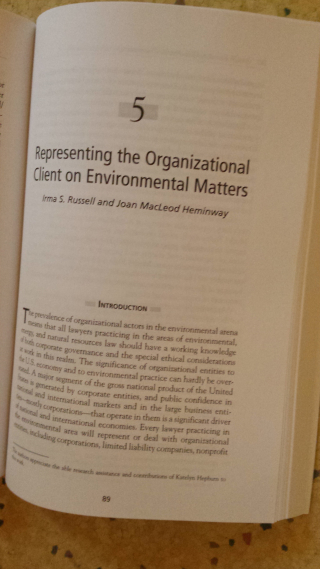
My good friend and long-time mentor Irma Russell and I wrote a chapter for the recently released ABA book, Ethics and the Environment: A Lawyer’s Guide.  Irma also is a co-editor of the book (with Vicki Wright).  In our joint contribution, the chapter entitled “Representing the Organizational Client on Environmental Matters,” Irma and I cover issues involving professional responsibility, corporate governance, and environmental compliance.  Guess which part was my primary responsibility . . . ?!)  Covering some 37 pages of the 242-page book, the rules we cover and the observations we make are fairly wide-ranging.  We hope, as we noted in our conclusion to the chapter, that we supply legal counsel representing corporations and other organizations with “foundational tools to assist them in providing advisory and advocacy-oriented services to organizational clients in the environmental law context.”  Irma and I received our copies last week.  The book soon will be available through the ABA and other outlets.


ABABookChapterPage

SaveSaveSaveSave

SaveSave

WB

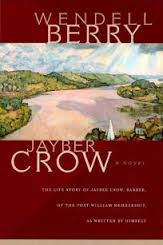
I highly recommend Jayber Crow by Wendell Berry

Set in rural Kentucky, Jayber Crow is a story about small town life, community, love/hate, sustainability, and industrialization. The main character, Jonah “Jayber” Crow loses both his parents and his Aunt and Uncle by the age of ten. He spends the next few years in an orphanage before obtaining a scholarship to a local college as a “pre-ministerial” student. Doubting his calling to the ministry, Jayber drops out and returns to his hometown. He serves as the town’s only barber, and he also picks up jobs as the local grave digger and church janitor. Jayber narrates, in vivid detail, the exodus from the small town by the younger generation and the invasion of large-scale, profit-focused, corporate farming.   

The author, Wendell Berry, warns that “persons attempting to explain, interpret, explicate, analyze, deconstruct, or otherwise ‘understand’ [this book] will be exiled to a desert island in the company only of other explainers” so I will simply end with a few of my favorite quotes below. I think one of the reasons I so liked this book is because it reminded me of my family’s property and of my maternal grandfather, who lived at a pace unknown

Logo

Last Friday, The New York Times ran a story on possible performance enhancing drug use inside the Nike Oregon Project.

The Nike Oregon Project is coached by running legend Alberto Salazar, who, by all accounts, is both incredibly competitive and dedicated to his work.

Among the athletes who are or have been associated with the Nike Oregon Project (and coached by Salazar )are gold medalist (in the 5000 & 10,000m in 2012 and 2016) Sir Mo Farah, gold medalist (in the 2016 1500m) Matt Centrowitz Jr., and silver medalist (in the 10,000m in 2012 and in the marathon in 2016) Galen Rupp. These three athletes have been the most dominant male distance runners for the U.S. over the last two Olympic cycles. 

Allegations of doping is nothing new for the Nike Oregon project coach and athletes. For example, Kara Goucher, U.S. Olympian and former member of the Nike Oregon Project herself, has been extremely vocal with allegations against the group for years. The Times of London published some of the same allegations against the Nike Oregon Project a few months before The New York Times. FloTrack has released what it thinks is the full report from USADA