
In August 2020, Citibank, as administrative agent for a syndicated loan to Revlon, Inc., accidently wired nearly $900 million to lenders.  It had intended to send a $7.8 million interest payment.  Some of the lenders refused to return the money.  Not surprisingly, Citibank was not happy about this.  Yesterday, U.S. District Judge Jesse M. Furman issued a ruling denying Citibank’s attempt to recoup the funds.  As it turns out, under NY law, keeping money wired by mistake generally amounts to conversion or unjust enrichment. However, under the discharge-for-value defense, “The recipient is allowed to keep the funds if they discharge a valid debt, the recipient made no misrepresentations to induce the payment, and the recipient did not have notice of the mistake.”  

Here’s coverage of the ruling in the NY Times, WSJ, and Reuters.
Co-blogger Joan Heminway predicted that GameStop Will Be 2021’s Great Gift To Business Law Professors.  Totally agree.  I think it’s also a great gift to those of us who research financial market infrastructure, particularly clearing and settlement.  This episode has highlighted the importance of clearinghouses.  In the past, I’ve written several posts on clearinghouses (for example, here, here, here).  In preparing to speak on this topic during the UT Law roundtable last week, I came across several great articles about the role of clearinghouses and margin calls in the Robinhood/GameStop story.  I share a few of these below with readers. 

Keep in mind that the DTCC’s clearinghouse, the National Securities Clearing Corporation (NSCC), was designated in 2012 by the Financial Oversight Stability Council (FSOC) as one of eight designated financial market utilities under Dodd-Frank’s Title VIII.  These designated FMUs are single points of failure in financial markets.  I’ve written extensively about Title VIII, beginning with The Federal Reserve as Last Resort.

Jeff John Robert’s Fortune article:  The real story behind Robinhood’s decision to restrict GameStop trading – and that 4 a.m. call to put up $3 billion.

Telis Demos’ WSJ article: Why

The Southeastern Association of Law Schools (SEALS) is scheduled to hold its annual conference in person, July 26-August 1, at The Omni Amelia Island Resort, Amelia Island, Florida.  SEALS has always been one of my favorite law conferences. It combines the opportunity to attend fascinating panels and discussion groups (showcasing our colleagues’ latest research) with plenty of networking opportunities and some fun in the sun! And one of the highlights of the conference is always the New Scholars Workshop, which provides opportunities for new legal scholars to interact with their peers and experts in their respective fields. Here’s an excerpt from the SEALS New Scholars Committee website:

For over a decade, the New Scholars Workshop has provided new scholars with the opportunity to present their work in a supportive and welcoming environment. The New Scholars Committee accepts and reviews nominations to the program, organizes new scholars into colloquia based on subject matter, and coordinates with the Mentors Committee to match each new scholar with a mentor in his or her field. We also hold a New Scholars Luncheon at the Annual Meeting at which New Scholars and their mentors can get to know one another and the

BLPB readers, I hope that everyone is enjoying the holiday season and the semester break!  I also want to get an early start on wishing everyone a HAPPY NEW YEAR!!! 

Before we leave 2020, I wanted to share that if you missed Bank Supervision: Past, Present, and Future, a stellar virtual conference hosted by the Federal Reserve Board of Governors, Harvard Law School, and the Wharton School on December 11, you can still access the conference materials here.  There’s lots of great stuff, including four literature reviews (below) that banking law profs researching in this area are certain to find helpful.  Enjoy!  And a big shout-out to the hosts for such a successful event!

Literature Review on Economics: Beverly Hirtle, Banking Supervision: The Perspective from Economics

Literature Review on Law: Julie Andersen Hill, Bank Supervision: A Legal Scholarship Review

Literature Review on History: Sean H. Vanatta, Histories of Bank Supervision

Literature Review of Supervisory Practices: Jonathan Fiechter and Aditya Narain, Enhancing Supervisory Effectiveness –Findings from IMF Assessments

In my previous post on the “Study on Directors’ Duties and Sustainable Corporate Governance” (“Study on Directors’ Duties”) that Ernst & Young prepared for the European Commission (Commission), I focused on the transformative power of corporate governance. I said that stakeholder capitalism would have a practical value if supported by corporate governance rules based on appropriate standards such as the ones provided by the Sustainable Development Goals (SDGs).

Some of my pointers for the Commission were the creation of a regulatory framework that enables the representation and protection of stakeholders, the representation of “stakewatchers,” that is, non-governmental organizations and other pressure groups through the attribution of voting and veto rights and their members’ nomination to the management board (similar to German co-determination). I also suggested expanding directors’ fiduciary duties to include the protection of stakeholders’ interests, accountability of corporate managers, consultation rights, and additional disclosure requirements.

In my last guest post in this series dedicated to the Study on Directors’ Duties, I ask the following questions. Do investors have a moral duty to internalize externalities such as climate change and income inequality, for example? Do firm ownership and investor commitment matter? Should investors’ money be “moral” money? 

In my first post on the “Study on Directors’ Duties and Sustainable Corporate Governance” (“Study on Directors’ Duties”) prepared by Ernst & Young for the European Commission, I said that corporate boards are free to apply a purposive approach to profit generation. I added that:

[a]pplying such a purposive approach will depend on moral leadership, CEOs’ and corporate boards’ long-term vision, clear measurement of the companies’ interests and communication of those interests to shareholders, and rethinking executive compensation to encourage board members to take on other priorities than shareholder value maximization. Corporate governance has a significant transformative role to play in this context. 

This week, I focus on corporate governance’s enabling power. Therefore, “T” is for transformative corporate governance. Market-led developments can and do precede and inspire legal rules. Corporate governance rules are not an exception in this regard. To illustrate these rules’ transformative potential, I dwell on the ongoing debate around stakeholder capitalism.

First question. What is stakeholder capitalism? In a recent debate with Lucian Bebchuk about the topic, Alex Edmans explained that “stakeholder capitalism seeks to create shareholder welfare only through creating stakeholder welfare.” The definition suggests that the way to create value for both shareholders and stakeholders

If you read the title, you’ll see that I’m only going to ask questions. I have no answers, insights, or predictions until the President-elect announces more cabinet picks. After President Trump won the election in 2016, I posed eleven questions and then gave some preliminary commentary based on his cabinet picks two months later. Here are my initial questions based on what I’m interested in — compliance, corporate governance, human rights, and ESG. I recognize that everyone will have their own list:

  1. How will the Administration view disclosures? Will Dodd-Frank conflict minerals disclosures stay in place, regardless of the effectiveness on reducing violence in the Democratic Republic of Congo? Will the US add mandatory human rights due diligence and disclosures like the EU??
  2. Building on Question 1, will we see more stringent requirements for ESG disclosures? Will the US follow the EU model for financial services firms, which goes into effect in March 2021? With ESG accounting for 1 in 3 dollars of assets under management, will the Biden Administration look at ESG investing more favorably than the Trump DOL? How robust will climate and ESG disclosure get? We already know that disclosure of climate

This is my second post in a series of blog posts on the “Study on Directors’ Duties and Sustainable Corporate Governance (“Study on Directors’ Duties”) prepared by Ernst & Young for the European Commission.

In 2015, the world gathered at the United Nations Sustainable Development Summit for the adoption of the Post-2015 development agenda. That Summit was convened as a high-level plenary meeting of the United Nations General Assembly. At this meeting, Resolution A/70/L.1, Transforming our World: The 2030 Agenda for Sustainable Development, was adopted by the General Assembly. In 2016, the Paris Agreement was signed. In my last post, I called both the United Nations 2030 Agenda and the Paris Agreement trendsetters because they kicked-off a global discussion on sustainable development at so many levels, including at the financial level.

During the 2015 United Nations Sustainable Development Summit, I recall that the Civil Society representatives called for a UN resolution on sustainable capital markets to tackle the absence of concrete actions regarding global financial sustainability following the 2008 Great Recession.

At the end of 2016, the European Commission (Commission) created the High-Level Expert Group on Sustainable Finance (HLEG). In early 2018, the HLEG published its report

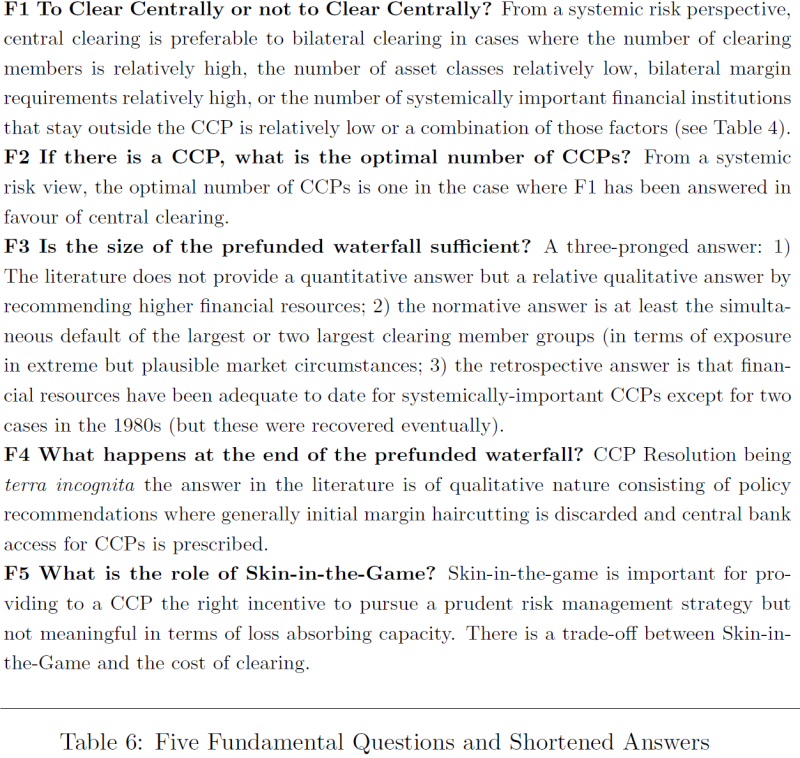
In doing my weekly SSRN search, I was absolutely delighted to see Professor Ron Berndsen’s Five Fundamental Questions on Central Counterparties (here) (note: these institutions are sometimes also referred to as CCPs or clearinghouses).  Berndsen has produced an extensive and invaluable review of the “booming literature on CCPs, of which about 60% is published in the last five years.”  As he notes, this area “can be considered as the most important niche of financial economics.” 

Berndsen organizes the review through “asking five fundamental questions about CCPs.”  Table 6 on p.30 (copied below) provides these questions and shortened answers.

Berndsen_Table6


I am grateful to Berndsen for writing this article, proposing future research topics based on his extensive review of the literature, and providing a comprehensive bibliography (even if it has increased my “to read” list!).  An abstract of the article is below:           

Central counterparties (CCPs) are designed to reduce aggregate counterparty credit risk and function as market infrastructures for capital markets in securities and derivatives. Although CCPs, also known as clearing houses, exist for well over a century, they have gained prominence since they became the main international public policy response to the

Yesterday, the Financial Stability Board (FSB) released a report: Holistic Review of the March Market Turmoil (Report).  It contains lots of really interesting information and is well worth a read (for a quick overview, there’s an Executive Summary and a two minute YouTube video of Randal K. Quarles, FSB Chair and a Governor of the Federal Reserve System, discussing the Report). 

I thought its emphasis on the increasingly central role of market liquidity to financial market resilience particularly important.  Today, both the traditional, highly regulated banking system and the market-based credit system provide credit to the economy.  These systems are interconnected and roughly equivalent in size.  Although the market-based credit system – non-bank financial intermediation (NBFI) – looks, smells, and acts like banking, it is not similarly regulated nor does it have access to deposit insurance or the Federal Reserve’s lender of last resort liquidity facility.  Nevertheless, in the financial crisis of 2007-09 and this past March, the Federal Reserve provided extraordinary liquidity and other support to the NBFI to promote financial stability and address bank-like runs.

On p.2, the Report notes that “The need to intervene in such a substantial way has meant that central banks had to take