
[I]t is counterproductive for investors to turn the corporate governance process into a constant Model U.N. where managers are repeatedly distracted by referenda on a variety of topics proposed by investors with trifling stakes. Giving managers some breathing space to do their primary job of developing and implementing profitable business plans would seem to be of great value to most ordinary investors. –Hon. Leo E. Strine Jr., Can We Do Better by Ordinary Investors? A Pragmatic Reaction to the Dueling Ideological Mythologists of Corporate Law, 114 COLUMBIA L. REV. 449, 475 (2014).

When was the last time you remember the U.S. Chamber of Commerce, the National Association of Corporate Directors, the National Black Chamber of Commerce, American Petroleum Institute, the Latino Coalition, Financial Services Roundtable, Center On Executive Compensation, and the Financial Services Forum joining forces on an issue? Well yesterday they signed on to a petition for rulemaking that was submitted to the SEC regarding the resubmission of shareholder proposals that “fail to elicit meaningful shareholder support.” 

Shareholders who own at least $2,000 worth of a company’s stock for at least one year may require a company to include one shareholder proposal in the company’s proxy statement

Earlier this spring, I posted about transactional resources  (the current source list is available here: Download Transactional Law Resources).

Continuing with the theme, I want to highlight a new hybrid resource, JURIFY, which is a mostly-free, online transactional law resource. 

“Jurify provides instant access to high-credibility, high-relevance legal content, including forms and precedent in Microsoft Word® format written by the world’s best lawyers, white papers and webinars from top-tier law firms, articles in prestigious law journals, reliable blog posts and current versions of statutory, regulatory and case law, all organized by legal issue.”

Here are the stats:  Jurify, launched in 2012, covers 5 broad transactional areas:  General Corporate, Governance, Mergers & Acquisitions, Securities and Startup Companies.  The 11,000+ sources that the website currently contains have been verified by transactional attorneys and generated from free on-line platforms or submitted by private attorneys who are voluntarily sharing their work.  Documents are organized according to 586 tags.  Three transactional attorneys started this website (husband/wife duo and their former law-firm colleague); none take compensation from editors, publishers or law firms. 

Jurify is a unique transactional law resource for the following reasons: 

  • FREE (mostly). Website contents including primary law, secondary sources

So, I am the fourth of our bloggers (here, here, and here), among others, to write on FOMO (fear of missing out), and I almost didn’t write this post for fear that my FOMO on the topic was the motivation:  FOMO of FOMO.  I decided that wasn’t the reason and that it was worth writing (at least for me).

FOMO has always been an issue for me.  I have always been a researcher, and I don’t mean just in the scholarly sense.  When I look for a car (and I really like cars), everything is on the table. Few people know more about the various options and configurations of vehicles on the market than I do.  It shows when I shop; I have never bought a car from someone who knows more about the product than I do.  (They know more about selling cars than I do, but not about the cars themselves.)

 This need to try to get it right (a common cause of FOMO) has mixed returns.  I never blow the budget on the car, which means I always know what I am missing.  Thus, my FOMO ensures in some instances that I

Alberto Gonzales has been named the new dean of Belmont University’s College of Law.  He is currently on the Belmont law school faculty, and his appointment is effective June 1, 2014.

The Tennessean story is here.

While Alberto Gonzales is certainly a controversial figure in some circles, I believe that people should be given multiple chances in life.  He brings a wealth of high level experience to his new position, including:

  • Partner at Vinson & Elkins, 
  • Justice on the Texas Supreme Court,
  • Texas Secretary of State,
  • General Counsel to the Governor of Texas,
  • Counsel to the President of the United States,
  • 80th Attorney General of the United States, and
  • Visiting Professor at Texas Tech University

My office is across campus at Belmont University’s business school, but I will teach Business Associations in the law school this fall (in addition to my courses in the business school), and I look forward to interacting with our new law school dean. 

Recently, I came across a post on the Wall Street Journal’s website by Warby Parker co-founder Neil Blumenthal entitled My Advice? Stop “Networking.”

This short post caught my eye for two reasons.

First, Warby Parker is a certified B corporation and one of the more visible (they sell glasses… humor is not my strong suit) and successful companies in the for-profit social enterprise movement. 

Second, since my move to a business school last fall, I have heard the term “networking” with increasing frequency.  Sure, “networking” is discussed in law schools and there are some networking events, but in business schools the term “networking” is ubiquitous and the events focused on “networking” are constant. 

“Networking” has some negative connotations, but I think Blumenthal’s attack is misplaced.  Instead of attacking “networking,” Blumenthal would have done better to attack “selfishness.”  

There is nothing wrong, and much good, in the dictionary definition of “networking”:

the exchange of information or services among individuals, groups, or institutions; specifically: the cultivation of productive relationships for employment or business.

Networking can be a wonderful thing, for everyone involved, if you can keep the selfishness at a minimum.  Unfortunately, many people

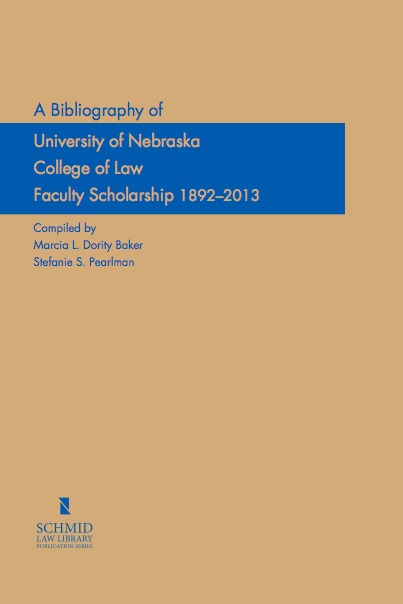
  Faculty Bib book cover

Two of the reference librarians at my school, Marcia Dority Baker and Stefanie Perlman, have compiled and published a bibliography of all the scholarship by Nebraska College of Law faculty going back to 1892: Marcia L. Dority Baker & Stefanie S. Perlman, A BIBLIOGRAPHY OF UNIVERSITY OF NEBRASKA COLLEGE OF LAW FACULTY SCHOLARSHIP 1892-2013 (2014).

I don’t know if others schools have done anything like this, but I think it’s a great idea. It’s really interesting to look at what people were writing one hundred years ago, and to consider the body of work of my current colleagues, only a couple of whom I believe were here a hundred years ago. I found the 14 pages of entries for the great legal scholar Roscoe Pound, including dozens of books, humbling.

On the domestic front, I’m happy to report that my listing is twice as long as my wife’s, although I’m not sure she will be happy to know that I reported that. I want to make it clear that she was not here a hundred years ago.

One of my attorney friends passed along information about a new, free legal research tool called “Casetext.”  (Disclosure: my attorney friend and her husband have an investment in the company.)

A description from Casetext CEO follows:

Casetext (https://www.casetext.com) is a legal research platform dedicated to interpreting and understanding the law. Casetext contains millions of cases, statutes, and regulations, and benefits from user-generated annotations from attorneys and professors who add analysis and insight. Contributors demonstrate thought leadership to Casetext’s 100,000 monthly users, including general counsels, law firms, and law students. Paid versions of the tool, still under development, will enable law firms to use the site’s annotations technology privately and internally for knowledge management.

Casetext and Google Scholar are both useful free resources for legals studies professors in business schools because our students often do not have Lexis/Westlaw access (or at least not full access to all the legal materials.)

Casetext uses the crowd for help with annotations and citations. Attorneys at law firm Bingham McCutchen LLP are featured annotators.  Citations can be voted up or down. 

In addition to citations from cases, Casetext also includes citations from law firm client alerts and blog posts.  One of the citations

Last night Belmont’s men’s basketball team beat a very good UW-Green Bay team 80 to 65 in the first round of the NIT.  Both teams were extremely close to making the NCAA tournament this year. Earlier this year, Belmont beat highly ranked UNC and UW-Greenbay beat ACC-Champs UVA.

[Photos courtsey of Belmont University Basketball]

Mann_bradshaw

Why is Belmont basketball relevant to this blog?

Well, actually, I just wanted to brag on my school’s team, but I will try to make a connection.

Some extremely interesting studies have been done tying atheletic success to increased applications, increased selectivity, and/or higher (academic) rankings.  See, e.g., Jain (Wharton) and Toma & Cross (UMKC & Michigan).  (While my co-blogger Steve Bradford called the U.S. News rankings of law schools “meaningless” earlier this week, even he admitted that rankings influence some student decisions.) 

In a similar study, a personal friend of mine and University of Georgia doctoral candidate, Michael Trivette, co-authored a paper in 2012 with Dennis Kramer (UVA) about the increases in selectivity and accepted student standardized test scores experienced by schools that switched athletic conferences.

Whether the time and money put into college sports is worthwhile makes for heated debate, and