
One of the most striking lines in Provost Jeff Van Duzer’s talk at the Nashville Institute of Faith and Work a few months ago was his statement that “even bank robbers can tithe.”

See a somewhat similar version of that talk here.

Jeff Van Duzer’s point seemed to be that you cannot be a truly socially responsible company simply by giving some money to good causes. I think he was exactly right. He went on to explain that socially responsible businesses should focus on creating good products and good jobs. 

This week I was thinking about Jeff Van Duzer’s talk when I considered, for about the one hundredth time, how to define social enterprises.

Think about Ben & Jerry’s, a company that comes up at almost every social enterprise conference. While I can think of some good that ice cream does, I wonder if Ben & Jerry’s main products are, on the whole, socially beneficial. We have a serious, deadly obesity problem in the country, and Ben & Jerry’s products seem to be contributing to this problem. Perhaps Ben & Jerry’s ice cream is more healthy than most options or uses more natural ingredients (I am unsure if this is true), but are Ben
MemorialDayWreath

Wikipedia tells us what most (if not all) of us already knew: “Memorial Day is a federal holiday in the United States for remembering the people who died while serving in the country’s armed forces.”  As I have often noted in conversations and communications with friends, regardless of one’s views on the appropriateness of war in general or in specific circumstances, most of us understand the importance of honoring those who have lost their lives in serving their country.  My dad, father-in-law, secretarial/administrative assistant, and many friends and students have served in the U.S. armed forces and survived the experience.  Others have not been so lucky.  I dedicate this post to all of them.

Last week, I had the pleasure of presenting at and attending a conference on Legal Issues in Social Entrepreneurship and Impact Investing—In the US and Beyond (also featuring co-blogger Anne Tucker).  My presentation was part of a panel on securities crowdfunding as impact investing.  But I attended many other presentations and participated in a lunch table talk on choosing the right entity for social enterprise and a brainstorming session on how legal education can better support social entrepreneurship and impact investing.  The conference was fabulous, and I learned a lot by listening to the great folks invited by the organizers–including others on my panel.

As I reflected on the holiday today in light of last week’s conference, my thoughts turned to organizations serving the families of fallen warriors and what types of formal entity structures they had chosen.  These organizations are mission-driven and socially conscious.  They exist, at least in part, to serve society.  All of the ones I could think of or easily find in a Web search (among them Children of Fallen Patriots FoundationThat Others May Live Foundation, and Travis Manion Foundation–although I do not intend to endorse any specific organization) are organized as non-profit corporations under various state laws and qualified as exempt from federal income taxes under Section 501(c)(3) of the U.S. Internal Revenue Code.  One might ask why.  

On June 8, I will answer this and other questions during an interactive session for a group of social entrepreneurs at Venture Cafe in Miami. Fortunately, I will have an accountant with me to talk through some of the tax issues. I was invited by the director of Radical Partners, a social impact accelerator. We estimate that 75% of the audience members will work for a nonprofit and the rest will work in traditional for profit entities with a social mission.

Many entrepreneurs in South Florida have an interest in benefit corporations, but don’t really know much about them. Our job is to provide some guidance on entity selection and demystify these relatively new entities. Some of the issues I plan to address in my 20 minutes are:

1) the differences between nonprofits, for profits, and benefit corporations

2) the differences between benefit and social purpose corporations (focusing on Florida law)

3) the biggest myths about benefit corporations (such as perceived tax benefits)

4) tax issues (for the accountant)

5) director duties

6) funding- changing funding model from donors to investors; going public

7) reporting, auditing, and certification requirements

8) benefit enforcement proceedings

9) the role of B Lab and the

In last week’s post, I mentioned Dr. Steven Garber. Recently, I finished his 2014 book Visions of Vocation: Common Grace for the Common Good. This book is among a handful of  books in the faith & work area that I have read over the past few months.

Visions of Vocation is beautifully written, lyrical and rich. Garber’s weaves philosophy, literature, and personal stories throughout the book’s 255 pages.

Garber’s thesis in this talk, which echoes in much of his work, is that “vocation is integral, not incidental to the Missio Dei (mission of God).” Garber says the book Visions of Vocation grew out of these questions: Can you know the world and still love the world? & What will you do with what you know? The first question hits home, as the flaws of jobs and people often become more vivid over time.  After the second question, Garber shows how stoicism and cynicism are unsatisfying responses.  

Garber offers no easy answers, which is, perhaps, on purpose. These are difficult questions in a difficult area, and easy answers may not exist. I finished the book still hoping for some clear principles for integrating faith and work, but

Today, I am spending my birthday attending and presenting at the Fifth Annual Midwest Symposium on Social Entrepreneurship in Kansas City, Missouri.  I owe my presence here to my entrepreneurship colleagues and friends Tony Luppino (UMKC Law) and John Tyler (Kauffman Foundation).  Thanks for the awesome birthday present, guys.

There’s so much I have to say about just the first day of this event.  (I also will be here and presenting tomorrow.)  The proceedings so far have been incredibly thought-provoking and instructive.  Most intriguing has been the focus around creating an ecosystem for social entrepreneurship.  Of course, law and lawyers have roles in that.  Hence, this blog post . . . .

Specifically, I want to devote today’s post to the four essential action-elements necessary to generate a successful, sustained future for social entrepreneurship as posited and described by Mark Beam, Maverick in Residence at the Kauffman Foundation, in his kick-off keynote presentation this morning.  (As an aside, I will note that Mark started his talk with a brief recounting of the origin of the word “maverick,” which was independently fascinating.)  Here are Mark’s four elements, as I captured them in my notes (likely imperfectly), together with a bit of summary definitional commentary.  He contended that, to build a sustainable ecosystem for social entrepreneurship, we must:

  1. Redefine work (recognizing entrepreneurship as work; taking into account the power and effects of technology, but knowing it needs to serve us and the human potential)
  2. Nurture entrepreneurial ecosystems that mimic and integrate natural systems (e.g., helping people to help themselves; moving resources from the “haves” to the “have-nots”)
  3. Evolve our capacity to serve more of the entrepreneurial community through ecosystem design (referring to three megatrends outlined by Kauffman Foundation CEO Wendy Guillies–demography, geography, and technology; opening up entrepreneurship to all to increase business, start-ups employment, productivity)
  4. Tell new stories (relating anecdotes that connect us; “we create the future through the stories we tell ourselves”—visioning the future through stories)

That may not sound like much, but trust me.  The talk (beautifully delivered with amazing graphics, photography, and media content) was much better than my quick summary of the outtakes.

What Mark said made a lot of sense to me based on my related experience and work.  But I found myself thinking about the role of the lawyer in these action items.  How can lawyers–especially business lawyers–who support social enterprise help social entrepreneurship to productively move forward?

From a Facebook post by Dr. Steven Garber, I recently learned of the mutuality in business project by Mars Corporation and University of Oxford.

Quoting from the website:

A collaborative project with the Mars Corporation exploring mutuality as a new principle for organising business. Mutuality – a principle that emphasises the fair distribution of the burdens and benefits of a firm’s activities – is seen as a promising new organising value with the potential to strengthen relationships and improve sustainability.

“Mutuality in business” seems to be yet another term for social responsibility in business. We already have so many terms for the social business concept – blended value, business for good, CSR, creative capitalism, multi-stakeholder governance, natural capitalism, shared value capitalism, social entrepreneurship, social enterprise, social innovation, sustainability, triple bottom line. Many people are trying to create, differentiate, and mark their corner in this social business space.

Despite the addition of yet another social business term, the information at the website is interesting, especially the research projects

As Haskell earlier announced here at the BLPB, The first U.S. benefit corporation went public back in February–just before publication of my paper from last summer’s 8th Annual Berle Symposium (about which I and other BLPB participants contemporaneously wrote here, here, and here).  Although I was able to mark the closing of Laureate Education, Inc.’s public offering in last-minute footnotes, my paper for the symposium treats the publicly held benefit corporation as a future likelihood, rather than a reality.  Now, the actual experiment has begun.  It is time to test the “visioning” in this paper, which I recently posted to SSRN.  Here is the abstract.

Benefit corporations have enjoyed legislative and, to a lesser extent, popular success over the past few years. This article anticipates what recently (at the eve of its publication) became a reality: the advent of a publicly held U.S. benefit corporation — a corporation with public equity holders that is organized under a specialized U.S. state statute requiring corporations to serve both shareholder wealth aims and social or environmental objectives. Specifically, the article undertakes to identify and comment on the structure and function of U.S. benefit corporations and the unique litigation

Attorney Kyle Westaway has started a monthly e-mail that compiles information about social enterprise and impact investing law. You can subscribe here.

In the latest Impact Esq. newsletter, Kyle included a link to the Kickstarter’s 2016 Benefit Statement. Kyle wrote that he had “never seen [a benefit report] as strong as Kickstarter’s.” Personally, I am not sure I would go that far. I think Greyston Bakery’s Report and Patagonia’s Report are at least as good. I do think the Kickstarter report is relatively good, but the bar is incredibly low, as many benefit corporations are ignoring the statutory reporting requirement or doing a pathetically bad job at reporting.

While the Kickstarter report is more detailed than most, it still reads mostly like a PR piece to me. The vast majority of the report is listing cherry-picked, positive statistics. That said, Kickstarter did note a few areas for possible improvement, which is extremely rare in benefit report. Kickstarter stated that they could do more to promote “sustainability,” that they could do more to encourage staff to “take advantage of the paid time off we provide for volunteering,” and that they wanted to “encourage greater transparency from creators, better educate

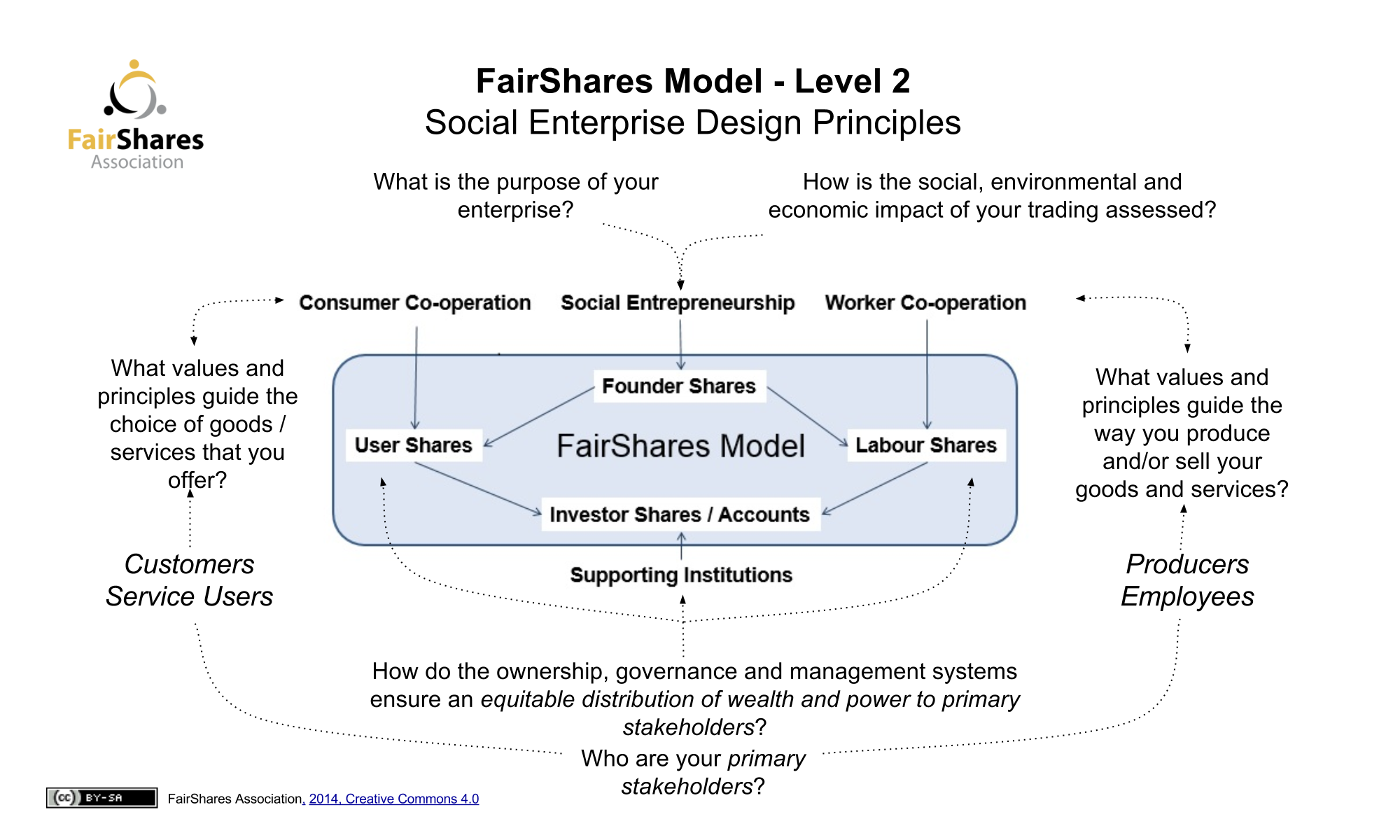
On of the many interesting things discussed during the social enterprise law workshop at Notre Dame Law School was the “FairShares Model.” Nina Boeger (University of Bristol-UK) brought the model to the group’s attention, and the model was new news to me.

The FairShares Model was “created during a research programme on democratising charities, co-operatives and social enterprises involving academics at Sheffield Hallam University and Manchester Metropolitan University in the UK.”

The FairShares Model cites the “Social Enterprise Europe Ltd” when noting that social enterprises “aim to generate sustainable sources of income, but measure their success through:

  • Specifying their purpose(s) and evaluating the impact(s) of their trading activities;

  • Conducting ethical reviews of their product/service choices and production/consumption practices;

  • Promoting socialized and democratic ownership, governance and management.”

To address theses aims, the FairShares Model offers social audits and suggests the issuing some combination of (1) founder shares, (2) labour shares, (3) investor shares, (4) user shares.

While I agree that significant corporate governance changes should be considered, at first glance this model seems a bit unwieldy if all four types of shares are issued. Still, I am interested in learning more. 

With co-editor Joan Heminway (and Anne Tucker via Skype), I am at Notre Dame for a symposium on social enterprise law. I will be presenting on aforthcoming book chapter, which builds on my stakeholder advisory board idea. My article Adopting Stakeholder Advisory Boards article was recently published in the American Business Law Journal and I posted it to SSRN this week. The abstract is reproduced below.

———–

Over the past decade, interest in socially responsible business has grown exponentially. The social business movement seeks to have firms focus on the interests of all corporate stakeholders, rather than solely the financial interests of shareholders. Coupled with the social business movement of the past decade has been the passage of social enterprise statutes by over thirty states. The social enterprise statutes provide legal frameworks for firms that seek profit alongside broader social and environmental ends. A plethora of social enterprise legal forms have been created in the United States since 2008, including benefit corporations, public benefit corporations, benefit LLCs, low-profit limited liability companies (L3Cs), general benefit corporations, specific benefit corporations, sustainable business corporations, and social purpose corporations.

Despite the interest in social business and the passage of numerous social enterprise laws, the basic