
The Business Law Clinic (Clinic) is part of a comprehensive curriculum in transactional law that is comprised of the Clinic, the Business Law Center (Center) and certificate and degree conferring programs. The Clinic, established in 1999, offers students a unique opportunity to develop essential lawyering skills in a professional, interactive environment. Loyola seeks a dynamic Clinic Co-Director/Center Executive Director to work collaboratively with the Clinic Co-Director and the Director of the Business Law Center to provide strategic leadership, teach the Clinic class, supervise student work with clients, and to assist the Center Director in the development of the business and transactional law curriculum, scholarly conferences and programming.

The Co-Director/Executive Director will serve as the Randy L. and Melvin R. Berlin Clinical Professor of Law that is a presumptively renewable long-term contract position with voting privileges within the Loyola University Chicago School of Law. Loyola University Chicago School of Law is a student-focused law center inspired by the Jesuit tradition of academic excellence, intellectual openness, and service to others. Our mission is to educate diverse, talented students to be responsible leaders in a rapidly changing, interdependent world, to prepare graduates who will be ethical advocates for justice and the rule of

Dean, School of Law University of Miami

The University of Miami invites nominations and applications for the position of Dean of the School of Law. The next Dean should be an innovative thinker and approachable leader who welcomes the opportunity to articulate a vision for the growth of a law school that builds on its long history of excellence. The University of Miami, considered among the top tier institutions of higher education in the U.S. for its academic excellence, superior medical care, and cutting-edge research, is the largest private research university in the southeastern United States. The University comprises eleven degree-granting schools and colleges, which are Architecture, Arts and Sciences, Miami Business, Communication, Education, Engineering, Law, the Miller School of Medicine, the Patricia and Philip Frost School of Music, Nursing and Health Studies, and the Rosenstiel School of Marine and Atmospheric Science. The core of the University is its 2,660 full-time faculty housed in three academic campuses within the greater Miami area. The University receives over $360 million annually in external research funding and has been classified as a Doctoral University with Highest Research Activity (R1) by the Carnegie Commission. We strive to create an environment where everyone contributes to

In Business Organizations, I am in the early part of teaching agency and partnership. In my last class, we discussed Cargill, which is a fairly typical case to open agency discussions.  I like Cargill, and I think it is a helpful teaching tool, but I think one needs to go beyond the case and facts to give a full picture of agency. 

Of note, the case deals only with “actual agency” — for whatever reason, the plaintiffs did not argue “apparent agency” or estoppel in the alternative.  A. Gay Jenson Farms Co. v. Cargill, Inc., 309 N.W.2d 285, 290 n.6 (Minn. 1981) (“At trial, plaintiffs sought to establish actual agency by Cargill’s course of dealing between 1973 and 1977 rather than ‘apparent’ agency or agency by estoppel, so that the only issue in this case is one of actual agency. ”). I think this explains a lot about how the case turns out.  That is, the court recognized that to find for the farmer, there had to be an actual agency relationship.  

I don’t love this outcome because one of the hallmarks of an agency relationship is its reciprocal nature. That is, once we find an agency relationship, the

image from pixabay.com

As we celebrate Martin Luther King Day today, I am moved to write a bit about him as a teacher.  Preachers (along with coaches and others who interact with us in various capacities in our lives) are teachers, of course.  They struggle, as educators, with similar challenges in their teaching to those that we face in curricular, co-curricular, and extracurricular teaching in law schools.

So many parallels are obvious.  But I want to focus on one small (and perhaps less obvious) thread in this post: love.  The choice of this focus derives from a David Brooks op-ed that I read a few days ago in The New York Times.  The column included a number of helpful facts and ideas relating to the connection between emotions and intelligence.  Perhaps one of the most poignant messages it conveyed was this one: “children learn from people they love, and . . . love in this context means willing the good of another, and offering active care for the whole person.”  That rang true to me.  How, then, might love unite Dr. King with teaching and learning?

Of course, as many may recall, Dr. King (like other Christian clerics) preached about loving one’s

I wasn’t one of those people who decided to become a lawyer after watching To Kill a Mockingbird, Witness for the Prosecution, and Twelve Angry Men, but they were some of my favorite movies. These movies and TV shows like Suits, How to Get Away with Murder, and Law & Order “teach” students and the general public that practicing law is sexy and/or confrontational. When I teach, I try to demystify and clear up some of the falsehoods, and that’s easy with litigation-type courses. When I taught Business Associations, it was a bit tougher but we often used movies or TV shows to illustrate the right and wrong ways to do things. As an extra credit assignment, I asked students to write a critique of what the writers missed, misrepresented, or completely misunderstood.

This semester, I will be teaching a transactional drafting course where the students represent either the buyer or the seller of a small, privately owned business. I would like to recommend movies or TV shows that don’t deal with multibillion dollar mergers, but I haven’t been watching too much TV lately. I’m looking for suggestions along the lines of Silicon Valley (which

ILT&LHeader

CALL FOR PRESENTATION PROPOSALS

Institute for Law Teaching and Learning Summer Conference
“Teaching Today’s Law Students”
June 3-5, 2019
Washburn University School of Law
Topeka, Kansas

The Institute for Law Teaching and Learning invites proposals for conference workshops addressing the many ways that law professors and administrators are reaching today’s law students.   With the ever-changing and heterogeneous nature of law students, this topic has taken on increased urgency for professors thinking about effective teaching strategies. 

The conference theme is intentionally broad and is designed to encompass a wide variety of topics – neuroscientific approaches to effective teaching; generational research about current law students; effective use of technology in the classroom; teaching first-generation college students; classroom behavior in the current political climate; academic approaches to less prepared students; fostering qualities such as growth mindset, resilience, and emotional intelligence in students; or techniques for providing effective formative feedback to students.

Accordingly, the Institute invites proposals for 60-minute workshops consistent with a broad interpretation of the conference theme. Each workshop should include materials that participants can use during the workshop and when they return to their campuses. Presenters should model effective teaching methods by actively engaging the workshop participants.  The Institute Co-Directors are glad

image from images.westacademic.com

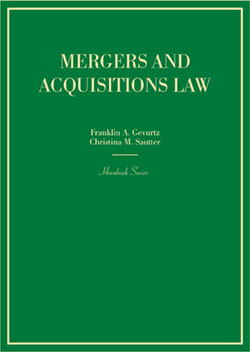
West Academic Publishing has just released a new mergers and acquisitions hornbook co-authored by dear friends and business law prof colleagues Frank Gevurtz and Christina Sautter.  I had known that the book was in the offing, but I just got a note from Frank on Saturday confirming its publication and availability.  Here is the synopsis from West:

Gevurtz & Sautter’s Hornbook on Mergers and Acquisitions provides a comprehensive exploration of this important topic. Written in a casual style designed to engage the reader, the book clarifies and critiques critical doctrine. In addition to covering corporate laws governing mergers and acquisitions, the book explores securities, tax, and antitrust laws, as well as addressing the business, financial, and practical lawyering aspects of mergers and acquisitions.

I know these two to be folks with solid backgrounds and interesting insights in this area.  I have requested my online review copy.  Perhaps some of you will want to do that, too.  And for those without that privilege who want this in their libraries, you can get it by clicking on the West Academic Publishing link at the beginning of this post or purchase it on Amazon here.

Even after 19 years or so of teaching Business Associations courses, I still marvel at how hard it is to teach corporate fiduciary duty doctrine to my students.  A lot of my frustration comes from the amount of (perhaps not-so-useful) judicially instigated labeling involved under Delaware law, as the leading state in the area.  In particular, there is the narrowing of the duty of care to exclude both substantive duty of care claims and Caremark claims.  And then there is the matter of how to best describe the nature of the business judgment rule and how to describe the interaction of disclosure (candor) with the fiduciary duties of care and loyalty. And finally there is a lingering doctrinal question as to whether, in other jurisdictions, good faith, classified as a subsidiary component of the duty of loyalty in Delaware, may be a free-standing fiduciary duty or, in the alternative, foundational, penumbral, etc. to the fiduciary duties of loyalty and care  . . . .  Tough stuff.

Is anyone else out there suffering in the same way I do in teaching fiduciary duties in a Business Associations or Corporations class?  How do you handle the legal complexity/labeling questions?  I continue to

Last Friday, I had the honor of being the keynote speaker for the 64th annual conference of the Southeastern Academy of Legal Studies in Business (SEALSB).  The invitation for this appearance was extended to me months ago by BLPB contributing editor Haskell Murray.  It was a treat to have the opportunity to mingle and talk shop with the attendees (some of whom I already knew).

The participants in SEALSB are largely business law faculty members teaching at business schools.  Having never before attended one of their meetings and as a bit of a “foreigner” in their midst, I wondered for quite a bit about what I should talk about.  Should I take the conservative route and present some of my work, hoping to dazzle the group with my legal knowledge (lol), or should I take a riskier approach and tell them what was really on my heart when I accepted Haskell’s kind invitation?

I chose the latter.  I spoke for 15-20 minutes on “Valuing and Visioning Collaboration” between business law faculties in business and law schools and then took about 10 minutes of questions.  I started with the stories of two of my students–who could have been the students

I may update this list from time to time; feel free to e-mail me with additions. Looks like a pretty strong hiring season for business law. Updated 12/04/18.

Law School Professor Positions – Business Specialty Sought

  1. Barry University 
  2. Belmont University
  3. Campbell University
  4. Cardozo
  5. Case Western University
  6. Duke University
  7. Drake University (Director of the Entrepreneurial/Transactional Law Clinic)
  8. Drake University (Assistant, Associate, or Professor of Law)
  9. Drexel University
  10. Emory University
  11. Florida A&M University 
  12. Louisiana State University
  13. Mercer University 
  14. Pennsylvania State University, University Park
  15. Saint John’s University
  16. Seton Hall University
  17. Southern Illinois University Carbondale (Professor of Practice) (9/17/18 deadline or until filled)
  18. University of Alabama
  19. University of Arizona (International Business Law Focus) (Review begins 9/28/18)
  20. University of Arkansas, Fayetteville
  21. University of Buffalo
  22. University of California, Berkeley (initial review 8/15/18; accepted through 3/1/19)
  23. University of California, Davis
  24. University of California, Irvine
  25. University of Connecticut
  26. University of Kentucky
  27. University of Louisville
  28. University of Miami
  29. University of Nebraska
  30. University of New Mexico (Oil & Gas Focus)
  31. University of North Texas at Dallas
  32. University of Oregon (Business Law Clinic)
  33. University of Pittsburgh
  34. University of Richmond
  35. University of Saint Thomas (Miami)
  36. University of South Carolina
  37. University of Wyoming 
  38. Washington & Lee University
  39. Washington University (St.