I am perpetually, endlessly amused by how courts navigate the tension between the presumption of market efficiency inherent in the fraud on the market doctrine, and the actual reality that markets may be generally efficient, but there are all kinds of blips and imperfections.  The Supreme Court acknowledged as much in Halliburton Co. v. Erica P. John Fund, Inc., but it still creates difficulties for the doctrine.

Case in point:  Fagen et al. v. Enviva, which was just decided in the District of Maryland.  Plaintiffs accused Enviva of greenwashing by, among other things, falsely claiming that its wood pellets were sourced from “low value” wood, such as tree trimmings and underbrush, rather than whole trees.  When the truth was revealed – partially through a short attack, and then through exposure on a conservation website – Enviva’s stock price dropped.

Enviva defended against the claim by pointing to various public filings where it admitted that its low value wood included some whole trees deemed unsuitable for sawmilling, such as small ones, or ones with defects.  Which of course sounds very reasonable, except there’s the pesky stock price drop that accompanied the disclosure.  So, on a motion to dismiss, the
Florence2024(groupphoto)

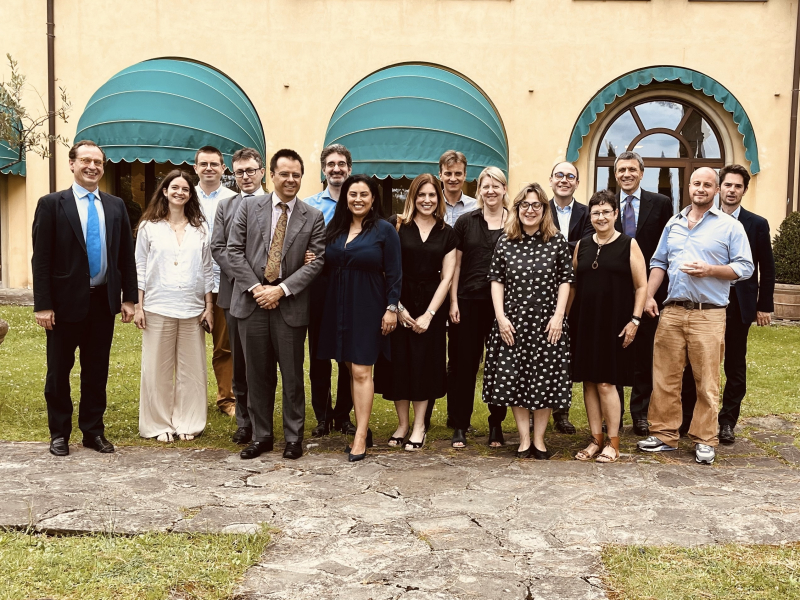
On Monday, I had the good fortune to be able to share some of my research and ideas with an international audience (photo above, taken at the European University Institute in Fiesole/Florence, Italy) on Monday.  The topic?  Smart-contracting as an alternative to traditional business contracting. Here’s the nub of what I offered, taken from my abstract (minus the footnotes).

Business transactions have historically been memorialized, if at all, in contracts—legally recognized forms of agreement that, if valid and binding, have the capacity to be enforced through judicial process. These contracts enable business firms to engage in private ordering relative to firm governance, investment activity, business combinations, intellectual property licensing, asset purchases and dispositions, and many other commercial dealings. Contracts have been essential to business governance, finance, and operations for centuries.

The advent of digital commerce has brought many innovations to business transacting. Click-wrap, browse-wrap, scroll-wrap, and sign-in-wrap forms of indicating the acceptance of contractual terms of use on the Internet have become commonplace. As a result, these inventions have been the subject of cases and controversies and related judicial opinions. “The courts in the electronic world search for the functional equivalent of the paper world’s formal requirements of a reasonable

Lotta handwringing today about the demise of Chevron, and I can’t begin to predict the ultimate fallout, but from the narrow perspective of securities, it doesn’t feel like it’s played much of a role in some time. 

Case in point: The Fifth Circuit’s recent decision striking down SEC rules governing private investment funds.

As the court notes, for a long time, private investment companies and their advisers were exempt from Investment Company Act/Investment Advisors Act regulation.  However, in 2010, Dodd Frank amended the IAA to require that even private fund advisers register with the SEC, and make and disseminate reports according to SEC rule.  The reports required must include, among other things, information on “valuation policies and practices of the fund;… side arrangements or side letters, whereby certain investors in a fund obtain more favorable rights or entitlements than other investors.”

As part of those amendments, Dodd-Frank made another statutory change.  Prior to Dodd-Frank, there existed 15 U.S.C. §80b-11, titled “Rules, regulations, and orders of Commission,” which broadly gave the SEC the power to “make, issue, amend, and rescind such rules and regulations and such orders as are necessary or appropriate to the exercise of the functions

The Supreme Court’s Jarkesy decision is out.  Unsurprisingly, it hands the SEC yet another loss and rules that it cannot pursue relief for securities fraud claims before its administrative law judges because the Seventh Amendment entitles defendants to a jury trial.

Functionally, this significantly impairs the SEC’s ability to enforce the securities laws and drives much enforcement activity into federal district courts.  One of the benefits to having a specialized ALJ hear securities claims is that the process becomes much swifter for two reasons.  First administrative adjudication is more efficient.  Second, the SEC doesn’t need to explain what securities fraud is to a court used to hearing these claims.  Now, the SEC will have to spend more time and treasure on run-of-the-mill enforcement actions.  As the SEC has limited resources, this will substantially reduce how much they can do.

Much of the opinion revolves around the scope of the “public rights” exception to the Seventh Amendment.  The exception allows administrative tribunals to handle matters that historically could have been resolved by the executive and legislative branches.  The opinion recognizes that the public rights exception at least includes “the collection of revenue; aspects of customs law; immigration law; relations with Indian

Some variations on a theme this week.

First, the Delaware legislature has now passed the amendments to the DGCL, which means that as of August 1, it will be legal for a company like Tesla, say, to contract with a shareholder like Elon Musk, say, to give him power to veto or demand specific AI initiatives, regardless of his particular financial stake in the company.  By contrast, at least as I read Texas law, such a contract would not be possible for Texas-organized entities, because Texas only permits agreements to restrict board discretion in nonpublic corporations.

Do you suppose this means Tesla will reincorporate back to Delaware?

Second, the Senate raked Boeing CEO Dave Calhoun over the coals this week.  Sen. Josh Hawley said: “I think you’re focused on exactly what you were hired to do.  You’re trying to squeeze every piece of profit out of this company. You’re strip mining it.”  He also posted to Twitter, “Boeing’s planes are falling out of the sky in pieces, but the CEO makes $33 million a year. What exactly is he getting paid to do?”  Meanwhile, at the hearing, Sen. Richard Blumenthal said, “Boeing needs to stop thinking

Sarah Haan recently led an effort to file an amicus in support of Maine’s effort to bar foreign governments from using business entities to make political contributions.  A copy of the amicus is available here.   I joined in good company alongside Gina-Gail S. Fletcher, George S. Georgiev, Andrew Jennings, Paul Rose, Faith Stevelman, Ciara Torres-Spelliscy, Anne M. Tucker, Cynthia A. Willliams, and Karen Woody.

Maine’s law set a 5% foreign-government-ownership threshold to bar corporations from political donations.  The District Court saw the 5% threshold as arbitrary.  The brief points out that many laws use a 5% ownership threshold to test for shareholder influence and that shareholders may wield significant influence over corporate policies with a 5% stake.

Although it didn’t make the final brief, this background section provides context:

On February 29, 2024, the U.S. District Court for the District of Maine granted Plaintiffs’ motion for preliminary injunction and enjoined a Maine law, “An Act to Prohibit Campaign Spending by Foreign Governments,” 21-A M.R.S. § 1064 (the “Act”). The Act prohibits any “foreign government-influenced entity” from making, directly or indirectly, a “contribution, expenditure, independent expenditure, electioneering communication or any other donation or disbursement of funds to influence the nomination or

image from m.media-amazon.com

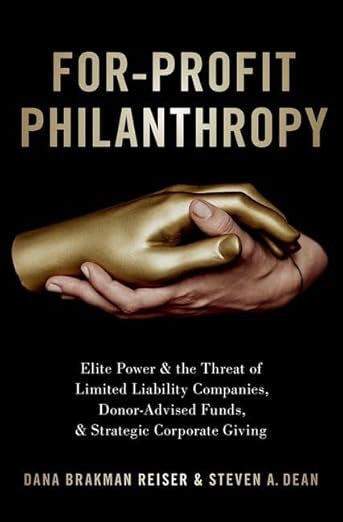
As I noted in one of my posts last week, I recently attended the 2024 Law and Society Association Annual Meeting in Denver, Colorado.  CRN46–the corporate and securities law collaborative research network that organizes sessions at the conference–supported a great series of programs at the conference this year.  I was privileged to be able to be a commenting reader for an Author Meets Reader session on Dana Brakman Reiser and Steven Dean’s book For-Profit Philanthropy.  The session was co-sponsored with the tax law collaborative research network (CRN31). 

For-Profit Philanthropy asserts that three for-profit vehicles (LLCs, donor-advised funds affiliated with investment banking entities, and strategic corporate philanthropy activities) operate to decrease donative trust.  They support their conclusion with observations from business entity and tax law.  Their focus is on accountability and transparency.  The story is compelling.  Ultimately, the book offers targeted reform proposals.

Although the panelists’ remarks were not recorded, I scripted out my comments to ensure that I stayed on track.  What I wrote is set forth below.  It represents a rough approximation of what I said (although I always change and add things as I go).

For-Profit Philanthropy represents an important and classic piece of legal

Here is the text of a letter I submitted in advance of the Delaware House Judiciary Committee Meeting regarding the proposed amendments to the DGCL:

Dear Chair Griffith:

I write to express my concerns about S.B. 313, and in particular the proposed amendments to Section 122 of the Delaware General Corporation Law (DGCL).  I believe the proposed amendments will cause Delaware to lose control over its law.

As proposed, the statute authorizes a shift of corporate governance from the charter to private contracts.  Corporate charters are subject to the law of the chartering state, thus, Delaware law.  Private stockholder agreements are not necessarily subject to the law of the chartering state.  That means other states’ laws would govern the interpretation of these contracts, and the appropriate remedies for any breaches.[1]

Additionally, the Federal Arbitration Act (FAA) provides that agreements to arbitrate disputes “shall be valid, irrevocable, and enforceable.”[2]  In practical effect, the FAA bars states, including state courts, from prohibiting or regulating arbitration agreements, and requires that such agreements be enforced as written.  It is likely that the FAA does not apply to corporate charters,[3] which is why Delaware was able to adopt Section 115 of

Corporate redomestication has been in the news.  Earlier this week, the Wall Street Journal ran an op-ed I penned with Nevada’s Secretary of state, Francisco Aguilar, explaining why some corporations seek to redomesticate from Delaware to Nevada or elsewhere.  Ann also covered the issue today in the context of Tesla’s redomestication to Texas.  

Although the Tesla redomestication proposal apparently passed at the shareholder meeting, not all redomestication proposals will pass.  Notably, Glass Lewis recommended against the Texas reincorporation.  I have some faith that states like Nevada will react and legislatively change their laws if they prove a barrier to securing additional incorporations.  After all, Delaware has been changing its laws to ensure it remains attractive for decades.  Indeed, much of the movement in Delaware around proposed amendments to Delaware’s corporate law seems aimed at maintaining Delaware’s dominance and securing continued incorporations.

The key will be striking the right balance between investor protection and shielding managers from possibly unwarranted and value-destroying litigation costs. Ultimately, striking the right balance is hard.  Under a too lenient standard for litigation, corporations and shareholders will suffer from costs driven by excess litigation.  Under too demanding a regime, shareholders may suffer losses from uncompensated

Whenever I talk about Elon Musk and corporate governance, an objection is raised to the effect of, “Isn’t Musk sui generis?  Can we really take any lessons from him?”

It’s a fair question, but if Musk is sui generis, there is no meaning in any of this, and that’s no fun at all.  So, for the purposes of this post, I’m putting it aside.

Take One:  What a supreme failure of the SEC

I’m sorry, I have to start here.  Sometime in the middle of the night (I was asleep), Elon Musk tweeted an extremely informal spreadsheet screencapture of the purported shareholder vote, and for the next several hours – including during actual trading – no one knew if he was telling the truth.  I spoke to reporters, which is a thing I do now whenever Musk is in the news (i.e., on days that end in “y”), and they were simply not sure whether to take the tweet seriously.  Initial headlines read “Elon Musk says” rather than “The vote is.”

It is unacceptable that the CEO of an S&P 500 company could publicly release extremely material information and have the entire world spend multiple hours wondering if he