
To help support the economy as the nation grapples with the coronavirus, the Federal Reserve announced today its decision to take a number of actions (here), including lowering the fed funds target rate to 0 to 1/4%, increasing its holdings of Treasury securities and agency mortgage-backed securities, and taking coordinated measures with foreign central banks (I’ve written about the Fed’s use of central bank swap lines, here).  Today’s announcement is the Fed’s second interest rate cut in two weeks.  On March 3, 2020, it lowered the fed funds target rate to 1 to 1.25%.  Economist Carola Binder recently posted (here) an interesting paper, Coronavirus Fears and Macroeconomic Expectations, related to this first March 2020 interest rate cut.  Here’s the abstract:

The Federal Reserve cut interest rates by 50 basis points on March 3, 2020, in response to concerns about the coronavirus (COVID-19). On March 5 and 6, I conducted an online survey of over 500 U.S. consumers that asked about their attention to, concerns about, and responses to the coronavirus, their awareness of the Fed’s policy move, and their inflation and unemployment expectations. I then provided respondents with information about the Fed’s policy announcement, and re-elicited inflation
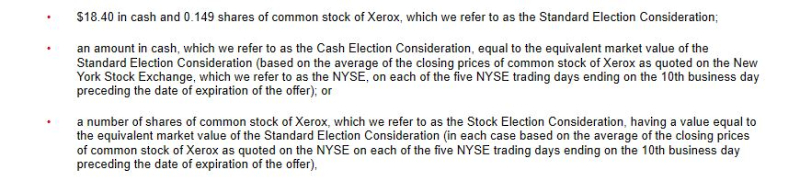

For the last several weeks, Xerox has been pursuing a takeover over HP.  At first, its overtures were friendly, and more recently it turned hostile (well, sort of hostile).  It has put the campaign on hold in light of the pandemic – it says, because it is unsafe to travel and conduct meetings with shareholders – but before that, it filed a Schedule TO and an S-4 with the details of the offer.  As relevant here, the S-4 explains that Xerox is proposing a tender offer followed by a second-step merger under DGCL 251(h).  Shareholders who do not tender their shares, and thus are merged out, will receive the same consideration as shareholders who tender.  Which is:

Election 1

That said, Xerox plans to pay a total of $27,326,000,706 in cash.  Therefore, if shareholders’ elections would result in a different figure, these elections are capped:

Election 2

In other words, shareholders have a choice of whether they receive stock, cash, or a combination of both, but only up to a point; if too many shareholders select one or the other, Xerox will rebalance.

Which brings us to the right of appraisal.  According to the S-4:

Election 3

So, what’s the law on this?  Delaware provides

In reading today’s Financial Times, Kate Beioley’s Corporate lawyers in high demand as coronavirus hits businesses (here -subscription required) caught my attention.  The informative article mentioned a recent Skadden report, Coronavirus/COVID-19 Update (here).  I thought the report provided a helpful overview of ways in which the coronavirus “may impact their [businesses’] operations and employees,” in areas including M&A activity, securities disclosures, securities litigation, annual meetings, supply chain disruptions, equity derivatives, commercial agreements, employment, and cybersecurity.  In particular, I found the discussion in the M&A section of a review of MAC provisions in 31 recent purchase agreements really interesting.  I encourage BLPB readers to review the report.

Over at Law & Liberty, Richard Reinsch reviews (here) Christopher Caldwell’s new book, The Age of Entitlement: America Since the Sixties.  As Reinsch puts it, Caldwell’s premise is that we are currently battling over “two irreconcilable constitutions: the constitution of 1788 and of 1964.”  What follows is an excerpt from the review.  Given the emphasis on diversity in corporate governance, the connection to this blog should be relatively obvious.  Since I am not an expert in the area, I’m curious if readers will identify any misstatements of fact in the excerpt or linked-to materials.

As many legal scholars have observed, the Rehnquist and Roberts Courts have aimed to return to the “color-blind” understanding of equal protection that inspired the Brown decision and the civil rights movement of the 1960s. Of course, many of these same scholars reject such an understanding as a just one …. But the colorblind position is on solid ground ….

As Shep Melnick argues, “the NAACP lawyers who brought the long string of cases culminating in Brown” endorsed the “colorblind” interpretation of the Fourteenth Amendment. It was chief counsel Thurgood Marshall before the Court who argued that the Fourteenth Amendment denies

If you have trouble viewing the embedded Tweets, please try a different browser (I recommend Internet Explorer).

On Thursday and Friday, Tulane hosted its 32nd Annual Corporate Law Institute.  The CLI is a major conference focused on the latest developments in M&A and related topics, and features a variety of speakers drawn from the bench, the bar, and the SEC.

Now, obviously, it’s a tough time to host a large conference – the big question was whether we’d see cancelations – and I’m not in charge of administration so I can’t say what the final numbers were, but from what I could see, attendance looked just fine.

That said, I personally was not able to attend the whole event, but I did go to a few of the panels, and below are my notes from Hot Topics in M&A Practice and Chancellor William T. Allen and His Impact on Delaware Jurisprudence.

Judge Wolf recently issued his opinion in the State Street case.  It’s a long read at over 159 pages. Judge Wolf scorches class counsel and ultimately refers the matter to the state bar for possible discipline, if appropriate.  This is a case I’ve written about before and explored in an article with Anthony Rickey, arguing that we need more disclosures about the relationships between institutional plaintiffs and class counsel in securities litigation.

For those not following the case as closely, here is a quick refresher.  After a $300 million settlement, class counsel sought a significant fee award and presented the court with information about the time and money spent on the case.  The Court allocated $75 million to the attorneys.  Then the Boston Globe’s Spotlight team started digging.  The Globe revealed that contract attorneys billed at $400 an hour had only been paid about $40 an hour for their work.  The Globe also revealed that the brother of the managing partner at one of the firms had been billed out at $500 an hour when he otherwise took $50 an hour court appointment cases.  The disclosures troubled the Court and caused it to appoint a special master to dig

If you have trouble viewing the embedded Tweets, please try a different browser (I recommend Internet Explorer).

Professor Saule T. Omarova at Cornell Law School recently posted (here) a new article to SSRN, Technology v. Technocracy: Fintech as a Regulatory Challenge (forthcoming, Journal of Financial Regulation).  I’m excited to read it.  Omarova’s articles are always excellent and it’s on an important, timely topic.  Here’s the abstract:

Technology is a tool. How to use it, for what purposes and to what effects, is a choice. What does this choice involve in the context of fintech? And how can it be translated into a coherent strategy of fintech regulation? These questions are at the heart of this article. Taking a broad view of fintech as a systemic force disrupting the very enterprise of financial regulation, as opposed to any particular regulatory scheme, the article offers a conceptual framework for the development of a more cohesive and effective public policy response to fintech disruption.

The article argues that the currently dominant technocratic model of financial regulation is inherently limited in its ability to respond to systemic challenges posed by fintech. The existing regulatory model operates primarily through the mechanisms of structural compartmentalization, bureaucratic specialization, and narrow targeting of isolated and well-controlled micro-level phenomena. Fintech, however

I often skim through recent opinions issued in private securities class actions, just to see what the latest issues are and how courts are addressing them.  So this week, I’ll talk about a few that caught my eye.  As the subject line indicates, most of this discussion concerns materiality, but there are some extra issues tossed in.

And yes, this is a very long one, so behind a cut it goes:
