
The National Business Law Scholars Conference (NBLSC) will be held on Thursday, June 19th and Friday, June 20th at Loyola Law School, Los Angeles. This is the fifth annual meeting of the NBLSC, a conference which annually draws together dozens of legal scholars from across the United States and around the world. We welcome all scholarly submissions relating to business law. Presentations should focus on research appropriate for publication in academic journals, especially law reviews, and should make a contribution to the existing scholarly literature. We will attempt to provide the opportunity for everyone to actively participate. Junior scholars and those considering entering the legal academy are especially encouraged to participate.

To submit a presentation, email Professor Eric C. Chaffee at eric.chaffee@utoledo.edu with an abstract or paper by April 4, 2014. Please title the email “NBLSC Submission – {Name}”. If you would like to attend, but not present, email Professor Chaffee with an email entitled “NBLSC Attendance.” Please specify in your email whether you are willing to serve as a commentator or moderator. A conference schedule will be circulated in late May.  More information is available here:  http://lls.edu/resources/events/listofevents/eventtitle,81539,en/

Conference Organizers

Barbara Black (The University of Cincinnati College of Law)
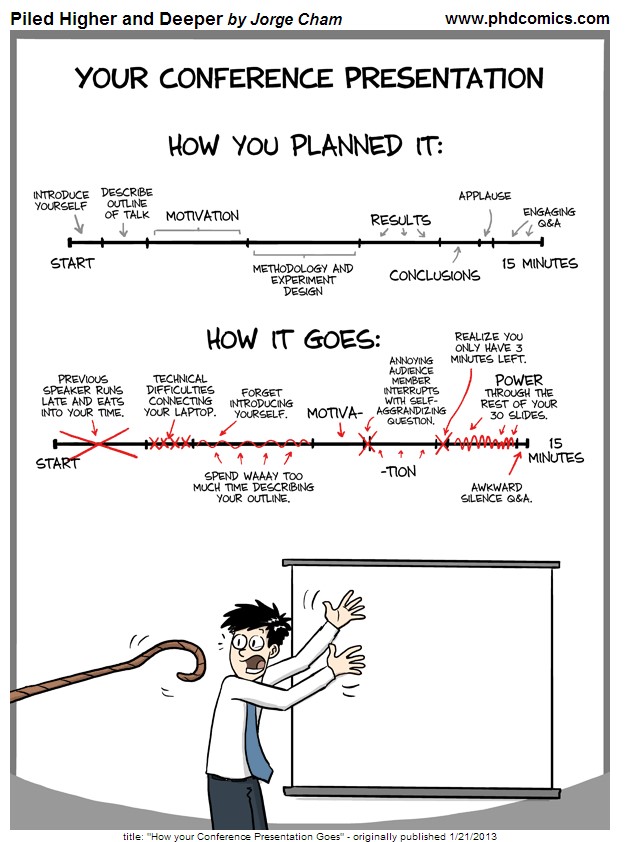
With winter break nearly upon us this means grading, writing projects, and possibly some conference travel with the upcoming AALS annual meeting.  I plan on putting together my AALS talk (on incorporating experiential exercises in teaching LLCs) next week, and have drawn inspiration from the following image:

Conference Image

The Business Law programs are on Saturday, January 4th and are listed below. If you would like to highlight other programs, please respond in the comments, and I will add to the list.

  • The program will explore:  The … topic of effectively teaching LLCs.  
  • 2:00 pm – 3:45 pm Business Associations
    The Value Proposition for Business Associations in Tomorrow’s Legal Education
  • The panel will be exploring: How does business associations teaching and scholarship contribute to the U.S. program of legal education?  How could or should it contribute?  What role does the basic law school course on business associations play in an optimized law school curriculum?  What course content, pedagogy, and teaching tools best support that role?  How does business associations scholarship inform and support that role?    
  • 4:00 pm –

A recent study, Who Owns West Virginia? (full report pdf), gives a glimpse into the land ownership in the state.  The report finds that much of the state’s private land is “owned by large, mainly absentee corporations, [but] the list of top owners – once dominated by energy, land holding and paper companies – now includes major timber management concerns.”  

As reported by Ken Ward Jr. in the Charleston Gazette, the report finds that “[n]one of the state’s top 10 private landowners is headquartered in West Virginia.”  Although it is accurate that the top ten owners are not indivdual owners,  I will note that not all of the top ten owners are “corporations.”  There is at least one master limited partnership and one limited liability company (LLC).  That may not mean much in the sense of absentee ownership, but it is a doctrinal distinction I maintain is still important.  

It’s not shocking that these entity owners would be out of state, especially because that was true back in 1974, too, when the last study was done.  There are relatively few large entities chartered or headquartered in West Virginia, and it appears that many of the

The Economist has an interesting piece on how “[a] mutation in the way companies are financed and managed will change the distribution of the wealth they create.”  You can read the entire article here.  A brief excerpt follows.

The new popularity of the [Master Limited Partnership] is part of a larger shift in the way businesses structure themselves that is changing how American capitalism works…. Collectively, distorporations such as the MLPs have a valuation on American markets in excess of $1 trillion. They represent 9% of the number of listed companies and in 2012 they paid out 10% of the dividends; but they took in 28% of the equity raised…. [The] beneficiaries, though, are a select class. Quirks in various investment and tax laws block or limit investing in pass-through structures by ordinary mutual funds, including the benchmark broad index funds, and by many institutions. The result is confusion and the exclusion of a large swathe of Americans from owning the companies hungriest for the capital the markets can provide, and thus from getting the best returns on offer….

Another booming pass-through structure is that of the “business development company” (BDC). These firms raise public equity and

Sarah C. Haan has posted “Opaque Transparency: Outside
Spending and Disclosure by Privately-Held Business Entities in 2012 and Beyond

on SSRN.  Here is a portion of the
abstract:

In this Article, I analyze data on outside spending from the
treasuries of for-profit business entities in the 2012 federal election – the
very spending unleashed by Citizens United v. FEC. I find that the majority of
reported outside spending came from privately-held, not publicly-held
companies, including a significant proportion of unincorporated business
entities such as LLCs, and that more than forty percent of spending by
privately-held businesses was characterized by opaque transparency: Though
fully disclosed under existing campaign finance disclosure laws, something
about the origin of the money was obscured. This happened when political
expenditures were spread among affiliated business-donors, typically donating
similar amounts to the same recipient(s) on similar dates, and when for-profit
business entities were used as shadow money conduits. I also argue that, due to
differences between access-oriented and replacement-oriented electoral
strategies, for-profit businesses engaged in outside spending in a federal
election are likely to be experiencing insider expropriation. The expropriation
of a business entity’s political voice by a controlling person is another
potential

Early this month, the United States
District Court for the Middle District of
Pennsylvania decided Gentex Corp. v. Abbott, Civ. A. No. 3:12-CV-02549,  (M.D.Pa. 10-10-2013).  The outcome of the case is not really objectionable (to me), but some of the
language in the opinion is. As with many courts, this court conflates LLCs and
corporations, which is just wrong.  The
court repeatedly applies “corporate” law principles to an LLC, without
distinguishing the application.  This is
a common practice, and one that I think does a disservice to the evolution of
the law applying to both corporations and LLCs.

I noted this in a Harvard Business Law Review Online article a while back:

Many courts thus seem to view LLCs as close cousins to corporations, and many even appear to view LLCs as subset or specialized types of corporations. A May 2011 search of Westlaw’s “ALLCASES” database provides 2,773 documents with the phrase “limited liability corporation,” yet most (if not all) such cases were actually referring to LLCs—limited liability companies. As such, it is not surprising that courts have often failed to treat LLCs as alternative entities unto themselves. It may be that some courts didn’t even appreciate that fact. (footnotes omitted).

To be

I am emerging from a rabbit hole of research that began approximately 3.5 hours ago.  The question was inspired by teaching the 2002 Delaware Supreme Court case,
Download Gotham 817_A.2d_160, in my unincorporated business associations class and students’ drafting of fiduciary duty waivers in a limited partnership agreement.  Many of you are already aware that Delaware allows for the complete elimination of general partners’ fiduciary duties. I knew that Delware was an outlier in this area, but I wasn’t certain by how much.  So 3.5 hours and a 50 state (plus D.C.) survey later, I have a concrete answer.  Only Delaware (
Download Delaware GP Fiduciary duty statute) and Alabama (
Download Alabama Statute) statutes allow for the complete elimination of fiduciary duties for general partners.  The remaining 49 jurisdictions surveyed only allow for the expansion or restriction of fiduciary duties, but not the elimination.  Of those 49 jurisdictions, 20 have a stand alone provisions that outline the fiduciary duties of general partners, and 29 statutes establish the minimum fiduciary duties for general partners by linkage to the traditional partnership statutes.  Of the 29 jurisdictions that rely on linkage to traditional partnership statutes, 13 use a Uniform

Lewis Lazarus recently posted Directors Designated By Investors Owe Fiduciary Duties to the Company as a Whole and Not to the Designating Investor at the Delaware Business Litigation Report.  In his article, he explained

[The Delaware] cases teach that directors designated by particular stockholders or investors owe duties generally to the company and all of its stockholders.  Where the interests of the investor and the company and its common stockholders potentially diverge, the directors cannot favor the interests of the investor over those of the company and its common stockholders.

Professor Bainbridge weighs in (here), agreeing that the above is the general rule, but that in some cases that may not be best.  He gives a few examples, such as a struggling company granting a union nominee a board position or a time when preferred shareholders can elect a board majority because no dividends were paid for a sufficient period of time. He then notes that a director’s “sponsor might reasonably expect the directors not just to ‘advocate’ for the shareholder’s position, but to vote for it and take other action.”  Professor Bainbridge concludes that he still doesn’t “think the sponsor should be able to punish