
I’ve previously expressed concern about Delaware organizational law intruding into other states’ spaces.  A new entry into the genre is VC Slights’s opinion in AG Resource Holdings, LLC, et al. v. Thomas Bradford Terral.

In AG Resource Holdings, Thomas Terral cofounded an LLC called AG Resource Management.  The business was eventually bought out by a private equity firm and restructured as a holding company, AG Resource Holdings LLC, that wholly owned the operating subsidiary, AG Resource Management LLC.  Terral was designated as one of several managers of the LLCs, and also was an officer.

Terral’s contractual obligations were embodied in separate agreements.  First, he had an Employment Agreement, which had various noncompetes, and a Delaware choice of law clause.  Second, the LLC agreements themselves required him to act in good faith and not compete, and chose Delaware law, and Delaware forums, to resolve any disputes. 

Terral was fired after it was discovered he was planning to compete with the companies, and he filed a complaint in Louisiana seeking to have the noncompete in the Employment Agreement declared unenforceable.  Terral’s argument – which a Louisiana court accepted on a motion for a preliminary injunction – was that because the work was performed in Louisiana, Louisiana law naturally governed the Employment Agreement, and under Louisiana law both the noncompete and the Delaware choice of law clause were unenforceable. 

The companies then sued in Delaware seeking to enforce the agreements.

Examining all of this, Slights agreed that, in the absence of the choice of law clause, Employment Agreement was governed by Louisiana law as the state with the greatest interest.  Louisiana would not have permitted employees to waive Louisiana law, or waive the right to compete (at least not in the way the agreement was drafted), therefore, those provisions were unenforceable.  For that reason, the Louisiana court action took precedence over the Delaware action.  So, the companies’ action to enforce the Employment Agreement was stayed in favor of the Louisiana action.

But the LLC agreements were a different story.  First, Terral had not sued under those agreements in Louisiana, so those issues were not before the Louisiana courts.  More importantly, though, those agreements were part of “the constitutive documents of a Delaware entity,” and even in the absence of choice of law/forum clauses, Delaware law would control by default.  And under those agreements, Terral had agreed to act in good faith and not to compete, and the companies had the right to enforce those agreements in Delaware.  As Slights put it:

Moreover, while Louisiana may possess a public policy interest in regulating the actions of employers toward employees within that state, Louisiana has no interest in regulating the governance or internal affairs of a Delaware entity. And, while LA. STAT. ANN. § 23:921(L) provides that, under Louisiana law, non-competes within LLC agreements will be subject to nearly identical restrictions as those within employment contracts, there is no indication that Louisiana purports to extend those restriction to fiduciaries acting within Delaware LLCs.

To state the distinction most directly, the claims under the Employment Agreement rest on Terral’s conduct as employee (regardless of whether he occupied a fiduciary status), while the claims under the LLC Agreement rest on Terral’s status as a member of the Company’s Board of Managers. In drawing this distinction, I acknowledge there may be some overlap in the litigation and adjudication of claims arising under the Employment Agreement on the one hand, and the LLC Agreements on the other, and further acknowledge there is at least some risk of inconsistent outcomes. Nevertheless, as discussed here, Terral is alleged to have engaged in wrongful conduct as a “manager” and “officer” of a Delaware entity. The Company is entitled to litigate that claim in this Court.

All of that contains a surface level appeal, but the problem is – at least as described in the opinion (it’s possible there’s more nuance to the underlying documents) – the LLC Agreements obligated Terral to basically do the same things as the Employment Agreement, as part of a relationship that substantively would be characterized as an employment relationship.  If that’s right, then it shouldn’t matter whether the LLC Agreements are labeled “LLC Agreements” or “Employment Agreements” or “Ishkabibble,” they are substantively contracts for employment and should carry with them the same restrictions.  If Terral, as someone who performs management services for the companies, is legally barred from waiving his right to compete under Louisiana law, then it shouldn’t matter what document the impermissible restriction is contained in. 

I mean, it’s absolutely possible that Terral had different responsibilities and legal rights as a member of the LLCs Board of Managers, and as an employee of the company, making it possible to distinguish between the different contracts, but if so, nothing in the opinion itself explains what the differences would be.

To put it another way, if someone is labeled an LLC “manager,” does that mean their relationship with the LLC is necessarily a question of Delaware organizational/entity law, or is there some particular type of relationship that is more appropriate for regulation under business organizational law rather than employment law, and if so, what is the scope of that relationship?

Interestingly, VC Laster confronted a somewhat similar situation a few months ago in Focus Financial Partners v. Holsopple.  There, an employee working out of California received as compensation certain units of a Delaware LLC.  As a condition of his employment, he signed “unit agreements” regarding the transfer of the units, which contained various noncompete/nonsolicit clauses, and stated they were governed by Delaware law with a Delaware forum selection clause.   Additionally – and I’m simplifying, there were amendments over time, it was a whole thing – the LLC itself had an operating agreement with a Delaware forum selection clause.

There was eventually a dispute over whether Holsopple had violated the noncompetes, and Focus Financial sued in Delaware.  The only way that Delaware would have personal jurisdiction over Holsopple was through the choice of forum/law provisions of the unit agreements and the operating agreement.  Holsopple, however, claimed that these provisions were all part of his employment contract, his employment contract (in the absence of these agreements) would be governed by California law, and California law would render them unenforceable.  Laster agreed.  Notwithstanding the fact that the provisions did not appear in the employment agreement per se – they appeared in unit transfer agreements and the LLC operating agreement – they were functionally part of his employment contract. 

Now, Laster had an easier time of it than did Slights in AG Resource Holdings, because Holsopple was not a manager of the LLC.  In fact, as Laster pointed out, “the units generally did not have ‘any voting or other consent or approval rights.’ Focus Parent is a manager-managed LLC in which holders of units have minimal rights.”  But that only begs the question whether – going back to to AG Resource Holdings – Slights should have conducted a more searching inquiry of Terral’s powers and responsibilities to determine if even his “manager” role was functionally that of an employee.

Notably, in Focus Financial, Laster had a very interesting footnote where he anticipated the corner into which Delaware had boxed itself:

Delaware court have confronted with increasing frequency situations in which parties have attempted to use choice-of-law provisions selecting Delaware law to bypass the substantive law of sister states. In this court, the conflicts most often involve agreements containing restrictive covenants.  … This court has also confronted a conflict between agreements selecting Delaware’s contractarian regime and the substantive law of a foreign jurisdiction. … Other Delaware courts have confronted similar issues in other contexts. …Because Delaware’s role as a chartering jurisdiction depends on other states deferring to the application of Delaware law to the internal affairs of entities, the increasing frequency with which parties use Delaware law to create conflicts with the substantive law of other jurisdictions raises significant public policy issues for this state. See Diedenhofen-Lennartz v. Diedenhofen, 931 A.2d 439, 451–52 (Del. Ch. 2007) (“If we expect that other sovereigns will respect our state’s overriding interest in the interpretation and enforcement of our entity laws, we must show reciprocal respect.”).

The point is, Delaware’s increasingly contractual approach to entity is organization is putting pressure on the boundaries of the internal affairs doctrine.  Also relevant here is the growing prevalence of shareholder agreements – studied by Gabriel Rauterberg in this paper and Jill Fisch in this one – which may very well select a law other than Delaware’s, so that the entity is organized under Delaware law but crucial governance matters are controlled by the law of another state.  See, e.g., KT4 Partners v. Palantir Technologies (shareholder may obtain books and records under Section 220 to investigate violations of stockholder agreements governed by California law).  These are going to create thorny choice-of-law issues going forward and, I worry, undermine the utility of the internal affairs doctrine itself.
I just posted a new article, Regulatory Ritualism and other Lessons from the Global Experience of Insider Trading Law, on SSRN. This article is the culmination of a five-year research project. It offers a comprehensive comparative study of insider-trading regimes around the globe with an eye to much-needed reform in the United States. It is the first article to consider global insider trading enforcement in light of the problem of regulatory ritualism. Regulatory ritualism occurs where great attention is paid to the institutionalization of a regulatory regime without commitment to, or acceptance of, the normative goals that those institutions are designed to achieve. The article develops and expands upon some themes and arguments that were first sketched out in Chapters 5 and 11 of my book, Insider Trading: Law, Ethics, and Reform. Here’s the article’s abstract:

There is growing consensus that the insider-trading regime in the United States, the oldest in the world, is in need of reform. Indeed, three reform bills are currently before Congress, and one recently passed the House with overwhelming bipartisan support. As the U.S. considers paths to reforming its own insider trading laws, it would be remiss to ignore potential lessons from global experimentation and innovation, particularly in light of the fact that so many insider trading regimes have been recently adopted around the world.

Any such comparative study should, however, be cautious in drawing its conclusions. Reformers should pay close attention to the political, social, and economic motivations that might explain the recent trend toward near-universal adoption of insider trading regulations around the globe. Evidence suggests that at least some countries have adopted their insider trading regimes ritualistically. Regulatory ritualism occurs where great attention is paid to the institutionalization of a regulatory regime without commitment to or acceptance of the normative goals that those institutions are designed to achieve. If countries’ insider trading regimes are adopted only ritualistically (e.g., to receive geopolitical carrots or to avoid geopolitical sticks), then comparative analysis should account for the fact that these regimes may not reflect its citizens’ (or markets’) lived experience or normative commitments.

This Article aids the effort of reforming our insider-trading laws here in the United States by considering lessons that can be learned from the global experience. Part I makes the case that the insider-trading regime in the U.S. is in need of reform. Part II charts the global rise of insider trading regulation in the twentieth century. Part III summarizes important features of representative regimes around the globe (e.g., in Japan, Europe, China, Russia, India, Canada, Australia, and Brazil). Part IV notes the trend toward universality in insider trading regulations and considers some of the moral and economic conclusions scholars and regulators have drawn from this trend. Part V identifies the problem of regulatory ritualism, and its implications for global enforcement and compliance. Part VI then turns to the constructive exercise of determining what can be learned from the global experience of regulating insider trading with an eye to reforming the American regime.

In August 2020, Citibank, as administrative agent for a syndicated loan to Revlon, Inc., accidently wired nearly $900 million to lenders.  It had intended to send a $7.8 million interest payment.  Some of the lenders refused to return the money.  Not surprisingly, Citibank was not happy about this.  Yesterday, U.S. District Judge Jesse M. Furman issued a ruling denying Citibank’s attempt to recoup the funds.  As it turns out, under NY law, keeping money wired by mistake generally amounts to conversion or unjust enrichment. However, under the discharge-for-value defense, “The recipient is allowed to keep the funds if they discharge a valid debt, the recipient made no misrepresentations to induce the payment, and the recipient did not have notice of the mistake.”  

Here’s coverage of the ruling in the NY Times, WSJ, and Reuters.

The following news of a virtual conference (hosted by the University of Kentucky Rosenberg College of Law, with support from the John S. and James L. Knight Foundation) comes to us from Ramsi Woodcock at UK Law/Business & Econ:
 
Please join us as we think through antitrust, data, taxation, consumer welfare, property, bigness, and tech policy from the perspective of the distribution of wealth at Inframarginalism & Internet: A Conference on Markets as Wealth Distributors, and the Implications for Tech Policy, which will be held online on Thursday, February 18 and Friday, February 19.


Speakers include:
 
-Herbert Hovenkamp
-Fiona Scott Morton
-A. Douglas Melamed
-Thomas Philippon, author of The Great Reversal: How America Gave Up on Free Markets
 
-Katharina Pistor, author of The Code of Capital: How the Law Creates Wealth and Inequality
 
-Chris Sagers, author of United States v. Apple: Competition in America
-David J. Teece
-Susan Crawford, author of Fiber: The Coming Tech Revolution–and Why America Might Miss It
-Gerrit De Geest, author of Rents: How Marketing Causes Inequality
 
Panels include:
Antitrust Futures
The Meaning and Control of Bigness
Redistribution Through Antitrust and Consumer Law
Taxation and Tech
Data and Power
Rent Theoretic Approaches to Property Law
A New Rent Theory?


Visiting Assistant Professor in Law

Faculty Posting Date: February 12, 2021

To Apply: apply.interfolio.com/84257


Duquesne University School of Law, located in Pittsburgh, Pennsylvania, invites applications to fill up to two full-time visiting assistant professors beginning 2021-2022 academic year. Each position will have a one-year appointment that may be renewable for a second year. VAP will teach courses in legal education. We seek colleagues who can contribute to the diversity of our campus community and wish to advance diversity, equity, and inclusion through teaching and service.

DUTIES AND RESPONSIBILITIES:

Teach Up to 12 credit hours for the year. Assigned courses will vary, but likely curricular needs include: torts, professional responsibility, technology, privacy, and health law.

REQUIRED QUALIFICATIONS:

Juris Doctorate from an ABA-accredited law school.

Preferred Qualifications

Experience teaching legal education.

Evidence of significant practical experience in an area of curricular need.

APPLICATION INSTRUCTIONS:

Catholic in its mission and ecumenical in spirit, Duquesne University values equality of opportunity as an educational institution and as an employer. We aspire to attract and sustain a diverse faculty that reflects contemporary society, serves our academic goals that enriches our campus community. We particularly encourage applications from members of underrepresented groups and support dual-career couples through our charter membership in this region’s HERC.

We invite applicants for this position to learn more about our University and its Spiritan heritage by visiting our Mission Statement. http://www.duq.edu/about/mission-and-identity/mission-statement. Those invited to campus for an interview may be asked about ways in which they see their talents contributing to the continued growth of our community and furthering its mission.

Application review will begin immediately and will continue until the position is filled. Duquesne University uses Interfolio to collect all faculty job applications electronically. Applicants should submit a letter of intent, a curriculum vitae, and contact information for three professional references via Interfolio http://apply.interfolio.com/84257. The letter of intent should include comments on ability to teach in flexible environments, including online, hybrid, and in-person classroom settings. Applicants are encouraged to describe in their letter of intent how their scholarship contributes to building and supporting a diverse and inclusive community. Applicants with questions about the position may contact Ann Marie Schiavone at schiavonea@duq.edu.


Duquesne University was founded in 1878 by its sponsoring religious community, the Congregation of the Holy Spirit. Duquesne University is Catholic in mission and ecumenical in spirit. Motivated by its Catholic identity, Duquesne values equality of opportunity both as an educational institution and as an employer.

Almost exactly one year ago, I blogged about an unusual books and records lawsuit involving Facebook.  The plaintiffs were seeking documents pertaining to Facebook’s $5 billion settlement with the FTC, on the theory that Facebook had improperly agreed to pay larger fines in order to protect Mark Zuckerberg, personally, from liability.  That, the plaintiffs claimed, was an interested transaction involving a controlling shareholder, subject to entire fairness review if not cleansed using MFW procedures.

As I said at the time, the reason this struck me as novel was because the entire lawsuit depended on Delaware’s slow evolution of thinking surrounding controlling shareholder transactions, and highlighted the box Delaware has put itself in.  Is it true that any controlling shareholder transaction gets entire fairness review absent MFW procedures?  Because if the controlling shareholder involved in day-to-day operations, that’s a very broad rule, and if that’s not the rule, what kinds of transactions qualify?

Anyhoo, VC Slights just issued his opinion in the 220 action and the remarkable thing about it is that it says … nothing.

I mean, it says something, obviously, it holds that (1) plaintiffs may obtained non-privileged electronic communications pertaining to the settlement and (2) plaintiffs have not – yet – shown a need for privileged communications, though I gather that may change depending on what comes of the electronic production.  But none of that strikes me as breaking new ground in Section 220 law, or anything; what leaps out is how very. carefully. nothing in the opinion weighs in on the merits of the potential claim here, i.e., how Delaware should review the FTC settlement itself.

To some extent, I suppose, that’s probably because Facebook never made any arguments in its briefing about the merits, i.e., whether the plaintiffs had actually identified a potential breach of fiduciary duty.  Which is, you know, correct – the Delaware Supreme Court recently said in no uncertain terms that a 220 action is not the place to litigate the merits of a potential claim, and VC McCormick suggested she might impose fee-shifting as a sanction for companies stonewalling on that issue.

But Facebook’s brief was filed before those cases were handed down, at a time when most companies were trying to use Section 220 to obtain a back door merits dismissal.  Yet Facebook … did not.

Which suggests to me that everyone – VC Slights, Facebook, and certainly the plaintiffs – recognize what a hot potato they have here.  Which is why I’m keeping a close eye on this one.

(We can save for another time a discussion of the value of a system where you litigate for a year to get the documents that you may use to file a complaint.)

Holger Fleischer has posted Corporate Purpose: A Management Concept and its Implications for Company Law on SSRN (here).  I like the idea of distinguishing (1) a “management concept” of identifying a corporate purpose “beyond mere profit” from (2) a corporate law conception of the for-profit corporation as a profit-maximizing entity.  Here is the abstract:

Many companies have recently been following the so-called corporate purpose concept that is recommended by leading management scholars. To this end, they identify a raison d’être for their enterprise that goes beyond mere profit making and they anchor it in the entire value chain. This paper puts the corporate purpose concept in perspective by linking it to the larger debate on corporate social responsibility and by outlining its theoretical foundations and practical application. It then goes on by explaining how this management concept fits into the company law framework, looking to France and the UK as well as to the US and Germany. Finally, this paper assesses various policy proposals made by leading purpose proponents, ranging from mandatory purpose clauses in the articles of association to say-on-purpose shareholder voting and dual-purpose business organisations.

Nevada legislators recently introduced legislation to create a statutory exemption from licensure for the investment advisers for certain qualifying private funds.  The language appears nearly identical to the model regulation released by the North American Securities Administrators Association (NASAA). Notably, NASSA explained that its regulatory approach would be “contingent in many respects on how the SEC moves forward on implementation in this area. Consequently, if the SEC makes significant alterations to its proposals NASAA may be required to reevaluate the provisions in any proposed model rule or rules.”  Nevada’s own Securities Division also recently released a proposed regulatory update which includes NASAA’s model regulatory exemption.

There are really two questions here.  The first is whether an appropriately tailored exemption from licensing requirements should exist for certain private funds.  Nevada’s own securities regulators support the exemption and included it in their draft regulations. As it stands, putting the exemption into place does not require the Nevada Legislature to do anything.  The exemption appears highly likely to be embodied in the final regulatory code at the conclusion of the ordinary regulatory process.  I filed a comment letter on this with the Nevada legislature and have reviewed the letters filed by supporters of the legislation.  Although they all seem like well-intentioned people who are enthusiastic about the exemption, none appear to be securities lawyers.

There isn’t any real debate over whether the exemption should exist.  The real question is whether to situate the exemption within the statute or regulatory code.  Enacting this legislation would calcify the exemption in statutory language and require additional legislative acts to address any later-discovered flaws with it or to modify it to conform to changing circumstances. In contrast, allowing state regulators to situate the exemption within their regulatory code will avoid these problems.  Indeed, most states who provide for such an exemption do so through their regulations and not through a statute.

Situating the exemption in the statute instead of the regulations presents real problems.  Nevada’s legislature does not meet on an annual basis.  It will not be well-positioned to respond to changing circumstances.  Moreover, the proposed legislation references federal regulations which may be changed by the SEC.  Will the content and meaning of Nevada’s statutes change when federal securities regulations change (as they often do) or become recodified with slightly different language or different citations?  How readily will people be able to understand Nevada’s statute if federal regulations change and Nevada’s unchanging statute refers to an outdated regulatory code?  I don’t know the answer to this but can see that it will create questions and likely require private funds to obtain expensive opinions from securities lawyers about what the statutory exemption means and whether they qualify for it. When other states update their regulatory code, Nevada’s statute will likely sit unchanged.

Putting the exemption in the statute seems likely to generate problems over time because statutes cannot be changed as readily as regulations.  In effect, this approach could raise the cost of capital formation and frustrate the goal of facilitating capital formation in Nevada.  These issues could avoided entirely by allowing state regulators to update their own exemptions to conform to the constantly-changing federal securities laws. To be sure, the variance between statute and regulations might not be great in the the first year.  Yet with each additional year, the probability that the statute will become outdated and diverge from model state securities regulations will increase.  

There is a real danger here that seeking positive economic development by passing legislation will, over time, make economic development more difficult.  If legislators want to support the exemption and also ensure that access to capital remains robust, they should take a different approach which would preserve regulation’s essential flexibility in the face of changing circumstances. The legislation might be amended to direct the Nevada Securities Division to periodically consider whether to amend its regulations to keep them up to date.  For example, the Legislature might direct the Securities Division to solicit public comments and review existing exemptions every three years and determine whether to initiate rulemaking to appropriately rebalance capital formation and investor protection.  The Legislature could also specify criteria for the Securities Division to consider, such as: (i) the cost and burden of existing regulation; (ii) the amount of capital raised under existing exemptions; (iii) the Securities Division’s experience overseeing particular exemptions; and (iv) any public comments received about the existing exemptions.  A structured prod to update could accomplish the same goal and avoid the problems which will likely flow from cluttering up the statute with something that belongs in regulations.


Co-blogger Joan Heminway predicted that GameStop Will Be 2021’s Great Gift To Business Law Professors.  Totally agree.  I think it’s also a great gift to those of us who research financial market infrastructure, particularly clearing and settlement.  This episode has highlighted the importance of clearinghouses.  In the past, I’ve written several posts on clearinghouses (for example, here, here, here).  In preparing to speak on this topic during the UT Law roundtable last week, I came across several great articles about the role of clearinghouses and margin calls in the Robinhood/GameStop story.  I share a few of these below with readers. 

Keep in mind that the DTCC’s clearinghouse, the National Securities Clearing Corporation (NSCC), was designated in 2012 by the Financial Oversight Stability Council (FSOC) as one of eight designated financial market utilities under Dodd-Frank’s Title VIII.  These designated FMUs are single points of failure in financial markets.  I’ve written extensively about Title VIII, beginning with The Federal Reserve as Last Resort.

Jeff John Robert’s Fortune article:  The real story behind Robinhood’s decision to restrict GameStop trading – and that 4 a.m. call to put up $3 billion.

Telis Demos’ WSJ article: Why Did Robinhood Ground GameStop? Look at Clearing

Stephen G. Cecchetti & Kim Schoenholtz’s blog post, GameStop: Some Preliminary Lessons

Robinhood’s post on “What Happened this Week

I tell my students that the participants in securities transactions are “the three Is” or  “I3“: issuers, intermediaries, and investors.  Tomorrow morning, having covered the definition of a security and the concept of materiality, I offer some foundational words on investors. 

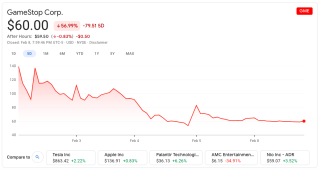
What to tell?  Of course, I will talk a bit about investment theory, the investor protection policy and mechanisms of federal securities law, the composition/demographics of the typical equity ownership of a public company, etc.  But what do I say about GameStop Corp.?  Set forth below is a chart summarizing the trading in GameStop common stock for the past five days: (courtesy of Google Finance):

Screen Shot 2021-02-08 at 11.54.19 PM

Who are the investors in the market for GameStop common stock, options, and short positions now?  Who will they be in a month or six months or a year (assuming a trading market can be sustained)?  And what do the changes in GameStop’s investor profile say about the firm itself, about the New York Stock Exchange, and about various related aspects of securities regulation?  

There remain few answers to the fundamental question of who owns or is trading in GameStop’s publicly traded common stock.  Nevertheless, there are many worthy conversation starters around the GameStop phenomenon that raise interesting opportunities for longer-term exploration.  More on all this as time marches on.  “Once more unto the breach, dear friends, once more . . . .”

[Editorial note (2/9/2021): I should have mentioned that I do plan to use John Anderson’s post from Saturday (which echos points he made in our UT Law roundtable last week) to talk about whether some of the people he mentions or alludes to (thrill-seekers, political speech purveyors, trading gamers, populist performers, nostalgic market-watchers) are or should be considered to be investors.]