Voting-1

Since almost all of us are thinking about Election Day 2020 (tomorrow!), I am taking a moment here to reflect on conversations I recently have had with my students about parallels in political and corporate governance.  Although current conversations center around the fiduciary duties of those charged with governance (a topic that I will leave for another day), just a few weeks ago, we were focused on voting (both shareholder and director voting).  The above photo shows me–sporting wet hair and rain-spotted, fogged-up glasses–waiting in line to vote early last week.  I admit that while I routinely vote in political elections, I have only been to a shareholder meeting once, and then as an advisor to the corporation, not to actually vote any shares held.  Having said that, in my fifteen years of law practice, I did draft proxy materials, structure shareholder meetings, and address concerns associated with shareholder voting.

My students are always curious about shareholder voting and most intrigued by proxy voting.  Corporate governance activities are, of course, not very transparent in daily life for most folks.  A course covering corporate law introduces both new terms to a student’s lexicon and new concepts to a student’s base of knowledge. 

Shareholder voting certainly has some commonalities with political voting (for example, proxy cards and ballots have a similar “feel” to them, and both systems of voting involve elections and may also involve the solicitation of approvals for other matters of governance and finance).  Yet the system of proxy voting in the corporate world knows no real parallel in political governance, and the Electoral College knows no parallel in corporate shareholder voting.  Moreover, the hullabaloo in 2020 about voting fraud in the political realm seems very foreign in a corporate space that allows people to appoint others to vote for them under the authority of a signature.  (I say this knowing that proxy voting can be affected by miscounts and that challenges can be made to proxy cards in proxy contests in the “snake pit” or “pit,” as it may be referred to more informally.)

The system of shareholder voting sometimes seems a bit old-school, despite the advent of electronic proxy materials, online voting, and virtual shareholder meetings–a hot topic of conversation this year, starting back in the spring, when many firms had to move to virtual meetings on an emergency basis due to the COVID-19 pandemic (as the U.S. Securities and Exchange Commission and others well recognized).  Although shareholder voting on blockchains may be the wave of the future (see my coauthored article referencing that, available here), today’s shareholder voting mechanics still involve somewhat traditional balloting and ballot tabulation.  Because shareholders can vote in person at the shareholder meeting (even if that may rarely be done), both digital and manual systems must be available to count votes.  Although, when a quorum is present, the election of directors may be ordained before the meeting even begins (especially when plurality voting obtains), the election results cannot be released until the voting ends.  That happens at the shareholder meeting.

Political voting also can seem a bit antiquated–especially with this year’s hand-marked ballots replacing electronic voting machines because of COVID-19.  Registered voters can cast their ballots early in many states or can vote in person on election day.  Depending on circumstances, some registered voters may be able to vote by absentee ballot or by mail, but in any case, their votes are tabulated electronically.  There are no quorum or meeting requirements.  The required vote typically is a plurality, which may be difficult to ascertain on Election Day (depending on how many absentee ballots are received and when/how they are counted).  Given the fact that a vote of the Electoral College, rather than the popular vote, actually elects the President of the United States (i.e., voters merely determine the composition of the Electoral College), in close presidential elections, the election results may not be available on or even soon after Election Day.  Thus, while there are common elements to shareholder and political voting, especially as to elections (other than those for the President), voting in corporate governance and voting in political governance situations can be quite different.

Having noted these comparative and contrasting reflections on voting in the corporate and political contexts in honor of Election Day, I recognize that, for many, it is difficult to be impassive about Election Day and voting this year.  Students, colleagues, friends, and family members have expressed to me their hopes, fears, enthusiasm, and anxiety about, in particular, tomorrow’s presidential election.  Whatever the result, some will be relieved, and some will be disappointed. 

As a student and teacher of mindfulness practices, I am compelled to note that they can be very useful in moments like these.  They can promote calm, considered, dispassionate reactions and decision-making, and research evidences they can have impacts on the brain that are correlated with stress reduction.  Of course, I recommend mindful yoga.  But meditation, breath work, mindful walking, and other activities through which the brain is able to focus on what is here now, in the present moment (and not on what was or will be), can be helpful in producing a calmer state of mind.  

Cheers to voting and mindfulness practices!  I recommend both as Election Day fast approaches.  And I have already done the voting part . . . .

Voting-2

Earlier this week, VC Laster issued his decision in United Food & Commercial Workers Union v. Zuckerberg.  Professor Stephen Bainbridge blogged about the decision here, with a lot more detailed discussion of the law than I’m going to provide, but I’m covering the same territory anyway because this case is an interesting example of the pathologies associated with the common law.

So, before stockholder plaintiffs are permitted to bring a derivative action on behalf of a corporation, they must first make a showing that the corporate board is too conflicted to be able to make the litigation decision themselves.  This may occur because board members are themselves at risk of liability regarding the underlying transaction being challenged, or because they are too close to someone who is.  The test was first articulated by the Delaware Supreme Court in Aronson v. Lewis, 473 A.2d 805 (Del. 1984), but because this was a common law creation and the court was mostly focused on the dispute in front of it, the test it articulated conflated the general inquiry – is the board able to be objective about the litigation – with the specific application of that inquiry to the Aronson Board.  In other words, the Aronson test conflated the issue of objectivity with respect to bringing a lawsuit with liability on the underlying claim, and phrased the former in terms of the latter.

As time wore on, that conflation made the Aronson test difficult and confusing to apply, for two reasons: First, in many cases – unlike the situation in Aronson – board members change between the time of the alleged fiduciary breach and the time of the lawsuit, making liability on the underlying claim irrelevant.  And second, the legal standards for liability changed, making Aronson’s articulation – which was tied to the liability standards for that board at that time – increasingly disconnected from the actual liability risk.

The Delaware Supreme Court started to fix these problems in Rales v. Blasband, 634 A.2d 927 (Del. 1993), where it created a new test – one rooted solely in the objectivity of the board at the time of the lawsuit – but instead of overruling Aronson, it said that the Rales test would only apply when the board entertaining the possibility of a lawsuit had not made a decision being challenged by the plaintiffs.

That, naturally, led to decades of confusing caselaw about whether Rales or Aronson would apply in a particular matter, making the issue the bane of corporate law professors who tried to teach the distinction to their students (ahem, some of us don’t bother and just teach Rales). 

And here’s the part that’s interesting to me: Why would the law persist in this obviously maladaptive way?  Because, I believe, no litigant had any interest in arguing for a change.  At the end of the day, Rales and Aronson are asking the same question, and regardless of which is used, they come out the same way – a point that several Delaware courts have made.  Which means neither plaintiff nor defendant had much of an interest in briefing the distinction or arguing the law should be changed, and they didn’t.  Without any litigants to press for clarification, Delaware courts allowed this state of affairs to continue and torture corporate law professors and junior associates throughout the land.

D90faa34f96e5b75a257706c4a308885

This is the weakness of common law rulemaking, and the adversarial system in general; courts decide what litigants ask them to decide. And litigants don’t always ask the right questions.

Which is likely why earlier this week, VC Laster – sua sponte – seized the initiative and gave Aronson the boot, even though the parties had assumed Aronson would apply and briefed the matter that way.  In so doing, Laster painstakingly detailed the problems with the Aronson test, concluding, “Precedent thus calls for applying Aronson, but its analytical framework is not up to the task….This decision therefore applies Rales as the general demand futility test.”

Now all that remains is to see if Laster’s bid for a change takes hold.  Notably, litigants still don’t have any incentive to make a serious argument on this score, but if they – like the academy – are relieved to see the shift, they may make a perfunctory gesture towards Aronson in future cases, but then cite Zuckerberg for the idea that Aronson may be dead letter, and go from there.  Even if the plaintiffs appeal Laster’s specific ruling in Zuckerberg dismissing their complaint, I’d be surprised if they waste precious briefing space on the Aronson/Rales distinction, which means the Delaware Supreme Court would have to go affirmatively out of its way to question Laster’s reasoning if it wants to preserve Aronson’s vitality.  Let’s hope it doesn’t bother.

That said, when it comes to the underlying substantive dispute in Zuckerberg, I’m not sure I agree with Laster’s analysis.

The lawsuit arose out of Mark Zuckerberg’s ill-fated proposal to amend Facebook’s charter to create a class of no-vote shares, essentially to allow him to transfer much of his financial interest in the company while maintaining his hold on the high-vote B shares that give him control.  As many will recall, the Board recommended the charter amendment and the shareholders – dominated by Zuckerberg’s high vote shares – voted in favor, but in a subsequent lawsuit, stockholder-plaintiffs uncovered multiple irregularities that had occurred in the course of negotiating the proposal.  Zuckerberg dropped the plan, and that was that, until new plaintiffs brought a derivative lawsuit alleging that even though the plan was abandoned, all of the expenditures associated with it damaged the company.  Thus, the question before Laster was whether the Facebook Board was sufficiently disinterested and independent to decide whether to bring a lawsuit over the Board’s earlier approval of the charter amendments, namely, whether to sue many of its own members.  And that question turned, in part, on whether Reed Hastings and Peter Thiel, two of Facebook’s Board members, faced a substantial risk of liability for having voted in favor of the charter amendment in the first place.

So really, part of the underlying legal question here was whether Hastings and Thiel breached their duties of loyalty by recommending the charter amendment.  The plaintiffs argued, in part, that they did so because they were “biased” in favor of founder control – namely, they believed that corporate founders should be able to run their companies free from the meddling influence of public shareholders.

Laster held that even if this was their reasoning, it did not constitute a lack of loyalty:

A director could believe in good faith that it is generally optimal for companies to be controlled by their founders and that this governance structure is value-maximizing for the corporation and its stockholders over the long-term. Others might differ. As long as an otherwise independent and disinterested director has a rational basis for her belief, that director is entitled (indeed obligated) to make decisions in good faith based on what she subjectively believes will maximize the long-term value of the corporation for the ultimate benefit of its residual claimants.  If a director believes that it will be better for the corporation to have the founder remain in control, then the director may make decisions to achieve that goal. As long as a director acts in good faith, exercises due care, and does not otherwise have any compromising interests, a director will not face liability for making a decision that she believes will maximize the long-term value of the corporation for the ultimate benefit of its residual claimants,…

The belief that founder control benefits corporations and their stockholders over the long run is debatable, but it is not irrational.

To which I respond – what about Blasius?

In Blasius Industries v. Atlas, an incumbent board maneuvered to neuter the effects of shareholder consents that would otherwise have replaced it with a dissident slate.  Chancellor Allen held that even if the Board sincerely and in good faith believed the dissident slate would harm the company and its own plans were better for shareholders, the incumbents would violate their fiduciary duties by taking the choice out of the shareholders’ hands.  As Allen put it:

As I find the facts … they present the question whether a board acts consistently with its fiduciary duty when it acts, in good faith and with appropriate care, for the primary purpose of preventing or impeding an unaffiliated majority of shareholders from expanding the board and electing a new majority. …I conclude that, even though defendants here acted on their view of the corporation’s interest and not selfishly, their December 31 action constituted an offense to the relationship between corporate directors and shareholders that has traditionally been protected in courts of equity. As a consequence, I conclude that the board action taken on December 31 was invalid and must be voided….

The real question the case presents, to my mind, is whether, in these circumstances, the board, even if it is acting with subjective good faith…, may validly act for the principal purpose of preventing the shareholders from electing a majority of new directors. The question thus posed is not one of intentional wrong (or even negligence), but one of authority as between the fiduciary and the beneficiary (not simply legal authority, i.e., as between the fiduciary and the world at large)….

I therefore conclude that, even finding the action taken was taken in good faith, it constituted an unintended violation of the duty of loyalty that the board owed to the shareholders.

Without, umm, weighing in on the overall merits of this particular lawsuit, might Blasius’s reasoning be transferred to the Facebook context?  Directors may believe it’s better if Zuckerberg remains in control of the company, but that doesn’t give them the right to unilaterally effectuate a recapitalization handing him that control even after he sells his shares.

This is not to say the proposed amendments were per se disloyal; just, as with any loss of control rights, you’d expect shareholders to get something in return.  A payment, for example, perhaps coupled with MFW-like protections (which Zuckerberg refused), rather than simply the dubious honor of having Zuckerberg control the company in perpetuity.

I suppose one might argue this isn’t a Blasius situation of interfering with the shareholder franchise so much as it as a Unocal/Unitrin situation of defending against a potentially damaging change in control (and yes, I realize some would argue they’re two sides of the same doctrinal coin).  But Blasius is used for entrenchment; Unocal is applied for mergers and hostile takeovers.  So it would be awfully strange to apply the Unocal framework when the whole issue arises because the existing controller (and the existing directors) are trying to entrench their positions by increasing the separation between control rights and financial rights.  And even if we were to apply Unocal, the maneuver would still fail on preclusiveness grounds; due to a lack of a majority-of-the-minority approval condition, it was mathematically impossible for the minority shareholders to maintain the existing capital structure.*

But that further raises the question whether an impermissible Unocal defense is necessarily a disloyal act (a critical issue here, since the question is being asked in the context of a claim for damages), and I am not certain the caselaw is entirely clear.

In any event, this is probably all old hat; I assume a lot of this territory was covered back during the Google case or during the briefing in the initial Facebook lawsuit.  Still, Laster’s opinion reopens those wounds, and we never got an answer the first time!

*One of the odd doctrinal blips here is that because the proposal was a conflicted-controller transaction, it was subject to entire fairness review, which should be a higher standard than Unocal/Unitrin scrutiny.  But if Unocal is the right framework, we know it fails due to preclusiveness; no further analysis required.  Assuming, of course, that we measure preclusiveness by the ability of the minority shareholders alone (rather than all the shareholders, including Zuckerberg) to reject the transaction.  Which I think we should do, since it was only the minority losing control, and that usurpation of control is what Unocal is concerned about.  But the fact that these kinds of contortions arise when the Unocal framework is used may simply demonstrate the impropriety of applying it in the first instance.

The courts have interpreted Section 10b of the Securities and Exchange Act as prohibiting insiders from trading in their own company’s shares only if they do so “on the basis of” material nonpublic information. This element of scienter for insider trading liability is sometimes tricky for regulators and prosecutors to satisfy because insiders who possess material nonpublic information at the time of their trade will often claim they did not use that information. The insider may claim that her true motives for trading were entirely innocent (e.g., to diversify her portfolio, to pay a large tax bill, or to buy a new house or boat). Such lawful bases for trading can be easy for insiders to manufacture and are often difficult for regulators and prosecutors to disprove.

Historically, the SEC and prosecutors sought to overcome this challenge by taking the position that knowing possession of material nonpublic information while trading is sufficient to satisfy the “on the basis of” test. This strategy met mixed results before the courts, with some circuits holding that proof of scienter under Section 10b requires proof that the trader actually used the inside information in making the trade.

Facing a circuit split, the SEC attempted to settle the “use-versus-possession” debate by adopting Rule 10b5-1, which defines trading “on the basis of” material nonpublic information for purposes of insider trading liability as trading while “aware” of such information. A number of commentators, however, question the statutory authority for Rule 10b5-1, and some courts have simply “ignored” it. See Donald C. Langevoort, “Fine Distinctions” in the Contemporary Law of Insider Trading, 2013 Columbia Bus. L. Rev. 429, 439 (2013).

Professor Andrew Verstein’s forthcoming article, Mixed Motives Insider Trading, (Volume 106 of the Iowa Law Review) charts a “third way” to resolve the ongoing use-versus-possession controversy. Professor Verstein would impose liability for mixed-motives insider trading only where material nonpublic information provides the “primary motive” for the trading. While I have argued elsewhere that a strict “use” test best complies with Section 10b’s scienter requirement, Professor Verstein’s primary-motive test offers a significant improvement over the strict awareness test reflected in both SEC Rule 10b5-1 and the Insider Trading Prohibition Act recently passed by the House of Representatives. For these reasons, Professor Verstein’s proposal warrants serious consideration as regulators and legislators consider paths to reform.

The SSRN abstract to Professor Verstein’s article follows:

If you trade securities on the basis of careful research, then you are a brilliant and shrewd investor. If you trade on the basis of a hot tip from your brother-in-law, an investment banker, then you are a criminal. What if you trade for both reasons?

There is no single answer, thanks to a three-way circuit split. Some courts would forgive you according to your lawful trading motives, some would convict you in keeping with your bad motives, and some would hand the issue to the jury. Sometimes called the “awareness/use” debate or the “possession/use” debate, the proper treatment of mixed motive traders has occupied dozens of law review articles over the last thirty years.

This Article demonstrates that courts and scholars have so far followed the wrong reasons to the wrong answers. Instead, this Article takes trader motives seriously, drawing on insights and solutions from the broader jurisprudence of mixed motive. This analysis generates a new legal test and demonstrates the test’s superiority.

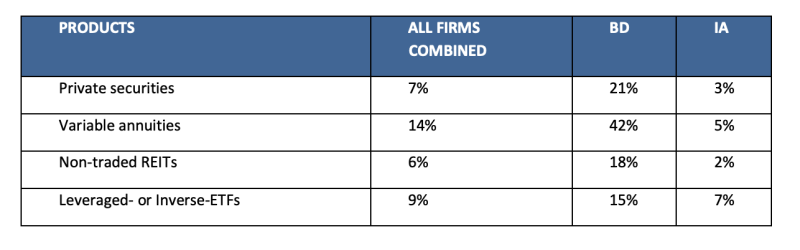
The North American Securities Administrators Association (NASAA) recently released a new report aimed at “identify a baseline of broker-dealer (“BD”) and investment adviser (“IA”) firm policies, procedures, and practices involving sales to retail investors, as those policies, procedures, and practices existed in 2018 prior to adoption and release of the final rule by the SEC (the “pre-BI period”).”  NASAA will do a second look later to see how Regulation Best Interest changes sales patterns.  My early prediction:  not much.

As it stands, some of the differences between the BD channel and the IA channel are shocking.  You’re nine times as likely to get sold a non-traded REIT by a BD than by an IA.  Across the board, BDs load investors up with riskier, complex products:

Screen Shot 2020-10-29 at 11.42.11 AM

This doesn’t surprise me.  Many of these complex products pay massive commissions to the brokers who sell them.  Unsurprisingly, they tend to get sold more often through that channel.  The IA channel compensates advisers differently and they lack the same incentive to get their clients into variable annuities and other complex, illiquid products.

Looking forward, if Regulation Best Interest has some meaningful effect, we would expect these numbers to change in some significant way.  I doubt that it will.


The University of Wisconsin Law School is looking to hire in the areas of Business/Corporate Law, among other closely related areas. We invite applications for faculty position at the rank of Assistant, Associate or Full Professor of Law beginning academic year 2021-2022. We seek entry-level and lateral candidates who show scholarly promise, as evidenced by publications, works in progress, or a research agenda. Applicants should have relevant experience such as teaching, legal practice, or a judicial clerkship. Hiring rank will be commensurate with years of relevant experience. All candidates must have proven success in conducting research or publishing papers in high-impact journals, and teaching appropriate to their stage of career. The University of Wisconsin is an Equal Opportunity and Affirmative Action Employer. We promote excellence through diversity and encourage all qualified individuals to apply. 


The complete PVL is available here: https://jobs.hr.wisc.edu/en-us/job/505740/assistant-associate-or-full-professor-of-law

ABALogo(2020)
I have written about the American Bar Association Limited Liability Institute in this space before.  See, e.g., here, here, here, here, and here.  The 2020 LLC Institute is being hosted virtually and begins next Friday–something to look forward to at the end of election week!  This ABA program is always a premier event, and it is the only national annual program that focuses in exclusively on LLCs and unincorporated business associations.

Importantly, this year’s institute is free to law students.  I have recommended registration and attendance to mine.  Click here for more information, including the agenda, list of speakers (including yours truly!), and registration.

If one is going to ignore entity distinctions, I supposed one may as well go all in.  Following is from an opinion issued last week that involves Christeyns Laundry Technology, LLC (“Christeyns”), which is a limited liability company.  The opinion, though, asserts: 

Selective is a New Jersey corporation with its principal place of business in New Jersey. [Docket No. 1-1, ¶ 2.] Christeyns is a Limited Liability Corporation with two partners: Christeyns Holding, Inc., and Rudi Moors. [Docket No. 25, at 14, ¶ 7.] Christeyns Holding, Inc., is a Delaware corporation with its principal place of business in East Bridgewater, Massachusetts. [Id. at 14, ¶ 8.] Rudi Moors is a resident of South-Easton, Massachusetts. [Id. at 14, ¶ 9.] The remaining parties’ claims arise out of a common nucleus of operative fact.

SELECTIVE INSURANCE COMPANY OF AMERICA, Plaintiff, v. CHRISTEYNS LAUNDRY TECHNOLOGY, LLC, et al., Defendants. Additional Party Names: Clean Green Textile Servs., LLC, Lavatec Laundry Tech., Inc., Single Source Laundry Sol., No. CV1911723RMBAMD, 2020 WL 6194015, at *3 n.2 (D.N.J. Oct. 22, 2020) (emphasis added).

We have already established that an LLC is a limited liability company, and not a corporation. And while the opinion seems to track the diversity requirements of corporation and an LLC correctly, LLCs are not partnerships, and thus do not have partners, either.  LLCs are made up of members. Referring to them as members clearly connotes limited liability protections that are generally provide to members of an LLC, while the generic “partner” could imply that each “partner” faces unlimited liability for the debts and obligations of a “partnership.” 

Similarly, another case from last week made the following observation about a witness:

“Ernest Thompson is listed as “GEN. PART” of M Nadlan LLC per DHPD records. The court takes this to mean General Partner of the Limited Liability Corporation.”

 Yolanda Martinez, Petitioner, M Nadlan LLC, Respondent., No. 41219/2019, 2020 WL 6166864, at *3 n.3 (N.Y. Civ. Ct. Oct. 21, 2020) (emphasis added).

Again with the mixing of entities.  In fairness, the court did not label Mr. Thompson as “GEN. PART.” Someone else did.  But the court did refer to the LLC as a corporation.  Once again, although I know LLCs sometimes adopt partnership terms, they should not.  And yet again, here, “general partner” could imply personal liability for entity debts on the part of Mr. Thompson, evening though it is more likely he is a managing member of the LLC.  If you are listed as a general partner, that holding out could be deemed to be a form or personal guarantee, at least where one could plausibly claim reliance.  Moreover, it’s just bad form.  

Anyway, it’s possible, and maybe even likely, that courts would uphold limited liability protections for these LLC members who are listed as partners. But why take the risk of having to find out?  

Image1

The NYU Pollack Center for Law & Business, Indiana University Maurer School of Law, and Securities and Exchange Commission Historical Society invite you to a virtual program entitled “Insider Trading: Honoring the Past|A Program Commemorating the 40th Anniversary of Chiarella v. United States,” which will take place on Thursday, November 5th from 10am-noon Eastern Time.

The program will explore the fascinating backstories of the Chiarella prosecution and the Supreme Court argument as well as the SEC’s and DOJ’s insider trading enforcement strategies in the wake of the Court’s ruling. The Chiarella case is also the subject of Donna Nagy’s recent essay, Chiarella v. United States and its Indelible Impact on Insider Trading Law.

A webinar link will be circulated to all those who RSVP, which you can do here. Conference details and schedule are below.

Conference Organizers:

Stephen Choi, Murray and Kathleen Bring Professor of Law, NYU School of Law, Co-Director Pollack Center for Law and Business
Donna M. Nagy, C. Ben Dutton Professor of Law, Indiana University Maurer School of Law
Jane Cobb, Executive Director, SEC Historical Society

Schedule:

10:00am Welcome by Stephen Choi, Murray and Kathleen Bring Professor of Law, NYU School of Law, Co-Director Pollack Center for Law and Business

10:10-11:10am    Session I: The Chiarella Prosecution and Supreme Court Litigation

John S. Siffert, Co-Founding Partner, Lankler Siffert Wohl; Adjunct Professor—NYU School of Law (Assistant US Attorney in the SDNY 1974-1979, prosecuted the Chiarella case and argued the 2nd Circuit appeal)
John “Rusty” Wing, Partner, Lankler Siffert Wohl (Chief of the Securities and Business Fraud Unit for the SDNY’s U.S. Attorney’s Office 1971-1978)
Hon. Judge Jed S. Rakoff, U.S. District Judge SDNY (Chief of the Securities and Business Fraud Unit for the SDNY’s U.S. Attorney’s Office 1978-1980)
Stanley S. Arkin, founding member of Arkin Solbakken (represented Vincent Chiarella at his criminal trial, 2nd Circuit appeal, and argument before the Supreme Court)
• Panel Moderator: Donna M. Nagy, C. Ben Dutton Professor of Law, Indiana University Maurer School of Law

11:10am-12:00pm    Session II: The SEC and DOJ’s Response to the Supreme Court’s Chiarella Decision

Donald C. Langevoort, Thomas Aquinas Reynolds Professor of Law, Georgetown University Law Center (SEC Special Counsel, Office of General Counsel, 1978-1981)
Lee S. Richards III, Co-Founding Partner, Richards Kibbe & Orbe (Assistant US Attorney in the SDNY 1977-1983, prosecuted US v. Newman based on the misappropriation theory advanced in, but left undecided by, the Court’s Chiarella ruling)
Hon. Judge Jed S. Rakoff, U.S. District Judge SDNY (SDNY Fraud Unit Chief during the Newman investigation, later served as defense counsel in Carpenter v. United States)
• Panel Moderator: Robert B. Thompson, Peter P. Weidenbruch, Jr. Professor of Business Law Georgetown University Law Center

Although my UT Law colleague Greg Stein is perhaps most well known for his work in the area of real estate law (development, finance, land use, etc.–see his SSRN page here), of late, he has been focusing increased attention on issues at the intersection of technological innovation and economic enterprise.  I have been interested in and engaged by this new twist to his research, thinking, and writing.  This post promotes two works he has completed that occupy this scholarly space, the first of which was recently published in the Brooklyn Law Review and the second of which is forthcoming in the Florida State University Law Review.

The Brooklyn Law Review piece is entitled “Inequality in the Sharing Economy.”  The SSRN abstract follows.

The rise of the sharing economy benefits consumers and providers alike. Consumers can access a wider range of goods and services on an as-needed basis and no longer need to own a smaller number of costly assets that sit unused most of the time. Providers can engage in profitable short-term ventures, working on their own schedule and enjoying many new opportunities to supplement their income.

Sharing economy platforms often employ dynamic pricing, which means that the price of a good or service varies in real time as supply and demand change. Under dynamic pricing, the price of a good or service is highest when demand is high or supply is low. Just when a customer most needs a good or service – think bottled water after a hurricane – dynamic pricing may price that customer out of the market.

This Article examines the extent to which the rise of the sharing economy may exacerbate existing inequality. It describes the sharing economy and its frequent use of dynamic pricing as a means of allocating scarce resources. It then focuses on three types of commodities – necessities, inelastic goods and services, and public goods and services – and discusses why the dynamic pricing of these three types of commodities raises the greatest inequality concerns. The Article concludes by asking whether some type of intervention is warranted and examining the advantages and drawbacks of government action, action by the private sector, or no action at all.

The title of the article that is forthcoming in the Florida State University Law Review is “The Impact of Autonomous Vehicles on Urban Land Use Patterns.”  The SSRN abstract for this article is set forth below.

Autonomous vehicles are coming. The only questions are how quickly they will arrive, how we will manage the years when they share the road with conventional vehicles, and how the legal system will address the issues they raise. This Article examines the impact the autonomous vehicle revolution will have on urban land use patterns.

Autonomous vehicles will transform the use of land and the law governing that valuable land. Automobiles will drop passengers off and then drive themselves to remote parking areas, reducing the need for downtown parking. These vehicles will create the need for substantial changes in roadway design. Driverless cars are more likely to be shared, and fleets may supplant individual ownership. At the same time, people may be willing to endure longer commutes, working while their car transports them.

These dramatic changes will require corresponding adaptations in real estate and land use law. Zoning laws, building codes, and homeowners’ association rules will have to be updated to reflect shifting needs for parking. Longer commutes may create a need for stricter environmental controls. Moreover, jurisdictions will have to address these changes while operating under considerable uncertainty, as we all wait to see which technologies catch on, which fall by the wayside, and how quickly this revolution arrives. This Article examines the legal changes that are likely to be needed in the near future. It concludes by recommending that government bodies engage in scenario planning so they can act under conditions of ambiguity while reducing the risk of poor decisions.

These articles offer interesting perspectives on the need for and desirability of legal or regulatory change as a response to existing and inevitable ripple effects of the new ways we engage with technology and use it in our lives–in commerce and in the more personal aspects of our existence–whether those effects are felt in the socio-economic landscape or the land use realm.  Many business law academics have been researching and writing about these relationships between and among legal and regulatory rules, technological innovation, and shifts in commercial and personal behavioral patterns.  Greg’s contributions to this body of work are both compelling and thoughtful.  I appreciate his insights.

This week, I’m plugging a new piece I posted to SSRN, forthcoming as a chapter in Research Handbook on Corporate Purpose and Personhood (Elizabeth Pollman & Robert Thompson eds., Elgar). It actually includes a lot of the arguments/observations I’ve previously made in this space, but if you want them compiled in a handy chapter, here’s the abstract:

ESG Investing, or, If You Can’t Beat ‘Em, Join ‘Em

If corporate purpose debates concern whether corporations should operate solely to benefit their shareholders, or if instead they should operate to benefit the community as a whole, “ESG” – or, investing based on “environmental, social, and governance” factors – occupies a middle ground. Its adherents welcome shareholder power within the corporate form and accept that shareholders are the central objects of corporate concern, but argue that shareholders themselves should encourage corporations to operate with due regard for the protection of nonshareholder constituencies. This Chapter, prepared for the Research Handbook on Corporate Purpose and Personhood, will explore the theory behind ESG, as well as the barriers to its implementation.