
The AALS Employee Benefits and Executive Compensation Section has a call for papers touching on investment advice and retirement savings.  There is so much going on on this front with the DOL getting ready to put its own gutted revamped fiduciary rule out, the new SEC Regulation Best Interest, and so many other things happening.  Plus, with over 10,000 Boomers turning 65 each day, these issues will only get more and more attention in the years ahead.


Call for Papers

Section on Employee Benefits & Executive Compensation

2020 AALS Annual Meeting

January 2-6, 2020 – Washington, D.C.


The AALS Section on Employee Benefits and Executive Compensation is pleased to announce a Call for Papers for the section panel for the 2020 AALS Annual Meeting.  The Employee Benefits and Executive Compensation section panel is scheduled from 3:30-5:15 p.m., January 2, 2020.  The panel is graciously co-sponsored by the Sections on Aging and the Law, Employment Discrimination, Labor Relations and Employment Law, and Poverty Law.


The topic for this year’s Employee Benefits and Executive Compensation panel is:


The Road to Wellbeing: Navigating the Potholes to Lifetime Financial Security


Panel Description: Although traditional employer-provided retirement and health benefits provide a significant safety net during employment and beyond, many in the U.S. struggle to achieve a state of long-term financial and health stability.  This panel brings together experts from diverse perspectives to address obstacles and possible solutions in the pursuit of individual wellbeing over time.


We welcome legal scholarship on any topic related to the panel topic, including employer-provided benefits, retirement security, Social Security, income disparity and poverty, and topics related to individual financial/investment advice and investor protections.


Eligibility:  Full-time faculty of AALS member schools or non-member fee-paid schools (determined as of the submission deadline) are eligible to submit papers.  For co-authored papers, both authors must satisfy the eligibility criteria.


Submission details and due dates:  Please submit abstracts (250-1000 words) by September 15, 2019, in Microsoft Word format, by e-mail to Susan Cancelosi, scancelosi@wayne.edu.  Only one abstract may be submitted by any potential speaker.  The subject line should read “2020 AALS Employee Benefits section CFP submission”.  Final papers are due by November 30, 2019.  Scholarship may be at any stage of the publication process, from work-in-progress to completed article; however, if an article has already been published, the publication date may not be before 2018. 


By submitting an abstract for consideration, you agree to attend and present at the 2020 AALS Annual Meeting Employee Benefits and Executive Compensation section panel on January 2, 2020, 3:30-5:15 p.m., should your paper be selected for presentation.


Abstracts will be reviewed by members of the Executive Committee of the Section on Employee Benefits and Executive Compensation.  Anyone selected to present will be notified by e-mail by September 26, 2019.  All presenters, including anyone selected to present through this Call for Papers, are responsible for paying their own AALS annual meeting registration fee, hotel and travel expenses.


Any questions should be directed to Section Chair Susan Cancelosi, scancelosi@wayne.edu.
In 2010, an Illinois court reviewed Delaware business law making the following observations:

With respect to a limited liability corporation, Delaware law states that “[u]nless otherwise provided in a limited liability company agreement, the management of a limited liability company shall be vested in its members….” 6 Del.C. § 18–402. Thus, pursuant to Delaware law, directors are generally provided with authority for managing the corporation and members are generally provided with authority for managing the limited liability company. The bankruptcy court therefore properly found that a member of a LLC would be an analogous position to a director of a corporation under Delaware law.

Longview Aluminum, L.L.C. v. Brandt, 431 B.R. 193, 197 (N.D. Ill. 2010), aff’d sub nom. In re Longview Aluminum, L.L.C., 657 F.3d 507 (7th Cir. 2011).

Well, initially, it must be noted that an LLC is not a corporation at all.  As the quoted Delaware law observes, it is a “limited liability company.” Corporations and LLCs are distinct entities. 

I’ll also take issue with adopting the bankruptcy court’s finding “that a member of an LLC would be an analogous position to a director of a corporation under Delaware law.”  I will concede that a member of an LLCmaybe an analogous position to a director of a corporation under Delaware law, but that is not inherently true. 

The Longview Aluminumcourt had determined that, “under Delaware law, a corporation generally must ‘be managed by or under the direction of a board of directors . . . .’” 8 Del. Code § 141. While that’s technically accurate, it understates that general nature of Delaware directors. Note that the statue is mandatory in nature (“shall”), and then provides limited changes:

The business and affairs of every corporation organized under this chapter shall be managed by or under the direction of a board of directors, except as may be otherwise provided in this chapter or in its certificate of incorporation. If any such provision is made in the certificate of incorporation, the powers and duties conferred or imposed upon the board of directors by this chapter shall be exercised or performed to such extent and by such person or persons as shall be provided in the certificate of incorporation.

8 Del. Code § 141(a).

Remember, the Longview Aluminumcourt stated that, “[w]ith respect to a limited liability corporation, Delaware law states that ‘[u]nless otherwise provided in a limited liability company agreement, the management of a limited liability company shall be vested in its members….’ 6 Del.C. § 18–402.”  Id.

But Delaware LLC law provides:

“Unless otherwise provided in a limited liability company agreement, the management of a limited liability company shall be vested in its members in proportion to the then current percentage or other interest of members in the profits of the limited liability company owned by all of the members, the decision of members owning more than 50 percent of the said percentage or other interest in the profits controlling . . . .” 

6 Del. Code § 18-402.

That’s different in structure than directors. Directors act as a body, usually with one vote per director. This default provision provides for a very different structure, providing that one member with over 50% of the interests is controlling.  That’s not like a board at all.  And furthermore, those members  in charge of the entity may not have any fiduciary duties to the LLC. The Delaware LLC Act states:

“To the extent that, at law or in equity, a member or manager or other person has duties (including fiduciary duties) to a limited liability company or to another member or manager or to another person that is a party to or is otherwise bound by a limited liability company agreement, the member’s or manager’s or other person’s duties may be expanded or restricted or eliminated by provisions in the limited liability company agreement . . . .” 6 Del. C. § 18-1101(c).

Corporate directors have some version of fiduciary duties. Again, a notable difference.  It appears that the Longview Aluminumcourt (affirming the bankruptcy court) may have been right to extend the corporate director concept to the LLC managers in that case because of the structure of the LLC’s operating agreement.  But the court went on to imply that a member of a LLC is“an analogous position to a director of a corporation under Delaware law.” That very much overstates things.

Why discuss this 2010-11 case at length now? Because this section was cited last week:

“[I]n referencing a director, Section 101(31)(B) was intended to refer to the party that “managed” the debtor corporation.” Longview Aluminum, L.L.C. v. Brandt, 431 B.R. 193, 197 (N.D. Ill. 2010) (citing 11 U.S.C. § 101(31)(B)). “With respect to a limited liability corporation, Delaware law states that ‘[u]nless otherwise provided in a limited liability company agreement, the management of a limited liability company shall be vested in its members ….” Id. (quoting 6 Del.C. § 18–402).

In re Licking River Mining, LLC, No. 14-10201, 2019 WL 2295680, at *41 (Bankr. E.D. Ky. July 19, 2019), as amended (July 19, 2019).

Fortunately, other than failing to correct the mistake of calling an LLC a corporation, the Licking River Miningseems to have gotten the outcome right.  The court determined that a 25% member interest lacked control because all LLC “decisions were to be made either by a majority of the LLC interests or by the entity’s managing member.”Id.Good call, and hopefully this case will clarify (and correct) any negative implications from the Longview Aluminum case.  But even if it does, it gives longer life to an incorrect reference to LLCs and increases the likelihood it will be cited repeatedly. 

Win some, lose some, I guess.


Like co-blogger Joan Heminway, I felt it a great honor and pleasure to attend the second annual Women’s Leadership in Legal Academia Conference last week (thanks, Joan, for bringing it to my attention via the BLPB!).  It was a fabulous two days – an opportunity to reconnect with colleagues from around the country, meet new ones, learn a ton, and participate in many highly-engaging discussions.  And as a UVA JD/MBA, it was also a wonderful chance to return to C’ville, catch up with a few former professors, and buy a much needed new pair of running shoes (Nike outlet new since my time!).

I loved Joan’s “mini-workshop.”  It really challenged teams of attendees to grapple with difficult scenarios (see yesterday’s post), provided valuable leadership insights, and reminded me of summer reading I want to do!  During the workshop, Joan mentioned the book Emotional Intelligence.  It’s been on my “must read” list for years.  Overall, the scenarios brought to life the emotional savvy (and regulation) essential to great leadership, and left me with two overarching thoughts.  First, in any situation, doing one’s best to understand the persons (including oneself!) and complexities involved is foundational to effective leadership.  It is also hard because it demands a sustained focus on others, and lots of active listening.  Second, and perhaps most important, giving people the benefit of the doubt – assuming the best of others – greatly assists conflict resolution.  Yet this too can often be hard.               

Additional takeaways on leadership from this and other workshops included, Leaders:

Put their people first, develop others, value everyone, and seek to build others up – “the best leaders bring out the best in people.”

Know themselves – their strengths AND weaknesses.

Build relationships.

Lead by example.

Seek and value wisdom.

Demonstrate technical competency.

Exhibit trustworthiness, integrity, courage, and honesty.

Get the right things done.  

Finally, while at the conference, random thoughts crossing my mind included: Extreme Ownership, a favorite book on leadership; The Power of Vulnerability, one of the most celebrated Ted Talks; and, “bloom where you’re planted,” a multifaceted phrase encouraging all to lead from where ever we are!  


WomensLeadership2019(IMG_1193)

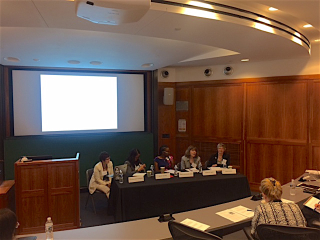
Last Thursday and Friday, I had the honor and pleasure of joining a large group of women interested in law school leadership at the second annual Women’s Leadership in Legal Academia conference.  The two days provided many opportunities for education and inspiration. Four of my UT Law colleagues started off the conference with a workshop focused on microaggressions.  My mini-workshop entitled “Leading from Where We Are” (picture above taken by fellow BLPB blogger Colleen Baker, who attended the session) followed.

The workshop extended my thoughts on leadership as a concept distinct from titles–thoughts I had touched on in an earlier blog post for the Leading as Lawyers blog. It also offered me the chance to describe an optimal organizational structure, with leaders at every key juncture.  In introducing my panelists, I noted leadership attributes that I had observed in each and told a related/relevant story about our relationship.  Then, we offered for discussion two hypothetical situations in which a faculty member is challenged to lead.  In each case, we started with small group work and followed through with a report-out to the “committee of the whole.”  One of the hypotheticals involved a (potential) misunderstanding between the dean and the faculty, and the other related to a traumatic incident involving one or more students from one of your classes.  The small group discussions yielded excellent thoughts for consideration in the larger group forum.

Among the observations?  I will highlight just two here.  First, that the way a faculty member handles a potentially divisive situation involving the dean and the faculty may depend on the dean’s leadership style (dictatorial or collaborative, e.g.) and the level of mutual trust between the dean and the faculty.  Also, in exploring the various ways in which a faculty member might address traumatic events known to the public (e.g., fires and floods) and those that are more private (e.g., a student death under unusual circumstances), we identified different levels of faculty comfort in addressing trauma in the classroom.  There was especial discomfort in addressing individual, personal trauma.

Colleen or I may have more to say about the conference in future posts.  I was thrilled with the creative energy generated by this panel.  I am grateful to have had the opportunity to share and learn.  What’s more, organizing the session enabled me to reconnect with four fabulous leaders in legal academia and to meet many more.  A total “win” for me.

I’ve previously blogged in this space about Shari Redstone and her conflicts with the CBS board.  Last week, New York Magazine published this fascinating article about Shari Redstone’s corporate battles and her relationship with her father, Sumner Redstone.  Shari Redstone refused to participate and thus much of it appears to have been drawn from other sources, but it was all new to me, and the anecdotes make for a fascinating – and eyebrow raising – read.  Here’s a taste:

In retrospect, it took some chutzpah for Moonves to take Redstone to court, when as reporting would later show, he was busily covering up the sexual-assault allegations against him. Less than six months later, he was gone. So were Gifford and most of the other elder men on the board who’d backed Moonves. …. CBS and Viacom are once again talking about merging, though Redstone cannot be officially involved until negotiations are further along. If the merger goes through, as it well may this summer, she will have cemented her control of a $30 billion media kingdom.

And Moonves’s stunning downfall has given Redstone, for all her wealth, something she’s never had before: a narrative that justifies her own rise. The #MeToo movement has hardly had a richer target than CBS, with its board of mostly old white men who protected Moonves and shrugged off the company’s treatment of women. …The new board of CBS is, like Viacom’s, majority female for the first time — and increasingly stacked with her allies. Women are being put in charge and on the air at CBS. And the face of the family controlling these companies was once the patriarch whose embarrasing sexual exploits were aired in court; now it’s his daughter.

As the excerpt indicates, the main theme of the article is that Shari Redstone – though an unlikely candidate for feminist hero – has battled a cadre of older men, many of whom disparaged or dismissed her apparently on the basis of gender, and has come out on top.  She’s now firmly in control of both CBS and Viacom, and likely will fulfill her ambition to combine the two companies.   A great piece to mull over.


When was the last time you sat in a classroom for 6 hours a day learning material that you weren’t sure that you would use on a daily basis for your job? I’m not talking about attending a CLE or an academic conference where you pick what you want to learn and from whom. I’m talking about taking notes, doing homework everyday, and being called on— you know, like we do with our students. 


Well I’ve just finished this experience and it will change how I teach from now on. Since mid June, I’ve taken 90 hours of immersive Spanish classes—30 hours through weekend work at the University of Miami and 60 hours through Habla Ya in Panama for two weeks. I did this while teaching a transactional drafting course online (asynchronously), which required me to hold individual video conferences with my 16 students and markup and review drafts. I also worked on a time consuming project for a client. This was no vacation. At times, it was pure hell. 

Here’s what I learned. 

  1. The teacher really does matter. I often hear my students saying “I just can’t learn from Professor X.” I always thought it was a lame excuse from students who liked the “easier” or more entertaining professors (who weren’t always easier). Having had several teachers over the past few week, I now agree with the students. It’s not as though I didn’t want to learn, but there was a real difference between the teachers. You could tell who really loved teaching and who was doing it for the paycheck. It’s the difference between those who love teaching 1Ls or working with first year associates and those who have to do so to be able to teach their upper level course of choice or work with certain clients. 
  2. Breaks are really important in long classes. When I teach classes of more than 1 hour 20 minutes, I give a short break. If students aren’t back from the break in time, I reserve the right to mark them absent. My classes in Panama had a break 2 hours in. By that time, my brain was fried and I was irritable. After the break, I was refreshed and ready to learn. That break was essential for me.  Breaks are essential for our students too and not just so they can check Instagram on their phones. 
  3. Listening to someone talk without having anything to look at is really hard. I’m a PowerPoint fan— I know many aren’t. I don’t use it as a crutch and my students find them helpful. The better Spanish teachers used a variety of visual aids and it really enhanced the learning. Those who didn’t lost our attention quickly and it impacted us to our detriment. What do our textbooks look like? How are we bringing the materials to life? It may be time to re-evaluate. 
  4. There are differently learning styles. I’ve always believed that some people learn better by hearing, some by seeing, some by doing, and some through a combination. For this reason, I’ve always polled my students before class about learning style and have adapted, if possible. Generally, I tend to use a combination of tactics.  I read somewhere that learning style theory had been debunked or at least had fallen out of fashion. However, I saw first hand how my classmates responded to different tasks based on how they were taught. The best teachers used all three methods and it kept us engaged.
  5. Make learning fun- Some of my best learning occurred during games in class. It broke the monotony and challenged us in different ways. When I’ve taught complex courses such as civil procedure and business associations, I’ve tried to be as entertaining as possible so that the students wanted to learn. For final exam review, I played jeopardy with them. Not only did they love it, but they really learned. 
  6. Make it relevant. This seems obvious but bears repeating. I struggled in my Spanish class with some of the concepts and sentence structure because I knew I would almost never use it. I had 4 hours a day of group work with grammar and 2 hours a day of private lessons on legal and business Spanish. When I told them in advance that I wasn’t interested in criminal or immigration terms and that instead I wanted to learn business, legal, and compliance vocabulary, they made accommodations. When I told them that the very formal sentence structure they wanted me to master was good to know but I would never use it, they adapted. When we teach our students, we need them to have the foundation, of course, but we also need to think of the skills that our students will need in the real world. This is hard as we try to make sure students understand theory, can pass the bar, and have practical knowledge, but we owe it to them to try harder. 
  7. Go slower. Spending 6 hours a day learning anything new is tough. We forget that we know the subject inside out and that the students do not. There were times that I wanted the teacher to slow down, but I didn’t ask. How many of our students feel the same way? My best teachers made it easy to ask questions. They also used formative assessment techniques to make sure we understood concepts before we moved on. Remember, our students are taking a number of classes and some are working. It may take more time for them to absorb concepts than we think. 
  8. Don’t forget how much harder it is for students whose first language is not English. Not only did I learn grammar, I also learned complex legal terms that most people don’t use in any language. Discussing cybersecurity and EU data protection regulations in Spanish in hour 5 of a 6 hour day is grueling. I had to read in Spanish, translate in my head into English, and then translate back to Spanish to answer questions or explain concepts in role play exercises. My substance, vocabulary, and grammar had to be correct. I always knew in theory that it had to be harder for my foreign born students to learn in my classes, but I now have an even deeper appreciation. 
  9. Give reasonable assignments. I had a lot of homework each night. Like many of our students, there were days that I did the work right before class. Sometimes we forget that our students have several classes, jobs, extracurricular activities, and personal lives. I got particularly frustrated when I did the homework (last minute) and certain teachers did not discuss it or even ask for it. I saw this as a lack of respect for my time. Our students likely feel the same way when we assign materials and never mention it again. 
  10. Be flexible. When my teachers saw that certain things didn’t work, they made changes quickly. When I complained about some of the grammatical structure I had to learn, my teacher started to point out examples of what I had complained about in articles by CNN, Forbes etc. They put in context for me and I stopped complaining. We can’t always do that in our classrooms, but we should try to pivot when possible. Bring in current events. Let students know why what they are learning matters.

I plan to continue my immersion courses but have also started taking other courses online. I love watching other people teach. Being a life long learner will make me a much better teacher and I will then mold much better future lawyers. What have you learned from watching other people teach?   


A new paper from a powerhouse trio just hit SSRN.  Steve Choi, Adam Pritchard, and Jessica Erickson teamed up to take a look at attorneys’ fees in securities class actions.  Erickson announced it earlier today with some quick summary tweets:

They collected data on over 1,700 settlements to examine how high and low value settlements differ from each other and whether judges treat the high-value cases differently than the low value ones.   Interestingly, they found some evidence that attorneys may engage in some make-work in high-value cases in order to justify collecting big fees. With all of the data they collected, we’ll likely see many more papers coming out of this set. 

Hopefully, the data will help courts make better decisions when scrutinizing fee requests in mega-settlements.  One challenge will be getting the information before courts reviewing settlements.  The attorneys representing parties generally have little incentive to police lead counsel fees.  Lead counsel wants to get paid.  And the defense doesn’t have as much interest in the allocation of settlement funds so much as the overall number.  Courts may need to be alerted to these settlement issues to protect the class.

I have been a dean for two days.  So, obviously, I have it all figured out.  (That’s very much a joke). 

My sample size is small, but it seemed like a good time for me to take a shot at comparing what it’s like to be a new dean versus what it’s like to be a new professor. Admittedly, I am working hard to remember what it was like to be a professor in his first two days. I have the benefit of hindsight with that, while my life as dean is very much real time.  But hey, it’s a blog, so I will give it a try. 

  • As a new professor, I was worried (very worried) that I did not know everything about the subject matter and that it would be obvious. As a new dean, I expect that others don’t expect me to know everything, and if they do, I know they’re wrong.    
  • As a new professor, I wanted everyone to like me.  As a new dean, I’d still appreciate that.  But I don’t need it, and I don’t expect it, and I know it is impossible. (It’s impossible as a professor, too, by the way, if you do your job, but you can get closer to 100%.).  
  • As a new professor, my goals were largely personal. They were aligned with my institution, but they were about my goals. Promotion. Tenure. Publication. Citation.  As a new dean, my goals are far more institutional. Bar passage. Jobs for students. Faculty opportunity. A high-quality and inclusive workplace. 
  • As a new professor, I was hopeful. I wanted to have an impact on students, policy, and our future. As new dean, I am hopeful.  And I want the same things, too. My role is very different, by my goal is the same. 

Short list, I suppose, but those are the comparisons the stick out to me.  

I don’t have any expectation that being a new dean is any easier than being a new professor. But one thing I learned as a new professor was that I need to be myself.  As a new dean, I will make mistakes, just as I did as a new professor. I hope not to, but that’s not how the world works.  And it’s not how learning works. Learning involves testing, trying, failing, and seeking solutions.  

What’s next? I will work to be myself. That’s one advantage I have.  When I started as a professor, I thought maybe I should be like other professors, and I worked to be “a professor.”  Dumb.  I want to make sure any mistakes I make are mine and not me trying to be something I am not. I am not trying to be a dean. I just am one.  If nothing else, I hope that will make it easier for people to forgive mistakes.  

To my new professor and new dean colleagues, good luck.  Let’s try to be ourselves and show our students and faculty and staff colleagues that genuineness has value. Because it does. It combines well with hard work, too.