The Estey Chair in Business Law was established in 2014 through the generosity of the Estey Family as well as through the support of alumni and friends of the College of Law at the University of Saskatchewan. The Chair was created to honour the late Supreme Court of Canada Justice Willard “Bud” Estey, a proud alumnus of the College. The Chair has previously been held by Rod Wood and Cally Jordan.

We invite applications from outstanding scholars and practitioners in the field of business law, defined broadly as including domestic and international structures (including but not limited to regulatory and dispute resolution frameworks and institutions), governance, transactions, finance, securities, competition, taxation, insolvency and related areas.

The College is seeking candidates in two categories:

  1. Those with a strong academic background and demonstrated academic leadership and teaching skills;

        OR

  1. Senior and highly experienced legal professionals.

In either category, the role of the Chair is to engage with faculty colleagues, students and members of the local legal profession and generate enthusiasm about the College’s business law programming. The College of Law provides a stimulating, supportive and highly collegial environment in which the Chair can deploy his or her knowledge and skills to explore new areas of research and to engage with students, experienced academics and senior practitioners.

Term length will normally be for one year, but the College will consider terms of less than one year, particularly in the case of senior legal professionals who wish to spend a shorter time with the College. In the academic category, the successful candidate for the Chair will be an academic with an established reputation and record of scholarly achievement. He or she will be in residence at the College of Law and is expected to enrich and enhance the intellectual life of the College by pursuing a research program, teaching one course or seminar, delivering a public lecture and planning and hosting a conference or focused scholarly workshop. In the senior legal professional category, the successful candidate for the Chair will be a senior and highly experienced professional with a national and/or international reputation in their chosen area of practice. He or she will be in residence at the College of Law and is expected to enrich and enhance the teaching and learning environment of the school, and its business law reputation, by sharing his or her practical knowledge and expertise with students, Faculty and members of the local profession. He or she will be expected to teach a seminar and to organize a workshop on a current and topical issue in his or her established field of practice.

The Chair is also expected to engage in outreach activities with the bar, judiciary and the wider community during their tenure. Appropriate administrative and financial supports will be provided, particularly with regard to the research and outreach obligations of the Chair. Salary will be commensurate with the experience and standing of the holder but it is anticipated that the Chair will be appointed at the level of Associate or Full Professor ranks. In the case of Associate Professor appointments, the successful candidate will be an emerging scholar with a growing reputation whose career trajectory would be enhanced by holding an endowed Chair appointment. The Salary range at the Associate Professor is $112,109 to $130,925; Professor $130,925 to $152,877, with a higher starting salary in rare and exceptional circumstances pursuant to Article 18.2.6.12 of the 2014-2017 USFA Collective Agreement (http://www.usaskfaculty.ca/?attachment_id=3298).

Applications will begin to be considered immediately. While the date for appointment is flexible, the ideal candidate would be available to occupy the Chair as of August 1, 2019. The College would also entertain applications from suitably qualified candidates who may wish to occupy the Chair in the 2019-20 or 2020-21 academic years.

This position includes a comprehensive benefits package which includes a dental, health and extended vision care plan; pension plan, life insurance (compulsory and voluntary), sick leave, travel insurance, death benefits, an employee assistance program, a professional expense allowance, and a flexible health and wellness spending program.

The College of Law is the oldest law school in western Canada, and has provided public service, innovative legal education and high-quality legal scholarship to the Province, Canada and beyond since 1912. We graduate leaders in a host of different areas with alumni holding judicial, political, academic, private and public sector positions at the highest levels in a number of different regions within the country and beyond. The law school is committed to providing its students with rich experiential learning opportunities. Our faculty members are award-winning teachers, recognized for their teaching innovation and effectiveness. The College has embraced the interdisciplinary opportunities presented by being part of a major research-intensive university. This fact is reflected in the value the law school attributes to the creation and dissemination of diverse forms of knowledge and the use of that knowledge to better the human condition.

Inquiries as well as letters of application, accompanied by a current curriculum vitae and an outline of the research plans of the candidate, should be directed to:

Professor Martin Phillipson Dean, College of Law
University of Saskatchewan
15 Campus Drive
Saskatoon, Saskatchewan
S7N 5A6
Telephone: (306) 966-5910
Fax: (306) 966-5900
Email: jean.der @usask.ca 

The University of Saskatchewan is strongly committed to a diverse and inclusive workplace that empowers all employees to reach their full potential. All members of the university community share a responsibility for developing and maintaining an environment in which differences are valued and inclusiveness is practiced. The university welcomes applications from those who will contribute to the diversity of our community. All qualified candidates are encouraged to apply; however, Canadian citizens and permanent residents will be given priority.
Those who follow developments in derivatives clearing know that the regulation of this area has frequently been a source of conflict among international regulators (see When Regulators Collide).  This past week, in the Financial Times article CFTC chair complains to European Commission over regulation jibe [subscription required], Philip Stafford and Jim Brunsden report that an EU official’s comments during a recent conference, which included the phrase “you fell for it,” in reference to a March agreement between the EU and the US, spurred CFTC Chairman Christopher Giancarlo to write EU Commissioner in charge of Financial Stability, Valdis Dombrovskies, to ask for a clarification of the comments.   For me, the article did double-duty: it updated me about happenings in one of my research areas and it reminded me of the importance of our words.      

I am in Colorado attending the Law & Economics Center’s 34th Economics Institute for Law Professors. It’s a fantastic conference, and I highly encourage you to attend if you can. You can view this year’s agenda here. (If you have trouble with the links, try a different browser.  If that doesn’t work, let me know.)

This past Wednesday, during the “Economics of Innovation and Dynamic Competition” class, Prof. John Yun discussed the difference between static and dynamic models of competition, and how this might impact our assessment of monopolists. One aspect of this discussion focused on the concept of “deadweight loss.” For those of you not familiar with this concept, go watch the following 3-minute video from “ACDC Econ”: https://youtu.be/YNcPxPz9fng .

The video provides the standard assessment that monopolies create “deadweight loss” and that this deadweight loss is inefficient. Consequently, the conventional wisdom is that government regulation/intervention is therefore justified. However, this analysis is based on comparing the expected behavior of a monopolist with a static model of perfect competition. One of the problems with using a static model is that it fails to take into account where we’ve been or where we’re actually likely to go. A more dynamic view might prompt questions such as, “If monopoly pricing power didn’t exist, would we ever get the innovation that creates monopoly power in the first place?” Or, “If perfect competition rarely, if ever, exists in the real world, why are we using it as a benchmark for regulation?” Put another way, does it really make sense to regulate away the incentive to innovate that is created by monopoly pricing power (and the accompanying consumer and producer surplus) merely because we theorize that if we lived in the magical world of perfect competition we’d have even more surplus?

The foregoing led me to ask whether it might not be better to use “utopian benefit” rather than “deadweight loss” to describe the difference between what we get with monopoly pricing as opposed to what we’d expect to get with perfect competition. It is natural to react to a “loss” of surplus as something that should be made up, corrected, or restored – but calls to put innovation at risk in order to pursue a “utopian benefit” might lead to more appropriate caution and humility when it comes to regulation.  Let’s see if we can get “utopian benefit” to catch on as an alternative to “deadweight loss.”

SEC Commissioner Peirce recently delivered a speech to the American Enterprise Institute and there’s a lot going on here.

First, though this wasn’t the nominal topic of the speech, Commissioner Peirce took the opportunity to take some shots at proxy advisors, complaining that:

Proxy advisor Glass Lewis, for example, has only 360 employees, only about half of whom perform research, who cover more than 20,000 meetings per year in more than 100 countries.  Companies may not get an opportunity to correct underlying errors. According to one recent survey, companies’ requests for a meeting with a proxy advisory firm were denied 57 percent of the time.  Companies submitted over 130 supplemental proxy filings between 2016 and 2018 claiming that proxy advisors had made substantive mistakes, including dozens of factual errors.  Proxy advisors ISS and Glass Lewis provide companies some opportunity to contest such errors, but access is not uniform for all issuers, and the process may not provide adequate opportunity for issuers to respond before proxies are voted.  The ramifications for the affected companies can be dramatic, as investment advisers, unaware of the error, vote their proxies in accord with the recommendation.

I’ve previously posted about the SEC’s new interest in regulating proxy advisors; the writing on the wall appears to be that whatever else the SEC does, it’s likely to create some kind of formal process by which companies can contest proxy advisor recommendations – potentially before the recommendations are distributed to investors, which, depending on how the regulations are drafted, could wind up impeding proxy advisors’ ability to distribute recommendations at all.  Glass Lewis recently began a pilot program to circulate companies’ rebuttals to Glass Lewis’s analyses; Glass Lewis says this is not about staving off regulation, which.  Sure, let’s go with that.

But the real topic of the speech was ESG investing, which she likened to a scarlet letter used to shame companies based on dubious metrics with little connection to financial value.  As she put it:

It is true that ESG issues may well be relevant to a company’s long-term financial value. At a recent hearing before the Senate Banking Committee, John Streur of Calvert Research and Management testified that it is a “misconception” that using ESG investment strategies results in the investor sacrificing returns.  In fact, he said, research has found that “firms in the top quintile of performance on financially material ESG issues significantly outperformed those in the bottom quintile.” Why, then, must the word “ESG” must be used at all? Of course, firms in the top quintile of performance on financially material issues outperform those on the bottom. If ESG disclosures mean disclosing what is financially material, there is little controversy, but the ESG tent seems to house a shifting set of trendy issues of the day…

There is, for example, a growing group of self-identified ESG experts that produce ESG ratings. ESG scorers come in many varieties, but it is a lucrative business for the successful ones. The business is a good one because the nature of ESG is so amorphous and the demand for metrics is so strong. ESG is broad enough to mean just about anything to anyone. The ambiguity and breadth of ESG allows ESG experts great latitude to impose their own judgments, which may be rooted in nothing at all other than their own preferences. Not surprisingly then, there are many different scorecards and standards out there, each of which embodies the maker’s judgments about any issues it chooses to classify as ESG.  The analysis can appear arbitrary as it may treat similarly situated companies differently and may even treat the same company differently over time for no clear reason. Putting aside the analysis that produces the final score, some ESG scores are grounded in inaccurate information….

Even if the rating is not wrong on its own terms, the different ratings available can vary so widely, and provide such bizarre results that it is difficult to see how they can effectively guide investment decisions….

People are free to invest their money as they wish, but they can only do so if the peddlers of ESG products and philosophies are honest about the limitations of those products. The collection of issues that gets dropped into the ESG bucket is diverse, but many of them simply cannot be reduced to a single, standardizable score. … We ought to be wary of shrill cries from a crowd of self-appointed, self-righteous authorities, even when all they are crying for is a label.

Now, I completely agree that often the call for ESG investing conflates the idea of investing based on moral/ethical considerations, and the idea of investing based on nonfinancial metrics which have a moral cast but are in fact part of financial analysis.   And I agree that there is a proliferation of untested, vague standards, as well as a wide variety of funds that market themselves as “ESG” without being anything of the sort.

Which probably explains why Cynthia Williams and Jill Fisch petitioned the SEC for formal rulemaking on the disclosure of ESG information.  It also explains why the SEC’s Investor Advisory Committee asked the SEC to consider modernizing the framework for reporting on human capital management.  So, maybe if there’s a demonstrated investor demand for reliable, consistent, comparable information about public companies, there’s something the SEC could do to help them out besides warning them to “be wary”?

JillFisch(1)

Today, the 10th annual National Business Law Scholars Conference concluded.  Jill Fisch gave today’s keynote lecture at lunchtime.  She masterfully (really) tied together the scholarship of the far-and-away vast majority of the business law scholars attending the conference by weaving together corporate purpose, private ordering, and choice of entity.  In tying these themes together, she encouraged us all to use our scholarship to serve multiple audiences–including the judiciary, the law practice community, and industry.

This talk resonated with me from start to finish.  I was riveted.  I knew Jill was talking directly to me and so many others in the room who have plumbed the core of corporate governance and tried to address multiple audiences with our work.  She validated, and encouraged us to continue (and expand), our work in these somewhat unsettled (and sometimes unsettling!) areas of business law.

Take me for example (since I know myself best . . . ).  As Jill talked about corporate purpose, I heard her to be validating part of my article on Corporate Purpose and Litigation Risk in Publicly Held U.S. Benefit Corporations.  When she addressed private ordering, I understood her to be endorsing my observations on that subject (as well as corporate purpose!) in Shareholder Wealth Maximization as a Function of Statutes, Decisional Law, and Organic Documents.  And when she extolled the virtues of scholarship on choice of entity, I realized she was supporting work like mine in Let’s Not Give Up on Traditional For-Profit Corporations for Sustainable Social Enterprise.  In each of those pieces, I was talking to audiences that include those outside the business law academy.  I have recently focused more direct attention on these additional audiences in essays like Why Can’t We Be Friends? A Business Finance Lawyer’s Plaintive Plea to Entrepreneurs and Professional Responsibility in an Age of Alternative Entities, Alternative Finance, and Alternative Facts.  I know that others in the audience saw similar reflections of Jill’s words in their own work.

Mike Guttentag observed in summary that Jill’s words represented both a “call to action” and a celebration.  I could not have summed Jill’s talk up any better than that.  (And she seemed pleased by that summary–indicating that if she had achieved those objectives, she had done the job she set out to do.)

I left the keynote program uplifted and, frankly, jazzed up about what I have done, am doing, and plan to continue to do.  The great comments I got on my insider trading project in the session right after her talk were icing on this beautiful cake.  Thank you, Jill, for your rousing endorsement of business law scholarship.

My colleagues started this series off well with Part I and Part II in the series, and I will try to build on their thoughts. There are so many decisions to make when you get started, including what book to use, what style you will use in the classroom, and what form or forms of assessment you will use.  To start, I will echo Joan Heminway’s advice because I think it is so critical: First, be yourself. 

It’s easy to to think of teachers you liked and think you need to teach like them to be effective. While we can all learn a lot from our best teachers, if you look closely, I think you’ll find that the thing best ones have in common (in addition to being prepared) is that they are true to themselves. That is not to say that every person is the same in classroom as they are outside.  Some people need to be actors — they take on a persona when they hit the classroom.  Others wear their hearts on their sleeves. Others are clinical, and still others are relaxed and casual. 

You may not know immediately your full style or classroom voice, but in my experience you know pretty quickly what isn’t your thing. My advice is to make sure you don’t stick with something you know doesn’t feel even a little bit right for you.  You can experiment and push yourself to try new things, and you should. Just don’t continue down a path that makes you feel like you’re going the wrong way. Your students will feel it, too. Every time. 

As for assessment, you’ll need to decide: Will you use one big final exam? Will you have a participation grade?  How about writing assignments or exercises? Will your exam be open book or closed book?  There are lots of options, and none are inherently right or wrong, though some may be better than others, especially for you and/or your school.  Here are some guidelines I use in deciding what to do: 

(1) If there is a manageable way to incorporate more writing in to the class, do it.  That might mean graded assignments, but it might mean in-class writing where students exchange their thoughts and compare it against a model or example answer.  It might mean multiple small papers or a series of blog posts.  The more students write, the better they will get at is.  And it doesn’t have to mean you will be grading 5 papers from 50 students in a semester. As long as their is some accountability — that is, someone other than the student will read it — I have found it valuable. Asking students to write for and assess themselves has value, too, but in my experience the participation rate for those assignments tends to be lower and with less commitment for many students. 

(2) If you’re not sure what to choose, or you’re agnostic, find out what your colleagues tend to do, and do something different.  For example, many of my colleagues have used open-book exams, so I chose to give a closed-book exam for Business Organizations.  This gives students a different experience, which I think is valuable.  If all my colleagues gave closed-book exams, I’d probably give an open-book one.  I have done both types, by the way, and both are fine, though I prefer the output I get from closed-book exams. Students tend to write what they know instead of searching for the “perfect” answer in the book. If no one gives take-home exams, maybe consider that (though I hated those as a student and I don’t like them as a teacher, your mileage may vary).  Different assessment styles provide one way to give students an experience they need as professionals to work with different partners or judges or clients. Not every experience is the same, and the best lawyers are adaptable. 

(3) Whatever you choose for any of these things, be intentional.  Do it for a reason that is more than that’s what my professor did or that’s what people do here.  You may choose a path for both reasons, but make sure you have considered other options and then made a conscious decision to follow that path. Be honest and open with yourself about why you chose that path. It will give you some comfort in your decision, as well as make it easier to see why you might want to change course in the future if your goals are not being met. 

(4) Be open with your students about what you are doing.  For me, that means explaining my thought process and why my rules are as they are.  My students know why, for example, I am giving a closed-book exam, do or do not use participation points, will or will not be flexible on deadlines, or why they may not want to tell me the reason they are missing class. Note that this works even for professors who are notoriously Socratic and won’t answer much of anything directly.  For the good ones, it is at least clear what they will not do.  That said, for me, it’s important to be as clear as possible about the what and the why.  Here is an example: in my energy law seminar, I tend to be flexible with deadlines (within reason) on due dates for drafts and papers, especially with advance notice. This is because the dates are somewhat arbitrary and designed as guidelines so I can provide feedback and students have time to internalize and incorporate my feedback. So, my students know that. But when I taught first-year legal writing, deadlines were absolute (or nearly so) with penalties up to including a failing grade for being one minute late.  Why?  One of my teaching goals there was to teach about severe and irrevocable deadlines that can be linked to court filings, statutes of limitation, and the like.  

Anyway, that’s a little about how I approach things. Good luck, and don’t forget to give yourself a break. As hard as we try, not everything will go perfectly. And sometimes what seemed like the right path was wrong. Or it just went poorly.  Try to figure out why, whether it was the idea, the execution, or an external factor, so you can decide whether to scrap it or just try again.  Even the best teachers are not perfect. But they are careful, committed, and intentional. Start there, and good things will tend to follow. 

GruninBanner_2019_0

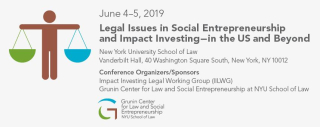
Earlier this month, I attended and presented at the 2019 Legal Issues in Social Entrepreneurship and Impact Investing–in the US and Beyond conference co-organized by the Impact Investing Legal Working Group and the Grunin Center for Law and Social Entrepreneurship at the NYU School of Law.  My friends Deb Burand and Helen Scott (also my Corporations and Securities Regulation professor when I was at NYU Law) co-direct the Grunin Center.  They organized a super conference this year.  Each year, the conference draws more folks–and with good reason.

I presented as part of a panel that compared and contrasted the use of different forms of entity for social enterprise businesses.  My role was (perhaps predictably, given that I wrote this piece) to defend the use of traditional for-profit corporations for this purpose.  I got some love from the panel and the audience, but so did others with different views . . . .

One of the nifty features of this conference is the use of lunchtime slots for “table talks” (roundtable discussions) and workshops.  I attended a table talk entitled “Gender Lens Investing: A Year in Review and A Look Ahead” and a workshop on “Re-Designing Legal Education for Lawyers, Social Entrepreneurs, and Impact Investors in the US and Beyond.”  (The latter, which involved a design-thinking exercise to work on a course plan/syllabus, has spawned an ongoing informal working group that met again earlier today on Zoom.)  The conference attracts both lawyers and folks from industry.

For me, a wonderful part of this conference–and the scholar convening that followed on the day after the conference–was the inspiration of a new ideas for research and writing.  In my view, a good conference routinely does that, without fanfare. I hope to report out on the details of some of those ideas in the future.

During the week before the Grunin Center conference, I was at the Law and Society Association Annual Meeting.  I presented my ongoing insider trading research at that meeting.  I will again be presenting that work (with some updates) at the National Business Law Scholars Conference later this week.  I hope to see many of our readers there and share my insider trading research in later posts.

Image result for olivia jade college

The college admissions scandal has been on my mind a good bit since the story broke. (Listen to the podcast “Gangster Capitalism” if you need to catch up on the details of the scandal.)

One student, more than any other in the scandal, has been in the media’s crosshairs: Olivia Jade Giannulli. Olivia Jade – a social media influencer (whatever that means) – seems to be getting so much attention because of her famous parents (actress Lori Loughlin and fashion designer Mossimo Giannulli), and because of some unfortunate comments she made about college on YouTube. Olivia Jade said: “I don’t know how much of school I’m going to attend but I’m going to go in and talk to my deans and everyone and hope I can try and balance it all. But I do want the experience of game day and partying, I don’t really care about school. As you guys all know. ” I don’t know much about Olivia Jade, but she comes across as spoiled, arrogant, selfish, entitled, obnoxious, and lacking self-awareness. In many ways, I hope my children and my students grow up to be her opposite. 

In contrast, three runners who I have met at the Music City Distance Carnival (“MCDC”) track meet over the past few years embody character traits that I hope my children and students develop. These traits include toughness, self-discipline, humility, and perseverance.

Image result for brave like gabe

First is Gabe Grunewald. Gabe passed away earlier this week, after four bouts with cancer. She ran the 1500m at MCDC 2017, just days after a round of chemo. Gabe was tenacious, but also immediately likable, kind, and selfless. Much of her massive, worldwide impact, stemmed from the positivity and resolve with which she faced her grim diagnosis. Her sponsor, Brooks Running, made this moving documentary that features some of her last races and shows the depth of her relationships. After her death, running clubs across the country gathered to run in her honor, and many pro runners featured #bravelikegabe on their race bibs. Gabe’s foundation still funds research to find cures for rare cancers.

Healy

Second, 50-year old, former Irish Olympian Shane Healy is still training and racing hard. At MCDC two weeks ago, Share broke the 50-54 year old world record in the mile (4:22), but he actually came in second to 53 year old Brad Barton who also broke the record in 4:19. I spoke to Shane the day after his race. He was gracious and thoughtful despite not claiming the record he flew across the Atlantic Ocean to secure. Shane’s childhood (including time in an orphanage) and his adolescence (being bullied and facing financial difficulties) was rough, but seem to have helped build his resilience. He is currently in much better shape than the vast majority of people half his age, and is fiercely competitive, but I also sensed a kindness in him that is usually only found in people who have known deep pain.  

Related image

Third, Heather (Dorniden) Kampf is probably best known for her college 600m race where she fell, but got up and willed herself to the win. (The 600m is almost a sprint, so this is incredibly impressive). Heather, now known as “the queen of the road mile,” has had a good bit of success, but has finished 7th and 15th in the U.S. Olympic Trials, failing to make the team. She has battled through injuries and even penned an article titled Embracing the Struggle. I talked with Heather briefly at MCDC, and I could quickly tell that she has benefited from not being handed success. She is putting in the work to continue to improve. 

These runners are admirable, interesting, likable, and influential, in large part, because of their struggles, because of the way they faced adversity. Yet, the parents in the college admissions scandal, and “lawn mower parents” everywhere, seek to remove all adversity from the lives of their children. Professors now give more “As” than any other grade and the percentage of the top mark appears to be continually on the rise, even though I bet most professors would opine that the quality of student work product is declining overall. As a father of three young children and as a professor, I understand the urge to smooth the path–it is extremely difficult to watch people you care about struggle. Of course, there are times when we should step in and protect, but rather than shielding our children and students from all adversity, I believe we should teach them to deal with the inevitable struggles of life with integrity, humility, determination, and selflessness. As for Olivia Jade, I truly hope she takes her current adversity and uses it as a tool to shape positive character traits. 

Today’s blog is the second post (first here) about advice for new business law profs.  It is also the promised follow-on to last week’s post, particularly my response to co-blogger Haskell Murray’s comment.

I am an assistant professor at the University of Oklahoma’s Price College of Business, and I’ve also taught in law schools.  The advice I’ll share today is generally applicable in both business and law school environments.

“Negotiation and Dispute Resolution” is one of my absolute favorite courses to teach!  However, I came to the area by happenstance.  During my PhD studies at Wharton, I wanted to fulfill my TA responsibilities by assisting the securities law professor.  He didn’t need a TA.  Fortunately, Professor Ken Shropshire did for his negotiations courses.  And as they say, the rest is history.  I’ve now taught dispute resolution courses, mediated cases, am on FINRA’s arbitration roster, and recently wrote an arbitration-related article with my OU colleague Professor Dan Ostas.  So, likely the most important advice of this post that I often share with students and others is to be open to unexpected opportunities in life, especially when the door to the option you originally wanted is closed.

Ok, onto the teaching part…given my love of dispute resolution and the increasing emphasis on experiential and active learning, I now incorporate a few dispute resolution exercises into each of my business law courses at both the graduate and undergraduate levels.  In general, students really enjoy these exercises.  The Harvard Program on Negotiation (PON) and Northwestern’s Dispute Resolution Research Center offer an extensive amount of dispute resolution materials for a fee (the materials are copyrighted).  Professors can create an account at these institutions to preview the materials.  Many exercises have teaching notes, which is helpful (especially for newbies to the area!). 

I work with our copy center to have the materials printed, and then I hand the materials out in class to students (electronic options are available).  Each dispute resolution exercise will have different roles, so you’ll have to assign students to different roles.  If you don’t plan to do the exercise in the class in which you hand out the materials, you’ll need to plan ahead to make sure that students are present for the exercise as otherwise you might have missing roles.  Class participation is part of the final grade in my courses.  I assign participation points to each exercise, which students lose if absent (unless their absence is excused per policies outlined in the syllabus).  I’m happy for readers who want additional logistical details to reach out to me.

In Legal Environment of Business, the basic undergraduate business law course at OU, I use three dispute resolution exercises.  After we cover ADR, I have students negotiate Waltham Construction Supply Corp. v Foster Fuels, Inc. and, after debriefing the exercise, we watch PON’s related mediation video (negotiation materials come with video).  I also talk about ways in which arbitration of the dispute would be different.  After administrative law, we do Negotiated Rulemaking Electric Utilities, during which teams of students representing various interested constituencies negotiate the draft of a proposed administrative rule prior to its release for public comment.  Finally, after covering tort materials, we do Broken Benches, which can be negotiated, mediated, or arbitrated.  This exercise is a really nice transition from tort to contract materials.  You can emphasize that any mediated settlement agreements made are enforceable contracts. 

These exercises are also helpful for more advanced business law courses.  For example, both I (in Law of Business Organization) and my colleague Professor Traci Quick (in Commercial Transactions) have used PON’s Bankruptcy Multiparty Negotiation Simulation.  In this exercise, teams of students representing the typical stakeholders in a mass tort bankruptcy have 45 minutes to negotiate a reorganization plan.  The pressure is on because the value of the firm’s assets are rapidly deteriorating, and scheduled losses occur at different time intervals if agreement has yet to be reached.  Definitely a student (and professor) favorite!!