Women and underrepresented founders face a tremendous funding gap when compared to their male, and particularly white male, peers.   Consider just the 2016 statistics.   All-male firms raised $58.2 billion in venture capital funding while all-female firms raised only 1.46 billion.  The funding gap grows starker when we look at black-female-founded firms.  Startups founded by black women raised an average of $36,000.  In contrasts, white men pulled in an average of $1.3 million for business ventures that failed.  

Many people see how identity affects capital allocation.  Academic research has shown that otherwise identical pitches are more favorably received when voiced by a man.  Founders can see it and try to present themselves in ways that cater to investor preferences. Ann McGinley and I have written about the gap and the extraordinary measures founders take to contort themselves and their businesses to increase their access to capital. We even categorized relatively common techniques that founders use to raise capital.  We identified substitution as when a woman sends a man in her stead as a founder or co-founder because she believes that it’s the right business decision to bypass investor bias.  We also identified something we called “manclusion” where a woman has to bring a bro to get that dough–essentially dragging men into meetings just because it makes the investors more manageable.

It seems as though everyone can see the problem.  Yet a new report from Morgan Stanley reveals that most investors still don’t see the problem.  Their survey found that about “eight in ten investors say that multicultural and female entrepreneurs receive the right amount, or more, of capital than their business models deserve.”  Morgan Stanley makes a business case for investing in women and underrepresented founders and highlights research showing that women-owned firms generate significantly more revenue than their all-male peers.  

Although market forces may cause smarter capital to flow toward women-owned businesses over time, slower shifts on this front may lead to lower overall economic efficiency and growth. As Ann and I highlighted, institutional investors may play a role in accelerating returns and broader economic equality by negotiating for commitments from venture capital firms to direct more capital to women-owned businesses.  The research on returns certainly supports targeting an increased allocation as consistent with an institutional allocator’s fiduciary duties.  Setting targets for venture capital firms creates an incentive for investors to learn how to see past their blind spots and recognize value.
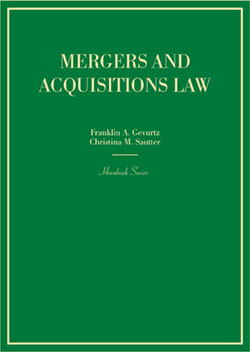

image from images.westacademic.com

West Academic Publishing has just released a new mergers and acquisitions hornbook co-authored by dear friends and business law prof colleagues Frank Gevurtz and Christina Sautter.  I had known that the book was in the offing, but I just got a note from Frank on Saturday confirming its publication and availability.  Here is the synopsis from West:

Gevurtz & Sautter’s Hornbook on Mergers and Acquisitions provides a comprehensive exploration of this important topic. Written in a casual style designed to engage the reader, the book clarifies and critiques critical doctrine. In addition to covering corporate laws governing mergers and acquisitions, the book explores securities, tax, and antitrust laws, as well as addressing the business, financial, and practical lawyering aspects of mergers and acquisitions.

I know these two to be folks with solid backgrounds and interesting insights in this area.  I have requested my online review copy.  Perhaps some of you will want to do that, too.  And for those without that privilege who want this in their libraries, you can get it by clicking on the West Academic Publishing link at the beginning of this post or purchase it on Amazon here.

Having just finished another semester of teaching a course required of all University of Oklahoma undergraduate business majors, the Legal Environment of Business (an introduction to business law), I wanted to share a few thoughts about why I have really enjoyed teaching business law in a business school.

When I taught Banking and Financial Institutions Law and Regulation in a law school, I loved when a student commented that my excitement for the topic had sparked their interest in the subject matter too.  Of course, such students were already generally attracted to the study of law!  I now occasionally have the joy of hearing that my enthusiasm for business law has sparked an undergraduate student’s interest in going to law school (they’d better take Banking!), and the excitement of knowing that I’ve potentially helped the student decide upon a professional direction. 

Like my students, I’ve found the Legal Environment of Business course to be challenging.  Teaching this course has definitely furthered my growth as a teacher.  In thinking of how best to engage students in the subject matter, I’m always searching for creative pedagogical approaches.  I’ve constructed in-class games such as “Procedural Trivia,” in which student teams compete against each other to display their mastery of the civil procedure material, be named the “Most Triumphant” team, and awarded a bag of chocolates.  The winning team is then under pressure to retain its grandiose title when we play a second trivia game with contract material later in the semester. 

Into our study of Alternative Dispute Resolution (ADR), Administrative Law, Torts, and Contracts, I’ve managed to weave negotiation role play exercises from the Harvard Program on Negotiation.  Ever since I serendipitously became a teaching assistant for Professor Ken Shropshire’s Negotiation course during my doctoral studies in the Ethics and Legal Studies Program at Wharton, Negotiation has been a favorite course to teach.  Imagine students delighting in bargaining over the language for an administrative agency’s upcoming rule proposal with Negotiated Rulemaking for Electric Utilities or experiencing first-hand the differential emotional impact of using mediation versus arbitration to resolve typical tort claims such as those at issue in Broken Benches.   

Now, those familiar with my research might be thinking that the utility negotiation exercise is just a sneaky ploy to introduce financial market utilities to a captive audience. Not true!  Nevertheless, teaching Legal Environment of Business has definitely improved how I present my research.  It challenges me to explain complex topics to an audience with whom I can’t make any assumptions about a basic level of background legal knowledge (similar to some audiences in my research presentations).  For many undergraduates, taking this course is somewhat like taking a foreign language course. The daunting, initial task for many students is to learn a whole new vocabulary.  For the teacher, this means constantly defining and explaining terms and concepts with crystal clarity that from a self-referential perspective might appear to be commonplace. 

In closing, I’d love to hear from other business school professors about teaching the introductory business law course in your university.  I’d also like to encourage readers interested in teaching business law to consider the possibility of teaching in a business school, and to feel free to reach out to me with any questions. 

Shop(Photo from Sharing Christmas)

‘Tis the season when people binge on those made for television holiday romance movies – mostly associated with the Hallmark Channel but, to be fair, there are plenty on Lifetime as well.

What strikes me about the genre is how business-centric it seems to be.  Though there are other types of plots (riffs on Cinderella/Roman Holiday/Sound of Music are always popular), a fairly common storyline is that there is some business that revolves around Christmas and is enjoyable for the townsfolk but relatively unprofitable.  The characters have to find a way to make the business viable without turning it over to a soulless corporate operator who will lay everyone off and destroy its essential character.  Typically, this involves teaching someone the true meaning of Christmas and the special value added to a company by longtime employees who put their hearts into their work.

It’s not that this is new, exactly; Christmas stories about profit-motive versus philanthropy trace back at least as far as Miracle on 34th Street (if not A Christmas Carol).  But viewed through a business lens, Miracle on 34th Street is a tale of shareholder primacy.  Of course, Santa didn’t care about profits; he only wanted to make children happy.  But Macy’s managers discovered that they would generate more wealth if they adopted a pretense of generosity, which is why they embraced Santa’s strategy.

The world looks a little different in Hallmark/Lifetime land.  It might, in fact, maximize profits to automate the bakery or relocate the bakery or renovate the community theater or renovate the ski lodge or sell the Christmas tree farm or sell the reindeer farm or evict the Christmas shop or close the toy store or close the toy store or close the toy store, but the characters find a way to generate some minimum profit that’s enough to keep things running while providing steady jobs for devoted employees and special memories for consumers.  And that’s the happy ending. 

In other words, the goal is to create a sustainable business model that meets the needs of all stakeholders without conferring a fortune on anyone.  I suppose we might call this the It’s a Wonderful Life view of business.

To be sure, some of the movies are more in the Miracle on 34th Street vein: the perfect advertising campaign is the one that captures the Christmas spirit because that’s what moves the product, but the notion of business as an anchor for a community seems to be the overwhelming favorite.

That said, almost all of these businesses are privately owned, so there are no public shareholders – or activists – to interfere with the mission.  And maybe that’s the Miracle on 34th Street difference:

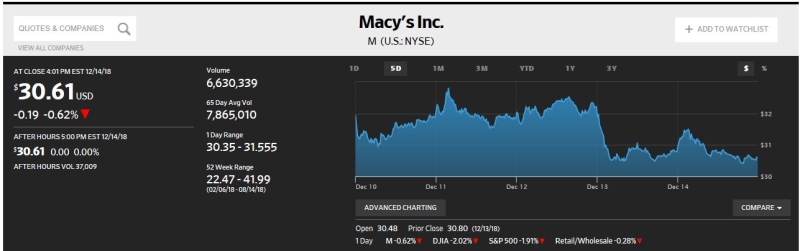
Macys

Haskell Murray, this one’s for you (and many others who work with B corporations and benefit corporations)!

Friend of the BLPB Tamara Belinfanti recently sent me a link to an article in which she was quoted.  The premise of the article is clear from its title: To B or not to B? That’s the question for companies who seek to “balance profit and purpose.”  Familiar proposition; great article title.  It’s certainly worth a quick read, even if it says nothing new.  (Although it does seem to imply that Justice Strine is no longer the Chief Justice of the Delaware Supreme Court . . . .)

In the article, various folks (including Justice Strine) comment about whether B corporation certification and/or benefit corporations are “needed” for social enterprise firms.  This is a question that I love to think about (especially if it can keep me from grading papers for a bit . . . ).  Some of you may remember my post on this topic from a few years ago.  It also is an issue that I have approached at times in pieces of my academic writing, including in the article featured in this post.

Next summer, at the Southeastern Association of Law Schools annual meeting/conference, I am moderating a discussion group on the subject to continue and enrich the conversation.  The title and brief abstract are set forth below.

Discussion Group: Benefit Corporation (or Not)? Establishing and Maintaining Social Impact Business Firms

As the benefit corporation form nears the end of its first decade of “life” as a legally recognized form of business association, it seems important to reflect on whether it has fulfilled its promise as a matter of legislative intent and public responsibility and service. This discussion group is designed to take on the challenge of engaging in that reflective process. The participating scholars include doctrinal and clinical faculty members who both favor and tend to recommend the benefit corporation form for social enterprises and those who disfavor or hesitate to recommend it.

To date, the participants include domestic and international law professors (clinical and doctrinal) and a practitioner, too!  Let me know if you would like to join this group.  The conference runs from July 28 – August 3 and will be held this year at the Boca Resort and Beach Club.

I will be interested in the discussion.  In the mean time, as someone who does not recommend the benefit corporation form, I am opening the BLPB “floor” for discussion here.  I am interested in your views.

Jack Welch, former GE CEO (1981 to 2001) was revered for his ability to maximize shareholder value.  Yet in 2009, he explained that shareholder value was

“the dumbest idea in the world. Shareholder value is a result, not a strategy… your main constituencies are your employees, your customers and your products. Managers and investors should not set share price increases as their overarching goal… Short-term profits should be allied with an increase in the long-term value of a company.”

This runs contrary to how many people think about the role of the CEO and the board of directors.  I think it’s spot on, and it is a key reason the business judgment rule, and its role in preserving director primacy, is so critical.   

Last week, a Wall Street Journal article about Dick’s Sporting Goods made the rounds. The article reported: 

Ed Stack, the chairman and chief executive of Dick’s Sporting Goods Inc., arrived at work the Monday after a gunman killed 17 people at a school in Parkland, Fla., nearly certain the outdoor retailer should limit sales of some guns.

. . . .

Dick’s Financial Chief Lee Belitsky asked, “So what’s the financial implication here?” according to Mr. Stack. “I basically said, I don’t really care what the financial implication is, but you’re right, we should look.”

Company executives convened the board via teleconference to explain the proposed plan, took some time to reflect, then gathered again a few days later to vote. “It was unanimous that we should do this and stand up and take a stand,” said Mr. Stack, whose family holds a controlling stake in the retailer.

This revelation led many folks to question whether Stack’s statement that he did not “really care” about the financial implications was a breach of fiduciary duty.  The concern was buoyed by the reality that store sales had dropped about 3% to  4% for the year, and the drop was linked to the decision to limit certain gun sales. 

That said, a drop in sales does not mean there was a breach of any duty any more than an increase in sales means no breach occurred. Results may be evidence, but that’s all they are. Part of the story. Incidentally, though it is not proof, either way, it is worth noting that Dick’s sales dropped, but profits rose after the decision because the company cut costs by replacing some guns with higher-margin items. 

It seems like every time a CEO or board issues a decision that is controversial or chooses to say that he or she supports a certain course of action because they think it is the “right thing to do,” the questions begin about whether either the duty of care or loyalty has been breached.  I maintain that a statement (or series of statements) like that is not sufficient to overcome the business judgment rule to allow a review of the decision.  

This is especially true where, like in the Dick’s situation, there is evidence that the company deliberated appropriately. The WSJ article noted that company executives called together the board to explain the proposed plan, “took some time to reflect, then gathered again a few days later to vote.” The vote was unanimous to end all assault-style weapons sales and to and stop selling guns or ammunition to those under 21 years of age. Interestingly, Walmart Inc. and other retailers followed Dick’s lead later that day. If the deliberative process is a concern, it would seem those following Dick’s should be more vulnerable to a fiduciary duty/business judgment rule challenge than Dick’s. 

For what it’s worth, I think Dick’s or any store deciding NOT to change their sales practice would also be protected by the business judgment rule, just as I think Chick-Fil-A’s decision not to open on Sundays should be protected by the business judgment rule (though if it were a Delaware corporation, I am not sure it would be). 

This is not to say I don’t believe in fiduciary duties. I very much do. I just also believe in a strong business judgment rule, ideally enforced as an abstention doctrine. (I believe in lots of things.)  

I need more than a few public statements before I think anyone should be looking behind an entity’s decision making. Recent examples raising entity fiduciary duty questions, like Dick’s and Nike’s Colin Kaepernick ads, have had positive financial outcomes of the entities, but it shouldn’t matter.  The business judgment rule is there to protect all the decisions of the board that are not the product of fraud, illegality, or self-dealing, not just correct decisions. 

Although a bit behind on getting it up, I wanted to flag this article from Ron Lieber about his experience showing up for a “complimentary gourmet meal” with an annuity salesman.  By doing a few record checks, he soon discovered some interesting facts about the annuity salesman:

And the host? An insurance salesman, Arif M. Halaby, who I quickly discovered had been the subject of a state cease-and-refrain order earlier in the decade because of certain financial products that an administrative law judge determined that he had sold. The state found that Mr. Halaby was offering “unqualified” securities after an ailing older client pulled equity from his home to invest in a real estate development in Costa Rica.

At this point, alarm bells should be going off.  This is the sort of high-risk move that could easily prove disastrous.  

The SEC has long warned about these seminars.  When it held its “senior summit” about a decade ago, it issued warnings that the seminars may involve misleading presentations that are just designed to sell products.

When Lieber attended this one, he discovered the presenter using a graphic depicting the annuity product significantly outperforming the S&P 500.  The fine print disclosed that the graphic omitted all of the gains from dividends paid by the companies in the S&P 500 index.  If dividends had been included, the S&P would have outperformed the annuity by over 30%.  Hopefully state regulators in California devote more resources to making sure that these sales seminars are not defrauding customers.

There have been problems with annuity sales practices for a long time.  Dateline even sent Chris Hanson, of To Catch a Predator fame, to investigate how these products were sold in Florida.  He found misrepresentations and a cottage industry built around helping these sales folk amass credentials that could dupe people into viewing them as financial experts.  For example, one outfit offered the opportunity to be “the author of a book called ‘Alligator Proofing Your Estate’.”

The financial advice problem is particularly thorny because our regulatory structure treats financial advice differently depending on who it comes from and what product, if any, they are selling.  Insurance falls mostly within state regulation while federal law and regulation covers stockbrokers and registered investment advisers.  The public doesn’t really appreciate the differences between these regimes and often walks into a sales environment under the mistaken expectation that the adviser would be giving them advice based on their best interest.  The confusion is understandable–at base savers are all seeking financial advice.  It’s unfortunate that our system requires them to be experts just to figure out who to trust.

A number of years ago, I attended the Biennial Conference on Applied Legal Storytelling.  It was a super event.  I came out of the conference with amazing ideas for teaching and scholarship.  I am thinking of taking my spring research project (on friends and family insider trading) to the conference in 2019.  Will you come join me?

Typically, the conference principally attracts legal writing instructors and clinicians. But more of us should be jumping on this bandwagon.   Storytelling and narrative more generally—which are (of course) a part of all advocacy and dispute resolution—also are used in transaction-building and negotiation.  Accordingly, I am hoping that some of you will consider attending the conference with me this coming summer.  Here are the details from the call for proposals.

*          *          *

Call for Proposals

Seventh Biennial Conference on Applied Legal Storytelling

Boulder, Colorado, July 9–11 2019

Hosted by the University of Colorado School of Law,
University of Denver Sturm College of Law, and University of Wyoming School of Law, and coordinated by the Rocky Mountain Legal Writing Scholarship Group

This is the call for proposals for the seventh biennial conference on Applied Legal Storytelling. We are offering two deadlines for submitting proposals: January 21, 2019 (priority deadline) and March 11, 2019 (extended deadline).

About the Conference

The Applied Legal Storytelling Conference brings together academics, judges, andpractitioners. The conference has previously convened in 2007 (London), 2009 (Portland),2011 (Denver), 2013 (London), Seattle (2015), and Washington D.C. (2017). We are veryexcited to bring it back to the Mountain West (Boulder) in July 2019.

Applied Legal Storytelling (AppLS) examines the use of stories—and of storytelling or narrative elements—in law practice, legal education, and the law.

This definition is intentionally broad in order to allow people creativity in the way theythink and present on the topic. Such topics may include: the ways in which fiction-writing techniques or narrative theory can inform legal storytelling; stories in the law, or law as stories; legal storytelling and metaphor; client story advocacy; legal storytelling and cognitive science; and ethical considerations in legal storytelling.

In an effort to continue the storytelling conversation for this seventh conference, and to welcome new attendees, we are providing resources for those interested in submitting a proposal and who wish to generate ideas or respond to others’. The first is a list of topicsfrom past conferences, available athttps://www.lwionline.org/sites/default/files/TopicsfrompastAppLSconferences.pdf. The second is a link to a bibliography on AppLS, including articles that have emerged from previous storytelling conferences, available at http://www.alwd.org/wp-contentuploads20151108-rideout_article2015-pdf/. We are also happy to answer questions and offer you suggestions—if you are a newcomer and interested in becoming involved, please reach out.

Continue Reading Storytelling is for Business Lawyers, Too