Palantir

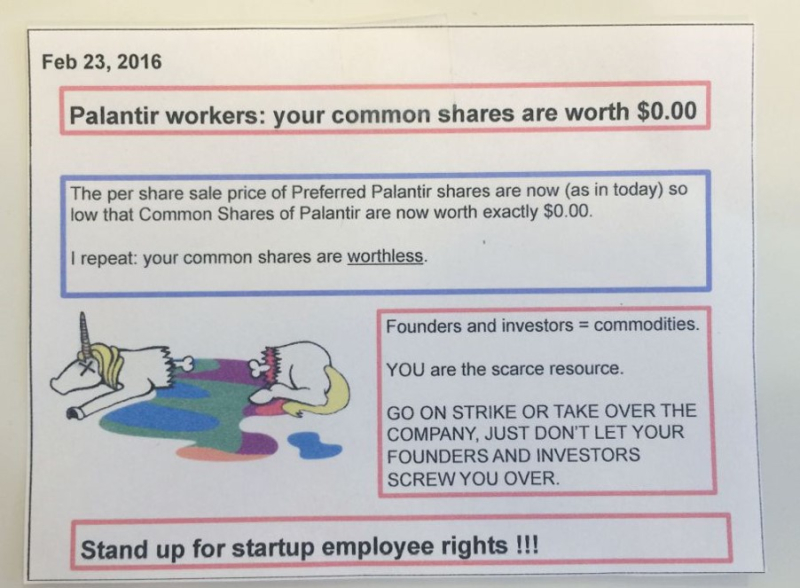
On Wednesday, I had the great pleasure of delivering an address at the North American Securities Administrators Association’s annual training conference for its corporate finance division.  I spoke about equity compensation for employees in private companies (you may recall that Joan linked to Anat Alon-Beck’s paper on that subject a couple of weeks ago).  Equity compensation to employees is exempt from federal registration under Rule 701 – and the SEC is currently deciding whether to broaden that exemption – but is still subject to state regulation.  Most states, however, simply follow the federal rules.  The purpose of my talk was to discuss some of the risks posed to employee-investors when companies stay private for prolonged periods, and to suggest that state securities regulators may want to consider if there is a need for additional oversight.

Under the cut, I offer the (massively) abridged (but still probably too long) version of my remarks.  For those interested in further reading on the subject, in addition to Anat’s paper highlighted by Joan, I recommend Abraham Cable’s excellent breakdown of the issues in Fool’s Gold? Equity Compensation and the Mature Startup.

[More under the jump]

Continue Reading Working for the Unicorn

A new paper from Colleen Honigsberg and Matthew Jacob sheds light on how to think about FINRA’s controversial expungement process.  As I explained in a post a couple years back, FINRA’s expungement process leaves its own paper trail behind, making it possible for firms and more sophisticated individuals to see whether a broker has scrubbed complaints from their record:

You should also know that these studies work off compromised databases.  BrokerCheck only shows a partial picture because many financial advisers have managed to have complaints expunged from their records.  In instances where an investor settles an arbitration claim against a financial adviser, FINRA arbitrators routinely agree to expunge the existence of the complaint from the public record.  One study found that FINRA arbitrators granted 90% of these requests for expungement.  In some instances, state regulators have even struggled to block the expungement of complaints from the public record.

Like Harry Potter’s Mad-Eye Moody, you too can see the invisible.  You can uncover whether (and possibly how many times) a financial adviser has used this process to scrub records by checking a different database.  FINRA makes its arbitration awards available.  While complaints may not show up on BrokerCheck, you may find whether a financial adviser has had complaints expunged by running their name or registration number through this awards database.  The arbitration award granting expungement still shows up in that database.  Wizardry.  

 Of course, some financial advisers may have used the expungement process to remove truly frivolous complaints.  Still, you probably want to know if a particular financial adviser regularly attracts complaints from disgruntled customers. 

Honigsberg and Jacob examined the expungement process and looked to see what having received an expungment meant about a broker.  In theory, expungment is an extraordinary remedy to remove baseless complaints from a broker’s record.  If the process works correctly, a broker that receives an expungement would probably be about as likely as a broker without any complaints to have a future complaint.  (Unless, of course, there is some other reason why a subset of brokers keep attracting baseless complaints.) On the other hand, if the process is scrubbing complaints truly generated by broker behavior–that is to say complaints that would warn other investors that they might have a problem with a broker in the future–brokers that have their slates wiped clean will be more likely to attract a new complaint than the average broker with a clean record.

The paper seems to indicate that the process now suppresses the signal sent by these complaints.  Removing them makes it harder for customers to use the BrokerCheck database to protect themselves.  The paper has some interesting findings–including “that removing this public information increases recidivism.”  Fascinatingly, brokers that successfully expunge complaints from their record may be “more likely to reoffend than a broker denied expungement.”  Honigsberg and Jacob point out that this might be explained by the behavioral economics literature indicating that success can breed overconfidence and excessive risk taking.  If a broker has been able to suppress a complaint in  the past, she might be a bit more aggressive in the future because she might believe she could suppress a future complaint as well.

Congratulations to Honigsberg and Jacob for this contribution.  The Wall Street Journal picked up on it already.  Hopefully it’ll also end up on the desks of regulators at the SEC and FINRA thinking about how to reform the expungement process.

It seems like it’s “Call for Papers Week” for me.  Here’s one near and dear to my heart, as you all must know . . . .

*     *     *     *     *

National Business Law Scholars Conference (NBLSC)
June 20-21, 2019
Call for Papers

The National Business Law Scholars Conference (NBLSC) will be held on Thursday and Friday, June 20-21, 2019, at the University of California, Berkeley School of Law.

This is the tenth meeting of the NBLSC, an annual conference that draws legal scholars from across the United States and around the world. We welcome all scholarly submissions relating to business law. Junior scholars and those considering entering the academy are especially encouraged to participate. If you are thinking about entering the academy and would like to receive informal mentoring and learn more about job market dynamics, please let us know when you make your submission.

To submit a presentation, email Professor Eric C. Chaffee at eric.chaffee@utoledo.edu with an abstract or paper by February 15, 2019. Please title the email “NBLSC Submission – {Your Name}.” If you would like to attend, but not present, email Professor Chaffee with an email entitled “NBLSC Attendance.” Please specify in your email whether you are willing to serve as a moderator. We will respond to submissions with notifications of acceptance shortly after the deadline. We anticipate the conference schedule will be circulated in May.

Conference Organizers:
Tony Casey (The University of Chicago Law School)
Eric C. Chaffee (The University of Toledo College of Law)
Steven Davidoff Solomon (University of California, Berkeley School of Law)
Joan Heminway (The University of Tennessee College of Law)
Kristin N. Johnson (Tulane University Law School)
Elizabeth Pollman (Loyola Law School, Los Angeles)
Jeff Schwartz (University of Utah S.J. Quinney College of Law)


I’d like to thank the Business Law Prof Blog for the opportunity to be a guest blogger!  In this first post, I build on a subject of previous posts (here, here, and here): Theranos, a now defunct Silicon Valley health-care start-up.

I rely heavily on the Financial Times to follow developments in one of my main research areas: financial market clearing and settlement (I’ll plan to report next week on the upcoming December 4th meeting of the Market Risk Advisory Committee, sponsored by CFTC Commissioner Rostin Behnam).  The FT recently announced that Wall Street Journal investigative reporter John Carreyrou’s book, Bad Blood: Secrets and Lies in a Silicon Valley Startup, had been named the FT/McKinsey Business Book of the Year 2018.  Having immensely enjoyed reading past winners, I wasted no time in ensuring that Amazon Prime speedily delivered it to my doorstep. 

Bad Blood is a riveting tale of Theranos’ spectacular rise and fall, and well-worth the reader’s time.  A fun fact is that a pathologist blogger, Adam Clapper (founder of the former Pathology Blawg), tipped Carreyrou onto the Theranos story (Chapter 19).  Additionally, in the months after Bad Blood’s publication, its founder and CEO, Elizabeth A. Holmes, and former COO, Ramesh “Sunny” Balwani, were charged by the Justice Department with wire fraud.    

I know little about the health-care industry.  Yet in reading Bad Blood, I was struck by links to and concerns shared with the financial industry (an area about which I know more).  Below, I make a few observations and invite reader comments on their importance in these and other industries.

Post-financial crisis, rock-bottom interest rates acted as a “key ingredient” to a new Silicon Valley boom (p.82).  Similarly, these low rates have also been a key ingredient for the many years of increasing stock market prices post-financial crisis.  Indeed, recent equity market declines made at least a temporary rebound yesterday after comments by Federal Reserve Chairman Jerome Powell at the Economic Club of New York.     

The increasing expansion of private markets enables companies such as Theranos to “avoid the close scrutiny” (p.178) to which public companies are subject (nevertheless, Theranos and Holmes settled fraud charges with the SEC).  Given current regulatory structures, it also risks severely limiting retail investment opportunities.  And it adversely impacts financial journalists’ access to information!  

When I teach Banking and Financial Institutions Law, the term “regulation-induced innovation” tends to amuse students.  The Theranos tale demonstrates, however, that such practices aren’t a laughing matter.  For example, its business strategies appeared to include: maneuvering in regulatory “gray zones” between the FDA and Centers for Medicare and Medicaid Services (p.88), exploiting “gap[s] spawned by outdated statutes” (p.125), and “operat[in]g in a regulatory no-man’s-land” (p.260).  Such practices can be troublesome enough in financial markets.  However, in Theranos’ case, the stakes (patient health) were much higher.    

Finally, who doesn’t love a good story?  Carreyrou, a two-time Pulitzer Prize-winning journalist, is an expert storyteller.  His portrayal of Holmes suggests that she too profoundly understood the power of stories, and that she had a bewitching talent for telling them.  Clearly, untruthful, non-fictional narratives are generally unethical and, depending upon the context, might also be illegal.  However, taking a cue from Holmes on the importance of stories and honing one’s ability to tell them could assist financial market policymakers.  Indeed, several years ago, the FT’s Gillian Tett wrote an opinion piece entitled, “Central bank chiefs need to master the art of storytelling.”  Enhanced storytelling capabilities could also assist academics researching financial market regulation.  For both, the ability to compellingly communicate with the public about issues in financial markets and their broad-based importance is critical.  Even so, constructing a fascinating narrative about clearing and settlement along the lines of Bad Blood would be no small feat!  

Colleen Baker

Colleen Baker is joining us as a guest blogger at Business Law Prof Blog for the next month. Colleen Baker is an Assistant Professor at the Price College of Business at the University of Oklahoma. She is also affiliate faculty at the University of Oklahoma College of Law. Her research interests primarily lie in the banking and financial institutions law and regulation space. Additional information about her education, practice, and publications can be found at her bio, linked to above. We are looking forward to Professor Colleen Baker’s posts and hope our readers will engage with her work.

Last week I posted Can LLC Members Be Employees? It Depends (Because of Course It Does), where I concluded that “as far as I am concerned, LLC members can also be LLCs employees, even though the general answer is that they are not. ” I thought I would follow up today with an example of an LLC member who is also an employee.  

I am not teaching Business Associations until next semester, but it galls me a little that I did not note this case last week, as it is a case that I teach as part of the section on fiduciary duties in Delaware.  

The case is Fisk Ventures, LLC v. Segal and the relevant facts excerpted from the case are as follows: 
Genitrix, LLC, is a Delaware limited liability company formed to develop and market biomedical technology. Dr. Segal founded the Company in 1996 following his postdoctoral fellowship at the Whitehead Institute for Biomedical Research. Originally formed as a Maryland limited liability company, Genitrix was moved in 1997 to Delaware at the behest of Dr. H. Fisk Johnson, who invested heavily. 
Equity in Genitrix is divided into three classes of membership. In exchange for the patent rights he obtained from the Whitehead Institute, Segal’s capital account was credited with $500,000. This allowed him to retain approximately 55% of the Class A membership interest. . . . 
 
Under the [LLC] Agreement, the Board of Member Representatives (the “Board”) manages the business and affairs of the Company. As originally contemplated by the Agreement, the Board consisted of four members: two of whom were appointed by Johnson and two of whom were appointed by Segal. In early 2007, however, the balance of power seemingly shifted. . . . 
 
Dr. Andrew Segal, fresh out of residency training, worked for the Whitehead Institute for Biomedical Research . . . [and when he] left the Whitehead Institute and obtained a license to certain patent rights related to his research.
With these patent rights in hand, Dr. Segal formed Genitrix. Intellectual property rights alone, however, could not fund the research, testing, and trials necessary to bring Dr. Segal’s ideas to some sort of profitable fruition. Consequently, Segal sought and obtained capital for the Company. Originally, Segal served as both President and Chief Executive Officer, and the terms of his employment were governed by contract (the “Segal Employment Agreement”). Under the Segal Employment Agreement, any intellectual property rights developed by Dr. Segal during his tenure with Genitrix would be assigned to the Company.

Fisk Ventures, LLC v. Segal, No. CIV.A. 3017-CC, 2008 WL 1961156, at *2 (Del. Ch. May 7, 2008) (emphasis added) (footnotes omitted).  

So, for my purposes, that’s a solid example of an LLC member who is also an employee, and it is from a case featured in more than one casebook, I might add.  

Co-blogger Joan Heminway noted in a comment to last week’s post that what it means to be an employee can vary, based on statutory and other conditions, which is certainly true. I stand by my prior conclusion that it depends on the case whether a particular member of an LLC is an employee, and even that can vary based on context.  Thus, LLC members are not inherently employees, and perhaps most of the time they are not, but it’s also true that LLC members can be employees. 

Finally, as to the Fisk Ventures case, in case you’re curious, the short of it is that Fisk decided not to provide additional financing to Genitirx, and Segal sued claimed that not doing so breached certain fiduciary duties under the LLC agreement and further various acts “tortiously interfered with the Segal Employment Agreement.”  Ultimately, Chancellor Chandler determined that there was no duty breached, the obligation of good faith and fair dealing did not block certain members from exercising express contractual rights, and the agreement’s clause disclaming any fiduciary duties was valid.  


From our friend and colleague, Djamchid Assadi at the Burgundy School of Business in Dijon, France:


Lisbon2019_EURAM-banner_1100

SIG 03 – ENT – Entrepreneurship

With our theme Exploring the Future of Management: Facts, Fashion and Fado, we invite you to participate in the debate about how to explore the future of management.

We look forward to receiving your submissions.

T03_08 – Entrepreneurship in the sharing economy: P2P strategies, models, and innovation paradigms

Proponents:

Djamchid Assadi, Burgundy School of Business BSB; Asmae DIANI, Sidi Mohamed Ben Abdellah University, Fez, Morocco; Urvashi Makkar, G.L. Bajaj Institute of Management and Research (GLBIMR), Greater Noida; Julienne Brabet, Université Paris-Est Créteil (UPEC); Arvind ASHTA, Arvind, CEREN, EA 7477, Burgundy School of Business – Université Bourgogne Franche-Comté, France

Short description:

Sharing of funds, files, accommodations, and other utilities and properties has become a vital part of the emerging social life and economy.

The traditional dyadic firm-to-customer transactions has given place to the depositional triadic of P2P platforms game changers which facilitate exchange between peer providers and peer recipients. As these P2P platforms disrupt conventional transactions, for example, P2P home exchange platforms like Airbnb thoroughly disorder the hotel industry, it is crucial that researchers consider conceptual refinement and empirical grounding for providing insights.

This track aims to bring together researchers with an interest in the sharing economy and, specifically, in P2P platforms.

Long description:

While direct interactions among individuals have always existed, P2P sharing platforms have considerably facilitated and lowered transaction costs for P2P exchanges. The P2P platforms do not supply nor demand. They do not divide a fortune to distribute its portions among peers. The P2P platforms simplify, accelerate and facilitate interactions among peers on the two-sided markets without the intermediation of central hubs. They enable individuals to unlock their unused and underused assets and skills for non or for-profit exchanges among peers.

They have transformed the way individuals consume and generate income and make use of their disposable resources and time. Numerous P2P platforms have sprung up for enterprising (Kickstarter, Indiegogo), working (Carpooling, Airbnb), dating (eHarmony, Match), innovating (Mindmixer), funding (Kiva, Zopa, Prosper), searching (CrowdSearching), etc. Airbnb and Uber are currently valued at $30 and $72 billion respectively.

This track aims to bring together researchers to provide insights and actionable visions to the emerging social and economic paradigms of spontaneous interactions and transaction among peers. It welcomes contributions that examine how P2P platforms transform market, entrepreneurship, competition, strategy, government-industry relations, supply chains, innovation, and other processes.

The following is a non-comprehensive list of leading issues in the sharing economy area.

How does entrepreneurship change in the sphere of sharing resources and utilities?
How do paradigms change in the case of open innovation?
Are the strategies and business models of sharing and collaborative online platforms peculiar?
Why do peers collaborate, share and circulate?
How does the sharing economy impact customer behavior?
What are the relations between social ties and ecosystem on the two-sided markets of the sharing economy?
How do conventional businesses react and develop business models to compete and/or coexist with the increasing trend of sharing economy?
How is value created (income steams) and distributed (value appropriation) among stakeholders in the sharing economy? Who are winners and losers? 
What is the role of institutions in the sharing economy?
How do technologies such as artificial intelligence, machine learning, augmented and virtual reality, and blockchains affect the functioning of sharing economy?
What are the effects of collaborative consumption on sustainability?
Is the possibility of evading ante-P2P regulations the dark side of the sharing economy?

Keywords:

Sharing and collaborative economy
Peer-to-peer and Two-sided market
Spontaneous order of P2P interactions and exchanges
Crowdfunding
Carpooling and Home-exchange
Online dating

Publication Outlet:

Optimization: Journal of Research in Management (Urvashi Makkar, proponent 2, is founding Editor-in-Chief of this journal. Djamchid Assadi, proponent 1, is member of the Editorial Board).

Innovative Marketing (Djamchid Assadi, proponent 1, is member of the Academic Advisory Board. He has exchanged for specific issues with Tatyana Kozmenko, Editorial Assistant).

The corresponding proponent, Djamchid Assadi, has exchanged with the individuals in charge within the books publishing companies. They have shown interest in considering proposals for collective books on the topic of sharing economy.

For more information contact:

Djamchid Assadi – djamchid.assadi@bsb-education.com

AUTHORS GUIDELINES

http://www.euramonline.org/submissions-guidelines-2019/author-s-guidelines/

  • Conference: 26-28 June 2019
  • Authors registration deadline: 25 April 2019 // Early birds registration deadline: 18 April 2019
  • Notification of acceptance: 20 March 2019
  • Deadline for paper submission: 15 January 2019 (2 pm Belgian time)

    Life is filled with difficult choices.  Chocolate or Vanilla?  Brady or Rogers?  Is that dress white/gold or blue/black?  And for law professors who teach Business Organizations, perhaps the most difficult choice of all:  UPA or RUPA?

    In all seriousness, and in the same vein as Joan’s earlier post on teaching fiduciary duty, the UPA/RUPA question when teaching partnership law is something that challenges me every year.  In the past, I focused on UPA and UPA cases, and then I briefly discussed RUPA as a point of contrast after finishing those materials.  My rationale, as I have explained elsewhere, was as follows:

    Despite the prevalence of RUPA in this country, the materials in this Chapter will discuss both UPA and RUPA.  There are several reasons for this dual treatment.  First, UPA is still the law in some commercially important states, including New York.  Second, UPA and RUPA share many common principles.  Because there is far more UPA case law than RUPA case law, however, many of the primary materials that are useful for teaching the basic principles of partnership law are based on UPA.  Third, it is easier to understand many of the significant changes in RUPA, particularly the dissociation and dissolution provisions, if one has a working knowledge of how those issues are dealt with under UPA.

While I am still comfortable with this rationale, the problem is that I never had time to do anything more with RUPA other than to set it up as a point of contrast—and for a single class at the most.  I always had the nagging feeling that my emphasis was backwards—my students should leave with a solid knowledge of RUPA and a passing familiarity with UPA, rather than the other way around.

    Over the past ten years or so, I have changed things.  Casebooks have gotten better about including RUPA-based cases (and there are now more of them), but most cases (and certainly the most “famous” cases) are still UPA-based.  Nevertheless, I tell my students that we are going to read and discuss all of the cases as if RUPA governed them.  I still discuss UPA, but I find that a brief discussion of the aggregate theory, the concept that partners joining and leaving the partnership leads to dissolution under that theory, and a few examples of aggregate-related problems (partnerships owning property, partnerships buying insurance) suffices to help the students understand why RUPA and its entity approach came about.  I feel much more confident that my students have a better grasp of RUPA (which is more important for them in Texas) and a passing familiarity with UPA, which I think is where they ought to be.  And when we get to LLCs, their familiarity with RUPA concepts is very helpful given that the modern uniform LLC statutes follow, in large part, the organization and logic of RUPA.

    I’m curious if others agree or disagree.  Assuming that you still teach general partnership law (and haven’t jettisoned it completely in favor of LLC materials, which is a subject for its own post), do you still teach UPA and, if so, why?