Hennion and Walsh, a FINRA member firm, has taken an unusually aggressive position, claiming that because it has procured expungements through the FINRA forum, members of the public cannot discuss the underlying conduct. A cease and desist letter sent to a law firm claims that the firm “posts information relating to Hennion and Walsh, Inc. and its’ [sic] employees which has been found to be false and has been ordered to be expunged.” The letter goes on to claim, without authority, that it’s “illegal to provide a false statement . . .of an individual’s character and/or reputation” and that unspecified “relevant records reflect the information you have posted for public consumption has been deemed to be false, was ordered to be expunged and that order has been confirmed in a court of competent jurisdiction.”

The letter doesn’t specify exactly what statements it wants removed, but I presume it’s blog posts or other things featuring news of past Hennion and Walsh settlements or complaints against Hennion and Walsh employees. These are all fairly typical things for a plaintiff-side firm to post. If one investor has filed or settled a claim against a particular broker, there may be other aggrieved investors out there looking for counsel. Having a blog post up informs the public that the attorney watches the space and would probably welcome a call for help.

So, this brings me to the key question, does the fact that expungements have been procured through the FINRA arbitration forum mean that law firms must send all those old posts down the memory hole? The reality here is that the best available research here from Colleen Honigsburg and Matthew Jacob shows that brokers who have obtained expungements are actually more likely to attract future customer complaints than similarly situated brokers who do not obtain expungements. Brokers with expungements are “3.3 times as likely to engage in new misconduct as the average broker.”

For many years, the process for expunging information about stockbrokers has been fundamentally broken. I’ve written about the enormous problems with the expungement system and called for a shift to a more regulatory framework. FINRA has also moved and significantly reformed its expungement process with new rules going into effect in 2023. Yet the prior system’s problems don’t go away immediately. One broker recently secured a record number of expungements under the old rules in an award that came out in September this year.

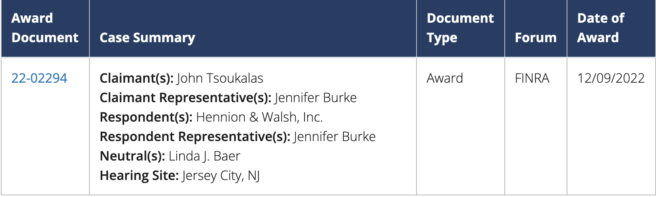
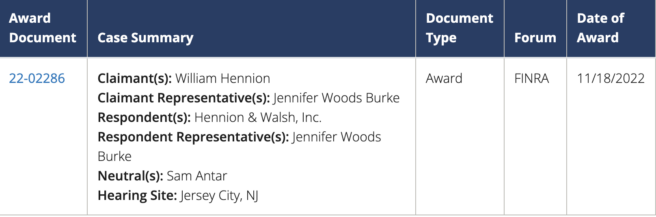
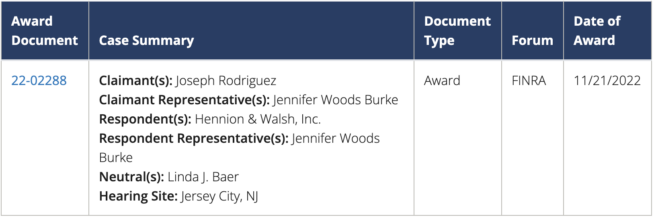
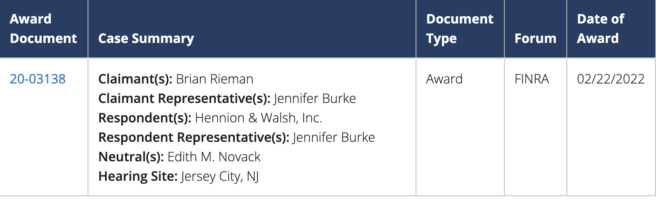
Some Hennion and Walsh expungements seem to exemplify the problems under the old system. Consider four different expungements secured by Hennion and Walsh brokers. In each of these matters, the broker seeking expungement filed a claim against Hennion and Walsh. Both the broker and Hennion and Walsh were simultaneously represented by Hennion and Walsh’s in-house counsel, Jennifer Woods Burke. All of these cases employed the ethically dubious dollar-trick strategy.
These cases raise two red flags for me. The dollar-trick strategy in this circumstance seems particularly hard to defend. It also strikes me as a violation of the concurrent conflict of interest rules.

Did The Damages Claims Have Any Basis?

Let’s start with the dollar-trick issue. I call the strategy ethically dubious because under ABA Model Rule 3.1 lawyers are only supposed to assert claims if they have a “basis in law and fact for doing so that is not frivolous, which includes a good faith argument for an extension, modification or reversal of existing law.” Asserting a $1 damages claim for the purpose of securing a single arbitrator allowed claimants to avoid the three arbitrators the FINRA Rules called for claims for non-monetary relief. Wanting non-monetary relief without wanting to pay fees for non-monetary relief doesn’t strike me as a claim that has some basis in law and fact. In an expungement hearing, I once asked a broker who had filed one of these claims why he thought his firm owed him a dollar. He was baffled and had no idea.

Here, the lawyer represented the broker and the firm in the same matter. Surely the lawyer would be well-positioned here to know whether there was any basis for seeking monetary damages. That the claim was dismissed at the hearing–as all other dollar-trick claims were–makes it appear as though there was no basis for the damages claim than a desire to avoid paying fees.

Simultaneous Claimant and Respondent Representation

The other major ethical issue with these expungements is the concurrent client conflict of interest. Burke represented both the claimant and the brokerage in each of these four matters. That raises an issue under Model Rule 1.7. The ethics rule states that you have a concurrent conflict if “the representation of one client will be directly adverse to another client.” It goes on to provide that you can only waive the conflict if “the representation does not involve the assertion of a claim by one client against another client represented by the lawyer in the same litigation or other proceeding before a tribunal.” Here, Burke simultaneously represented both the claimant and the respondent in the same proceeding before an arbitration tribunal.

Comment 17 to the Rule explains:

[17] Paragraph (b)(3) describes conflicts that are nonconsentable because of the institutional interest in vigorous development of each client’s position when the clients are aligned directly against each other in the same litigation or other proceeding before a tribunal. Whether clients are aligned directly against each other within the meaning of this paragraph requires examination of the context of the proceeding. Although this paragraph does not preclude a lawyer’s multiple representation of adverse parties to a mediation (because mediation is not a proceeding before a “tribunal” under Rule 1.0(m)), such representation may be precluded by paragraph (b)(1).

With Burke representing both the brokers and the firm in the same proceeding, you cannot pretend that the “institutional interest in vigorous development of each client’s position” was achieved. You also cannot pretend that the public’s interest in preserving public information about past complaints against brokers was vigorously represented.

For a long time, FINRA expungements were often sham proceedings. In most expungement cases, no person with any interest in surfacing information militating against expungement ever spoke to the arbitrator. FINRA has put in place rule changes to deal with the problem and now allows state regulators to appear in these proceedings on the theory that they may serve as better defenders of the public’s interest in information.

Ultimately, Hennion and Walsh secured its expungements through this dubious process, for whatever that’s worth. But they should not be able to use expungements secured through this dubious process to force everyone else to pretend that no complaints were ever raised about their personnel in the past. They had past complaints. They got them expunged. The process they used seems ethically dubious. They won four expungements when the same lawyer represented the claimant and the firm before an arbitration tribunal. Take the facts for what they’re worth.

In law school, students take a professional responsibility exam and then take the MPRE exam. After graduation, they sit through (often boring) continuing legal education courses and try to get that precious ethics credit.

I don’t teach professional responsibility anymore, although I do speak about ethics in my Compliance, Corporate Governance, and Sustainability and my Business and Human Rights courses.

But as business professors, I’m not sure that we spend enough time talking about business ethics. Yes, it’s important to know about conflicts of interests but do we know how to advise our business clients on the issues that affect them?

I get to flex my “ethics” muscles in an interdisciplinary Innovation, Technology, and Design program housed in our School of Engineering, where I teach a course on Ethics, Equity, and Responsibility- basically Ethics and Technology.

They say grading is the worst part of being a professor.

But not this week.

My students in the ITD class brought me to tears reading their final exams.

I was impressed by their projects on regulating technologies like social media, cloning, AI, and robotics, and by their business plans and pitches for new innovations.

I would invest in some of them today if I could.

But their final reflections on the semester hit me hardest.

This class explored traditional philosophical principles (Kant, Descartes, Bentham, Hume, Locke, virtue theory, Socrates, Plato) and nontraditional theories (Ubuntu, care ethics, indigenous perspectives), applying them to topics like:
– Ethical supply chains
– Geoengineering
– Autonomous vehicles
– China’s social credit system
– AI and education, healthcare, and the environment
– Drone warfare
– Killer robots
– Social media

Some students did mock podcast interviews for their final exams. Others wrote long-form blog posts or letters to their future selves.

What struck me most:
– They debated these issues with family and friends, even when they weren’t asked to do so.
– They now approach debates and discourse with a critical eye for rhetoric, fallacies, and red herrings.
– Some deleted their social media apps or significantly cut down on their use and noted how their self esteem went up and their anxiety went down.
– They reflected on how they’ll use these lessons in their future careers.
– Some even changed career paths or dream employers.

Of course, they’re college students; their perspectives may evolve again.

But…

I believe that just one person can change the world.

These are our future business leaders, regulators, and government officials. They are our students’ future clients.

If I convinced even one student to consider ethics, privacy, and human rights be design in their careers or future government roles, then mission accomplished.

No one teaches – whether kindergarteners or law students – for the money.

We do it to shape the future, one person at a time.

We do it for moments like this.

I can’t wait to see how these sophomores and juniors change the world.

Whether you teach or not, I hope you’re in a role where you can inspire even one person to create a better future.

Who’s the one person you’re inspiring today?

Now, back to grading my law school exams… and hoping these don’t bring tears for other reasons!

Like Steve Bainbridge and Matt Levine, I’m very entertained by this complaint Albertsons filed against Kroger over the breakup of their merger due to antitrust concerns.

The crux of it is that Kroger promised to make some kind of effort – more on that in a moment – to meet FTC demands in order to clear the deal, Kroger got cold feet and refused to meet those demands, and as a result, the FTC got the deal blocked in court, and now Kroger owes Albertsons damages for its breach.

As Matt Levine points out, one weakness in these kinds of disputes is establishing that Kroger’s recalcitrance was, in fact, the reason for the FTC rejection.  For example, not long ago, Anthem sued Cigna with a similar set of allegations, and though the court agreed that Cigna breached the contract, the court also concluded that the deal would have been blocked anyway.

But the part that I’m enjoying is the argument about what, exactly, kind of effort Kroger agreed to make.  This is from the complaint:

First, Kroger generally agreed to use “reasonable best efforts” to satisfy all closing conditions “as promptly as reasonably practicable.”

Second, Kroger assumed a more stringent obligation to use its “best efforts”—not limited by any standard of reasonableness—“to avoid, eliminate, and resolve any and all impediments under any Antitrust Law . . . so as to enable the Closing to occur as promptly as practicable.” That “best efforts” provision explicitly required Kroger to divest any assets and make any changes to its operations that were necessary to obtain antitrust approval.

Third, if a regulator threatened or instituted an antitrust challenge, Kroger committed to take “any and all actions” necessary to “eliminate each and every impediment under any Antitrust Law” to closing the Merger….

There was only one caveat to Kroger’s “best efforts” and “any and all actions” obligations: those commitments did not require Kroger to divest more than 650 physical stores.

So the claim here is that Kroger’s “best efforts” to avoid antitrust impediments should be interpreted to include conduct that goes a step beyond its ordinary “reasonable best efforts” to satisfy closing conditions.

Is that plausible?  Presumably, Kroger argues something like, are you seriously asking a court to hold that “best efforts” is not implicitly modified by some degree of reasonableness?  What, you think the default presumption should be that we agreed to unreasonable efforts?  Doesn’t it make more sense to presume parties agree to reasonableness, and then, if you want to hold someone to a standard of unreasonableness, it has to be written right there in the contract?  Cf. Alliance Data Sys. v. Blackstone Capital Partners V LP, 963 A.2d 746 (Del. Ch. 2009) (“‘Best efforts’ is implicitly qualified by a reasonableness test—it cannot mean everything possible under the sun.”).

For that reason, Steve Bainbridge argues that Albertsons has the weaker argument, because Delaware historically has treated all “best efforts” clauses as generally similar.  Which is no doubt true.  For example, here is VC Laster’s opinion in Akorn v. Fresenius Kabi AG:

Deal practitioners have a general sense of a hierarchy of efforts clauses.  The ABA Committee on Mergers and Acquisitions has ascribed the following meanings to commonly used standards:

• Best efforts: the highest standard, requiring a party to do essentially everything in its power to fulfill its obligation (for example, by expending significant amounts or management time to obtain consents).

• Reasonable best efforts: somewhat lesser standard, but still may require substantial efforts from a party.

• Reasonable efforts: still weaker standard, not requiring any action beyond what is typical under the circumstances.

• Commercially reasonable efforts: not requiring a party to take any action that would be commercially detrimental, including the expenditure of material unanticipated amounts or management time.

• Good faith efforts: the lowest standard, which requires honesty in fact and the observance of reasonable commercial standards of fair dealing. Good faith efforts are implied as a matter of law.

Commentators who have surveyed the case law find little support for the distinctions that transactional lawyers draw.  Consistent with this view, in Williams Companies v. Energy Transfer Equity, L.P., the Delaware Supreme Court interpreted a transaction agreement that used both “commercially reasonable efforts” and “reasonable best efforts.” Referring to both provisions, the high court stated that “covenants like the ones involved here impose obligations to take all reasonable steps to solve problems and consummate the transaction.”

Now, that strikes me as possibly simplifying matters for a judge, but also kinda out of step with Delaware’s recent (repeated) insistence that it is an exceptionally contractual jurisdiction.  See, e.g. New Enterprise Associates 14 LP v. Rich, 295 A.3d 520 (Del. Ch. 2023).   If deal planners claim that they understand these terms to have different meanings to the point where ABA Guidance to lawyers says the terms have different meanings, why would the Delaware judiciary reform the contract to strip those nuances away?

Yet again, if deal planners contract in the shadow of cases like Akorn, can’t we assume they do know that Delaware courts flatten the distinctions among terms, and therefore we should assume that’s the intent?

Maybe that’s even what’s most efficient; after all, we also know that contractual terms are not drafted from scratch; attorneys may cut and paste from different models, and god knows even sophisticated players can make rookie mistakes after things go back and forth a few times in blackline, so maybe Delaware courts are doing everyone a favor by presuming all best efforts clauses are roughly the same, unless someone actually goes out and writes “no this time we really really mean the standard is unreasonableness.”

Except maybe that actually did happen here?  Take a look at the language of the merger agreement.  As Albertsons pleads in the complaint, there are two different provisions: “reasonable best efforts” to close, and “best efforts” with respect to antitrust.  This is what they look like:

Section 6.3      Regulatory Matters

Subject to the terms and conditions of this Agreement (including any differing standard set forth herein with respect to any covenant or obligation, including, with respect to Antitrust Law, as provided below), the Company, on the one hand, and each of Parent and Merger Sub, on the other hand, will cooperate with the Other Party and use (and will cause their respective Subsidiaries to use) its reasonable best efforts to (i) take or cause to be taken all actions, and do or cause to be done all things, necessary, proper or advisable to cause the conditions to the Closing to be satisfied as promptly as reasonably practicable and to consummate and make effective, as promptly as reasonably practicable, the Merger, including taking actions necessary to avoid, eliminate, and resolve any and all impediments under any Antitrust Law with respect to the Transactions, including without limitation preparing and filing promptly and fully all documentation to effect all necessary filings, notifications, notices, petitions, statements, registrations, submissions of information, applications and other documents (including filing any Notification and Report Form required pursuant to the HSR Act within fifteen (15) Business Days following the execution of this Agreement), (ii) obtain promptly all Consents, clearances, expirations or terminations of waiting periods, registrations, authorizations and other confirmations from any Governmental Entity or third party necessary, proper or advisable to consummate the Merger and (iii) defend, contest and resist any Proceedings, whether judicial or administrative, challenging this Agreement or the consummation of the Merger. ….

Without limiting the generality of the obligations of Parent and Merger Sub pursuant to this Section 6.3, Parent agrees to, and will cause its Affiliates to, use best efforts, to take, or to cause to be taken, any and all actions necessary to avoid, eliminate, and resolve any and all impediments under any Antitrust Law with respect to the Transactions…

In addition if any Proceeding is instituted (or threatened) challenging the Merger as violating any Antitrust Law or if any decree, order, judgment, or injunction (whether temporary, preliminary, or permanent) is entered, enforced, or attempted to be entered or enforced by any Governmental Entity that would make the Merger illegal or otherwise delay or prohibit the consummation of the Merger, Parent and its Affiliates and Subsidiaries shall take any and all actions (i) to contest and defend any such Proceeding to avoid entry of, or to have vacated, lifted, reversed, repealed, rescinded, or terminated, any decree, order, judgment, or injunction (whether temporary, preliminary, or permanent) that prohibits, prevents, or restricts consummation of the Transactions and (ii) to eliminate each and every impediment under any Antitrust Law to close the Transactions prior to the Outside Date.

(emphasis added)

I mean, I’ll let the parties do their own briefing but my preliminary read of the contract seems to explicitly contemplate different standards for closing in general, versus antitrust in particular. That’s what it says right there in the beginning.

And another thing: Final Shareholder Primacy podcast of 2024 is up!  Mike Levin and I talk about what happened in 2024, and what’s coming in 2025.  Here at Apple; here at Spotify; and here at Youtube.

If you’re a law professor, please consider sending a team to Miami on January 16th for the University of Miami’s inaugural contract drafting and negotiation competition.

We have slots for 4 more teams and there is no registration fee due to the generosity of our sponsors, Law Insider and SimpleDocs. We are excited to welcome students from the University of Miami, William & Mary, SMU Dedman, St. Thomas (Miami), and North Carolina Central University.

We will award $5000 in cash prizes and students will be in beautiful Miami, Florida in January. What more could you want? We will hold registration open until December 20 or until we fill the slots.

Key dates are below:

Saturday December 21, 2024:

8:00am: Written Round prompt release

Monday January 13, 2025:

5:00pm: Deadline for Written Round contract submission.

8:00pm: Release of Negotiation Round 1 prompt.

All required in-person events will be held at the Newman Alumni Center

6200 San Amaro Dr, Coral Gables, FL 33146

Thursday January 16, 2025

3:00-4:00pm: Registration and Check In

4:00-5:20pm: Negotiation Round 1

5:30-7:00pm: Networking Reception

7:30-10:00pm: Dine Around Dinners

10:00pm: Negotiation Round 2 prompts released.

Friday January 17, 2025

8:30am-10:00am: Continental breakfast available

9:00am-10:00am: Registration and Check In

10:00-11:20am: Negotiation Round 2

12:00pm-1:00pm: Lunch

1:00-2:15pm: Finalist receive their last prompt and prepare for the final
round

2:15-2:30pm: Closing Remarks

2:30-3:50pm: Championship Negotiation

3:50-4:00pm: Award Presentation and Toast to the Participants

If students want to register, they can use this link here. More information is in the official Welcome Packet here. Feel free to email me at mweldon@law.miami.edu if you have more questions.

I hope to see you in Miami next month!

In my previous post on a November 7th Society of Corporate Compliance and Ethics (SCCE) panel on ESG through the life cycle of a business, I outlined the shifting landscape of ESG in the wake of recent regulatory and social developments in the U.S. This follow-up provides more detail on the insights shared by my fellow panelists, Eugenia Maria Di Marco and Ahpaly Coradin, who explored ESG in the contexts of startups, international markets, private equity, and M&A. As President-elect Trump continues to name cabinet members and advisors, I and others expect that ESG issues will continue to be a hot button issue here in the US.

Ahpaly shared his perspective on ESG trends, particularly in private equity. Although he acknowledged that in the US, interest in ESG is waning, many PE firms still screen for ESG risks at the initial target selection stage and during due diligence. Larger firms see market positioning and risk mitigation as the main benefits of ESG. However, revenue growth and capital allocation are not primary motivators due to the lack of data. He noted that many limited partners are increasingly deploying capital away from sectors like tobacco, alcohol, and to a lesser extent, fossil fuels.

Ahpaly opined that given the current climate, we are likely to see divergent trends between the U.S. and the rest of the world, with the U.S. pulling back on ESG-related initiatives. Additionally, PE firms in the U.S. are asking fewer and less detailed ESG-related questions compared to their counterparts in other regions, underscoring the stark difference in ESG priorities between the U.S. and the rest of the world.

When it comes to climate-related due diligence, Ahpaly emphasized the importance of focusing on four key areas: physical risk, compliance risk, litigation risk, and shareholder activism. Physical risk includes disruptions due to climate-related events like storms, floods, and droughts, particularly affecting supply chains. Companies need contingency plans, adaptation, and resilience strategies. Even if the decision is to take no action, having a documented analysis of why adds value. Compliance risk varies by industry and location. While the U.S. may see deregulation of GHG emissions and anti-DEI measures, international businesses must still comply with foreign regulations like the UK Modern Slavery Act and the EU Corporate Sustainability Due Diligence Directive. Litigation risk around greenwashing claims may become more difficult to pursue under potential U.S. deregulation, but this risk hasn’t disappeared entirely. Shareholder activism is increasingly focused on stranded asset risk, particularly in the energy sector, where assets may become obsolete due to market changes, technology, or regulation.

Ahpaly also advised that less regulation and enforcement in the U.S. might increase ESG-related risks for buyers in M&A deals. These risks should be factored into pricing and negotiations by considering strategies like reps and warranty insurance and expanding MAE clauses to cover ESG scenarios.

Eugenia Di Marco, who is headquartered in Miami but works with Latin American and European startups shared valuable insights on the role of ESG for startups and international markets. She emphasized that startups can use ESG as a competitive advantage, particularly in Latin America and the EU, where ESG considerations are becoming more critical than in the U.S. Investors and consumers in these regions are placing a higher premium on sustainability, ethical governance, and social responsibility. By embedding ESG principles into their business models early, startups can differentiate themselves, attract investment, and build trust with partners and customers. According to Eugenia, in international markets, ESG is not just a “nice-to-have” but an essential component of market entry and growth strategy.

KPMG’s 2023 statistics are revealing, as highlighted in The Sustainable Advantage: Leveraging ESG Due Diligence report:

  • The top reasons U.S. investors are conducting ESG due diligence are to identify risks and upsides pre-signing, to meet increased investor focus, and to respond to regulatory requirements.
  • 53% of U.S. investors have had deals canceled, and 42% have opted for a purchase price adjustment due to ESG concerns.
  • 23% of U.S. investors are conducting ESG due diligence without an adequate understanding of ESG in their area of investment.
  • 43% of U.S. investors will perform ESG due diligence on the majority of their deals in the future, compared to only 33% in the past.
  • 90% of U.S. investors with a robust ESG due diligence approach use their findings to drive a clear post-close action plan.
  • 62% of U.S. investors are willing to pay a premium for companies that align with their ESG priorities.
  • 54% of U.S. respondents plan to work with external advisors for ESG due diligence in the future.
  • The top challenges U.S. investors face with ESG due diligence are a lack of robust data, inadequate understanding of ESG across stakeholders, and difficulty defining a meaningful scope.
  • 82% of investors in Europe, the Middle East, and Africa (EMEA) integrate ESG into their M&A agenda, compared to 74% of U.S. investors.

It will be interesting to see the results of KPMG’s survey two years from now.

This morning I spoke to an in-house lawyer in the EU, who is knee deep in ESG initiatives. Meanwhile, on this side of the pond, an HR executive for a major hospital system told me that they have been instructed to scrub all references to DEI from company policies and practices to avoid losing government funding.

Given this complex landscape and the incoming administration, businesses must stay agile. The only thing that’s clear is that there will be a lot of work for lawyers and a lot for me to talk about in my Compliance, Corporate Governance, and Sustainability course in the Spring.

Earlier this week, I spoke on a panel for the SEC’s Investor Advisory Committee. The was the agenda. Although the video is not yet up and available publicly, I put the draft of my remarks up on SSRN.

Other panelists included:

If you’re interested in these issues, the panel may be worth listening to when the SEC makes it available.

One of the challenges with the discussion is how to zero in on what we mean by alternative investments. As conceived for the panel, the category includes the wide world of things beyond ordinary stocks, bonds, and public stock/bond mutual funds that may show up in a brokerage account.

This is an issue we’re going to have to navigate in the coming years. It’s not an easy one. There is a huge difference between the sorts of products issued by leading private equity firms and major institutional issuers and some of the other predatory alternative investments that have been sold to retail investors.

As I see it, the SEC faces a few challenges here. First, how do you inform retail investors about the kinds of uncertainty they may face with valuing alternative assets? Brokerage statements usually just give people a number. If they rely on that number with many alternatives, they may end up disappointed when they actually liquidate the product. In my view, it would be better to have account statements communicate a value range instead of a set figure so that investors see the uncertainty. Of course, this will probably be unpopular with financial advisers that sell the products. They’ll sell it at a fixed price and then have to discuss a range in their client meetings.

Second, the other major issue is how to protect retail investors from adverse selection in private markets? I understand why some retail investors will want to “get in” on private market investments on the theory that lots of hot firms like, say, Space-X, just won’t be available on public markets. Yet why would a promising startup or private company have any interest in courting a dispersed base of retail investors? My big fear here is that retail will get to take bets that institutional investors walk past.

There may be ways to mitigate these concerns by making more alternative investment access indirect through funds with sophisticated fiduciary management. One idea might be to only open some funds up to retail so long as there is some ratio between retail and sophisticated institutional capital. Now, CalPERS will see different opportunities than retail. But we might use CalPERS or other sophisticated defined-benefit pension plan participation in an offering as a way to minimize adverse selection risks.

Another major challenge in this space is that retail investors have needs that differ form institutional capital. Lots of alternative investments are illiquid and have a longer time horizon. Retail is much more likely to need sudden liquidity when life happens. Some fund structures may be better than others at balancing these objectives.

The one thing I think the Committee should avoid is focusing on voluminous issuer-disclosures. Retail investors don’t read them. If the goal is to protect retail, we’ll need to do something else.

I don’t know what the Committee will ultimately recommend here, but it’s focused on an important issue.

Yup, two posts in one day – and early in the week for me – but this seems to be a day for an outpouring of corporate governance news. I reserve the right to take the week off at some future date.

Anyhoo, NASDAQ adopted a comply-or-explain rule for board diversity, which was approved by the SEC, and it was immediately challenged.  Unconstitutional, beyond SEC authority, major questions, etc etc. 

A rare Democratic Fifth Circuit panel upheld the rule, but then the case went en banc, and today, the full Court struck the rule in a 9-8 ruling.

The striking thing about the Fifth Circuit’s opinion is how narrowly it construes the purpose of the securities laws.  Sure, it unsurprisingly cast doubt on the evidence that NASDAQ offered regarding the benefits of diversified boards, but most of the opinion is devoted to a reinterpretation of the Exchange Act to focus nearly exclusively on the prevention of fraud and manipulation.

For example, some excerpts:

We (B) explain that an exchange rule is not related to the purposes of the Exchange Act simply because it is a disclosure rule. The Act exists primarily to protect investors and the macroeconomy from speculative, manipulative, and fraudulent practices, and to promote competition in the market for securities transactions. A disclosure rule is related to the purposes of the Act if it has some connection with those purposes, but not otherwise….

Congress enacted these disclosure provisions to protect investors and prevent speculation. … Second, it thought disclosure would facilitate “the evaluation of prices of securities” and therefore promote the efficient “direction of the flow of savings into industry.” .. Or put differently, disclosure would stabilize markets by curbing speculation.

See what they did in that latter paragraph? I deleted the citations but note how they acknowledged the price formation function of the securities laws but immediately reinterpreted it to be entirely about fraud prevention.  And then there’s:

That makes sense. If companies could hide their financial conditions, they could defraud investors or whip them into a speculative frenzy. Disclosure of basic corporate and financial information was a sound antidote. But it was not an end in itself; it served a purpose—essentially the same purpose served by restrictions on margin loans and short sales. That much is clear from the fact that Congress carefully limited SEC’s power to compel disclosure to the kinds of information that are most likely to eliminate fraudulent and speculative behavior.

By contrast, the original panel opinion (and the dissent here) read the purpose of the securities laws as to mandate disclosure.  Here are quotes from the original panel:

The “fundamental purpose” of the Securities Exchange Act of 1934 (Exchange Act), codified as amended at 15 U.S.C. § 78a et seq., is to enforce “a philosophy of full disclosure . . . in the securities industry.”…

The “fundamental purpose” of the Exchange Act is “implementing a philosophy of full disclosure,” …—not just the disclosure of information sufficient to state a securities fraud claim.  Indeed, the Exchange Act gives the SEC “very broad discretion to promulgate rules governing corporate disclosure.”  To give one example, for a security to be registered on an exchange, the SEC can require the issuer to disclose any information about “the organization, financial structure, and nature of the business” as is “necessary or appropriate in the public interest or for the protection of investors.”  15 U.S.C. § 78l(b)(1)(A).  Nothing in this provision or the provision governing exchange rules cabins disclosure rules to information that would meet the materiality element of a securities fraud claim.  And, as the SEC Approval Order explains, “[e]xchanges have historically adopted listing rules that require disclosures in addition to those required by [SEC] rules.”  …

That’s a crucial difference, because – while there surely are those who approach things differently – I’d argue the mainstream view today is that the meta purpose of the securities laws is to ensure that investors have sufficient information to accurately price securities (according to risk/return), with the broader goal of ensuring efficient capital allocation throughout the economy.  We want investors to give money to useful and productive businesses, and not to businesses that will set resources on fire, and the securities laws facilitate that.  (Here are two cites; there are countless more)

Fraud prevention suggests a much narrower scope for SEC disclosure regulation than does regulation for accuracy in pricing.

So, it’s not surprising that the Fifth Circuit went from there to hold that the diversity disclosure rule does not serve the narrow purpose of preventing fraud.  At one point, it went so far as to suggest the rule might be barred even if it provided financially useful information to investors:

Moreover, SEC may have asked the wrong question. SEC considered evidence respecting the effects of diversity on firm performance. See JA9. But it is not clear what firm performance has to do with the Exchange Act. Of course, investors generally like it when firms make more money, but Congress did not pass the Exchange Act for the purpose of maximizing shareholder wealth. It passed the Act to protect investors from fraud, manipulation, speculation, and anticompetitive exchange behavior. Firm performance has little to do with those objectives.

(As part of its logic, the Fifth Circuit also attacked the rule on MQD grounds by writing that “the SEC has never claimed the authority to impose diversity requirements, or anything resembling them, on corporate boards.” Item 407(c)(vi) would never)

So I am less concerned about the fate of this particular rule, than I am for the rhetoric here that suggests a dramatic curtailment of all securities disclosure requirements.

At which point I have to mention the climate change rules.

Those are currently being challenged in the Eighth Circuit.  With the election, who knows how that challenge will proceed; what’s certain is that the Trump Admin will end up unwinding the rules.

But in general, both the diversity rules, and the climate change disclosure rules, tend to be challenged with the same arguments.  Opponents accuse the SEC of stepping outside its lane to solve problems allocated to other agencies – to solve climate change, which is the EPA’s job, or to solve workplace discrimination, which is the EEOC’s.  When presented with evidence that major investors want these disclosure rules, there tend to be sideswipes to suggest these investors – BlackRock, for example – aren’t really seeking investment related information, but are instead trying to impose their own (Larry Fink’s) notion of the social good on corporate America.  The challengers also point out that the rules themselves are structured as disclosure rules, but function as governance rules – “disclose your process for evaluating climate risk,” for example, technically allows a company to say “we don’t evaluate that,” but no company wants to admit as much, so, in fact, the rule forces companies to start evaluating climate risk (or diversifying their board, or whatever), and that, opponents say, is bad. 

That’s definitely what the Fifth Circuit said in this case about the diversity rules (e.g., “If Congress had granted a diversity mandate to any agency … we would have expected Congress to give it to the Equal Employment Opportunity Commission or even the Department of Justice”; “corporations that do not meet those objectives must explain why they failed. That is not a disclosure requirement. That is a public-shaming penalty for a corporation’s failure to abide by the Government’s diversity requirements.”), and you see it in the briefing and general commentary on the climate change disclosure rules.

The challengers are half right.  Because, I tend to agree that diversity disclosure rule is not, in fact, intended to help investors price securities or even to adopt governance practices that contribute to wealth creation; it is more in the category of the kind of rule that serves a kind of signaling function, that the corporation is exercising its power responsibly and inclusively.  It’s a display of self-governance and discipline, in a manner that costs corporations very little but perhaps wins them legitimacy.  It benefits companies and investors, but not in the traditional manner by which the securities laws operate; it does so by contributing to their social license to operate. (Yeah, I talk about that in my paper, Of Chameleons and ESG).

But that’s not what the climate change rules do.  The climate change rules force companies to evaluate the actual financial impact of climate change on their business, and that is crucial information not to fight climate change (which the SEC is accused of trying to do), but to ensure that companies – and investors – accurately begin to weigh the financial costs of climate change.  And on a broader level, to encourage investors to seriously stop allocating capital to areas and industries that will simply not survive the transition.  Which is exactly what the function of the securities laws should be in our society.

That said, my fear with the challenges to the climate change rules was, the rules were so obviously financially-relevant that any decision by a court striking them down would necessarily have spillover effects to other, more traditional securities disclosure rules, which would damage the entire system.  How ironic that the Fifth Circuit did that anyway with the diversity rules – only it did so, as far as I can see, quite intentionally, in what looks like the first step in a project to pare back the securities laws across the board.

Anyhoo, in case you missed it, Mike Levin and I talked about the climate change disclosure rules on our podcast a few episodes ago – here on Apple, and here on Spotify.

First, the Supreme Court DIG’d the NVIDIA case. I previously blogged about that case here; it, along with the Facebook case (which was also DIG’d), was a spectacularly bad grant resulting from disgruntled defendants who successfully made it appear that their extraordinarily fact-specific pleading-stage losses presented grand overarching legal questions that necessitated Supreme Court guidance. Belatedly, the Supreme Court realized they did not. Would that it had done so for other securities cases.

Second, the 2024 DGCL proposed amendments are out. As far as I can tell, the big change concerns litigation limiting bylaws and forum selection provisions (a subject I have addressed … frequently). The backstory here is, after a pair of decisions – Boilermakers Local 154 Retirement Fund v. Chevron Corp, 73 A.3d 934 (Del. Ch. 2013) and ATP Tour Inc. v. Deutscher Tennis Bund, 91 A.3d 554 (Del. 2014) – Delaware amended its code to address charter or bylaw provisions that govern internal-affairs-like state law stockholder claims. Specifically, corporations may require all such claims be brought in a particular forum, as long as plaintiffs retain access to the Delaware Superior Court or the Delaware Court of Chancery, but they may not require fee-shifting for unsuccessful shareholder claims.

In Salzberg v. Sciabacucchi, the Delaware Supreme Court functionally held that corporations may also adopt bylaws and charter provisions to govern non internal affairs claims that may be brought by stockholders – like federal securities claims – but these preexisting code provisions would not govern those claims. In practical effect, then, corporations could adopt bylaws and charter provisions that required fee shifting for unsuccessful federal securities claims, and that selected any forum for federal securities claims, including arbitral forums.

Hal Scott tried to get an arbitration bylaw passed at J&J for federal securities claims; a lot of 14a-8 litigation followed until Scott’s dispute was mooted.

Meanwhile, two companies, Boeing and Gap, adopted bylaws that purported to require that all “derivative” claims be brought in the Delaware Court of Chancery. I would literally bet body parts that the bylaws were intended to apply to state law fiduciary derivative claims, which would make the provisions unremarkable. But then, both companies became the target of exceedingly rare derivative Section 14(a) claims under federal law (Boeing also became the target of a derivative 10(b) claim, though that was dropped), and both companies argued that their bylaws required (1) the cases be filed in the Delaware Court of Chancery, and (2) they then be dismissed, since the Delaware Court of Chancery has no jurisdiction to hear claims under 14(a) (or 10(b)).

The Seventh and the Ninth Circuit split (blog posts here and here), meaning, the Ninth Circuit allowed companies to unilaterally select Delaware state courts for at least some federal securities claims, which would then require the claims’ immediate dismissal, since federal law requires those claims be brought in federal court.

Professors Mohsen Manesh and Joseph Grundfest wrote a long paper on the correctness of CA9’s ruling with respect to derivative 14(a) claims (well, the paper was in draft form, CA9 cited it, then they finalized it), while I wrote a paper on the general horror show of permitting state constitutive documents to govern federal securities claims at all, and then I wrote a response to Manesh and Grundfest specifically on derivative 14(a) claims, to which they responded here.

And thank god those latter papers were published in the last week or so, because of course now the DSBA is proposing amendments to the DGCL that would render all of the arguments moot. Specifically, the proposals would amend Delaware law to prohibit corporations from adopting bylaw/charter provisions that would (1) require fee shifting for non internal affairs claims, and (2) deny access to any Delaware court with jurisdiction to hear those claims. In practical effect, corporations must at least grant shareholders access to the District of Delaware for any securities claims that must be brought in federal court.

So, yay, I win, sort of!

And wow, that’s an awfully plaintiff-friendly proposed amendment, so *eyebrow raise* again!

Except, you know, from what I’ve seen, notwithstanding CA9’s holding, this is exactly what’s become market standard. No one is seeking fee-shifting or exclusive arbitration anymore; companies are generally adopting bylaw and charter provisions that would permit access to federal courts for claims that cannot be brought in state court. This does not, in other words, practically change the landscape.

And that’s particularly true because CA9’s decision permitting forum-selection provisions forcing federal claims into a state court with no jurisdiction was limited to derivative 14(a) claims – which is a very rare beast to begin with.

Point being, I don’t think the DSBA made many concessions here, and if I may say, this looks like a kind of plaintiff-friendly cover to paper over the rifts from last year’s SB 113 battles and whatever is coming for 2025 (my bet – limiting controlling shareholder liability).

And another thing: New Shareholder Primacy podcast is up! Me and Mike Levin talk about Chancellor McCormick’s latest ruling in the Musk pay package case, and what’s next. Available at Apple, Spotify, and YouTube.

Ferdinand Bratek, April Klein, and Yanting (Crystal) Shi have recently posted to ssrn The Market Value of Pay Gaps: Evidence from EEO-1 Disclosures.

Most companies are required to file reports with the EEOC regarding the diversity of their workforce, however, these EEO-1 reports are confidential unless the companies choose to release them. In 2023, a FOIA lawsuit forced the public release of EEO-1 reports for government contractors. The authors use this newly-released granular workforce data to confirm that women and people of color are paid less than white men in a variety of positions, and also that firms financially benefit by having more women and people of color in their workforce. In general, analysts often tout the purported financial benefits that diversity brings to a firm, but these authors suggest the disturbing possibility that diversity benefits a firm by lowering its labor costs.

Most strikingly, the authors find that when this particular EEO-1 data became public, the firms with greater pay gaps experienced more positive shareholder returns. In other words, the market, as well, recognized the value of underpaying women and people of color.

From a ruthless shareholder wealth maximization perspective, that makes perfect sense. But I note that pay-equity shareholder proposals are a popular genre and proceed from the (apparently?) false premise that investors value equality rather than discrimination.

And another thing: New Shareholder Primacy podcast is up – this time, Mike Levin and I talk about Caremark claims in Delaware, and the information that Broadridge can supply to activists. Available at Spotify, Apple, and YouTube.

Yesterday, Judge Badalamenti denied Target’s motion to dismiss a securities fraud claim against it arising out of its decision to run a pride campaign. The securities fraud claim was brought by America First Legal and other firms. They issued the following statements after the decision:

Statement from Reed D. Rubinstein, America First Legal Senior Vice President:

“Today’s decision is a warning to publicly traded corporations’ boards and management: Our federal securities laws mandate fair and honest disclosure of the market risk created by management when it uses shareholder resources, including consumer goodwill, to advance idiosyncratic and extreme social or political preferences. The risk of ESG mandates and DEI initiatives, such as Target’s “Pride Month” that targeted young children, cannot be whitewashed with boilerplate language or ignored,” said Reed Rubinstein.

Statement from Jonathan Berry, Managing Partner of Boyden Gray PLLC:

“Today’s ruling is an important win for our clients; we look forward to continuing to litigate this case to obtain relief for our clients and hold Target accountable for their actions,” said Jonathan Berry.

The decision certainly sends a message to corporations about what to expect. Candidly, the decision surprised me. After the initial complaint in the matter, I expected the case to get dismissed and for the court to order sanctions against them for filing the suit. I even wrote an opinion piece last year making that point.

But the Court had its own view of the pleadings. Two things surprised me about the decision. The first is that it allowed claims to go forward on the possibility that statements might be false. The other is that it found scienter by ruling that a business decision was reckless–not that a statement was recklessly made.

Possibly False Statements

Let’s start with the alleged misstatements. Target’s 2021 Annual Report contained a risk factor disclosing that it could face boycotts for things that it does. It specifically states:

It may be difficult to control negative publicity, regardless of whether it is accurate. Target’s responses to crises and our position or perceived lack of position on environmental, social, and governance (ESG) matters, such as sustainability, responsible sourcing, and diversity, equity, and inclusion (DE&I), and any perceived lack of transparency about those matters, could harm our reputation. While reputations may take decades to build, negative incidents involving us or others with whom we do business can quickly erode trust and confidence and can result in consumer boycotts, workforce unrest or walkouts, government investigations, or litigation.

To me, this and other similar disclosures appear to cover the possibility that people could boycott it if Target did something the public disliked. Consumers boycotted Target after its 2023 pride campaign. This seems like the sort of risk that the risk factor contemplates.

The plaintiffs alleged, without any evidence I can see, that “’the known risk of [] reactions was not being monitored or addressed by the Board” and because of this, “Target was thus not attempting to ‘preserve Target’s reputation’ or ‘control negative publicity’.”

The Court allowed the claim to go forward on the possibility that Target might have made a false statement. It explained that “[t]o be clear, the Court is not finding that Defendants’ 2021 disclosure is misleading because such an assertion would be premature at this stage in the proceedings.” As best I can understand it, the Court let the case go forward on the theory that the disclosure might be false if discovery can establish that Target’s board actually did not monitor or consider the risk of backlash from a pride campaign.

Later, the Court allows plaintiffs to explore whether a statement was false again. Consider this language:

These pleaded facts demonstrate that it is plausible that Target, its Board, and its GSC may have ignored social and political risks relating to the 2023 Pride Month Campaign . . .

This seems inconsistent with the way the PSLRA is supposed to work. I understood it to prohibit fishing expeditions to see whether or not some statement was false. Target ran a pride campaign. Target experienced backlash. There doesn’t appear to be any factual allegation to support the view that Target’s leadership or board did not consider the possibility that they would face backlash. Instead the plaintiffs just baldly assert that Target failed to disclose that it wasn’t considering these risks. Apparently that was enough for the Court.

It’s entirely possible that Target thought about backlash risk and just misjudged it. I would even say that is the stronger inference available from the known facts.

The Court also disagreed with Target’s argument that shareholders understood the risk that it could be boycotted for pride campaigns because it had been boycotted for pride campaigns before. It found that the prior campaigns didn’t put shareholders on notice of risks that might arise from “placing potentially controversial merchandise at the center of its stores—could be construed as a change to their ESG/DEI campaigns in prior years.”

I take it from this that if Target were to relocate adult-oriented merchandise from one location to another in the store, it might also be securities fraud? This issue isn’t limited to Target. Could Walmart face securities fraud liability under this theory if it relocates products from one area to another? Do we want retailers to really add risk factor disclosures that they could be boycotted if they do something differently than they did it in the past? How does that substantially alter the total mix of information available?

Scienter

The Court also found fraudulent intent with the following reasoning:

Plaintiffs pleaded that Defendant Cornell acted with severe recklessness because he knew that the 2023 Pride Campaign carried the risk of customer backlash. . . Severe recklessness constitutes a strong inference of scienter. . . . Severe recklessness is established by showing “highly unreasonable omissions or misrepresentations that involve not merely simple or even inexcusable negligence, but an extreme departure from the standards of ordinary care, and that present a danger of misleading buyers or sellers which is either known to the defendant or is so obvious that the defendant must have been aware of it.” . . .

Here, the Court finds that Plaintiffs have adequately pleaded severe recklessness. Specifically, Plaintiffs have pleaded that Cornell had knowledge that prior LGBT campaigns led to backlash, such as Target’s opposition to the North Carolina transgender bathroom law. . . Target’s reaction to the law caused 1.5 million people to pledge to boycott Target, and Target’s sales fell in the following three quarters following Target’s opposition. . . . Further, Plaintiffs pleaded that—not only did Cornell know about the boycott—he admitted that Target “didn’t adequately assess risk” in the matter. . . These facts demonstrate severe recklessness. It is highly unreasonable that Cornell would approve a new, more aggressive LGBT campaign in 2023 after allegedly admitting that Target didn’t adequately assess the risk of boycotts in a prior campaign. Plaintiffs have pleaded that Cornell’s decision to issue a new aggressive campaign—knowing that the preceding campaign received immense backlash—is an extreme departure from the standards of ordinary care that was so obvious that Cornell should have been aware of it. Accordingly, Plaintiffs have adequately pleaded scienter . . .

As best I can understand it, the scienter reasoning here seems entirely disconnected from the alleged possible misstatements. The reasoning seems to find, in hindsight, that the business decision to run a pride campaign was “severely reckless” because Target had faced a boycott before. That doesn’t seem like securities fraud to me.